
Wristwatches · Wristwatch
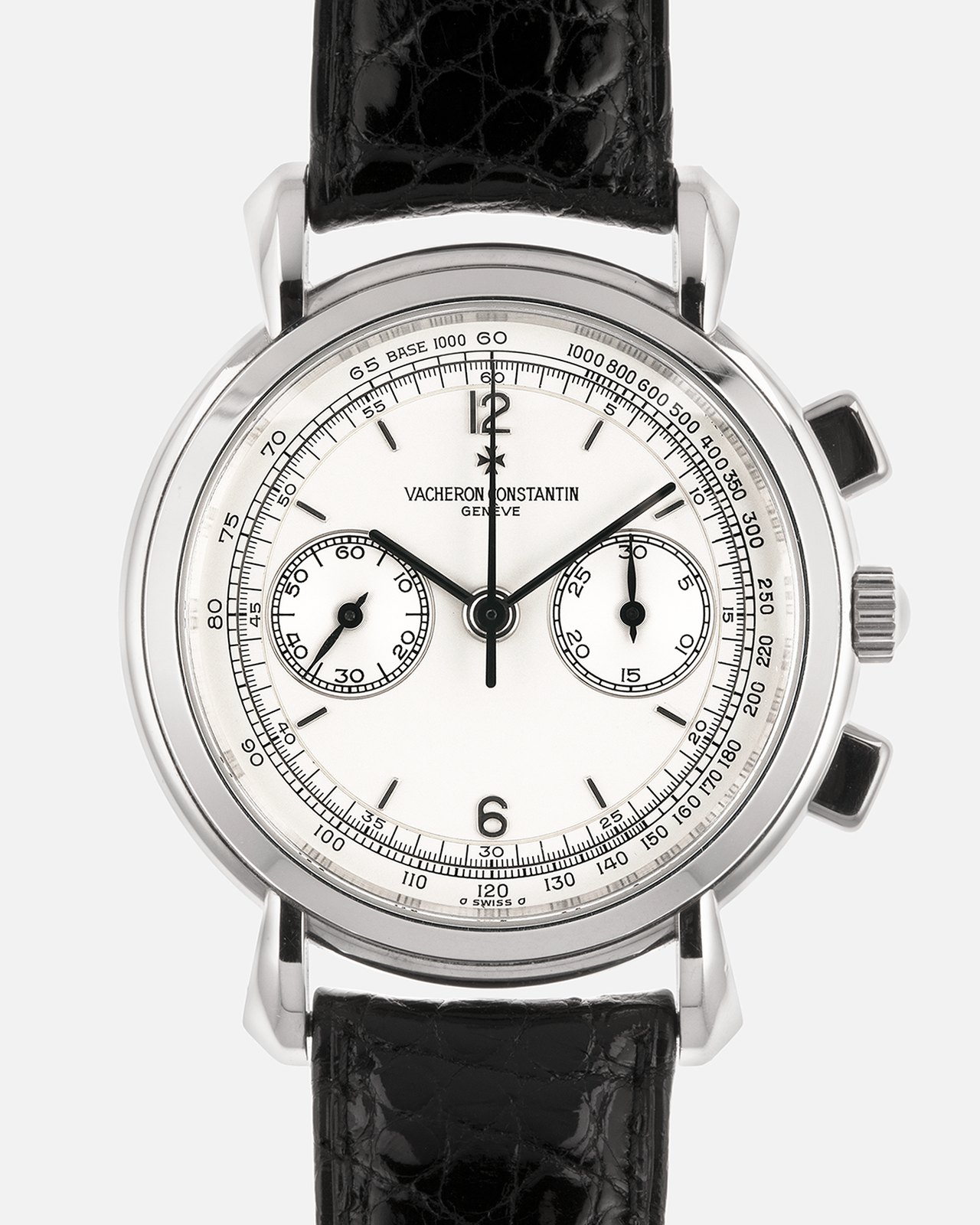
Vacheron Constantin Les Historiques Chronograph 47101 Platinum, 1995
- Maker / attribution
- Vacheron Constantin (maker)
- Date
- 1995
- Historical period
- Mechanical Renaissance (1990 – 2010)
- Country of origin
- Switzerland
- Object type
- Wristwatch
- Materials / technique
- platinum
- Dimensions
- Case 36 mm
- Stock no.
- Product 7717333008471
- Credit line
- Dealer listing, S.Song Watches (product 7717333008471)
- Catalogue title (original)
- Vacheron Constantin Les Historiques Chronograph 47101 Platinum (English)
View the source record (dealer listing) ↗ (opens another website in a new tab)Suggest a correction
Record summary
Catalogued by S.Song Watches (dealer), Seattle (stock number Product 7717333008471), this is a wristwatch by Vacheron Constantin, made in Switzerland, dated 1995. The Atlas places it in the Mechanical Renaissance period (1990 – 2010) of its Wristwatches collection. Materials and techniques recorded by the source: platinum. Recorded dimensions: Case 36 mm. The record is illustrated with 6 photographs.
Assembled from the source record's structured fields. Dates and attributions are given as the source states them; where a field is missing the Atlas leaves it blank rather than estimating.
Catalogue description
Dealer description — S.Song Watches
Long admired by collectors for its classical approach to watchmaking, Vacheron Constantin stands out for its commitment to heritage-driven design and traditional mechanics. With this, some of Vacheron's designs offer a retrospective view of the timepieces that came generations before the modern watches of today, and this Les Historiques Chronograph 47101, with its beautiful silver dial and platinum case, is one of the finest examples of that philosophy brought to life. For context, the 1990s were an interesting time for watches. The period marked a radical change in the watchmaking industry as it gradually emerged from the quartz crisis. Mechanical horology was steadily regaining popularity. Today, watches from this era, now known by many as “neo-vintage”, represent a significant shift in mindset for many luxury brands that returned to producing mechanical watches during that time. The story here begins in 1989 with the launch of the Les Historiques Chronograph 47101. As one of the very first references in Vacheron Constantin's newly established Historiques collection, it was conceived as a faithful tribute to the legendary Ref. 4178, widely regarded as one of the most elegant chronographs ever produced. Rather than simply recreating the original, Vacheron modernised the formula with subtle refinements while preserving its graceful proportions, faceted teardrop lugs, and unmistakably vintage character. Most examples were produced in yellow gold, while platinum examples such as this were manufactured in considerably smaller numbers. Scholarly sources suggest that only around 300 platinum examples were produced across both the 47101 and its later successor, the 47111, making this configuration one of the rarer executions of the reference. When it comes to overall design, what immediately draws the eye is the wonderfully restrained silver dial. Unlike some later variants featuring guilloché decoration, this example relies on a smooth matte surface that perfectly complements its classical aesthetic. The layout is beautifully balanced, with twin recessed sub-dials featuring concentric graining, comprising a running seconds register at 9:00 and a 30-minute chronograph counter at 3:00. Around the dial sits a finely printed tachymeter scale, while applied baton markers and oversized Arabic numerals at 12:00 and 6:00 maintain exceptional legibility without disrupting the symmetry. As with all Ref. 47101s, the dial carries the "σ SWISS σ" signature at 6:00, denoting the use of solid gold hands and hour markers, a hallmark introduced by l'Association pour la Promotion Industrielle de l'Or (APRIOR). Later production examples would transition to the "σ SWISS MADE σ" signature, though both retain the same use of precious metal components. There is simply no dispute here; the 47101 is an exceptionally elegant and refined chronograph. Turn the watch over, and it reveals the magnificent Cal. 1140, based on the legendary Nouvelle Lémania Cal. 2310 ébauche. It features 21 jewels and is equipped with a self-compensating Breguet hairspring, a swan-neck regulator, and is adjusted to five positions. The movement showcases Lémania's unmistakable labyrinthine architecture, beautifully enhanced by Vacheron Constantin's exemplary finishing across the bridges, levers, baseplate, and screws. It represents the kind of traditional movement architecture that has become increasingly uncommon in modern chronograph production. As far as wearability goes, the 36mm x 10.6mm case wears exceptionally well on the wrist. To some, this may sound small on paper, but I assure you, the elongated teardrop lugs perceptively increase the wrist presence of the case ever so slightly. The platinum construction also lends the watch a reassuring heft that belies its elegant proportions. Combined with the clean silver dial, the overall aesthetic feels quietly confident rather than overtly luxurious, making it a watch that transitions effortlessly between formal and casual settings. To me, the 47101 represents one of the defining watches of the neo-vintage era. It arrived at precisely the moment mechanical watchmaking was finding its footing once again, demonstrating that the future of horology did not have to abandon the elegance of its past. More than three decades later, it remains every bit as sophisticated as it was when first introduced, standing as one of the purest expressions of Vacheron Constantin's enduring commitment to classical watchmaking.
Historical context
Mechanical Renaissance (1990 – 2010)
Mechanical watches return as cultural objects; independent watchmaking flourishes.
Mechanical watches returned as cultural and luxury objects. Complications, tourbillons and new materials proliferated; independent watchmakers such as George Daniels, F.P. Journe and Philippe Dufour revived artisanal watchmaking; collecting vintage watches became a major field.
Read the period in the timelineMore wristwatches from this periodEarlier: Quartz Revolution
Atlas type guide
Chronographs and split-seconds watches
A chronograph is a watch with an additional seconds hand that can be started, stopped and returned to zero independently of the timekeeping. Louis Moinet built an early example in 1816 and Nicolas Rieussec a recording 'chronographe' in 1821; Adolphe Nicole's heart-shaped reset cam (patented 1862) made the modern return-to-zero possible. Split-seconds (rattrapante) chronographs add a second hand that can be stopped for intermediate times; flyback chronographs restart instantly.
Chronographs were essential tools for doctors (pulsometer scales), artillery (telemeter), engineers and sport. In wristwatches, Valjoux, Venus, Lemania and later the automatic chronographs of 1969 (Zenith El Primero, the Chronomatic Calibre 11 group and Seiko 6139) are milestones.
What to look for
- Push-pieces on the case band or a single button in the crown (monopusher).
- Subsidiary registers for minutes and hours; tachymeter, telemeter or pulsometer scales.
- Column wheel versus cam control visible in the movement.
- Calibre markings of specialist makers (Valjoux, Lemania, Venus, Landeron).
Dating clues
- Pocket chronographs with heart cam reset: after 1862.
- Wrist chronographs: from c. 1910; two-button designs from the 1930s.
- Automatic chronographs: from 1969.
General guidance written by the Atlas editors about this kind of object. It is not a statement about this particular piece; for that, rely on the source record above and on physical examination.
Read next:Flyback chronographChronograph
Related records
Pocket Watches · c. 1896
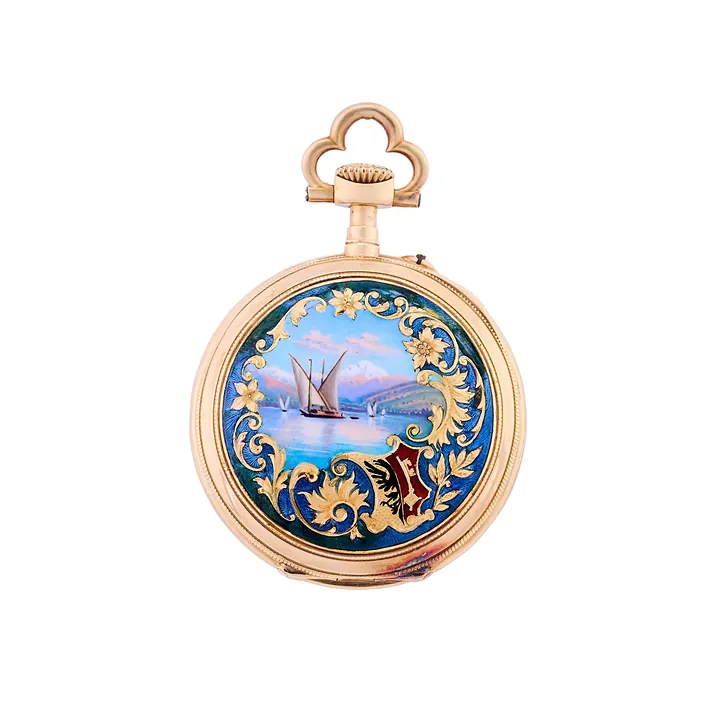
Vacheron Constantin “grand TIR de L’exposition Nationale, Genève 1896, c. 1896
Antiquorum auction archive, Geneva
Pocket Watches · c. 1940
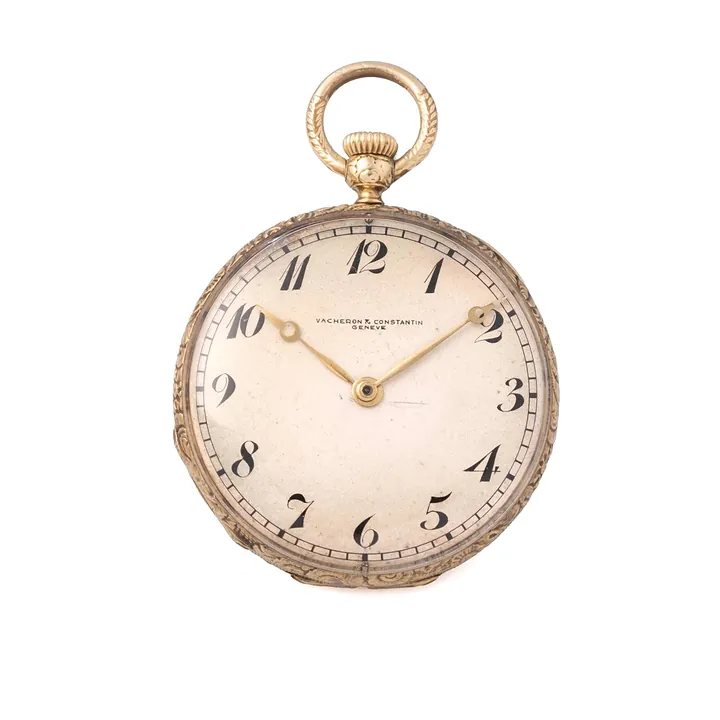
Vacheron Constantin pocket watch, ref. 345, c. 1940
Antiquorum auction archive, Geneva
Pocket Watches · c. 1945
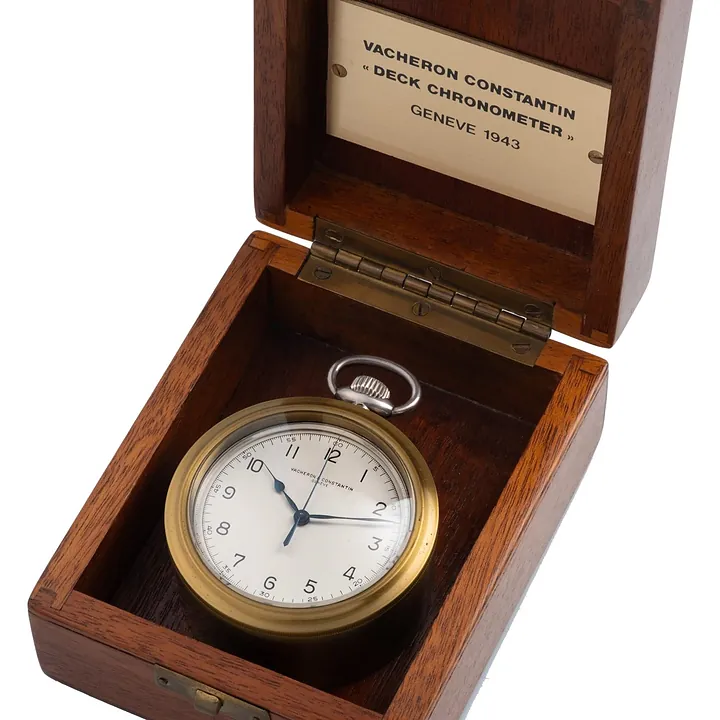
Vacheron Constantin pocket chronometer, c. 1945
Antiquorum auction archive, Geneva
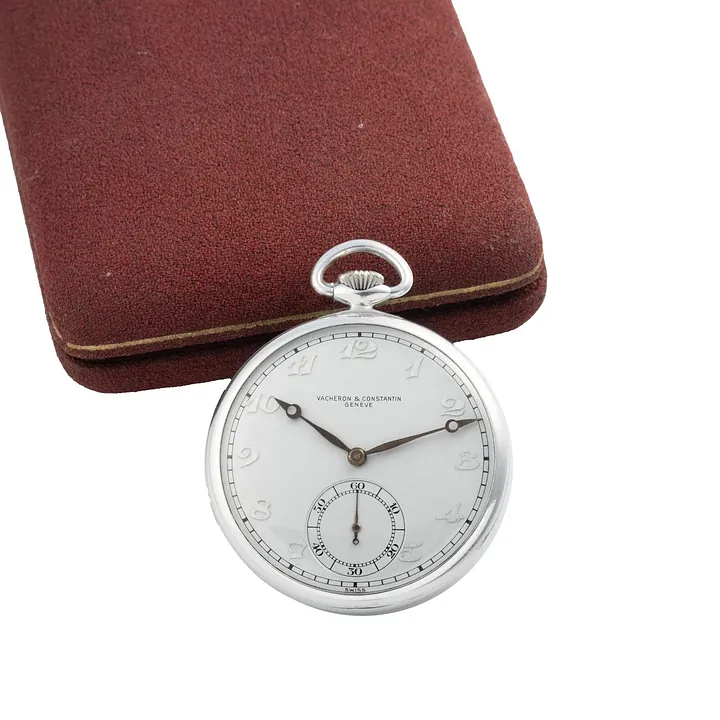
Pocket Watches · c. 1945
Vacheron Constantin watch, c. 1945
Antiquorum auction archive, Geneva

Wristwatches · 2008
Wristwatch by Breitling?, 2008
Museum Rotterdam

Wristwatches · c. 1990s
Audemars Piguet Bamboo, c. 1990s
Antiquorum auction archive, Geneva

Wristwatches · c. 1990
Audemars Piguet Huitieme Perpetual Calendar, ref. 25696PT, c. 1990
Antiquorum auction archive, Geneva

Wristwatches · c. 1990
Breitling Chronomat, ref. b13050.1, c. 1990
Antiquorum auction archive, Geneva