
Wristwatches · Wristwatch
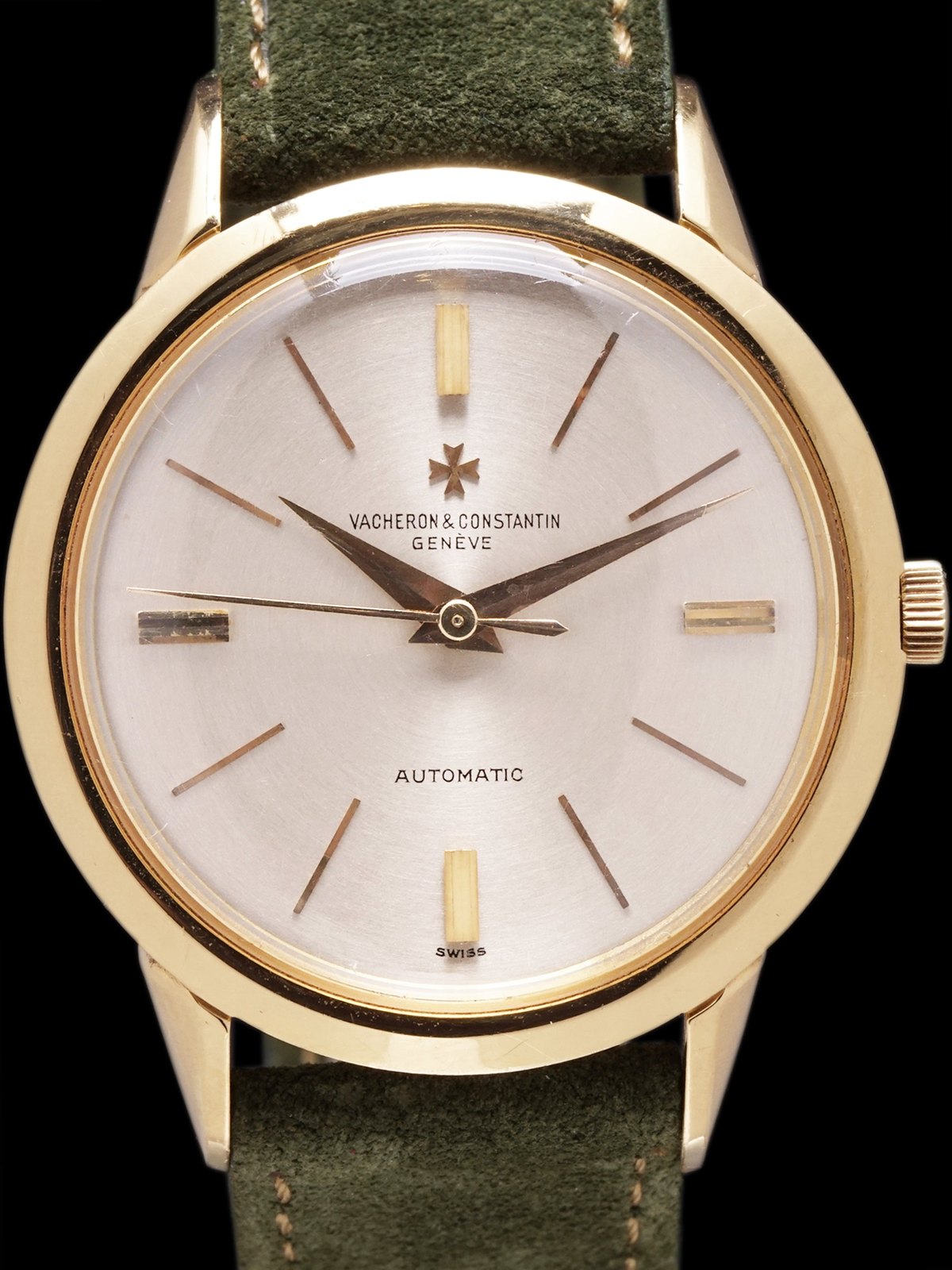
Vacheron Constantin Calatrava (Ref. 6592) 18k YG, 1959
- Maker / attribution
- Vacheron Constantin (maker)
- Date
- 1959
- Historical period
- Modern Mechanical Horology (1945 – 1969)
- Country of origin
- Switzerland
- Object type
- Wristwatch
- Dimensions
- Case 35 mm
- Stock no.
- VC6592
- Credit line
- Dealer listing, Craft & Tailored (VC6592)
- Catalogue title (original)
- 1959 Vacheron Constantin Calatrava (Ref. 6592) 18k YG (English)
View the source record (dealer listing) ↗ (opens another website in a new tab)Suggest a correction
Record summary
Catalogued by Craft & Tailored (dealer), Los Angeles (stock number VC6592), this is a wristwatch by Vacheron Constantin, made in Switzerland, dated 1959. The Atlas places it in the Modern Mechanical Horology period (1945 – 1969) of its Wristwatches collection. Recorded dimensions: Case 35 mm. The record is illustrated with 6 photographs.
Assembled from the source record's structured fields. Dates and attributions are given as the source states them; where a field is missing the Atlas leaves it blank rather than estimating.
Catalogue description
Dealer description — Craft & Tailored
Vacheron Constantin has never contained itself to being a single type of watchmaker. Since their creation in 1755, the Swiss watchmaking house has set out to push the horological boundaries. This couldn't be more true for the ref. 6592 Calatrava, where Vacheron Constantin seemingly took one the most uniform watch designs and tailored it into something unique onto itself. The ref. 6592 features a deep saucer style 18k yellow gold case to house the meticulous cal. K1071 automatic movement, tall blade-like thin lugs that give the watch proportion without adding width, and an elegant silver dial that boasts concentric brushing for an added depth to the dial. It isn't every other watch movement that receives the Poincon de Geneve stamp (Seal of Geneva quality hallmark), so the Vacheron Constantin cal. K1071 is impressive, to say the least. The 29 jewel rhodium-plated movement is decorated in fausses-côtes, featuring a beryllium balance with timing screws, adjusted to five positions, isochronism, and to both heat and cold. Accompanied by a straight-line lever escapement, swan-neck micrometer regulator, Breguet balance spring, 18K yellow gold trimmed rotor with ruby bearings, and a shock-absorbing mechanism. Stock # VC6592 Brand Vacheron Constantin Style Calatrava Model 6592 Serial 38XXXX/55XXXX Size Men's Material 18k Yellow Gold Dial Silver Millimeters 35mm Strap 2pc Handmade Leather Strap CASE & BRACELET The beautifully constructed 18k yellow gold case is in wonderful condition, showing very little signs of use. The bezel shows very little signs of use and retains a high polished sheen. The case retains its original unsigned gold crown. The watch will come supplied on a 2pc handmade leather strap. DIAL & HANDS The gorgeous concentrically brushed silver dial is a near-perfect example. The dial itself shows no blemishes or signs of aging. The gold markers and gold dauphine hands remain in excellent condition, like the dial. ACCESSORIES
Historical context
Modern Mechanical Horology (1945 – 1969)
Tool watches for divers, pilots and astronauts; electric watches anticipate the electronic age.
The classic era of the mechanical wristwatch: dive watches, chronographs for motor racing and space flight, GMT watches for jet travel, slim dress watches, automatic calendars, and the rise of Japanese manufacturers alongside Swiss, American, German and Soviet industries.
Read the period in the timelineMore wristwatches from this periodEarlier: Golden Age of Mechanical Watchmaking
Atlas type guide
Wristwatches
Bracelet watches were worn by women from the early nineteenth century — Breguet made one for Caroline Murat, Queen of Naples, in 1810–12 — but the wristwatch only became a man's instrument with military use and aviation in the early twentieth century. Between the World Wars it overtook the pocket watch; the 1920s and 1930s brought rectangular Art Deco cases, water-resistant cases and the first automatic winding systems.
After 1945 the wristwatch became a carrier of identity — dress watches, sports and dive watches, chronographs, calendars — produced by Swiss, American, Japanese, German, Soviet and Chinese industries. The quartz revolution after 1969 and the mechanical renaissance since the 1990s, including the rise of independent watchmakers, complete the story.
What to look for
- The reference number (between the lugs or inside the case back) and serial number, the starting point for dating.
- The calibre: its maker and number are often stamped under the dial or on the bridge.
- Originality of dial, hands and crown — refinished ('redial') dials are common.
- Case material marks: 18K/750, 14K/585, stainless steel, gold-filled, plated.
Dating clues
- Wire-lug cases: before c. 1925.
- Water-resistant screw-down cases: from 1926.
- Quartz movements: from 1969; sapphire crystals widespread after c. 1980.
General guidance written by the Atlas editors about this kind of object. It is not a statement about this particular piece; for that, rely on the source record above and on physical examination.
Read next:Identification Centre
Related records
Pocket Watches · c. 1896
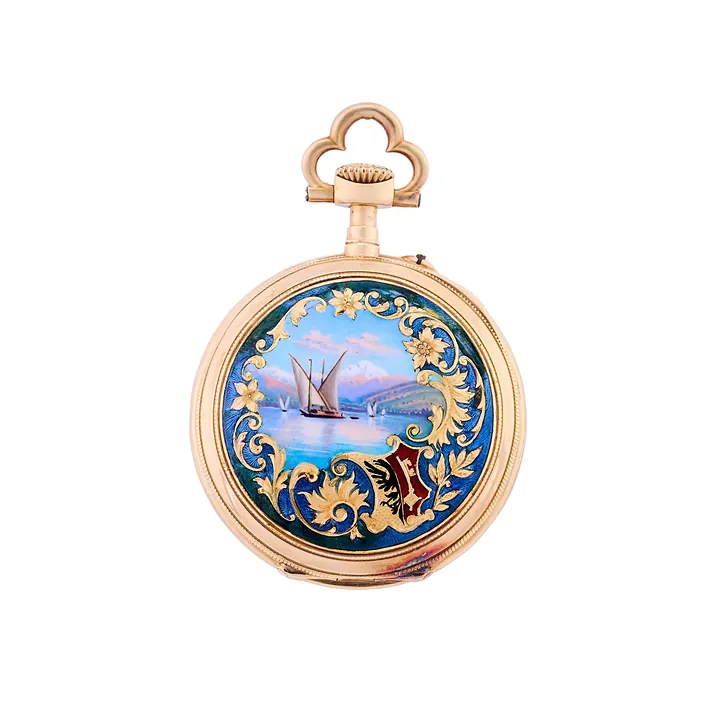
Vacheron Constantin “grand TIR de L’exposition Nationale, Genève 1896, c. 1896
Antiquorum auction archive, Geneva
Pocket Watches · c. 1940
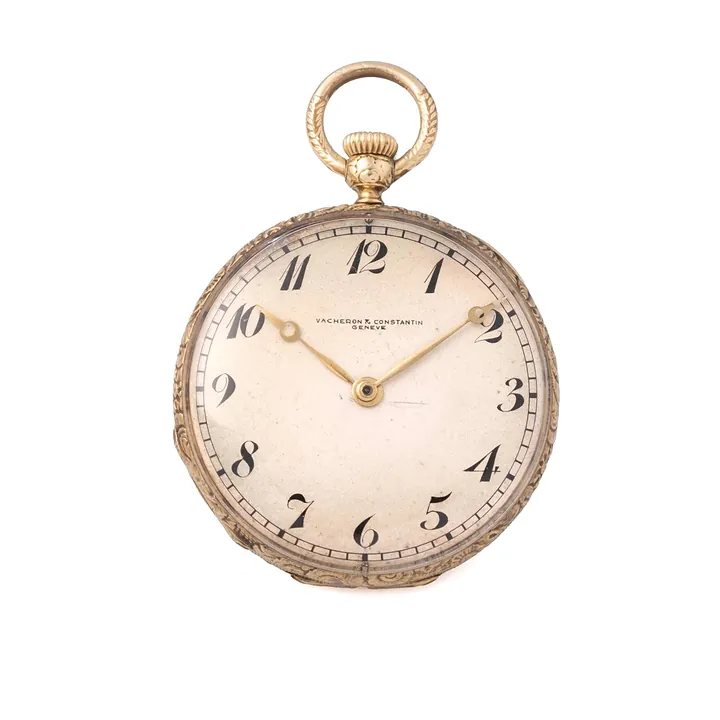
Vacheron Constantin pocket watch, ref. 345, c. 1940
Antiquorum auction archive, Geneva
Pocket Watches · c. 1945
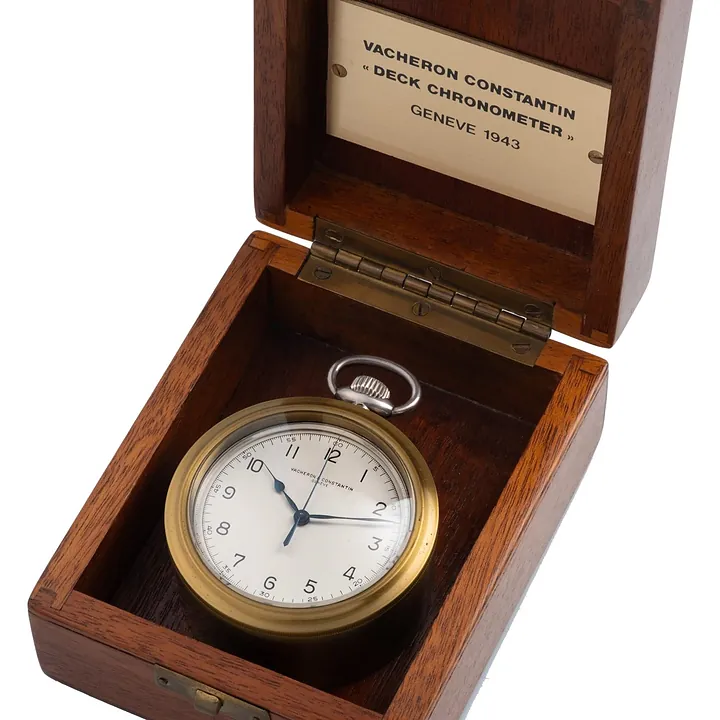
Vacheron Constantin pocket chronometer, c. 1945
Antiquorum auction archive, Geneva
Pocket Watches · c. 1945
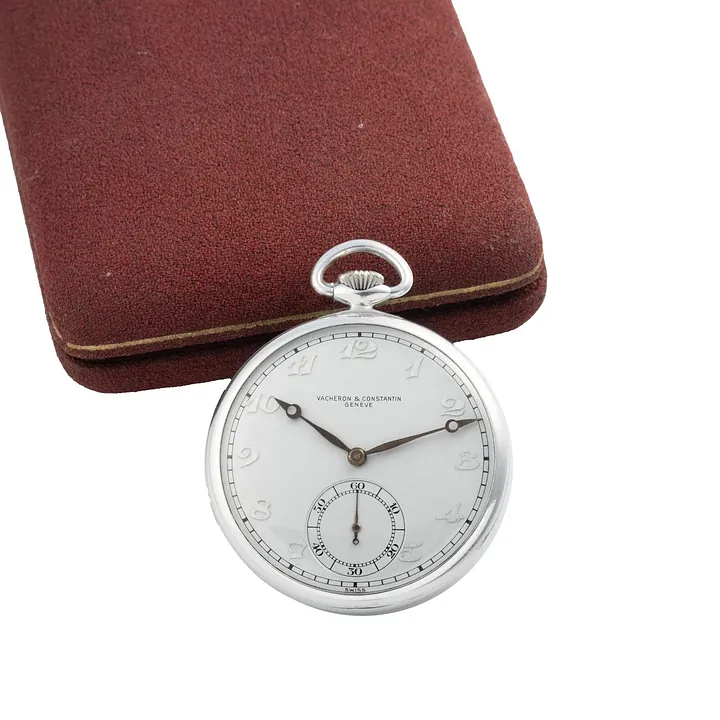
Vacheron Constantin watch, c. 1945
Antiquorum auction archive, Geneva

Wristwatches · 1945
Wristwatch by Eterna, 1945
Museum Rotterdam

Wristwatches · c. 1945
Breitling Premier, ref. 790, c. 1945
Antiquorum auction archive, Geneva

Wristwatches · c. 1945
Universal Genève Uni-Compax, ref. 22492, c. 1945
Antiquorum auction archive, Geneva

Wristwatches · c. 1950s
Baume & Mercier wristwatch, c. 1950s
Antiquorum auction archive, Geneva