
Wristwatches · Wristwatch
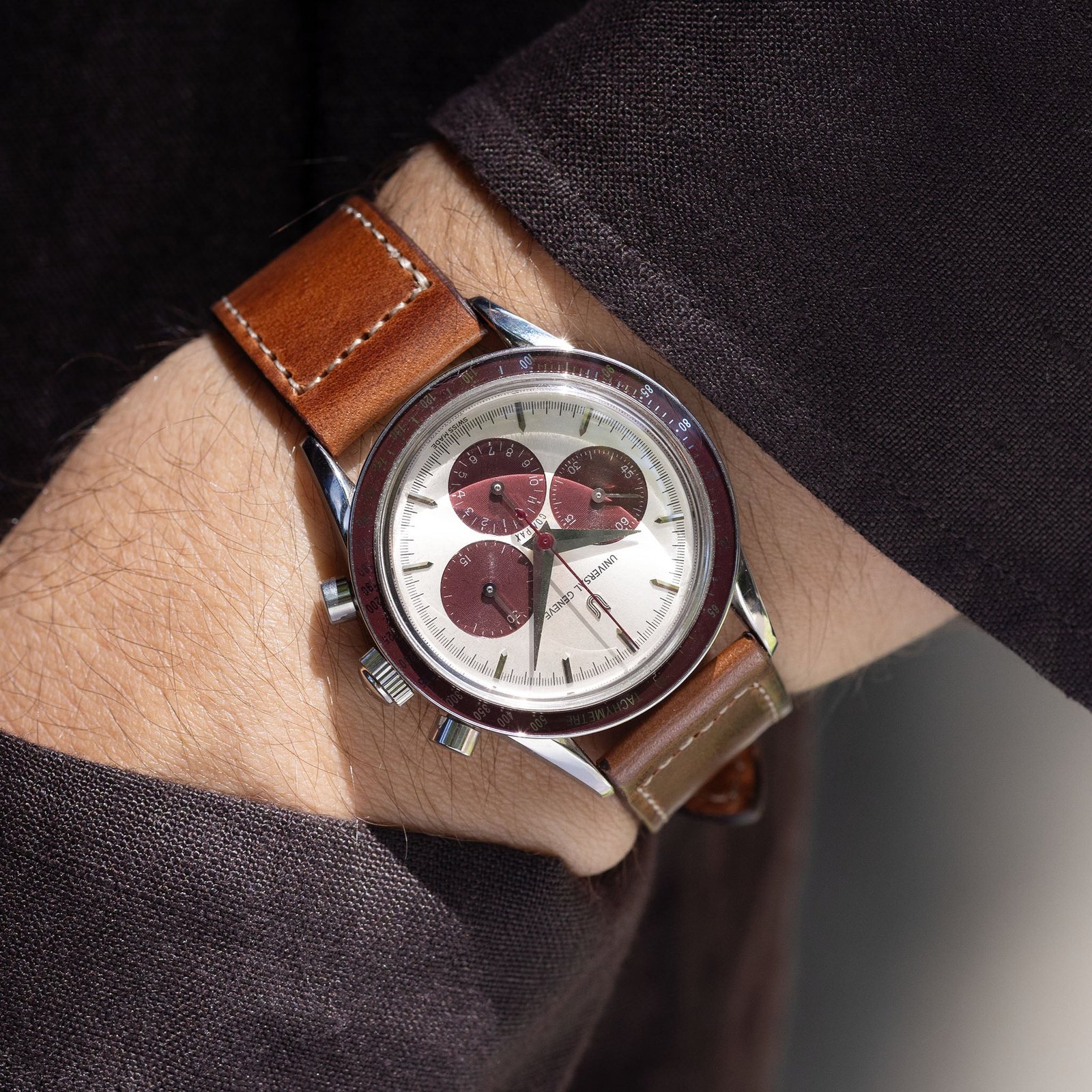
Universal Genève Compax Chronograph Silver Dial Burgundy ref. 884.485, 1990
- Maker / attribution
- Universal Geneve (maker)
- Date
- 1990
- Historical period
- Mechanical Renaissance (1990 – 2010)
- Country of origin
- Switzerland
- Object type
- Wristwatch
- Materials / technique
- silver
- Dimensions
- Case 37 mm
- Stock no.
- W-3870
- Credit line
- Dealer listing, Bulang & Sons (W-3870)
- Catalogue title (original)
- Universal Genève Compax Chronograph Silver Dial Burgundy ref. 884.485 (English)
View the source record (dealer listing) ↗ (opens another website in a new tab)Suggest a correction
Record summary
Catalogued by Bulang & Sons (dealer), Copenhagen (stock number W-3870), this is a wristwatch by Universal Geneve, made in Switzerland, dated 1990. The Atlas places it in the Mechanical Renaissance period (1990 – 2010) of its Wristwatches collection. Materials and techniques recorded by the source: silver. Recorded dimensions: Case 37 mm. The record is illustrated with 6 photographs.
Assembled from the source record's structured fields. Dates and attributions are given as the source states them; where a field is missing the Atlas leaves it blank rather than estimating.
Catalogue description
Dealer description — Bulang & Sons
Universal Genève is one of the great names in Swiss watchmaking. Founded in 1894 in Le Locle, Switzerland, as Universal Watch, the brand earned a reputation for pioneering wrist chronographs and elegant dress watches. It reached its golden era during the mid-20th century before being severely impacted by the Quartz Crisis. In late 2023, Universal Genève was acquired by Breitling, with a comprehensive revival of the historic manufacture now underway. In 1936, Universal Genève introduced the Compax, the world's first chronograph wristwatch equipped with a 12-hour counter. The collection would later expand into celebrated variants such as the Aero-Compax, the Uni-Compax, and the flagship Tri-Compax, which combined a chronograph with a full calendar and moonphase display. These innovations earned Universal Genève the nickname "The King of Chronographs." In the United States, the brand was distributed by the Henri Stern Agency—the exclusive importer of Patek Philippe—further reinforcing its reputation among discerning collectors. Today, vintage references such as the Tri-Compax "Eric Clapton" and the Compax "Nina Rindt" remain among the most desirable Universal Genève models, prized for their rarity, timeless design, and historical significance. Presented here is the Compax reference 884.485, often referred to by collectors as the "Compax 1950" or "Baby Nina." Produced during the 1990s, this handsome neo-vintage chronograph was created as Universal Genève looked to recapture the spirit of its legendary 1960s chronographs—most notably the iconic "Nina Rindt." The watch features a beautifully proportioned 37mm stainless steel case with an acrylic crystal, classic pump pushers, and a striking burgundy tachymeter bezel that gives the watch a distinctive sporting character. Its silver dial is equally attractive, fitted with applied boat-shaped hour markers, an applied Universal Genève logo, and three contrasting burgundy sub-dials that echo the bezel perfectly. A set of polished dauphine hands completes the design, giving the watch a refined yet unmistakably masculine presence. The watch is powered by a hand wound UG cal. 84 (based on a Lemania 1873)movement that has been fully serviced by our watch maker. A splash of burgundy makes everything better & Neo-vintage done exactly right. We'd happily wear this one ourselves, get in touch! Specifications: Universal Genève Compax chronograph reference 884.485 37mm steel case with burgundy colour tachymeter bezel Serial 408xxxx dates to 1990’s Non lume silver dial with burgundy red sub dials ,Dauphine hands UG Calibre 84 manual wind movement Bulang and sons leather strap Fully serviced by our watchmaker
Historical context
Mechanical Renaissance (1990 – 2010)
Mechanical watches return as cultural objects; independent watchmaking flourishes.
Mechanical watches returned as cultural and luxury objects. Complications, tourbillons and new materials proliferated; independent watchmakers such as George Daniels, F.P. Journe and Philippe Dufour revived artisanal watchmaking; collecting vintage watches became a major field.
Read the period in the timelineMore wristwatches from this periodEarlier: Quartz Revolution
Atlas type guide
Chronographs and split-seconds watches
A chronograph is a watch with an additional seconds hand that can be started, stopped and returned to zero independently of the timekeeping. Louis Moinet built an early example in 1816 and Nicolas Rieussec a recording 'chronographe' in 1821; Adolphe Nicole's heart-shaped reset cam (patented 1862) made the modern return-to-zero possible. Split-seconds (rattrapante) chronographs add a second hand that can be stopped for intermediate times; flyback chronographs restart instantly.
Chronographs were essential tools for doctors (pulsometer scales), artillery (telemeter), engineers and sport. In wristwatches, Valjoux, Venus, Lemania and later the automatic chronographs of 1969 (Zenith El Primero, the Chronomatic Calibre 11 group and Seiko 6139) are milestones.
What to look for
- Push-pieces on the case band or a single button in the crown (monopusher).
- Subsidiary registers for minutes and hours; tachymeter, telemeter or pulsometer scales.
- Column wheel versus cam control visible in the movement.
- Calibre markings of specialist makers (Valjoux, Lemania, Venus, Landeron).
Dating clues
- Pocket chronographs with heart cam reset: after 1862.
- Wrist chronographs: from c. 1910; two-button designs from the 1930s.
- Automatic chronographs: from 1969.
General guidance written by the Atlas editors about this kind of object. It is not a statement about this particular piece; for that, rely on the source record above and on physical examination.
Read next:Flyback chronographChronograph
Related records
Wristwatches · 1970s
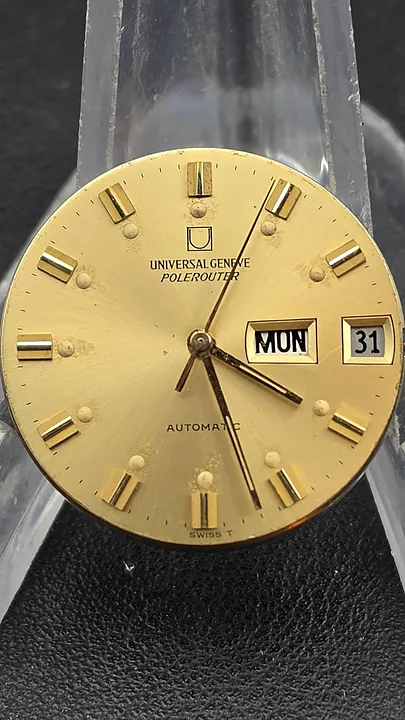
1970s Universal Geneve Polerouter Day-Date Movement Dial Cal 72 Microtor 17J 29mm Auto
LiveAuctioneers auction archive
Wristwatches · 1960s
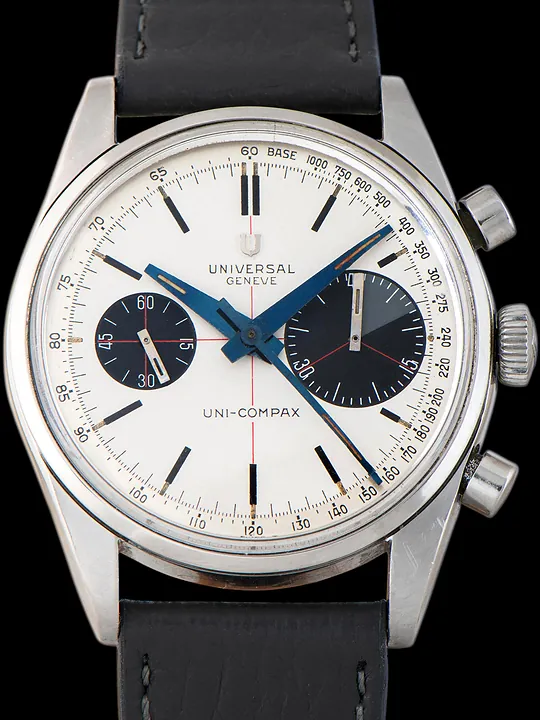
Universal Geneve Uni- Compax (Ref. 884100/02) “Big Eye”, 1960s
Craft & Tailored (dealer), Los Angeles
Wristwatches · 1960s
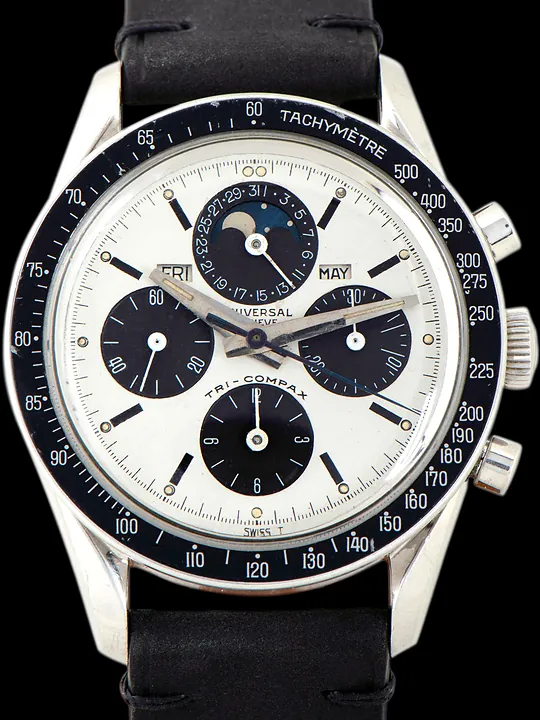
Universal Genève Tri-Compax (Ref. 881101/01) "Eric Clapton", 1960s
Craft & Tailored (dealer), Los Angeles
Wristwatches · 1960s
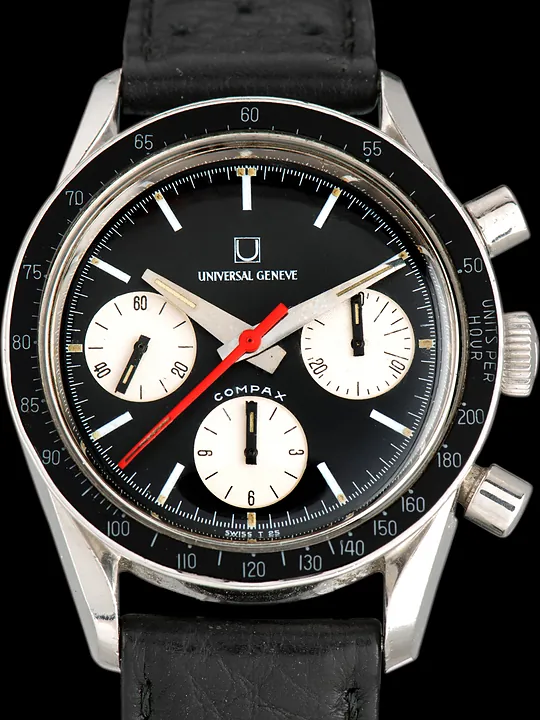
Universal Geneve Compax (Ref. 885103/01) "Evil Nina" W/ Base 200 UPH Bezel, 1960s
Craft & Tailored (dealer), Los Angeles

Wristwatches · 2008
Wristwatch by Breitling?, 2008
Museum Rotterdam

Wristwatches · c. 1990s
Audemars Piguet Bamboo, c. 1990s
Antiquorum auction archive, Geneva

Wristwatches · c. 1990
Audemars Piguet Huitieme Perpetual Calendar, ref. 25696PT, c. 1990
Antiquorum auction archive, Geneva

Wristwatches · c. 1990
Breitling Chronomat, ref. b13050.1, c. 1990
Antiquorum auction archive, Geneva