
Wristwatches · Wristwatch
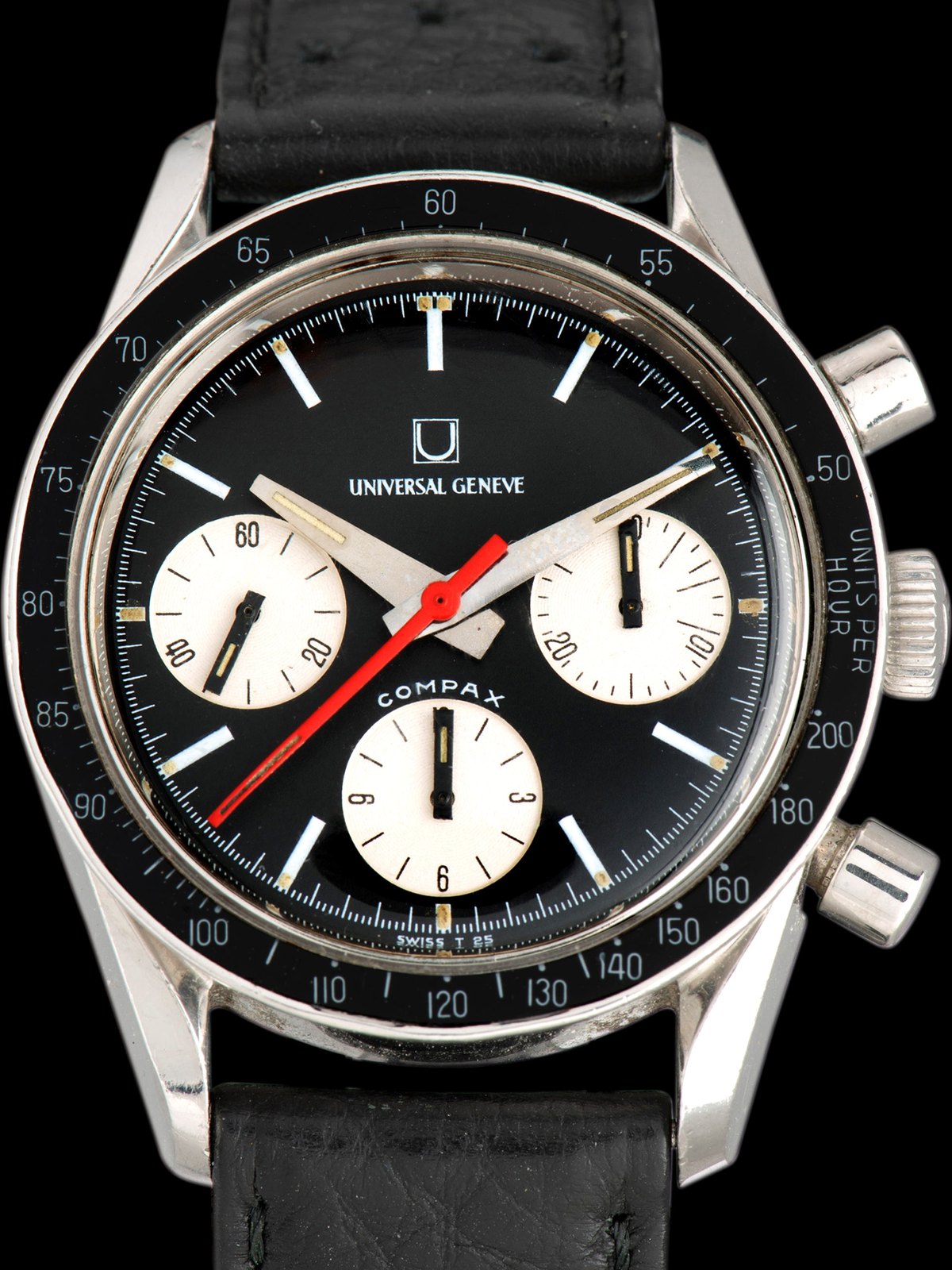
Universal Geneve Compax (Ref. 885103/01) "Evil Nina" W/ Base 200 UPH Bezel, 1960s
- Maker / attribution
- Universal Geneve (maker)
- Date
- 1960s
- Historical period
- Modern Mechanical Horology (1945 – 1969)
- Country of origin
- Switzerland
- Object type
- Wristwatch
- Stock no.
- UGC885103/01EN
- Credit line
- Dealer listing, Craft & Tailored (UGC885103/01EN)
- Catalogue title (original)
- 1960s Universal Geneve Compax (Ref. 885103/01) "Evil Nina" W/ Base 200 UPH Bezel (English)
View the source record (dealer listing) ↗ (opens another website in a new tab)Suggest a correction
Record summary
Catalogued by Craft & Tailored (dealer), Los Angeles (stock number UGC885103/01EN), this is a wristwatch by Universal Geneve, made in Switzerland, dated 1960s. The Atlas places it in the Modern Mechanical Horology period (1945 – 1969) of its Wristwatches collection. The record is illustrated with 6 photographs.
Assembled from the source record's structured fields. Dates and attributions are given as the source states them; where a field is missing the Atlas leaves it blank rather than estimating.
Catalogue description
Dealer description — Craft & Tailored
There are many collectible vintage watches, but only a few references have been propelled to pop-culture status, receiving the namesake of a past icon that was known for wearing the specific timepiece. Paul Newman with the exotic dial Rolex Daytona, Eric Clapton with the Universal Geneve Tri-Compax moon phase, Steve McQueen with the Heuer Monaco, Nina Rindt with the white dial Universal Geneve Compax, and Joe Siffert with the white dial Heuer Autavia to name a few. These iconic people were looked at as the gold standard of “cool” for their achievements, taste, and style which transcended to the watch community as collectors noticed the exciting timepieces they chose to daily drive. Nina Rindt was a style icon in Europe and a well-known model. However, her most noticeable appearances were at the Formula One track where she was often seen timing her late Husband Jochen Rindt who was a famous F1 racer throughout the 60s. Jochen Rindt was also notably known for wearing a Heuer Autavia ref. 2446 and gifted Nina the Universal Geneve Compax ref. 885103/02 which would later become a wristwatch icon on its own. While Nina Rindt made the ref. 885103/02 famous, featuring a white dial with black sub-dials, the Compax was produced in another dial colorway that bears the "Nina" nickname as well. The ref. 885103/01 Compax is essentially the inverse of the white dial variant and can be more theatrically described as its evil twin, featuring a matte black dial with white sub-dials and a bright red center chronograph hand. Subsequently, this black dial variant was dutifully nicknamed the "Evil Nina" and has risen in the ranks of notable timepieces alongside its white dialed counterpart. As the saying goes, a rising tide lifts all ships, though we think the Evil Nina deserves to be celebrated as a standalone and respectable timepiece from one of the most exciting companies from the 20th century. SPECS Stock # UGC885103/01EN Brand Universal Geneve Style Compax Model 885103/01 Serial N/A Size Men's Material Stainless Steel Dial Matte Black W/ White Sub-Dials Millimeters 36 Bracelet 2pc Handmade Leather Rally Strap CASE & BRACELET The excellent case shows light signs of use and has seen a gentle polishing in its past, retaining the beautifully executed twisted lugs design with robust dimensions and symmetry. The original and extremely rare base 200 "Units Per Hour" black acrylic bezel is very well preserved with no cracks or separation present and only light signs of use. The case retains its original Universal Geneve signed crown and pump pushers. The serial and reference were removed from the case back in a past polishing which is very common to see as they were applied very lightly from the factory. The watch will come supplied on a 2pc handmade leather rally strap. DIAL & HANDS The gorgeous matte black dial with white sub-dials is exceptionally well-preserved with no blemishes or signs of age present. the white sub-dials exhibit a slight warmth in coloration and feature no damage or dust that would normally be seen in this dial variant. The tritium lume plots have achieved a handsome creamy patina and show no notable degradation under U.V. light inspection. The original tritium lumed sub-dial hands and tritium hour and minute hands all match the dial's lume patina nicely with no degradation present under U.V. light inspection. The lume in the original red center chronograph hand remains fully present as well and has aged slightly darker which is commonly seen and fits the overall aesthetic of the watch. ACCESSORIES None. Watch is functioning and keeping time perfectly, previous service history is unknown
Historical context
Modern Mechanical Horology (1945 – 1969)
Tool watches for divers, pilots and astronauts; electric watches anticipate the electronic age.
The classic era of the mechanical wristwatch: dive watches, chronographs for motor racing and space flight, GMT watches for jet travel, slim dress watches, automatic calendars, and the rise of Japanese manufacturers alongside Swiss, American, German and Soviet industries.
Read the period in the timelineMore wristwatches from this periodEarlier: Golden Age of Mechanical Watchmaking
Atlas type guide
Wristwatches
Bracelet watches were worn by women from the early nineteenth century — Breguet made one for Caroline Murat, Queen of Naples, in 1810–12 — but the wristwatch only became a man's instrument with military use and aviation in the early twentieth century. Between the World Wars it overtook the pocket watch; the 1920s and 1930s brought rectangular Art Deco cases, water-resistant cases and the first automatic winding systems.
After 1945 the wristwatch became a carrier of identity — dress watches, sports and dive watches, chronographs, calendars — produced by Swiss, American, Japanese, German, Soviet and Chinese industries. The quartz revolution after 1969 and the mechanical renaissance since the 1990s, including the rise of independent watchmakers, complete the story.
What to look for
- The reference number (between the lugs or inside the case back) and serial number, the starting point for dating.
- The calibre: its maker and number are often stamped under the dial or on the bridge.
- Originality of dial, hands and crown — refinished ('redial') dials are common.
- Case material marks: 18K/750, 14K/585, stainless steel, gold-filled, plated.
Dating clues
- Wire-lug cases: before c. 1925.
- Water-resistant screw-down cases: from 1926.
- Quartz movements: from 1969; sapphire crystals widespread after c. 1980.
General guidance written by the Atlas editors about this kind of object. It is not a statement about this particular piece; for that, rely on the source record above and on physical examination.
Related records
Wristwatches · 1970s
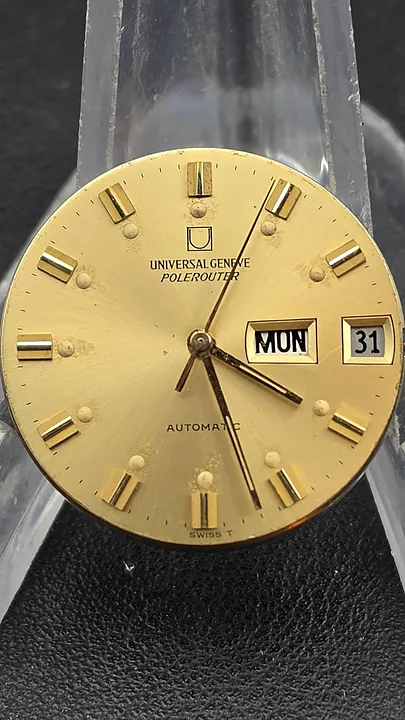
1970s Universal Geneve Polerouter Day-Date Movement Dial Cal 72 Microtor 17J 29mm Auto
LiveAuctioneers auction archive
Wristwatches · 1960s
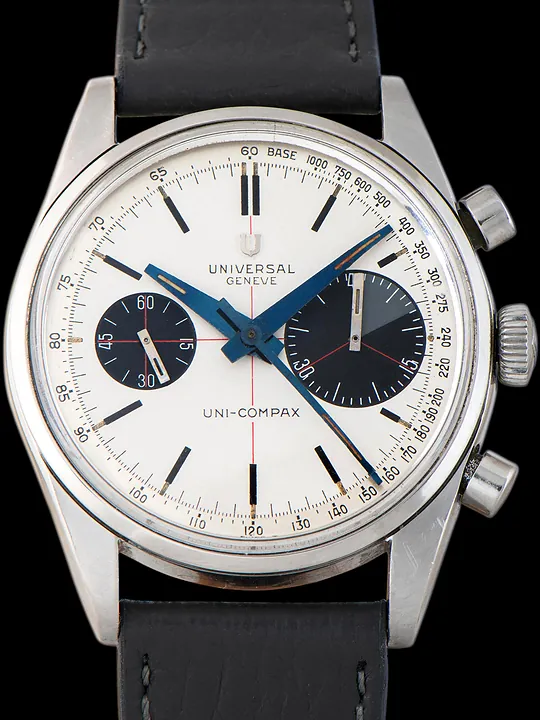
Universal Geneve Uni- Compax (Ref. 884100/02) “Big Eye”, 1960s
Craft & Tailored (dealer), Los Angeles
Wristwatches · 1960s
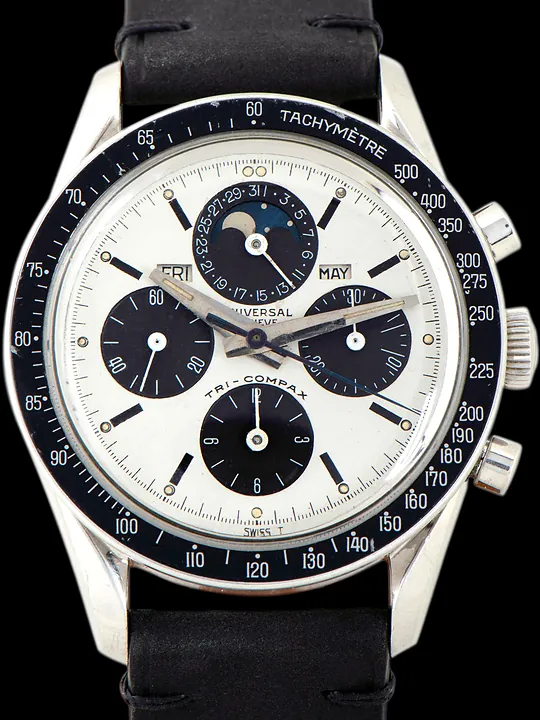
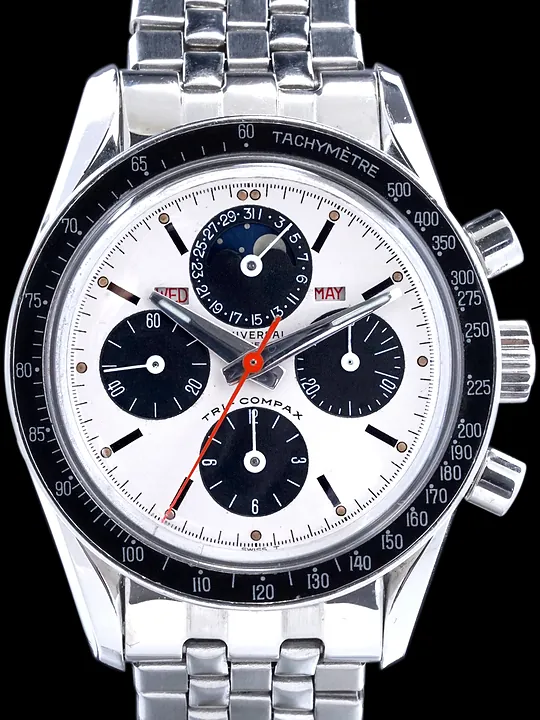
Universal Genève Tri-Compax (Ref. 881101/01) "Eric Clapton", 1960s
Craft & Tailored (dealer), Los Angeles
Wristwatches · 1960s
Universal Genève Tri-Compax (Ref. 881101/01) "Eric Clapton", 1960s
Craft & Tailored (dealer), Los Angeles

Wristwatches · 1945
Wristwatch by Eterna, 1945
Museum Rotterdam

Wristwatches · c. 1945
Breitling Premier, ref. 790, c. 1945
Antiquorum auction archive, Geneva

Wristwatches · c. 1945
Universal Genève Uni-Compax, ref. 22492, c. 1945
Antiquorum auction archive, Geneva

Wristwatches · c. 1950s
Baume & Mercier wristwatch, c. 1950s
Antiquorum auction archive, Geneva