
Wristwatches · Wristwatch
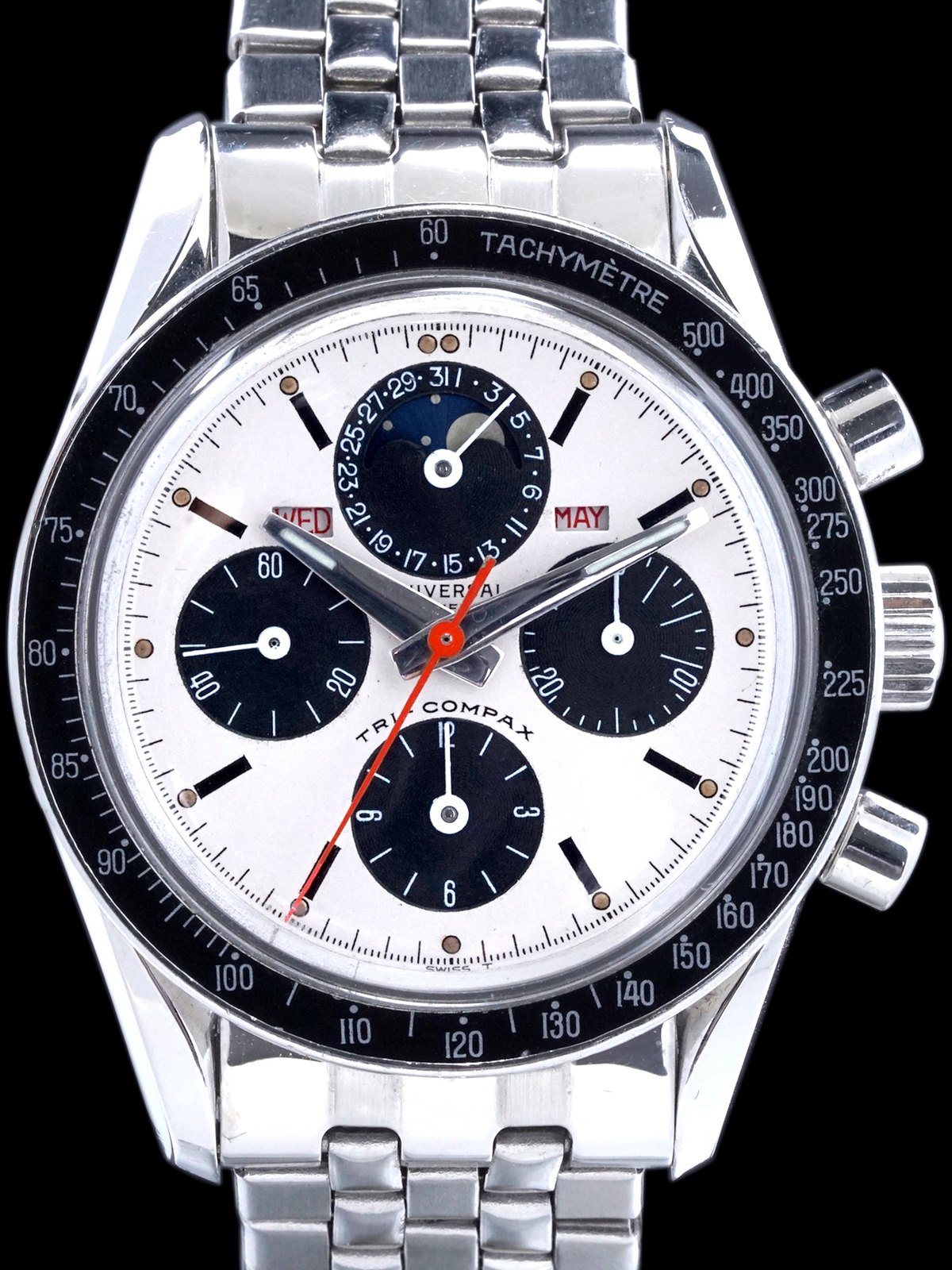
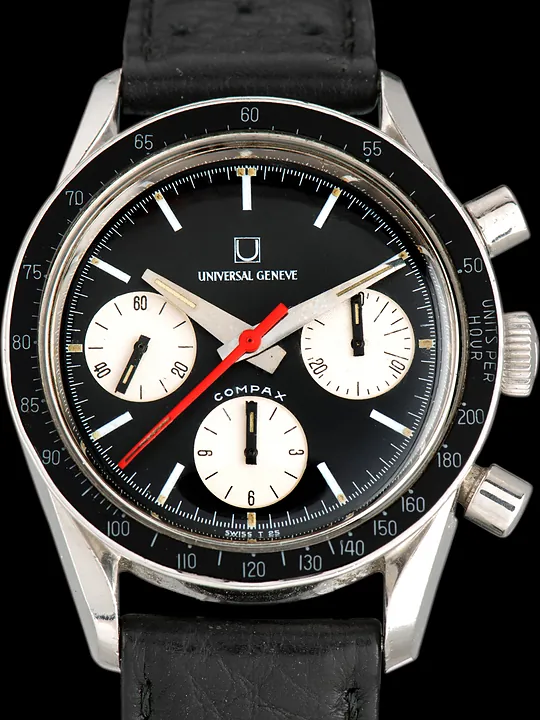
Universal Genève Tri-Compax (Ref. 881101/01) "Eric Clapton", 1960s
- Maker / attribution
- Universal Geneve (maker)
- Date
- 1960s
- Historical period
- Modern Mechanical Horology (1945 – 1969)
- Country of origin
- Switzerland
- Object type
- Wristwatch
- Stock no.
- UGTCEC881101
- Credit line
- Dealer listing, Craft & Tailored (UGTCEC881101)
- Catalogue title (original)
- 1960s Universal Genève Tri-Compax (Ref. 881101/01) "Eric Clapton" (English)
View the source record (dealer listing) ↗ (opens another website in a new tab)Suggest a correction
Record summary
Catalogued by Craft & Tailored (dealer), Los Angeles (stock number UGTCEC881101), this is a wristwatch by Universal Geneve, made in Switzerland, dated 1960s. The Atlas places it in the Modern Mechanical Horology period (1945 – 1969) of its Wristwatches collection. The record is illustrated with 6 photographs.
Assembled from the source record's structured fields. Dates and attributions are given as the source states them; where a field is missing the Atlas leaves it blank rather than estimating.
Catalogue description
Dealer description — Craft & Tailored
Universal Genève created its first chronograph in 1917 and roughly 18 years later, they released their first “Compax” model. Many variations of the “Compax” would follow and vintage Universal Genève’s sports watches have gone on to cement their place in the market as particularly desirable watches thanks to their incredible variety, unique designs, and the larger sports watch case sizing they featured. Although Universal Geneve created a variety of highly notable and collectible watches, they are best known for their incredibly innovative chronographs, and of the many chronographs the marque has produced, the Tri-Compax remains their most recognizable range of watches. Created to celebrate the company's 50th anniversary, the Tri-Compax was introduced in 1944 as the new flagship for Universal Geneve. Featuring not only a fully functional chronograph function, the Tri-Compax also impressively boasted both triple calendar and moon phase complications -- an incredible feat considering the Tri-Compax’s relatively compact design. Most remarkably, the Tri-Compax's design presents its many features in a tasteful, legible, and downright beautiful dial layout which has made the model deeply loved by collectors today. The 881101/01 houses a Martel caliber 281 movement, a complicated and highly celebrated movement within the watch community, along with an external tachymeter bezel -- which was the first of its kind within the Tri-Compax line. While earlier iterations of the Tri-Compax were produced in gold or gold-plated versions, this reference was rendered in steel, making it the perfect blend of horological sophistication and tool watch toughness. While these watches would undoubtedly be considered legends of horology on the strength of their design alone, they’re also closely associated with guitar hero (and prolific watch collector) Eric Clapton, whose love of this specific reference has made this Tri-Compax even more notable and desirable. SPECS Stock # UGTCEC881101 Brand Universal Geneve Style Tri-Compax Model 881101/01 Serial 25XXXXX Size Men's Material Stainless Steel Dial White "Panda" Millimeters 36 Bracelet Universal Geneve "Gay Freres" Stretch Bracelet CASE & BRACELET The gorgeous twisted lug case has been lightly polished and remains in impressive condition, showing full and symmetrical lugs with minimal signs of use. The original "dot over 90" bezel is in exceptional condition, remaining deep black with almost no signs of use. The case retains its original pump pushers, setting pushers, and Universal Geneve signed crown. The case back does exhibit some wear but the factory engravings, including the reference and serials, all remain intact. The Universal Geneve "Gay Freres" stretch bracelet is in exceptionally well-preserved condition, showing no sag whatsoever. The end pieces on the bracelet are believed to be aftermarket which is very common for these watches. DIAL & HANDS The matte white Mk. II "panda" dial is exceptionally exquisite, with no aging or damage present on the dial. The black sub-dials are also in superb condition, exhibiting no damage or signs of age. The tritium lume plots have aged to a handsome dark brown coloration and display no degradation under U.V. light inspection. All of the hands, including the red center chronograph hand, remain original to the watch, under U.V. light inspection the hour and minute hands have been professionally restored with tritium and are bright white in coloration. ACCESSORIES
Historical context
Modern Mechanical Horology (1945 – 1969)
Tool watches for divers, pilots and astronauts; electric watches anticipate the electronic age.
The classic era of the mechanical wristwatch: dive watches, chronographs for motor racing and space flight, GMT watches for jet travel, slim dress watches, automatic calendars, and the rise of Japanese manufacturers alongside Swiss, American, German and Soviet industries.
Read the period in the timelineMore wristwatches from this periodEarlier: Golden Age of Mechanical Watchmaking
Atlas type guide
Wristwatches
Bracelet watches were worn by women from the early nineteenth century — Breguet made one for Caroline Murat, Queen of Naples, in 1810–12 — but the wristwatch only became a man's instrument with military use and aviation in the early twentieth century. Between the World Wars it overtook the pocket watch; the 1920s and 1930s brought rectangular Art Deco cases, water-resistant cases and the first automatic winding systems.
After 1945 the wristwatch became a carrier of identity — dress watches, sports and dive watches, chronographs, calendars — produced by Swiss, American, Japanese, German, Soviet and Chinese industries. The quartz revolution after 1969 and the mechanical renaissance since the 1990s, including the rise of independent watchmakers, complete the story.
What to look for
- The reference number (between the lugs or inside the case back) and serial number, the starting point for dating.
- The calibre: its maker and number are often stamped under the dial or on the bridge.
- Originality of dial, hands and crown — refinished ('redial') dials are common.
- Case material marks: 18K/750, 14K/585, stainless steel, gold-filled, plated.
Dating clues
- Wire-lug cases: before c. 1925.
- Water-resistant screw-down cases: from 1926.
- Quartz movements: from 1969; sapphire crystals widespread after c. 1980.
General guidance written by the Atlas editors about this kind of object. It is not a statement about this particular piece; for that, rely on the source record above and on physical examination.
Related records
Wristwatches · 1970s
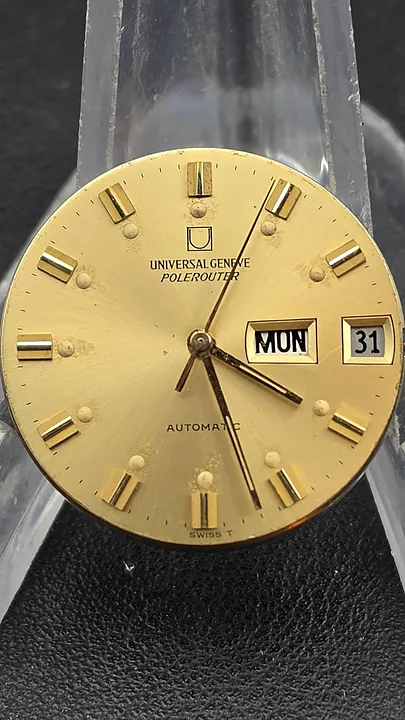
1970s Universal Geneve Polerouter Day-Date Movement Dial Cal 72 Microtor 17J 29mm Auto
LiveAuctioneers auction archive
Wristwatches · 1960s
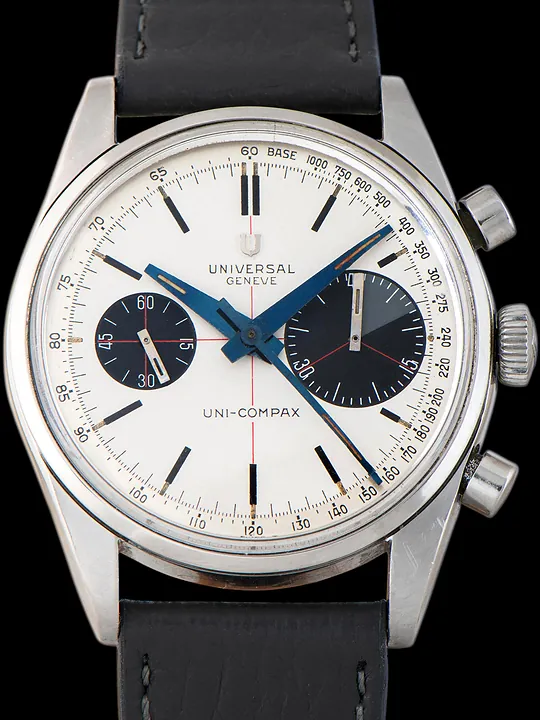
Universal Geneve Uni- Compax (Ref. 884100/02) “Big Eye”, 1960s
Craft & Tailored (dealer), Los Angeles
Wristwatches · 1960s
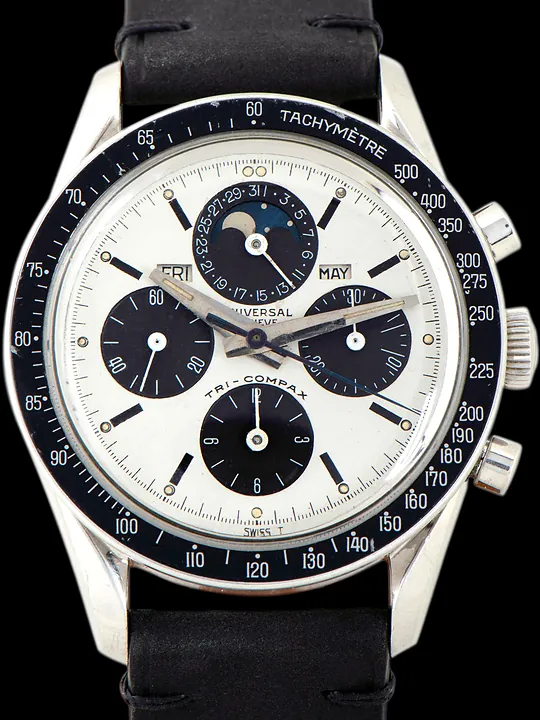
Universal Genève Tri-Compax (Ref. 881101/01) "Eric Clapton", 1960s
Craft & Tailored (dealer), Los Angeles
Wristwatches · 1960s
Universal Geneve Compax (Ref. 885103/01) "Evil Nina" W/ Base 200 UPH Bezel, 1960s
Craft & Tailored (dealer), Los Angeles

Wristwatches · 1945
Wristwatch by Eterna, 1945
Museum Rotterdam

Wristwatches · c. 1945
Breitling Premier, ref. 790, c. 1945
Antiquorum auction archive, Geneva

Wristwatches · c. 1945
Universal Genève Uni-Compax, ref. 22492, c. 1945
Antiquorum auction archive, Geneva

Wristwatches · c. 1950s
Baume & Mercier wristwatch, c. 1950s
Antiquorum auction archive, Geneva