
Instruments · Deck watch
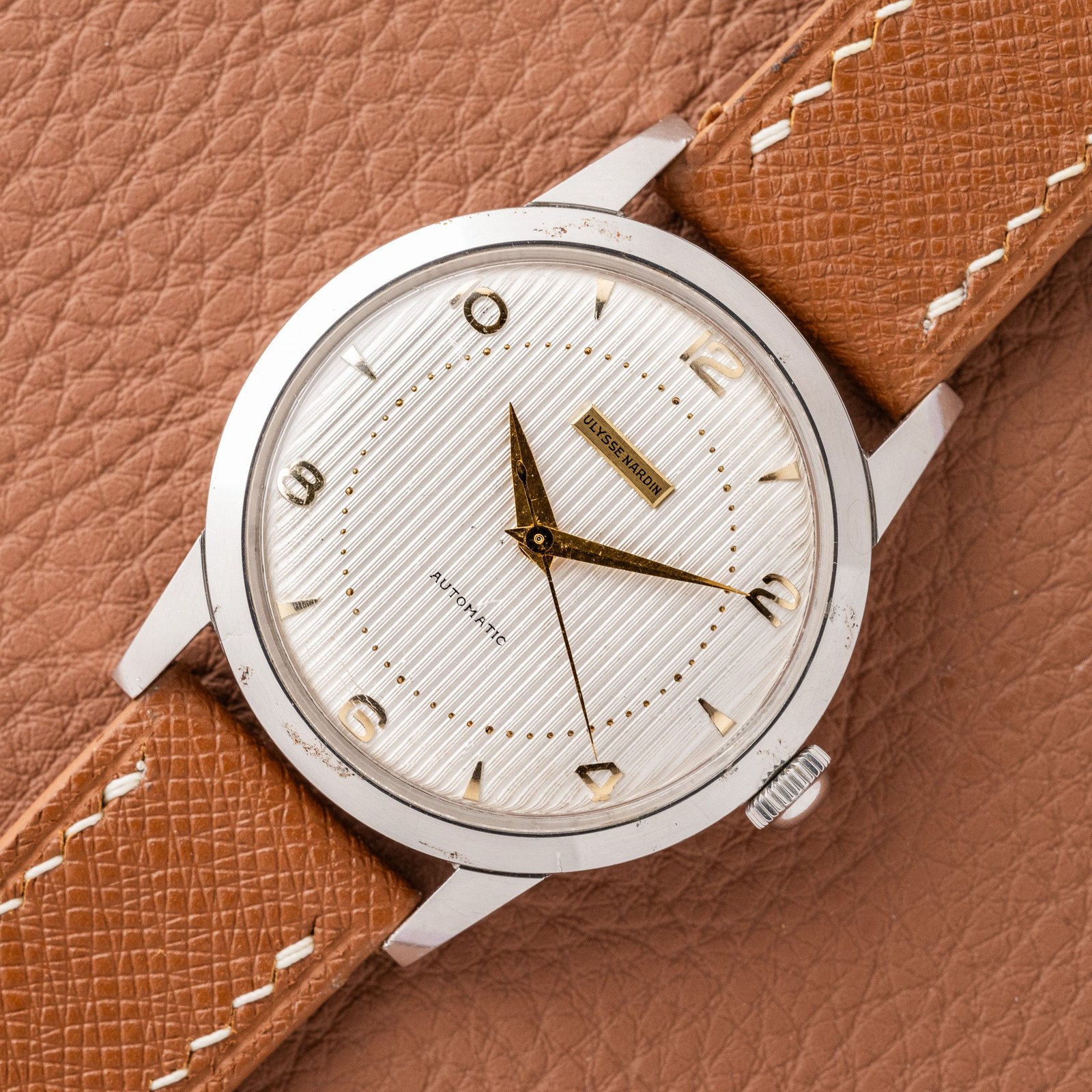
Ulysse Nardin Automatic Silver Guilloché Tapestry Dial, 1950s
- Maker / attribution
- Ulysse Nardin (maker)
- Date
- 1950s
- Historical period
- Modern Mechanical Horology (1945 – 1969)
- Country of origin
- Switzerland
- Object type
- Deck watch
- Materials / technique
- silver
- Dimensions
- Case 34 mm
- Stock no.
- Product 8322939682999
- Credit line
- Dealer listing, Huntington Company (product 8322939682999)
- Catalogue title (original)
- 1950s Ulysse Nardin Automatic Silver Guilloché Tapestry Dial (English)
View the source record (dealer listing) ↗ (opens another website in a new tab)Suggest a correction
Record summary
Catalogued by Huntington Company (dealer) (stock number Product 8322939682999), this is a deck watch by Ulysse Nardin, made in Switzerland, dated 1950s. The Atlas places it in the Modern Mechanical Horology period (1945 – 1969) of its Instruments collection. Materials and techniques recorded by the source: silver. Recorded dimensions: Case 34 mm. The record is illustrated with 6 photographs.
Assembled from the source record's structured fields. Dates and attributions are given as the source states them; where a field is missing the Atlas leaves it blank rather than estimating.
Catalogue description
Dealer description — Huntington Company
History and Significance Ulysse Nardin is best known today for its modern marine chronometers and technical watchmaking, but the brand’s mid-century dress watches are where much of its quiet credibility was built. During the 1940s and 1950s, Ulysse Nardin produced restrained, high-quality automatic wristwatches that favored balance, legibility, and thoughtful dial execution over overt branding or excess. This example is a classic expression of that period. The vertically brushed silver dial gives the watch its character, catching light differently throughout the day while remaining understated. Applied Arabic numerals and dagger markers provide depth without clutter, and the gold-tone dauphine hands add warmth against the steel case. The automatic movement reflects Ulysse Nardin’s early adoption of self-winding technology in a refined, everyday format. Watches like this represent a time when Ulysse Nardin was producing elegant, wearable pieces for daily use, long before the era of oversized cases or experimental designs. For collectors drawn to mid-century Swiss watchmaking with subtle personality, this is a compelling and honest example. Writer’s Thoughts This watch wears exactly how a vintage dress watch should. The proportions are balanced, the dial has real texture rather than decoration, and the overall feel is calm and confident. It works just as well on leather with tailoring as it does casually, which is not something every vintage piece can claim. The dial furniture and automatic movement give it enough interest to stand apart without trying too hard. Our Promise Every watch we offer is carefully inspected and evaluated for authenticity and originality. We stand behind each piece we sell and disclose all known details and condition observations as accurately as possible. Specifications Brand: Ulysse Nardin Model: Automatic Year: circa 1950s Case Material: Stainless steel Case Size: 34mm Dial: Silver vertically brushed with applied Arabic numerals and markers Crystal: Acrylic Movement: Automatic Strap: Brown leather strap Buckle/Clasp: Generic buckle Contents: Watch only Condition Case: Stainless steel case shows honest surface wear consistent with age. The case appears unpolished with well-defined lines and lugs. Bezel: Bezel shows light wear and minor marks visible under close inspection. Crystal: Acrylic crystal shows surface scratches consistent with age, with no cracks. Dial: Silver brushed dial is clean overall with light age-appropriate wear. Texture remains perfect and evenly preserved. Hands: Original gold-tone hands show light patina consistent with age. Strap: Brand new condition. Buckle/Clasp: Brand new condition.
Historical context
Modern Mechanical Horology (1945 – 1969)
Tool watches for divers, pilots and astronauts; electric watches anticipate the electronic age.
Electronic instruments, quartz frequency standards and the first atomic clocks transformed precision timing in laboratories and broadcasting.
Read the period in the timelineMore instruments from this periodEarlier: Golden Age of Mechanical Watchmaking
Atlas type guide
Marine chronometers
A marine chronometer is a precision timekeeper carried at sea to find longitude: the navigator compares local noon, observed with a sextant, with the time at a reference meridian kept by the chronometer. Each hour of difference corresponds to fifteen degrees of longitude. John Harrison proved the method in the 1760s; Pierre Le Roy, Ferdinand Berthoud, John Arnold and Thomas Earnshaw then developed the detent escapement and the compensation balance that made chronometers practical to manufacture.
By the nineteenth century London, Liverpool, Le Locle and Glashütte supplied navies and merchant fleets. A typical box chronometer has a spring-detent escapement, a fusee to equalise mainspring torque, a bimetallic compensation balance with a helical balance spring, and is mounted in gimbals inside a wooden box so that it stays level.
What to look for
- Gimbals and a three-tier wooden box with a glazed inner lid.
- A power-reserve ('up and down') indicator on the dial, usually showing 56 hours on two-day instruments.
- Spring-detent escapement and a cylindrical (helical) balance spring visible through the movement.
- Admiralty or navy marks (broad arrow), and rating certificates from observatories.
- The maker's number on the dial and movement; many makers' registers survive, allowing dating.
Dating clues
- Earnshaw-type spring-detent chronometers became standard after about 1800.
- Auxiliary compensation devices on the balance appear from the mid-nineteenth century.
- Quartz and radio time signals ended routine use of mechanical chronometers in the 1970s and 1980s.
General guidance written by the Atlas editors about this kind of object. It is not a statement about this particular piece; for that, rely on the source record above and on physical examination.
Read next:Spring detent (chronometer) escapementFuseeBalance spring (hairspring)Detent escapement
Related records
Pocket Watches · c. 1880
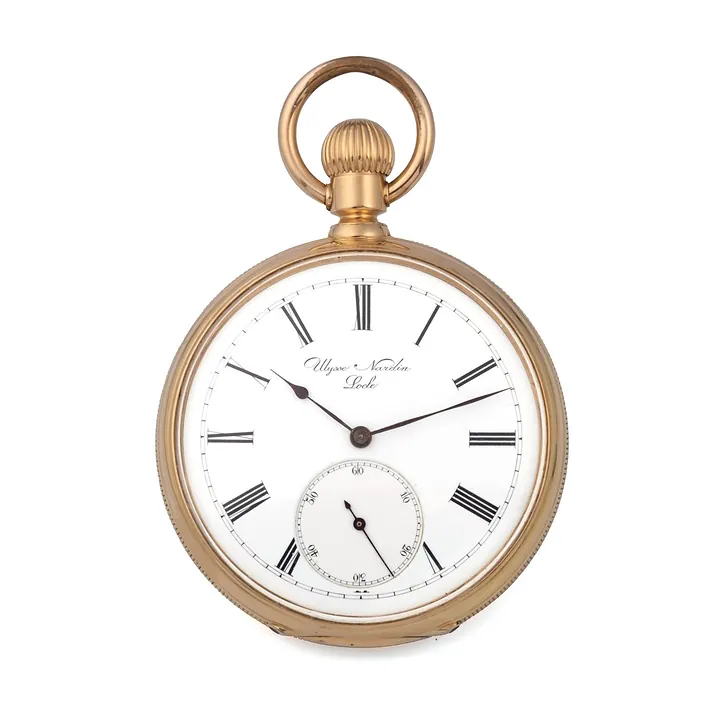
Ulysse Nardin pocket watch, c. 1880 (Antiquorum Lot 374-168)
Antiquorum auction archive, Geneva
Pocket Watches · c. 1880
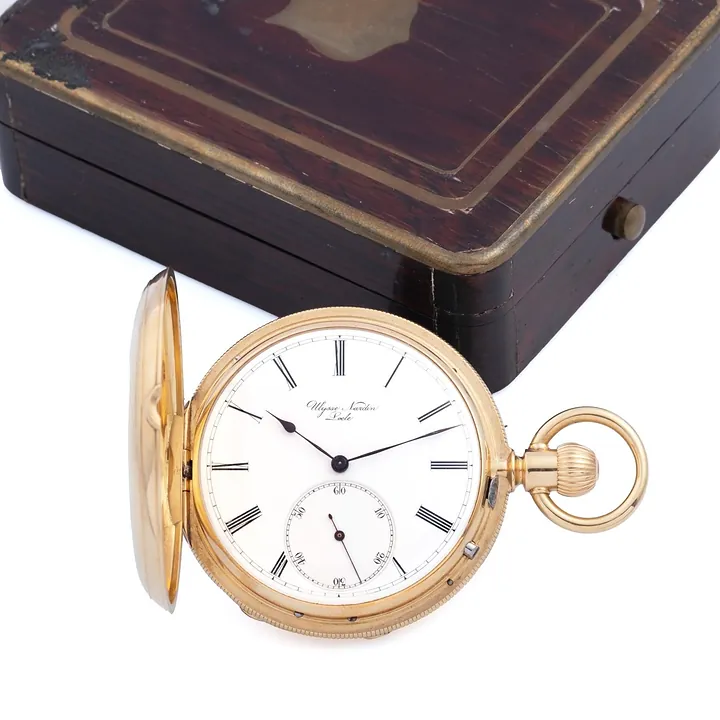
Ulysse Nardin pocket watch, c. 1880 (Antiquorum Lot 374-197)
Antiquorum auction archive, Geneva
Pocket Watches · c. 1920
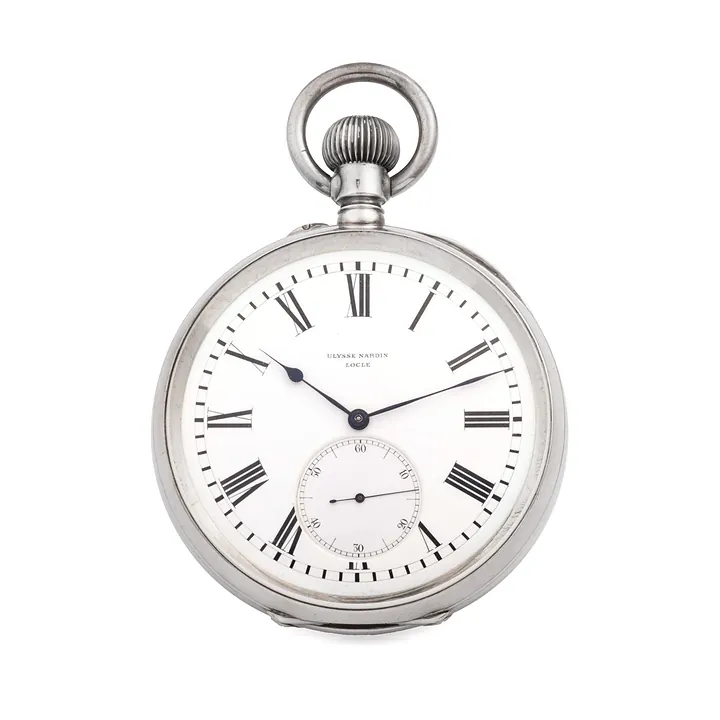
Ulysse Nardin Chronometer, c. 1920 (Antiquorum Lot 374-162)
Antiquorum auction archive, Geneva
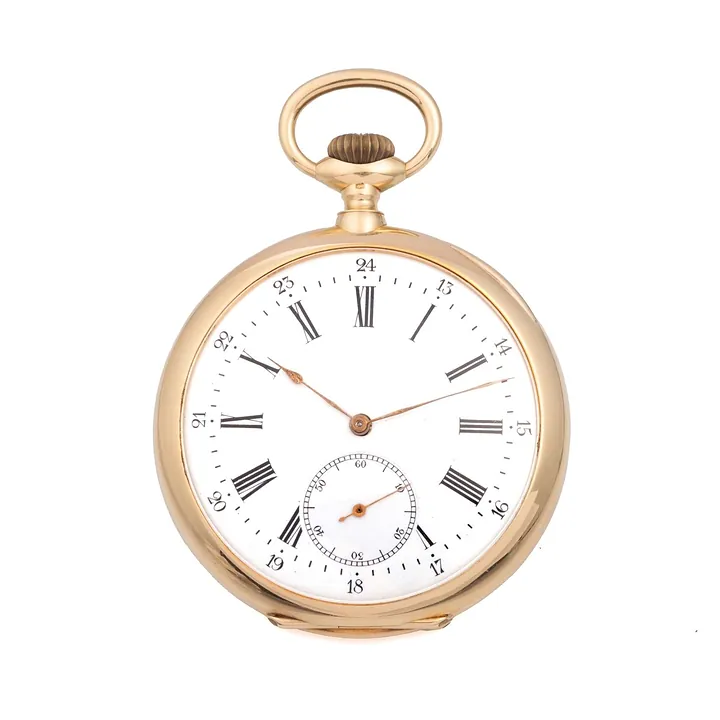
Pocket Watches · c. 1920
Ulysse Nardin Chronometer, c. 1920 (Antiquorum Lot 374-169)
Antiquorum auction archive, Geneva

Instruments · 1950–1976
Omega Megaquartz 2400 marine chronometer, 1950–1976
Science Museum Group, London
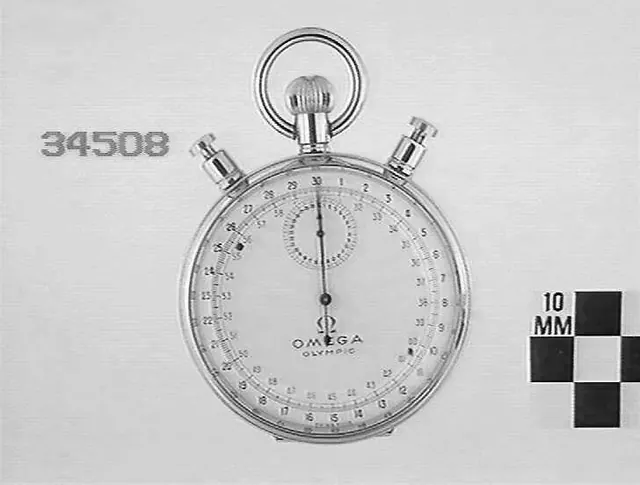
Instruments · c. 1955
Stop Watch - Omega, Switzerland, c. 1955
Museums Victoria, Melbourne
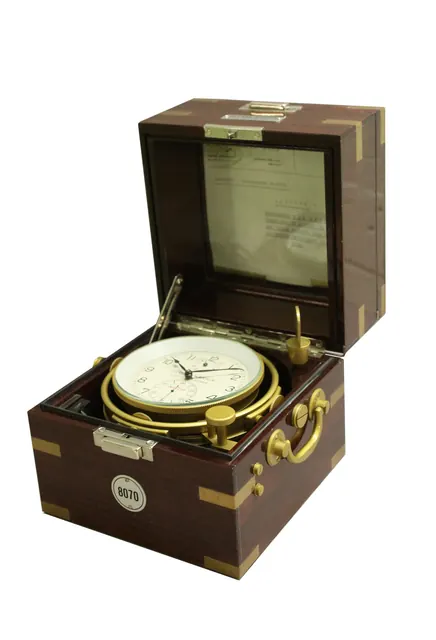
Instruments · 1954–1957
Marine chronometer by Ulysse Nardin, Switzerland, 1954–1957
Tiedemuseo Liekki
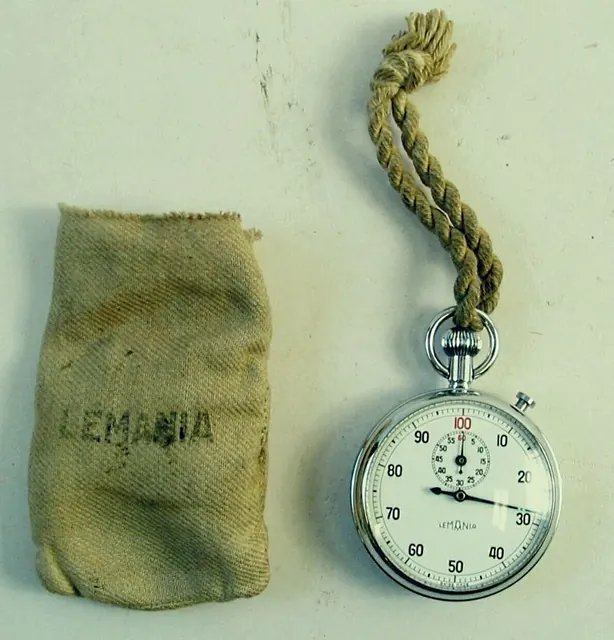
Instruments · 1950–1970
Stopwatch by Lemania, Switzerland, 1950–1970
Museokeskus Vapriikki