
Pocket Watches · Pocket watch
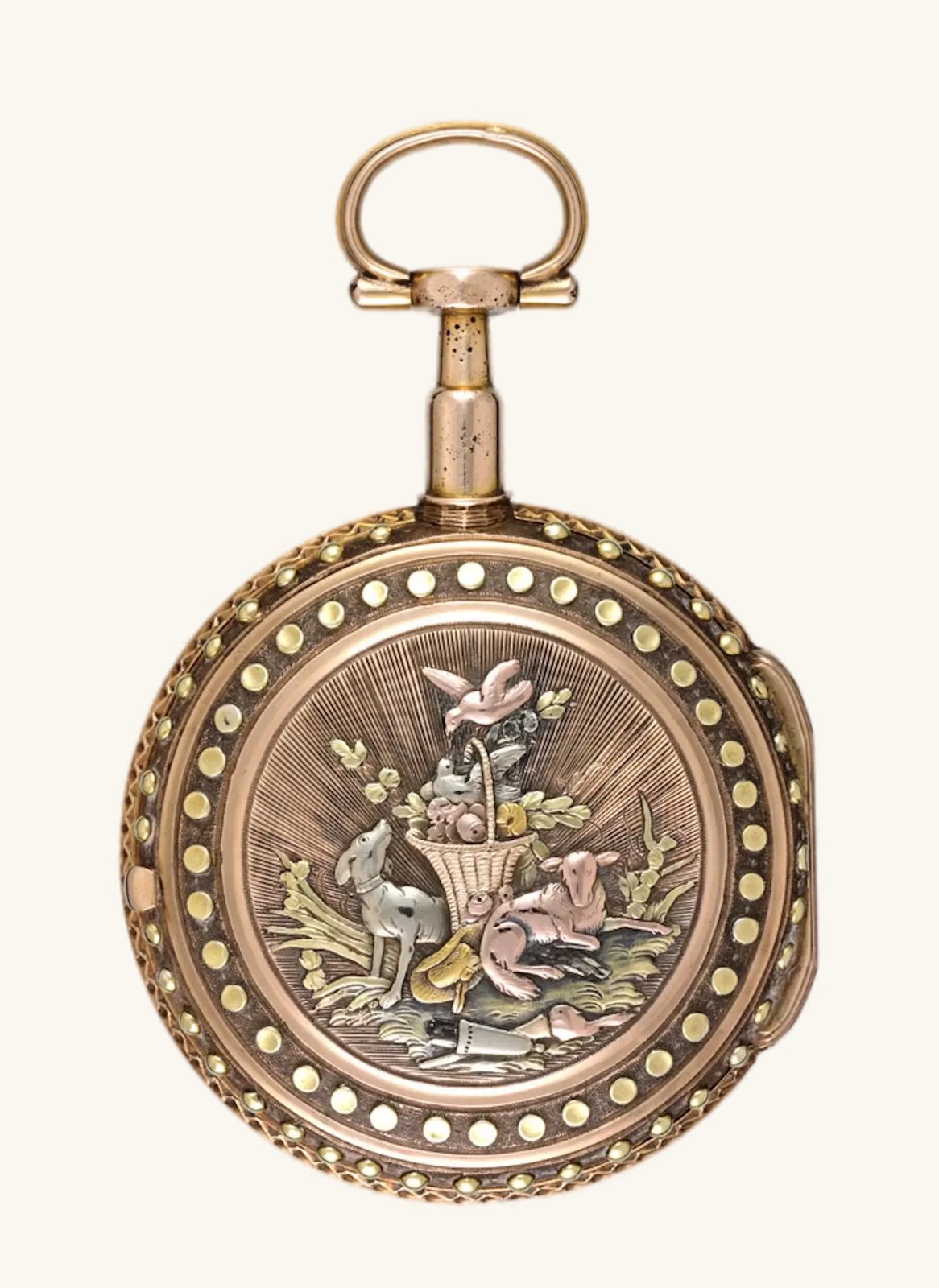
Three Colour Gold French Verge, 1790
- Maker / attribution
- Unrecorded in source
- Date
- 1790
- Historical period
- Precision & Scientific Horology (1750 – 1850)
- Country of origin
- France
- Object type
- Pocket watch
- Materials / technique
- gold
- Dealer
- WatchMuseum.org shop
- Stock no.
- Product 1299
- Credit line
- Dealer listing, WatchMuseum.org shop (product 1299)
- Catalogue title (original)
- Three Colour Gold French Verge (English)
View the source record (dealer listing) ↗ (opens another website in a new tab)Suggest a correction
Record summary
Catalogued by WatchMuseum.org shop (stock number Product 1299), this is a pocket watch, made in France, dated 1790. The Atlas places it in the Precision & Scientific Horology period (1750 – 1850) of its Pocket Watches collection. Materials and techniques recorded by the source: gold. The record is illustrated with 4 photographs.
Assembled from the source record's structured fields. Dates and attributions are given as the source states them; where a field is missing the Atlas leaves it blank rather than estimating.
Catalogue description
Dealer description — WatchMuseum.org shop
Step back in time with the exquisite “Three Colour Gold French Verge – 1790,” a masterful creation from the late 18th century that epitomizes the elegance and craftsmanship of its era. This remarkable French verge watch boasts a full plate gilt fusee movement, a testament to the intricate engineering of the period. The finely pierced and engraved bridge cock, complemented by a steel coqueret, and the plain three-arm gilt balance with a blue steel spiral hairspring, highlight the meticulous attention to detail. The silver regulator dial, adorned with a blue steel indicator, exudes sophistication, while the white enamel dial with Roman and Arabic numerals and pieced and engraved gold hands ensures clarity and legibility. Encased in a gold consular case embellished with applied gold dots, the watch showcases a stunning three-colour gold motif featuring a basket with doves, a dog, and a sheep, both on the sides and the back, adding a unique artistic touch. Signed by Juhel a Paris and dating back to circa 1790, this timepiece, with a diameter of 38 mm and a depth of just 7 mm, not only serves as a functional watch but also as a piece of historical art, reflecting the opulence and precision of 18th-century French watchmaking. This is a beautiful late 18th century French verge watch with a full plate gilt fusee movement. The watch features a finely pierced and engraved bridge cock with steel coqueret, as well as a plain three arm gilt balance with a blue steel spiral hairspring. The silver regulator dial with a blue steel indicator adds a touch of elegance to the piece, while the white enamel dial, with Roman and Arabic numerals and pieced and engraved gold hands, provides great legibility. The watch is housed in a gold consular case with applied gold dots and is decorated with three colours of gold, depicting a basket with doves, a dog and a sheep on either side. The back of the case is particularly attractive, featuring the same three-colour gold motif. The watch is signed Juhel a Paris and dates from around 1790. With a diameter of 38 mm and a depth of just 7 mm, this exquisite timepiece is sure to impress. Signed Juhel a Paris Circa 1790 Diameter 38 mm Depth 7 mm Origin French Period 18th Century Materials Yellow Gold Carat for Gold 18 K
Historical context
Precision & Scientific Horology (1750 – 1850)
Harrison solves longitude; Mudge invents the lever; Breguet's Paris workshop defines the modern watch.
From 1750 to 1850 the watch became a precision instrument. Mudge's lever escapement, the cylinder escapement, Lépine's thin bar calibre, Breguet's innovations (overcoil, tourbillon, perpétuelle) and the pocket chronometer of Arnold and Earnshaw all date from this period, while verge watches remained common in cheaper production.
Read the period in the timelineMore pocket watches from this periodEarlier: Early Modern Horology
Atlas type guide
Verge and pair-cased watches
After Christiaan Huygens and Robert Hooke applied the balance spring around 1675, the verge watch became a reasonably reliable timekeeper and the minute hand became standard. Through the eighteenth century the typical English watch was a pair-cased verge: a fusee movement with a pierced, engraved balance cock, housed in an inner case and a separate protective outer case, often of repoussé gold, shagreen, tortoiseshell or enamel.
French watches of the same period were thicker 'oignons', later replaced by elegant thinner watches following Jean-Antoine Lépine's bar-bridge calibre of c. 1770. Dutch, Swiss and German makers supplied international markets, and verge watches were made until the mid-nineteenth century as cheaper alternatives to the cylinder and lever.
What to look for
- The pierced balance cock on the backplate: winged (continental) or with a foot (English); its style dates the watch.
- Fusee and chain visible through the movement; key winding through the dial (early) or case back.
- Hallmarks inside English silver or gold cases, which give a date letter.
- Maker's name and serial number engraved on the backplate; watch papers inside outer cases.
- Enamel dials (after c. 1720) versus earlier champlevé metal dials.
Dating clues
- Champlevé dials: c. 1680–1730; white enamel dials thereafter.
- English case hallmarks give the year of assay to within a year.
- Verge watches persisted in cheap production until c. 1850.
General guidance written by the Atlas editors about this kind of object. It is not a statement about this particular piece; for that, rely on the source record above and on physical examination.
Read next:Verge escapement
Related records
Pocket Watches · 1745–1755
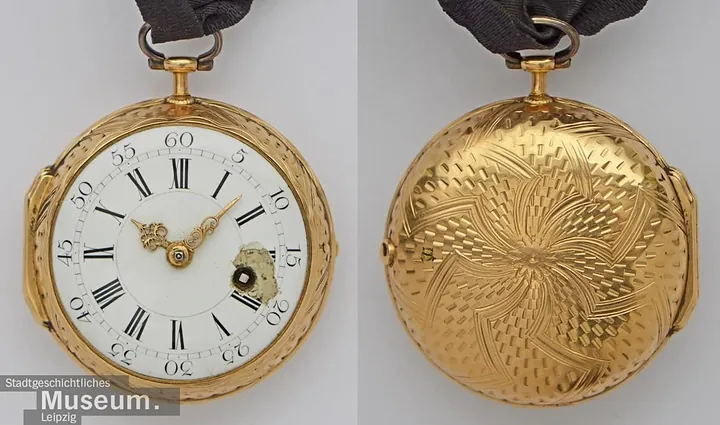
Pocket watch by Jean Baptiste Baillon, France, 1745–1755
Museum of City History Leipzig
Pocket Watches · c. 1750
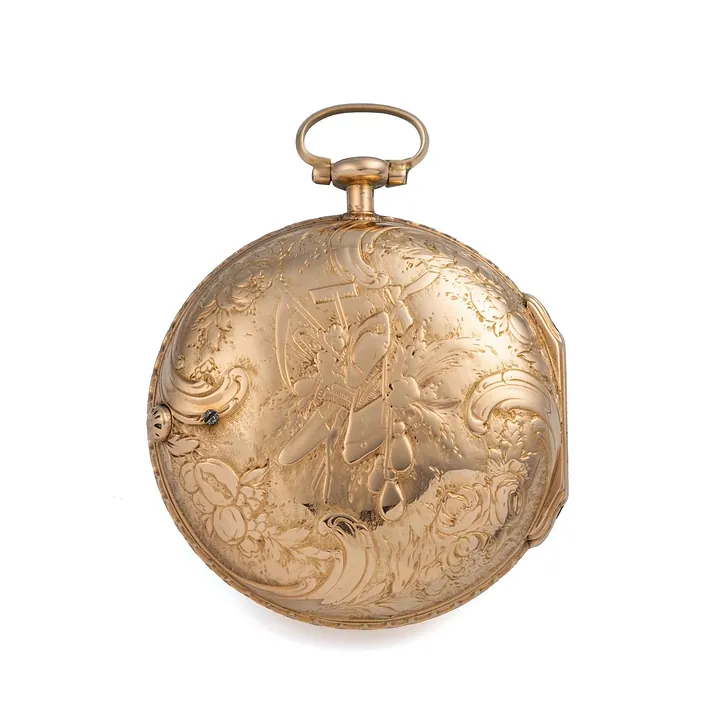
Baillon À Paris pocket watch, c. 1750
Antiquorum auction archive, Geneva
Pocket Watches · 1750–1780
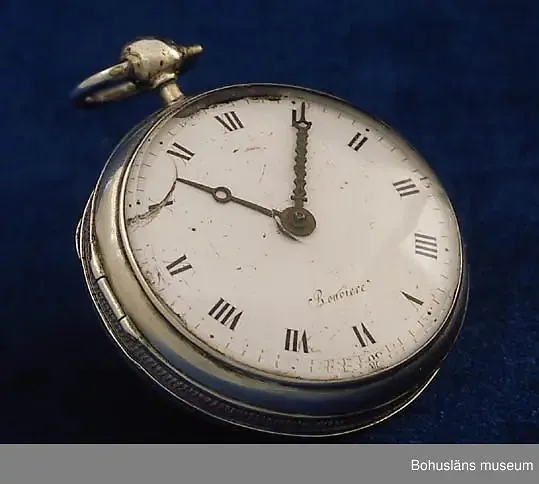
Pocket watch by BONBIERE, France, 1750–1780
Bohuslän Museum
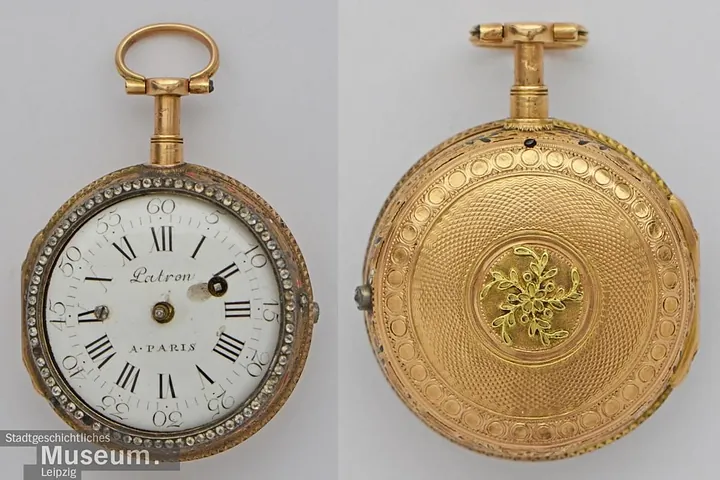
Pocket Watches · 1750
Pocket watch by Patron, France, 1750
Museum of City History Leipzig
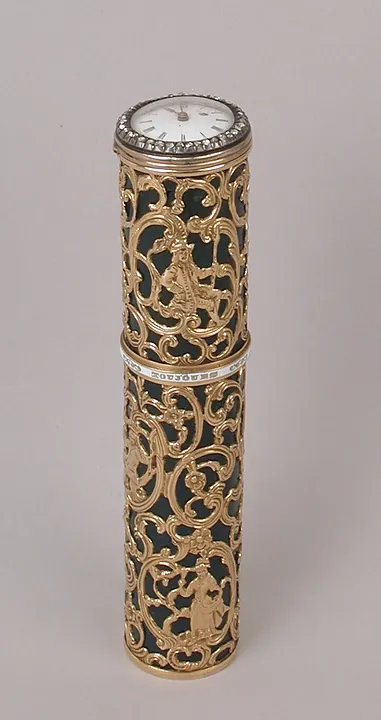
Pocket Watches · second half 18th century
Watch probably by by an imitator of Abraham-Louis Bréguet, France, second half 18th century
The Metropolitan Museum of Art, New York
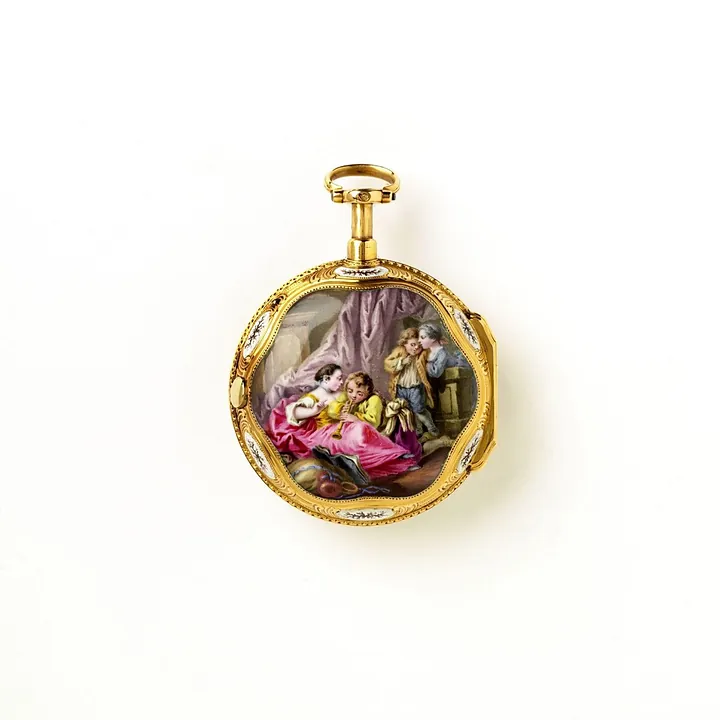
Pocket Watches · 1760–1761
Enamelled gold, quarter repeating watch, Paris, 1760-62, Romilly
Victoria and Albert Museum, London
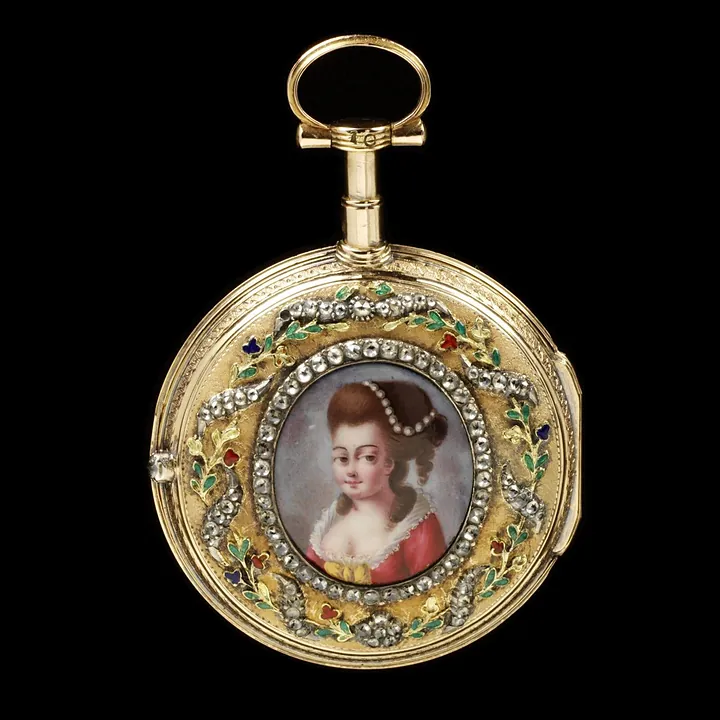
Pocket Watches · 1770-5
Enamelled copper gilt watch set with pastes, signed 'Vauchez A Paris'; made in France or Switzerland, 1770-5
Victoria and Albert Museum, London
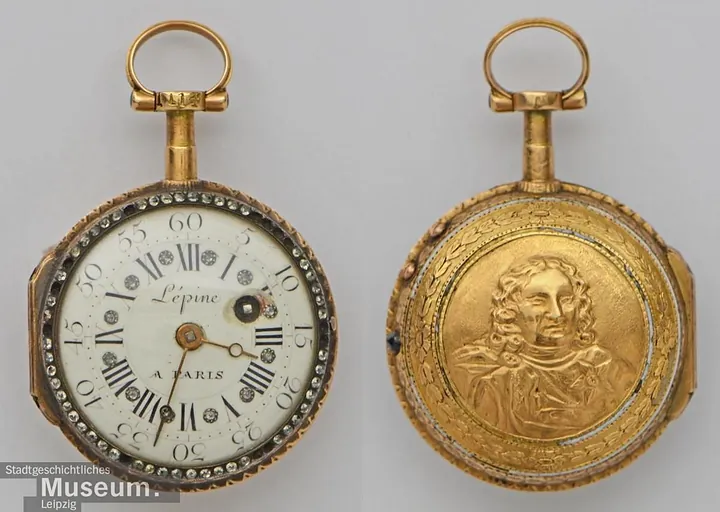
Pocket Watches · 1770–1780
Pocket watch by Lepine, France, 1770–1780
Museum of City History Leipzig