
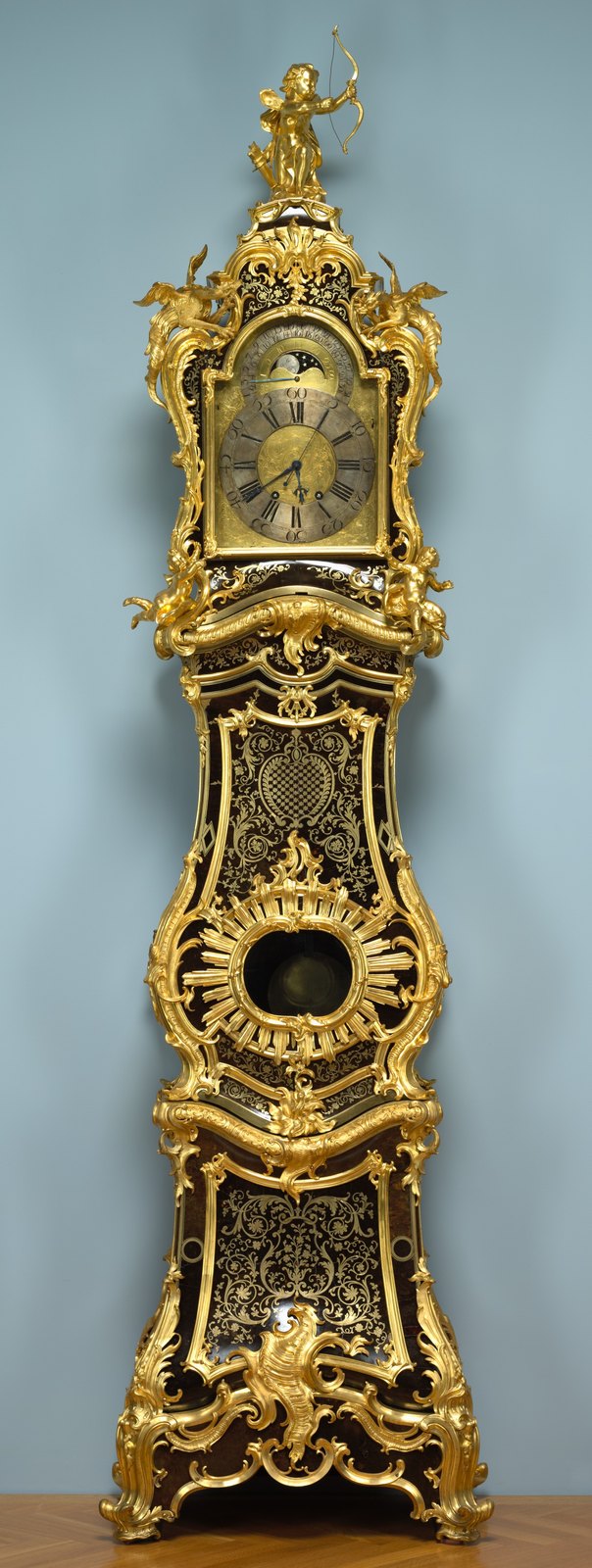
Clocks · Tall- case Clock
Tall- case Clock (Regulateur)
- Maker / attribution
- Jean-Pierre Latz (artist); Stollewerck (movement maker)
- Date
- 1744
- Historical period
- Early Modern Horology (1600 – 1750)
- Country of origin
- France
- Place
- France, Paris
- Object type
- Tall- case Clock
- Materials / technique
- boulle marquetry with gilt bronze mounts
- Dimensions
- Overall: 261.6 x 69.9 x 41.9 cm (103 x 27 1/2 x 16 1/2 in.)
- Holding institution
- Cleveland Museum of Art
- Accession / object no.
- 1949.200
- Credit line
- John L. Severance Fund
- Catalogue title (original)
- Tall- case Clock (Regulateur) (English)
View the source record ↗ (opens another website in a new tab)Suggest a correction
Record summary
Held and catalogued by Cleveland Museum of Art (object number 1949.200), this is a tall- case clock by Jean-Pierre Latz, made in France, Paris, dated 1744. The Atlas places it in the Early Modern Horology period (1600 – 1750) of its Clocks collection. Materials and techniques recorded by the source: boulle marquetry with gilt bronze mounts. Recorded dimensions: Overall: 261.6 x 69.9 x 41.9 cm (103 x 27 1/2 x 16 1/2 in.). The record is illustrated with 6 photographs.
Assembled from the source record's structured fields. Dates and attributions are given as the source states them; where a field is missing the Atlas leaves it blank rather than estimating.
Catalogue description
The source record does not include a narrative description. The structured fields above are reproduced from it.
Inscriptions & marks
incised on the back of the lowest front panel: .LATZ . A . PARISIIS . FECIT ./. MDCCXLIV; engraved on the clock face: Stollewerck/Paris.
Provenance
Russian Court, gift of King of France; gift of Catherine II to Gagarine family; Prince Victor Gagarine; Prince Serge Gagarine; Prince Troubetzkoy; (Cesar de Hauke, Inc., New York).
Historical context
Early Modern Horology (1600 – 1750)
Huygens' pendulum and balance spring transform accuracy; English makers develop the anchor and deadbeat escapements.
Huygens's pendulum (1656–57) improved clock accuracy from about a quarter of an hour to under a minute a day. The anchor escapement (c. 1670) and the long seconds pendulum created the longcase clock; London makers such as Fromanteel, Knibb, Tompion and Quare led European clockmaking, and French makers created the Boulle pendule.
Read the period in the timelineMore clocks from this periodEarlier: Renaissance Horology
Atlas type guide
Regulators, wall and Vienna clocks
A regulator is a precision pendulum clock used as a time standard in observatories, workshops and railway offices. Typical features are a deadbeat or Graham escapement, a temperature-compensated pendulum (mercury jar, gridiron or later invar), maintaining power and a regulator dial that separates hours, minutes and seconds. George Graham's deadbeat escapement (c. 1715) and his mercury pendulum, together with Harrison's gridiron, set the pattern for two centuries.
Wall clocks span a much wider range: the elegant Viennese Laterndluhr and Dachluhr of the Biedermeier period, the Dutch stoelklok and staartklok, English 'dial' clocks used in schools, offices and railway stations, and mass-produced spring and weight wall clocks from Germany (Gustav Becker, Junghans, Kienzle) and America.
What to look for
- Deadbeat escapement and compensated pendulum (gridiron rods, mercury jar or wood rod).
- A regulator dial with a large central minute hand and separate hour and seconds dials.
- Vienna regulators: glazed cases, slender pendulum, small weights, enamel two-piece dials.
- German factory trademarks stamped on the backplate (e.g. Gustav Becker anchor and crown, Junghans star).
Dating clues
- Graham-type deadbeat regulators: from c. 1720.
- Viennese Laterndluhr: c. 1800–1850.
- German factory 'Vienna-style' regulators: c. 1870–1930; Gustav Becker serial numbers allow close dating.
General guidance written by the Atlas editors about this kind of object. It is not a statement about this particular piece; for that, rely on the source record above and on physical examination.
Read next:Deadbeat escapementAnchor (recoil) escapementGrasshopper escapement
Related records
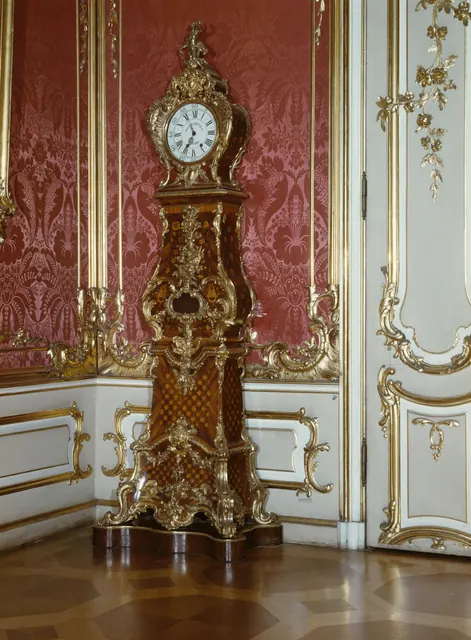
Clocks · 1754
Longcase clock by Jean Biesta, France, 1754
Stiftung Preußische Schlösser und Gärten Berlin-Brandenburg
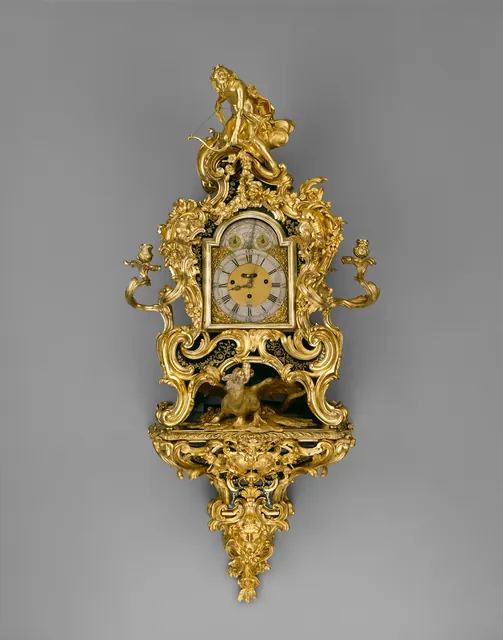
Clocks · c. 1735–40
Wall clock, case by Jean-Pierre Latz, France, c. 1735–40
Art Institute of Chicago
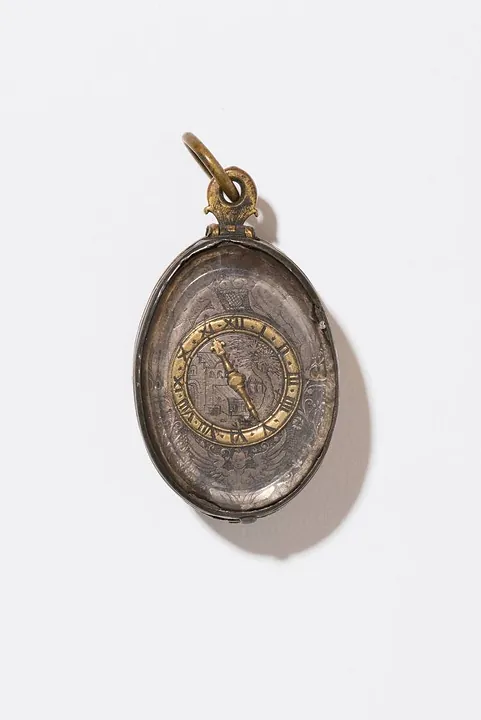
Clocks · 1590–1610
Clock, France, 1590–1610
MAK – Museum of Applied Arts
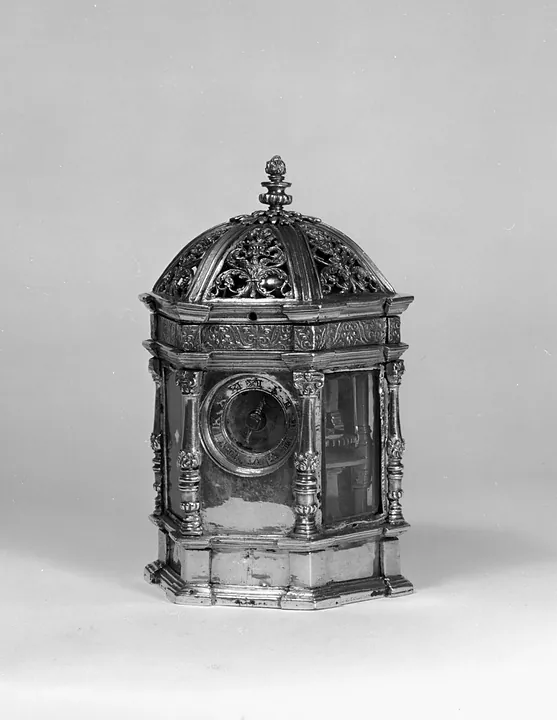
Clocks · c. 1600
Table Clock, sheet brass, engraved, pierced and gilt, Paris, ca.1600, signed 'B(?) Pichard, à Paris'
Victoria and Albert Museum, London
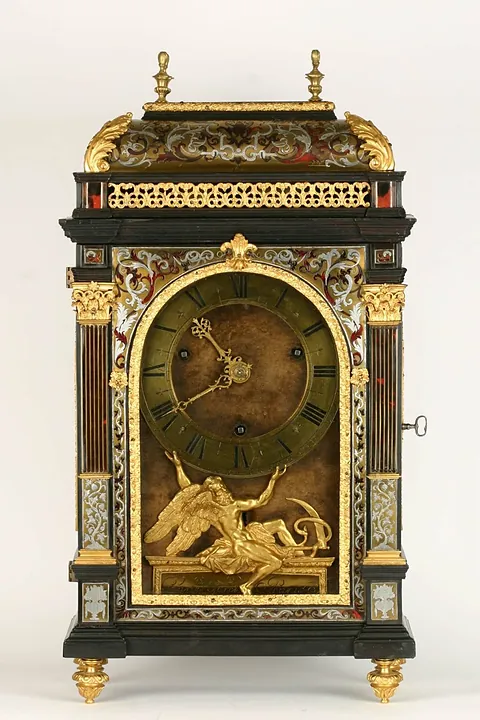
Clocks · 1600–1699
Table clock by Charles Goret, France, 1600–1699
German Clock Museum
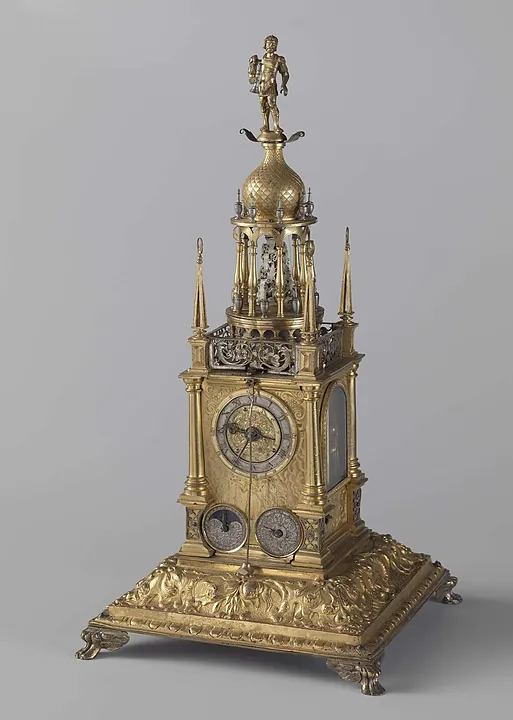
Clocks · 1640
Table clock, France, 1640
Rijksmuseum
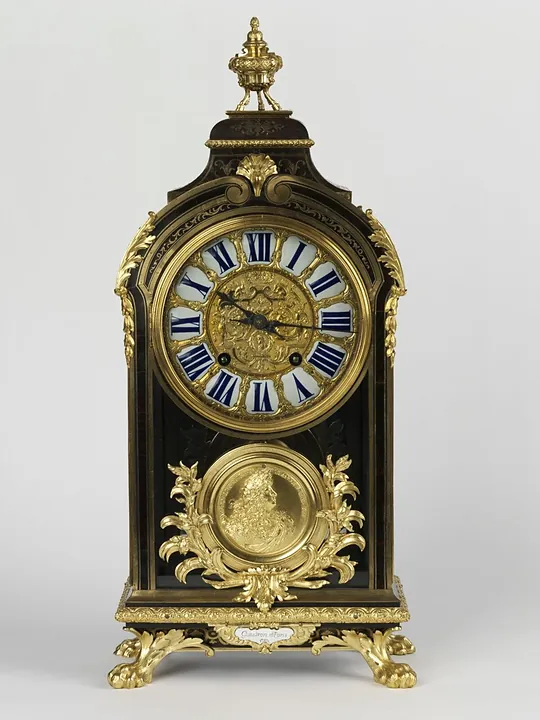
Clocks · late 17th century
Clock with case of tortoiseshell inlaid with brass, Paris, late 17th century
Victoria and Albert Museum, London
Clocks · 1650
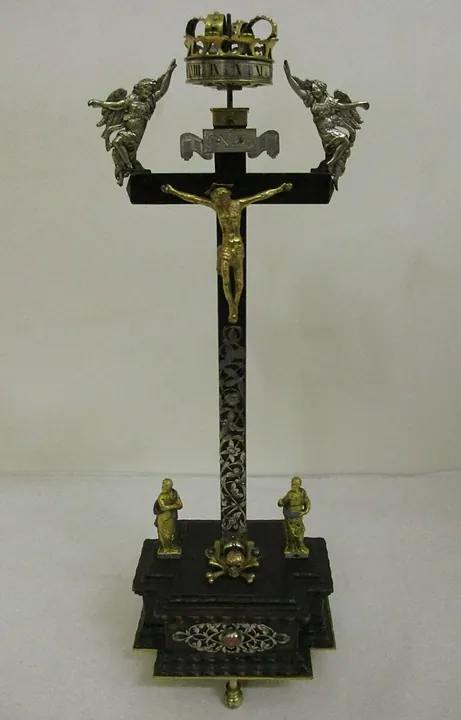
Crucifix Clock, signed W. H. Arnstad, mid- 17th century.
Victoria and Albert Museum, London