
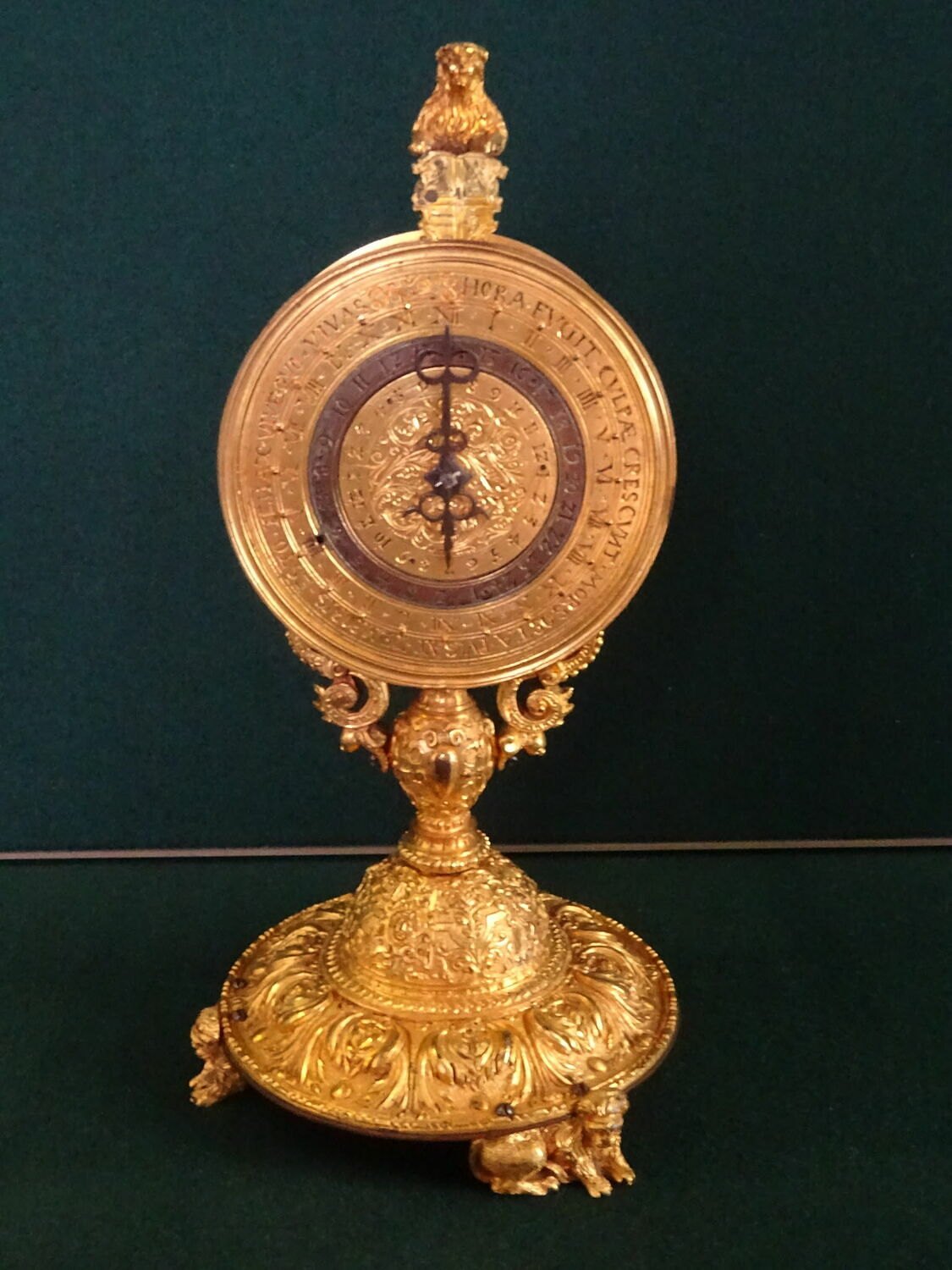
Clocks · Table clock
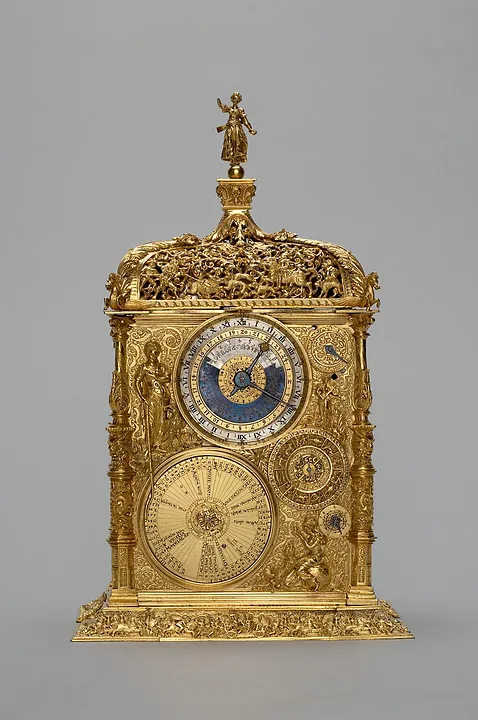
Table clock, Germany, 1500–1600
- Maker / attribution
- Unrecorded in source
- Date
- 1500–1600
- Historical period
- Renaissance Horology (1400 – 1600)
- Country of origin
- Germany
- Place
- Allemagne du sud = sud de l'Allemagne
- Object type
- Table clock
- Materials / technique
- bronze
- Dimensions
- height 26,2 cm; diameter 12,8 cm
- Holding institution
- Musée du Louvre, Paris
- Accession / object no.
- MRR 239
- Credit line
- Musée du Louvre, Département des Objets d'art du Moyen Age, de la Renaissance et des temps modernes
- Catalogue title (original)
- Horloge de table en forme de monstrance (French)
View the source record ↗ (opens another website in a new tab)Suggest a correction
Record summary
Held and catalogued by Musée du Louvre, Paris (object number MRR 239), this is a table clock, made in Allemagne du sud = sud de l'Allemagne, Germany, dated 1500–1600. The Atlas places it in the Renaissance Horology period (1400 – 1600) of its Clocks collection. Materials and techniques recorded by the source: bronze. Recorded dimensions: height 26,2 cm; diameter 12,8 cm. The record is illustrated with 4 photographs.
Assembled from the source record's structured fields. Dates and attributions are given as the source states them; where a field is missing the Atlas leaves it blank rather than estimating.
Catalogue description
Catalogue description — Musée du Louvre (French)
Au revers, armoiries avec l'inscription F. IOHANNES LEVESQVE DELA. CASSIERA. MAGISTER. HOSPITALIS. HIERVSSALEM. Supportée par trois pieds en forme de lion, la base circulaire est gravée et repoussée de feuilles d'acanthe sur fond amati. Elle est surmontée d'un hémisphère gravé de grotesques sur lequel repose le pied, gravé de cartouches et flanqué d'arabesques symétriques. Le cadran vertical à réveil présente trois cercles marquant les heures du jour et de la nuit dont l'un est à chiffres romains (deux fois XII) doublé d'une bordure de boutons saillants. Les deux autres, mobiles, sont marqués de chiffres arabes (deux fois 12). Aiguille en acier terminée par deux fleurons. L'indes du réveil manque. Sur le pourtour, une maxime rappelle : HORA. FVGIT. CVLPAE. CRESCVNT. MORS. OSTA. PVLSAT. TEMPORIS. ESTO. TENAX. VIVE QUO VIVAS. ("L'heure fuit, les fautes augmentent, la mort pousse les portes du temps. Sois tenace. Vis où tu dois vivre.") La carrure de la boîte circulaire est ajourée de fleurs et de rubans gravés. Sur le fond est gravé un écusson accompagné de la mention du propriétaire probable de l'horloge : Jean L'Evêque de la Cassière, né en Auvergne en 1502, mort à Rome en 1581, devenu le 50e grand-maître de l'ordre de Malte en 1572. La boîte, s'ouvrant à charnière, découvre un mouvement en acier et laiton.
Shown in the original language of the source catalogue. An editor-reviewed English translation has not yet been published; we do not publish machine translations as authoritative text.
Dating and period as catalogued (French)
Epoque / période : Louis XII (1498-1515) (Occident->Renaissance->dynastie des Valois-Orléans) ; François I (1515-1547) (Occident->Renaissance->dynastie des Valois-Angoulême) ; Henri II (1547-1559) (Occident->Renaissance->dynastie des Valois-Angoulême) ; François II (1559-1560) (Occident->Renaissance->dynastie des Valois-Angoulême) ; Charles IX (1560-1574) (Occident->Renaissance->dynastie des Valois-Angoulême) ; Henri III (1574-1589) (Occident->Renaissance->dynastie des Valois-Angoulême) · · Date de création/fabrication : 1500 - 1600
Shown in the original language of the source catalogue. An editor-reviewed English translation has not yet been published; we do not publish machine translations as authoritative text.
Materials and techniques as catalogued (French)
Matériau : laiton (doré) · Matériau : bronze · Technique : techniques métal (horlogerie)
Shown in the original language of the source catalogue. An editor-reviewed English translation has not yet been published; we do not publish machine translations as authoritative text.
Inscriptions & marks
Etiquette : ; 1030 (imprimée) ; Inscription : ; F. IOHANNES LEVESQVE DELA. CASSIERA. MAGISTER. HOSPITALIS. HIERVSSALEM. (armoiries au revers) ; HORA. FVGIT. CVLPAE. CRESCVNT. MORS. OSTA. PVLSAT. TEMPORIS. ESTO. TENAX. VIVE QUO VIVAS. (maxime sur le pourtour du cadran) ; Marque de l'atelier : ; Raguet 10/1738 (marque de réparation sur l'un des ressorts du mouvement)
Provenance
Collection Pierre Révoil (1776-1842) ; acquisition Révoil, 1828 Cat. Courajod n° 213 : "L'horloge de L'Evesque della Cassiera, qui fut grand-maître de Malte en 1572. Ses armes, son nom et ses titres sont gravés au revers du cadran." ; C 269 Cette horloge a longtemps été appelée, de façon erronée, OA 676.
Historical context
Renaissance Horology (1400 – 1600)
Spring power makes clocks portable; Nuremberg and Augsburg produce the first watches; the Prague Orloj is built.
Spring power made the domestic clock portable. Augsburg and Nuremberg produced gilt-brass table clocks, often with astronomical dials and alarms; weight-driven Gothic wall clocks and English lantern clocks served households. Clocks of this period have foliot or balance-wheel control and usually only an hour hand.
Read the period in the timelineMore clocks from this periodEarlier: Medieval Period
Atlas type guide
Bracket, table and spring-driven clocks
Spring-driven clocks freed timekeeping from the hanging weight. The coiled mainspring, documented from the fifteenth century, made portable table clocks possible; to even out its declining force, makers used the fusee, a conical pulley connected to the barrel by a gut line or chain. Renaissance table clocks from Augsburg and Nuremberg — drum-shaped, square or tower-shaped in gilt brass — were luxury scientific objects, often with astronomical dials and alarms.
After the pendulum, English makers developed the bracket clock: a wooden case with a carrying handle, a short pendulum with a verge escapement, and often repeating work to sound the hours on demand at night. Later examples use the anchor escapement. In the nineteenth century, 'table clock' became a broad term for spring clocks of every nationality.
What to look for
- A fusee in the movement (cone-shaped pulley) and the type of line — gut or chain.
- Verge escapement with a short bob pendulum, often with a decoratively engraved backplate.
- Repeat cords or buttons that make the clock strike again on demand.
- Gilt-brass engraved cases and horizontal dials on Renaissance pieces.
- Case shapes: inverted bell, bell top, break-arch, lancet or balloon.
Dating clues
- Drum and tower table clocks: c. 1520–1650.
- Ebony veneered English bracket clocks with verge escapements: c. 1670–1800.
- Engraved backplates were usual on English clocks until c. 1800, then generally plain.
General guidance written by the Atlas editors about this kind of object. It is not a statement about this particular piece; for that, rely on the source record above and on physical examination.
Related records
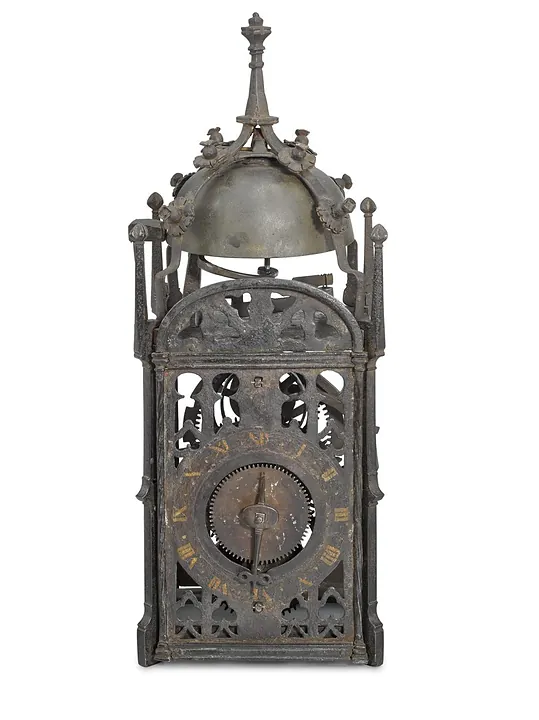
Clocks · 1400–1499
Lantern clock, Germany, 1400–1499
Science Museum Group, London
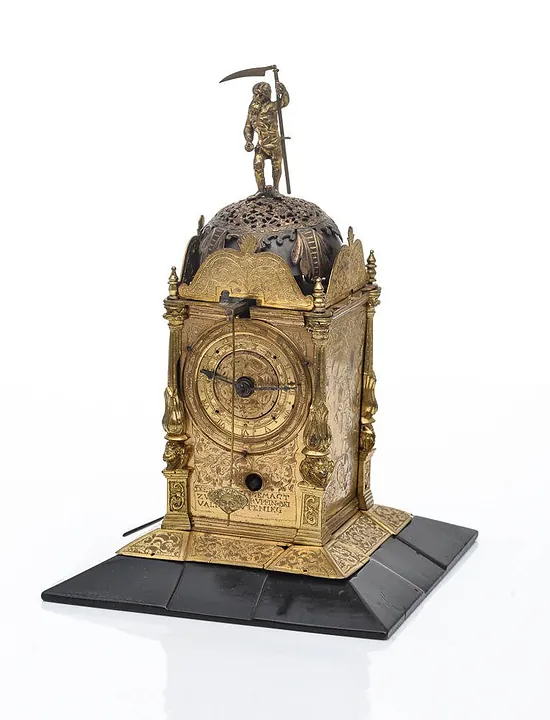
Clocks · 1500–1599
Table clock by Valentin Rutenieg, Germany, 1500–1599
City Museum Berlin
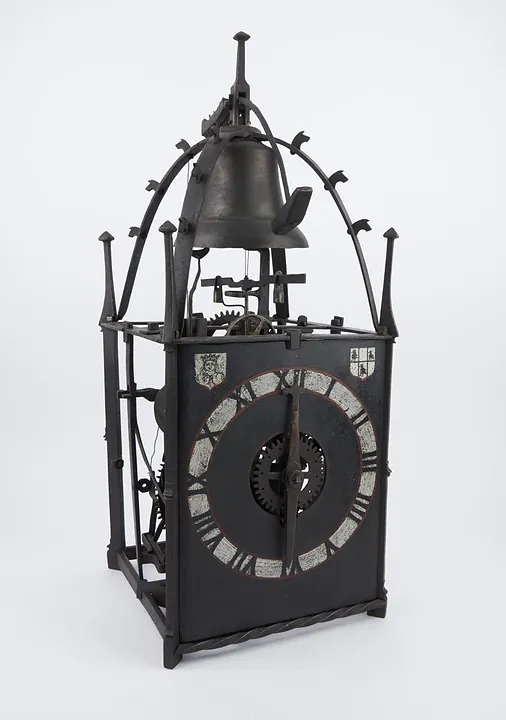
Clocks · 1501–1600
German 16th century iron chamber clock
Science Museum Group, London
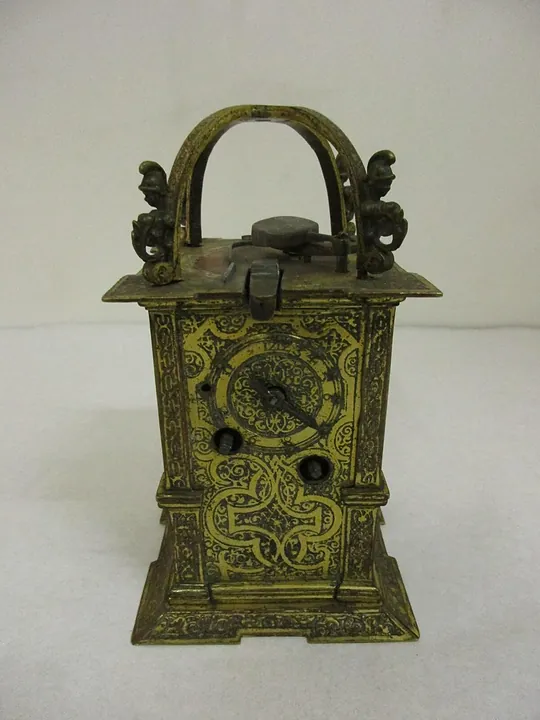
Clocks · c.1550
Clock, a striking alarm clock in a gilt brass case, Germany, c.1550.
Victoria and Albert Museum, London
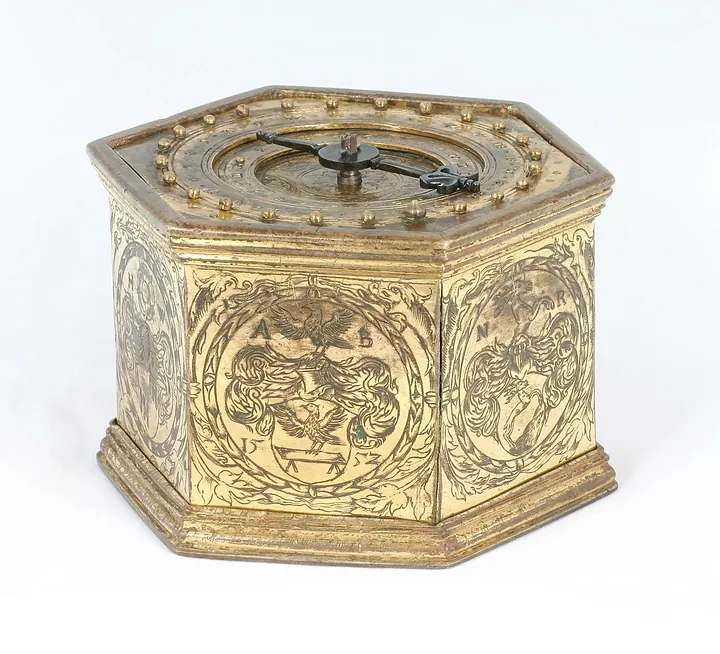
Clocks · 1552
Carriage / travel clock, Germany, 1552
German Clock Museum
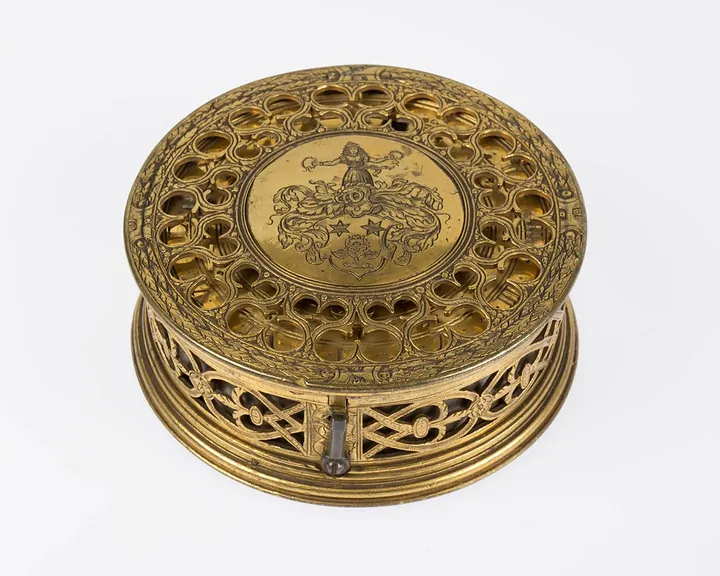
Clocks · c. 1560
Carriage / travel clock by HG, probably Germany, c. 1560
German Clock Museum
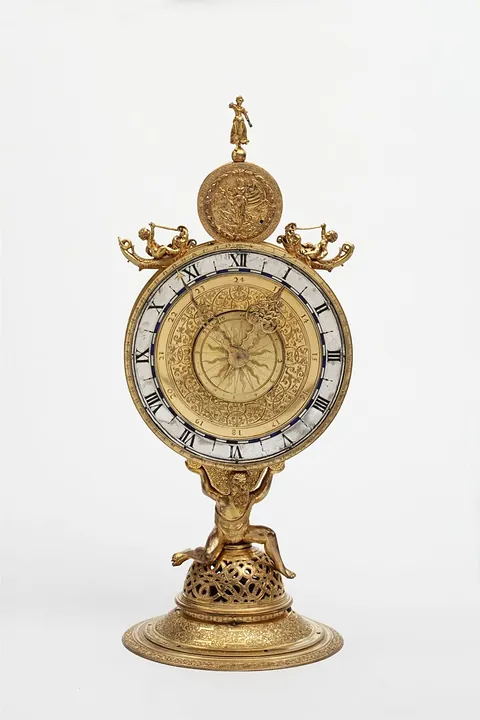
Clocks · 1564
Clock, gilt brass with enamelled silver dial ring, signed by Jeremias Metzger, Augsburg, southern Germany, dated 1564
Victoria and Albert Museum, London
Clocks · 1564
Table clock by Jeremias Metzker, Germany, 1564
Fine Arts Museum Vienna