Clocks · Clock
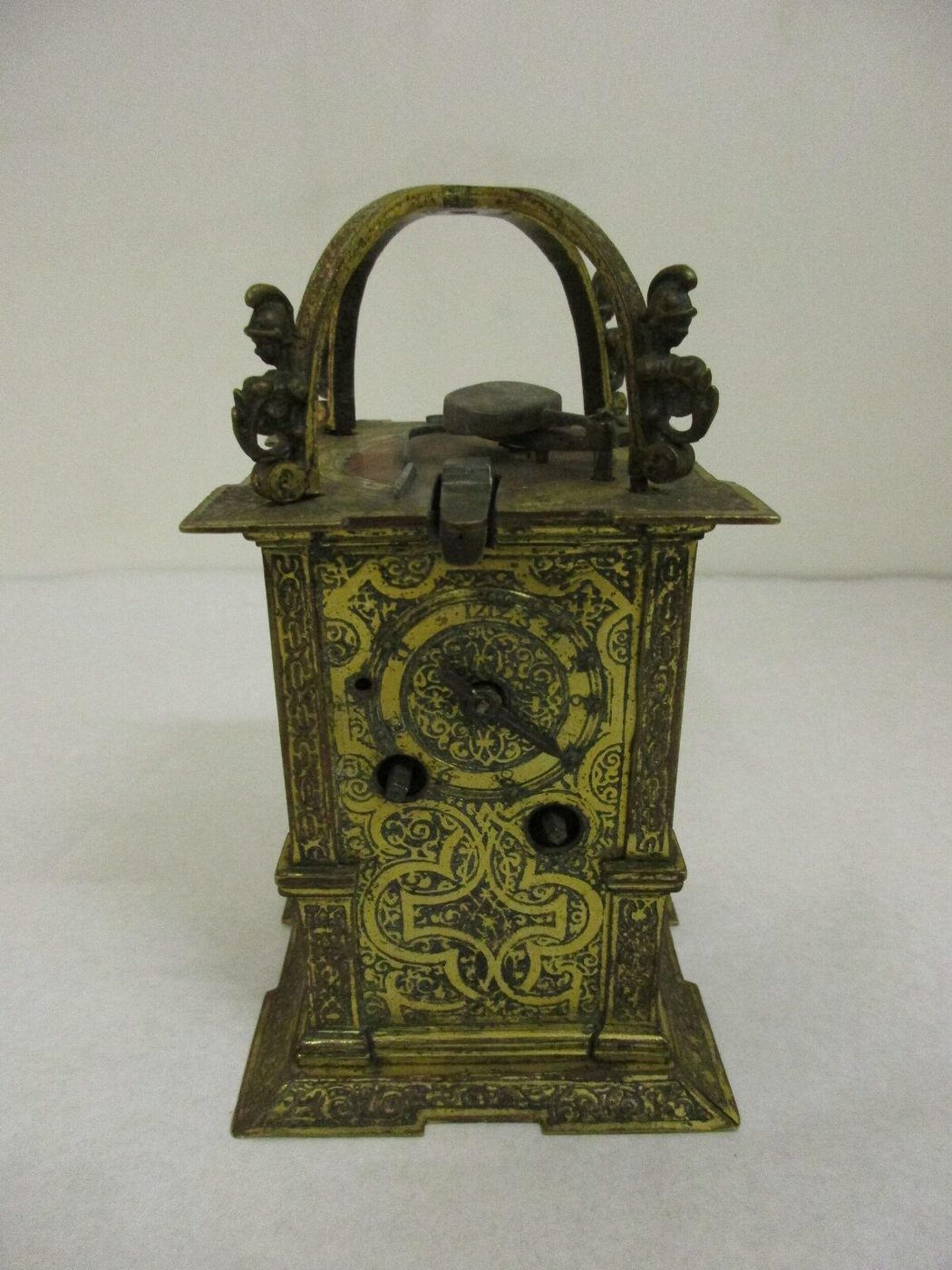
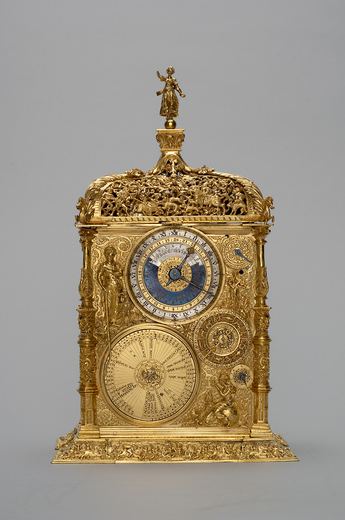
Clock, a striking alarm clock in a gilt brass case, Germany, ca.1550.
- Maker / attribution
- Unrecorded in source
- Date
- ca.1550
- Historical period
- Renaissance Horology (1400 – 1600)
- Country of origin
- Germany
- Place
- Germany
- Object type
- Clock
- Materials / technique
- Gilded brass, engraved and enamelled, the movement and hands of iron.
- Dimensions
- Height: 7.2 in; Width: 3.3 in
- Holding institution
- Victoria and Albert Museum, London
- Accession / object no.
- M.259-1919
- Credit line
- Bequeathed by J.G.Joicey in 1919
Record summary
Held and catalogued by Victoria and Albert Museum, London (object number M.259-1919), this is a clock, made in Germany, dated ca.1550. The Atlas places it in the Renaissance Horology period (1400 – 1600) of its Clocks collection. Materials and techniques recorded by the source: Gilded brass, engraved and enamelled, the movement and hands of iron. Recorded dimensions: Height: 7.2 in; Width: 3.3 in. The record is illustrated with 4 photographs.
Assembled from the source record's structured fields. Dates and attributions are given as the source states them; where a field is missing the Atlas leaves it blank rather than estimating.
Catalogue description
V&A — Summary
An alarm tabernacle clock in a square gilt-brass case with corner pilasters and projecting foot and cornice surmounted by a bell and a male cymbal player. German, about 1580
V&A — Physical description
Small table clock with gilt-brass case of rectangular form with angle pilasters and projecting foot and cornice; with a bell above enclosed within double arch ornamented with human-headed brackets and surmounted by a male figure beating cymbals, the base and sides engraved and painted with strapwork and arabesque foliage. The iron movement has a verge escapement and steel hands, South German, mid-16th century. Dial: the brass dial has an applied chapter ring 0.6 cm broad with Roman numerals I to XII and half-hour marks. Within this is a sunken ring with 13 to 24 in arabic numerals. The central alarm disc 2.5 cm diameter has arabic numerals 1-12. The modern hand is a crude replacement. The strike dial is also engraved with arabic numberals 1-12 on the rear plate with touch pins and a crude replacement hand. Movement: Going train at front with fusee and train (now completely loose) and verge escapement. The bob pendulum is broken off and missing. All the wheels of steel except for contrate and crown wheels (which are later renewals of brass). The going train fusee arbor continued through the rear plate to a winding hole in the back plate. Locking plate striking train at the rear, with fusee and now with gut line; train all of iron except for brass fanfly. Count-wheel drive by reduction gearing from second wheel of strike train. Alarm train, all of steel, at right rear of movement, wound through a hole low in right side plate of case. Frame of steel, with square pillars and three narrow plates. One vertical pillar stamped AI in escutcheon
V&A — Object history
The clock was one of two beqeathed by J.G.Joicey in 1919 with over thirty watches. Little is known of John George Joicey’s life. He was born in 1863, the youngest son of James Joicey, of Tanfield, Durham, and spent much of his time abroad. When he was in London, he stayed at the Junior Carlton Club, Pall Mall. In 1907 Joicey contacted the Director about depositing on loan a portion of his collection of ceramics, which it was also his intention to bequeath to the Museum. The items were duly exhibited in the Loan Court in 1909. Joicey’s collection comprised Sevres porcelain, English and rare foreign china, gold enamel watches and snuffboxes, inlaid guns and furniture. Joicey died on 8 July 1919, aged 56. The objects already on deposit at the Victoria and Albert Museum, the London Museum, and the Laing Art Gallery became their absolute property; among the residue of object stored at the Chancery Lane Safe Deposit, the Museum was entitled to 'all those of foreign origin'.
Inscriptions & marks
'AI'
Historical context
Renaissance Horology (1400 – 1600)
Spring power makes clocks portable; Nuremberg and Augsburg produce the first watches; the Prague Orloj is built.
Spring power made the domestic clock portable. Augsburg and Nuremberg produced gilt-brass table clocks, often with astronomical dials and alarms; weight-driven Gothic wall clocks and English lantern clocks served households. Clocks of this period have foliot or balance-wheel control and usually only an hour hand.
Read the period in the timelineMore clocks from this periodEarlier: Medieval Period
Atlas type guide
Alarm clocks
Alarm work is among the oldest clock functions: monastic clocks woke monks for night prayers, and Renaissance table clocks often carried an alarm disc set by a pin. A separate spring or weight is released at the set time and drives a hammer against a bell. Some early alarms also lit a candle by striking a flint — the 'tinder pistol' alarm.
The cheap, mass-produced alarm clock arrived in the second half of the nineteenth century. American firms such as Seth Thomas and Westclox (the 'Big Ben' of 1910) and German makers such as Junghans and Kienzle made millions of drum-shaped alarms with pin-pallet escapements. Electric, quartz and digital alarm clocks followed in the twentieth century.
What to look for
- A separate alarm-setting dial or disc and an extra winding key.
- Twin bells on top (common after c. 1920) or a bell enclosed in the base.
- Pin-pallet escapements in inexpensive factory alarms.
- Trademarks and patent dates on dial or back.
Dating clues
- Renaissance alarm table clocks: sixteenth to seventeenth centuries.
- Drum alarm clocks: from the 1870s.
- Luminous dials with radium paint: c. 1910–1960.
General guidance written by the Atlas editors about this kind of object. It is not a statement about this particular piece; for that, rely on the source record above and on physical examination.
Read next:Anchor (recoil) escapement
Related records
Clocks · 1400–1499
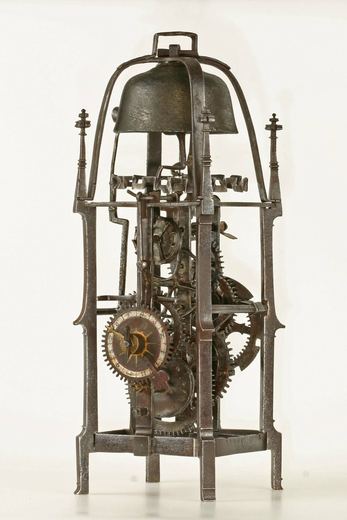
Alarm clock, Germany, 1400–1499
German Clock Museum
Clocks · 1400-1499
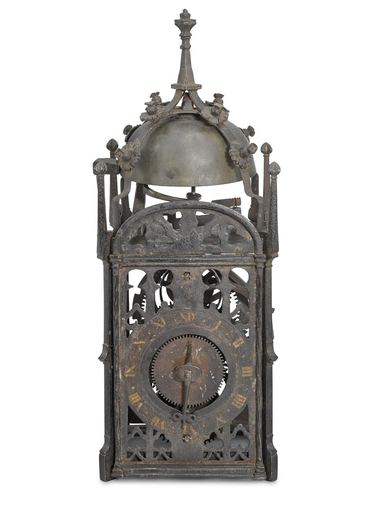
Lantern clock, Germany, 1400-1499
Science Museum Group, London
Clocks · 1500–1599
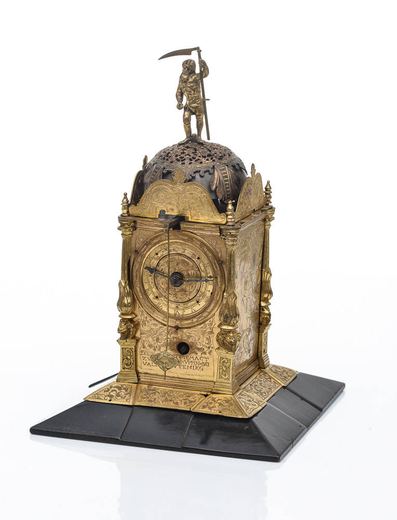
Table clock by Rutenieg, Valentin (um 1550) (Uhrmacher), Germany, 1500–1599
City Museum Berlin
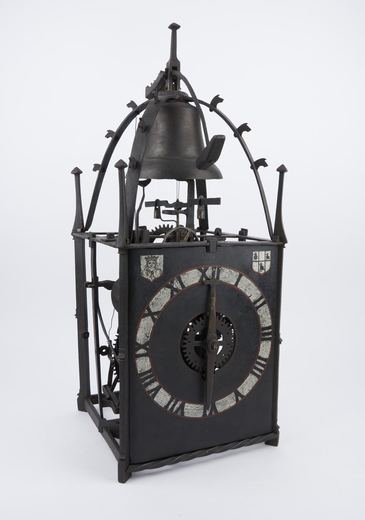
Clocks · 1501-1600
German 16th century iron chamber clock
Science Museum Group, London
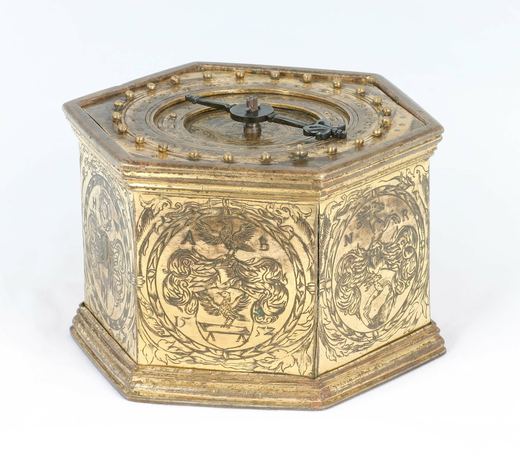
Clocks · 1552
Carriage / travel clock, Germany, 1552
German Clock Museum
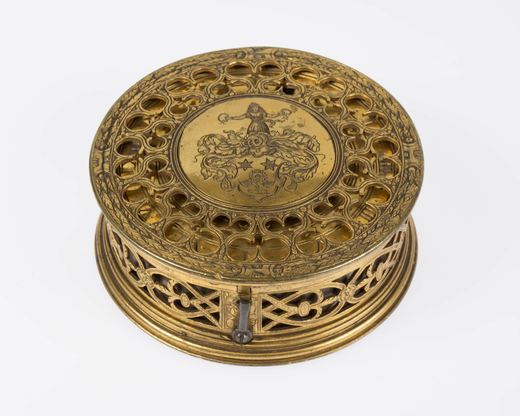
Clocks · 1560
Carriage / travel clock by HG, Germany, 1560
German Clock Museum
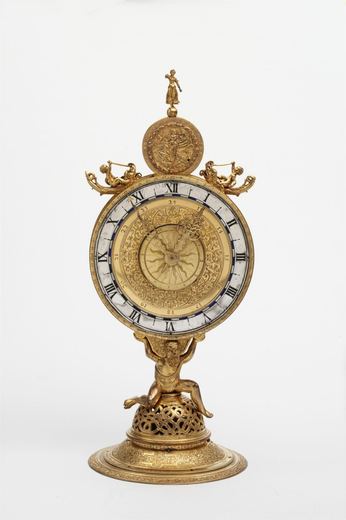
Clocks · 1564
Clock, gilt brass with enamelled silver dial ring, signed by Jeremias Metzger, Augsburg, southern Germany, dated 1564
Victoria and Albert Museum, London
Clocks · 1564
Table clock by #Jeremias_Metzker_Künstler/in, Germany, 1564
Fine Arts Museum Vienna