Clocks · Clock
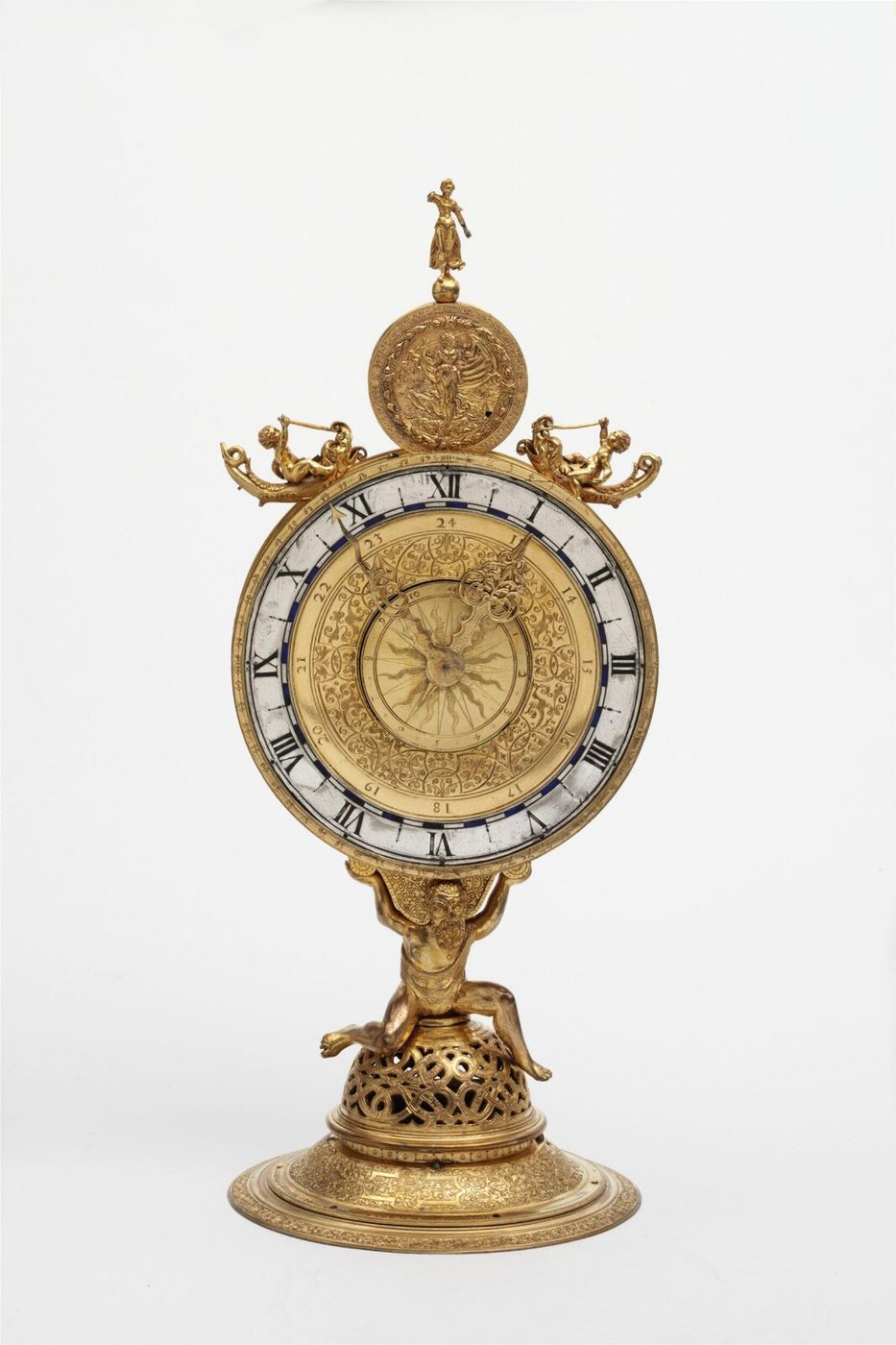
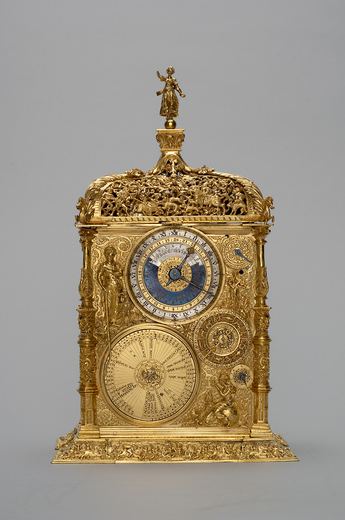
Clock, gilt brass with enamelled silver dial ring, signed by Jeremias Metzger, Augsburg, southern Germany, dated 1564
- Maker / attribution
- Jeremias Metzger (maker)
- Date
- 1564
- Historical period
- Renaissance Horology (1400 – 1600)
- Country of origin
- Germany
- Place
- Augsburg
- Object type
- Clock
- Materials / technique
- Gilt brass with enamelled silver dial ring
- Dimensions
- Height: 37.8 cm; Width: 15.8 cm (Dial); Depth: 40 mm; Diameter: 15.2 cm; Weight: 2.82 kg
- Holding institution
- Victoria and Albert Museum, London
- Accession / object no.
- 4273-1857
Record summary
Held and catalogued by Victoria and Albert Museum, London (object number 4273-1857), this is a clock by Jeremias Metzger, made in Augsburg, Germany, dated 1564. The Atlas places it in the Renaissance Horology period (1400 – 1600) of its Clocks collection. Materials and techniques recorded by the source: Gilt brass with enamelled silver dial ring. Recorded dimensions: Height: 37.8 cm; Width: 15.8 cm (Dial); Depth: 40 mm; Diameter: 15.2 cm; Weight: 2.82 kg. The record is illustrated with 3 photographs.
Assembled from the source record's structured fields. Dates and attributions are given as the source states them; where a field is missing the Atlas leaves it blank rather than estimating.
Catalogue description
V&A — Summary
This clock was made in 1564 by a famous German clockmaker, Jeremias Metzger (or Metzker), of Augsburg. This form of clock with a vertical, circular dial on a footed base is known as a 'monstrance' or 'mirror' clock for its similarity in shape. Such clocks were popular in Europe between 1580 and 1630. Their cases were usually of cast and chased bronze or of cast and beaten copper and brass sheet. The cases were commonly gilded (coated with a fine layer of gold). The movements are similar to those of a table clock. This clock should not be seen simply as a functional household item but more as a treasury piece, bought primarily for its craftsmanship and technical ingenuity. By the 1550s it was fashionable for wealthy gentlemen to have a sound understanding of all branches of learning, from art and literature to mathematics and the natural sciences. Clocks such as this were housed alongside automatons and scientific instruments such as astrolabes and sundials in Scientifica , collections celebrating human ability to control nature. Clocks were luxury items designed to impress as well as educate. Clockmakers like Jeremias Metzger served an aristocratic clientele. One of Metzger's clocks, also dated 1564, and now in the Kunsthistorisches Museum, Vienna, is probably the same clock as one described in an inventory of the collection of Archduke Ferdinand II. In the 1570s Ferdinand extended his castle at Schloss Ambras in Austria to house his large collections of arms and armour and works of art. The Kunstkammer which housed the latter, included a cupboard specifically for clocks and instruments.
V&A — Physical description
An upright chiming table clock of monstrance (or mirror) form. The low circular base rises gently to a curved section which is surmounted by a dome-shaped pierced casing enclosing a bell mechanism. A cast figure of Atlas sits astride the dome with raised arms and palms supporting a shaped, engraved bracket which is adjoined to a circular clock case. The recessed flat sides of the clock case are finely chased with a triumphal procession. The clock is fitted with 3 dials, (2 on the front, 1 on the back). The upper centre of the clock case is surmounted by a medallion-like case with pierced sides featuring an alternating scrolling foliate and animal pattern. The front of the case features a finely chased wreath bordered image of a chased figure of a draped female form standing on a fish and holding a sail surrounded by an engraved border. The back features a chased figure of a draped Justice holding a sword and scales set within a finely chased wreath border and outer pierced, chased and engraved border featuring alternating foliate and creature pattern incorporating a [stag or antelope], owl, unicorn and eagle. The upper shoulders of the clock case are each set with a single cast putti astride a dolphin, each holding a trident attached to the upper beak of each dolphin and right arm of each putti. The back is modern.
V&A — Historical context
The 'monstrance' or 'mirror' clocks made in Augsburg often had rich astronomical and calendar details. This form of clock with a vertical, circular dial on a footed base was first mentioned in an inventory of the Emperor Charles V and was popular between 1580 and 1630. Housings for clocks were usually of chased cast bronze or partly cast and partly beaten and gilt copper and brass sheet. The movements are similar to that of a table clock. This clock should not be seen necessarily as a functional household item but more as a treasury piece, bought primarily for its craftsmanship and technical ingenuity. By the 1550s it was fashionable for wealthy gentlemen to have a sound understanding of all branches of learning, from art and literature to mathematics and the natural sciences. Clocks such as this were housed alongside automatons and scientific instruments such as astrolabes and sundials in Scientifica , collections celebrating human ability to control nature. Clocks were luxury items designed to impress as well as educate. Clockmakers like Jeremias Metzger served an aristocratic clientele. One of Metzger's clocks, also dated 1564, and now in the Kunsthistorisches Museum, Vienna, was probably in the collection of Archduke Ferdinand II. In the 1570s Ferdinand extended his castle at Schloss Ambras in Austria to house his large collections of arms and armour and works of art. The Kunstkammer which housed the latter, contained a cupboard of clocks and instruments. An inventory of the collection describes a clock very similar to the one now in Vienna. (see: Impey, O and MacGregor, A. The Origins of Museums (Oxford: 1985), p.36).
V&A — Object history
The maker, Jeremias Metzger (or Metzker), was a clockmaker born in Augsburg in 1527 and working from 1555 to around 1575. He died in around 1599. The decorative treatment of the clockcase and the use of a cast draped female finial are common features on clocks signed by Metzger. These features also appear on an astronomical clock by Metzger, dated 1563, in the J de Rothschild collection at Waddesdon Manor. Elements of the Rothschild clock design in turn are repeated on clocks signed by other makers suggesting that Metzger was responsible for the mechanisms and assembly of the clocks but had no ownership of the case designs. The gilt-brass case would have been supplied by a goldsmith or bronze-maker. (see: Bellaigue, Geoffrey de, The James A. De Rothschild Collection at Waddesdon Manor: Furniture Clocks and Gilt Bronzes , Volume I, National Trust, England, 1974 p.150) The Museum bought this clock in 1857 for £30. Susanne Thürigen explains that the term 'monstrance' clock was not used by the clockmakers in the 16th and 17th centuries. A mid-17th century hand written description by by Caspar Langenbucher of his table clock today preserved in Brunswick (Braunschweig) is entitled 'Account and Description of the Mirror Clock and Masterpiece of Augsburg master craftsman'. Langenbucher was trained in Ulm.
V&A gallery label
CLOCK German (Augsburg) dated 1564 Gilt brass with enamelled silver dial ring Signed: IEREMIAS.METZGER.VRONACHER.15.64. IN AVGSPURG The back modern
V&A gallery label
CLOCK Gilt brass, with enamelled silver dial ring Signed: IEREMIAS . METZGER . VRMACHER . 15 . 64 . IN AVGSPURG German (Augsburg); dated 1564 The back modern
Inscriptions & marks
'IEREMIAS.METZGER.VHRMACHER.15.64. IN AVGSPVRG'
Historical context
Renaissance Horology (1400 – 1600)
Spring power makes clocks portable; Nuremberg and Augsburg produce the first watches; the Prague Orloj is built.
Spring power made the domestic clock portable. Augsburg and Nuremberg produced gilt-brass table clocks, often with astronomical dials and alarms; weight-driven Gothic wall clocks and English lantern clocks served households. Clocks of this period have foliot or balance-wheel control and usually only an hour hand.
Read the period in the timelineMore clocks from this periodEarlier: Medieval Period
Atlas type guide
Domestic clocks
A clock combines four systems: a source of power (falling weight, coiled spring, or later electricity), a gear train that divides time, an escapement and oscillator that regulate it (foliot, pendulum or balance), and an indicating system of dial and hands or a bell. Its history runs from the large iron weight-driven clocks of the late thirteenth century to Renaissance spring-driven table clocks, the pendulum revolution of 1656, the factory clocks of the nineteenth century and electric and quartz clocks of the twentieth.
Domestic clocks also reflect regional furniture and decorative traditions — English longcase and bracket clocks, French pendules, Viennese regulators, Black Forest and American shelf clocks — and therefore record changing tastes as much as technical progress.
What to look for
- How the clock is powered: weights, spring barrel, fusee, electric coil.
- The oscillator: foliot, short pendulum, long seconds pendulum or balance.
- Whether it strikes: hour only (count wheel) or hours and quarters (rack striking).
- The maker or retailer's name on dial and movement, and any factory trademarks.
- Signs of alteration — replaced dials, converted escapements, 'married' cases.
Dating clues
- Before 1656 clocks used foliots or balances; after, most domestic clocks have pendulums.
- Anchor escapements spread after c. 1670; minute hands became common at the same time.
- Factory production in America and Germany transformed prices after c. 1840.
General guidance written by the Atlas editors about this kind of object. It is not a statement about this particular piece; for that, rely on the source record above and on physical examination.
Related records
Clocks · 1400–1499
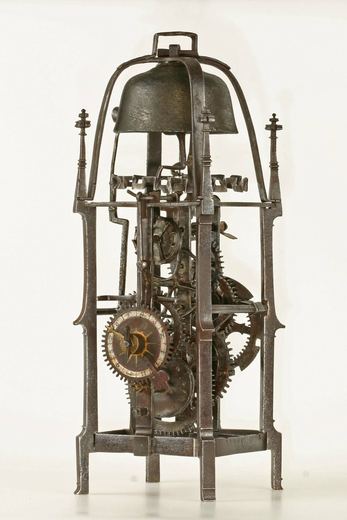
Alarm clock, Germany, 1400–1499
German Clock Museum
Clocks · 1400-1499
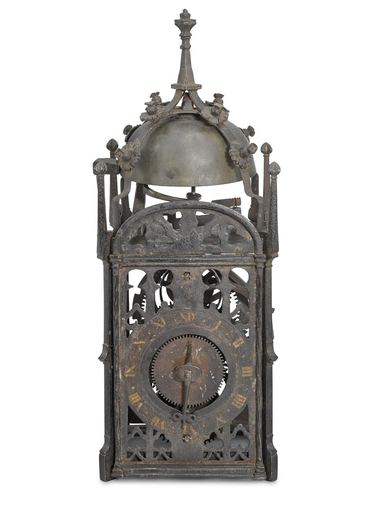
Lantern clock, Germany, 1400-1499
Science Museum Group, London
Clocks · 1500–1599
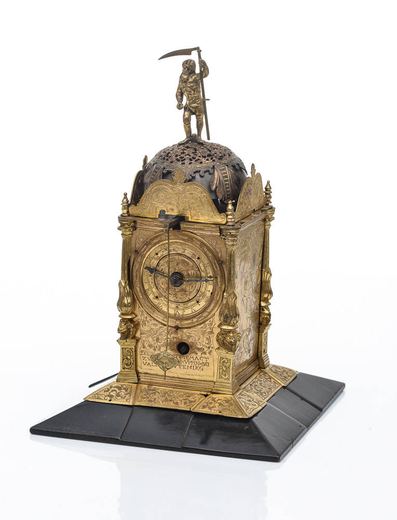
Table clock by Rutenieg, Valentin (um 1550) (Uhrmacher), Germany, 1500–1599
City Museum Berlin
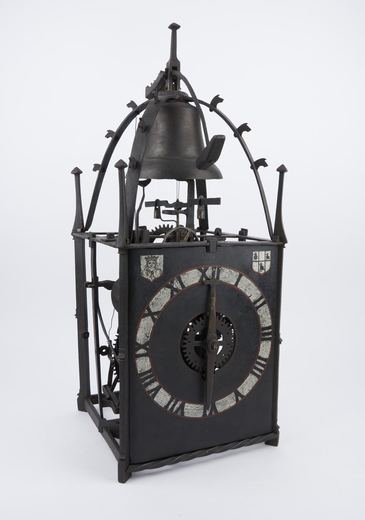
Clocks · 1501-1600
German 16th century iron chamber clock
Science Museum Group, London
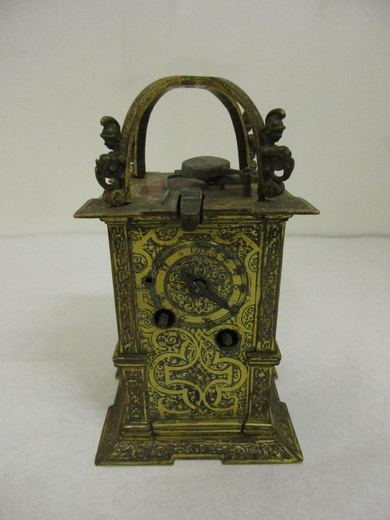
Clocks · ca.1550
Clock, a striking alarm clock in a gilt brass case, Germany, ca.1550.
Victoria and Albert Museum, London
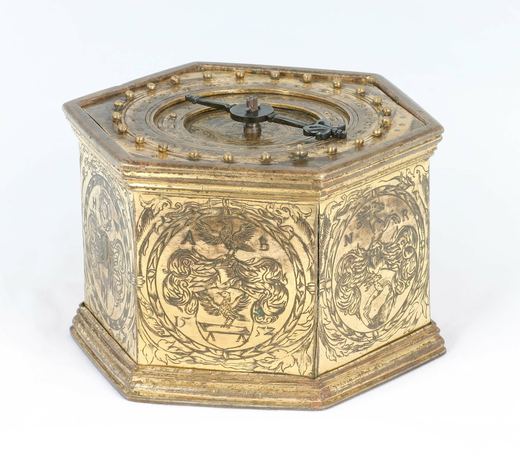
Clocks · 1552
Carriage / travel clock, Germany, 1552
German Clock Museum
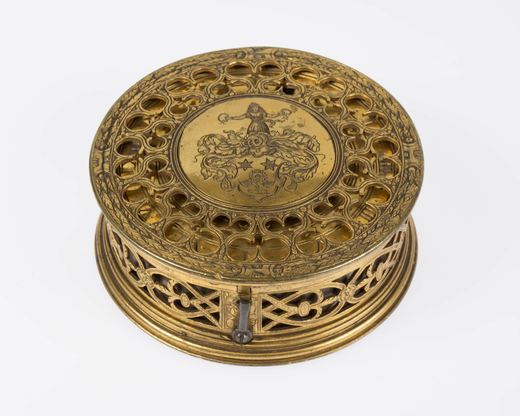
Clocks · 1560
Carriage / travel clock by HG, Germany, 1560
German Clock Museum
Clocks · 1564
Table clock by #Jeremias_Metzker_Künstler/in, Germany, 1564
Fine Arts Museum Vienna