
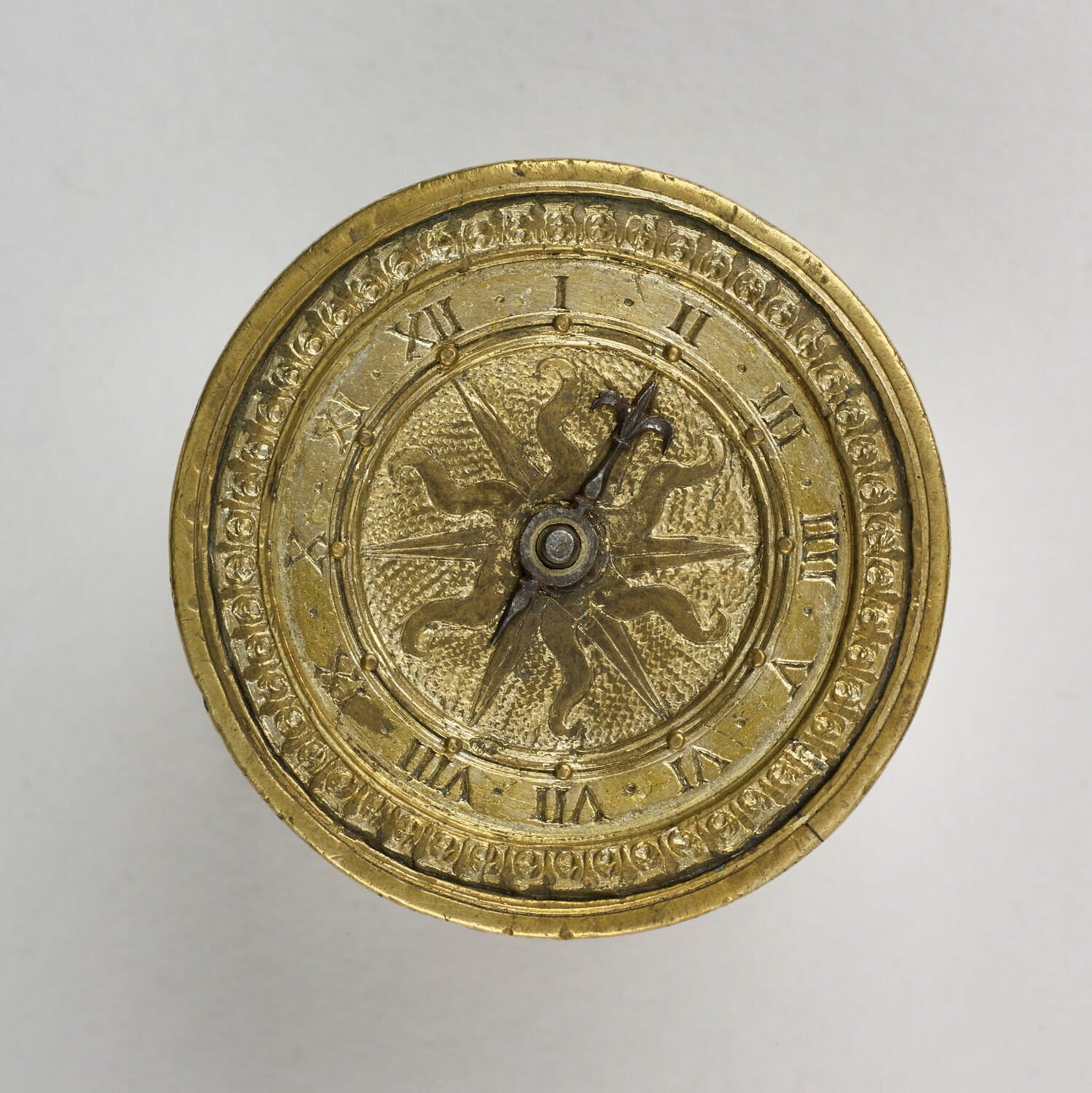
Clocks · Table clock
Table clock, France, 1540–1560
- Maker / attribution
- Unrecorded in source
- Date
- 1540–1560
- Historical period
- Renaissance Horology (1400 – 1600)
- Country of origin
- France
- Place
- France
- Object type
- Table clock
- Materials / technique
- iron, brass
- Dimensions
- height 4,7 cm; diameter 5,3 cm
- Holding institution
- Musée du Louvre, Paris
- Accession / object no.
- OA 8397
- Credit line
- Musée du Louvre, Département des Objets d'art du Moyen Age, de la Renaissance et des temps modernes
- Catalogue title (original)
- Horloge de table cylindrique (French)
View the source record ↗ (opens another website in a new tab)Suggest a correction
Record summary
Held and catalogued by Musée du Louvre, Paris (object number OA 8397), this is a table clock, made in France, dated 1540–1560. The Atlas places it in the Renaissance Horology period (1400 – 1600) of its Clocks collection. Materials and techniques recorded by the source: iron, brass. Recorded dimensions: height 4,7 cm; diameter 5,3 cm. The record is illustrated with 5 photographs.
Assembled from the source record's structured fields. Dates and attributions are given as the source states them; where a field is missing the Atlas leaves it blank rather than estimating.
Catalogue description
Catalogue description — Musée du Louvre (French)
Boîte gravée sur le fond et le pourtour d'un décor de moresques et de grotesques. Pourtour présentant, parmi les entrelacs, des oiseaux, deux termes masculins, une palmette. Volet mobile dévoilant la fusée et l'état du remontage. Fond simplement ajusté sur la boîte, décoré de mascarons et fleurettes ; troué au-dessus du carré de remontage. Cadran horizontal gravé de chiffres romains ; boutons saillants marquant les divisions des heures ; au centre, motif rayonnant sur fond granulé ; aiguille fleurdelisée. Mouvement muni d'une haute fusée sur laquelle s'enroule une cordelette. Echappement à roue de rencontre entretenant les oscillations d'un foliot en forme de barre horizontale dont une extrémité est arrondie, l'autre formant un disque plein. Les trois piliers en forme de balustre. Mouvement avec des traces de restaurations.
Shown in the original language of the source catalogue. An editor-reviewed English translation has not yet been published; we do not publish machine translations as authoritative text.
Dating and period as catalogued (French)
Epoque / période : Henri II (1547-1559) (Occident->Renaissance->dynastie des Valois-Angoulême) · · Date de création/fabrication : 1540 - 1560
Shown in the original language of the source catalogue. An editor-reviewed English translation has not yet been published; we do not publish machine translations as authoritative text.
Materials and techniques as catalogued (French)
Matériau : fer · Matériau : laiton
Shown in the original language of the source catalogue. An editor-reviewed English translation has not yet been published; we do not publish machine translations as authoritative text.
Inscriptions & marks
Inscription : ; sur la boîte : 1504 ; S barré ; Signature : ; boîte signée : NOEL
Provenance
collection Jules-René Olivier (1855-1933), horloger-collectionneur ; legs de sa sœur Marie-Julie Olivier, n° 752 ; comité du 24 janvier 1935 ; conseil du 5 février 1935 ; décret du 4 août 1935 ; déposée au musée des Arts décoratifs le 4 novembre 1935 ; retour au musée du Louvre, arrêté du 5 février 1982.
Historical context
Renaissance Horology (1400 – 1600)
Spring power makes clocks portable; Nuremberg and Augsburg produce the first watches; the Prague Orloj is built.
Spring power made the domestic clock portable. Augsburg and Nuremberg produced gilt-brass table clocks, often with astronomical dials and alarms; weight-driven Gothic wall clocks and English lantern clocks served households. Clocks of this period have foliot or balance-wheel control and usually only an hour hand.
Read the period in the timelineMore clocks from this periodEarlier: Medieval Period
Atlas type guide
Bracket, table and spring-driven clocks
Spring-driven clocks freed timekeeping from the hanging weight. The coiled mainspring, documented from the fifteenth century, made portable table clocks possible; to even out its declining force, makers used the fusee, a conical pulley connected to the barrel by a gut line or chain. Renaissance table clocks from Augsburg and Nuremberg — drum-shaped, square or tower-shaped in gilt brass — were luxury scientific objects, often with astronomical dials and alarms.
After the pendulum, English makers developed the bracket clock: a wooden case with a carrying handle, a short pendulum with a verge escapement, and often repeating work to sound the hours on demand at night. Later examples use the anchor escapement. In the nineteenth century, 'table clock' became a broad term for spring clocks of every nationality.
What to look for
- A fusee in the movement (cone-shaped pulley) and the type of line — gut or chain.
- Verge escapement with a short bob pendulum, often with a decoratively engraved backplate.
- Repeat cords or buttons that make the clock strike again on demand.
- Gilt-brass engraved cases and horizontal dials on Renaissance pieces.
- Case shapes: inverted bell, bell top, break-arch, lancet or balloon.
Dating clues
- Drum and tower table clocks: c. 1520–1650.
- Ebony veneered English bracket clocks with verge escapements: c. 1670–1800.
- Engraved backplates were usual on English clocks until c. 1800, then generally plain.
General guidance written by the Atlas editors about this kind of object. It is not a statement about this particular piece; for that, rely on the source record above and on physical examination.
Related records
Clocks · 1530
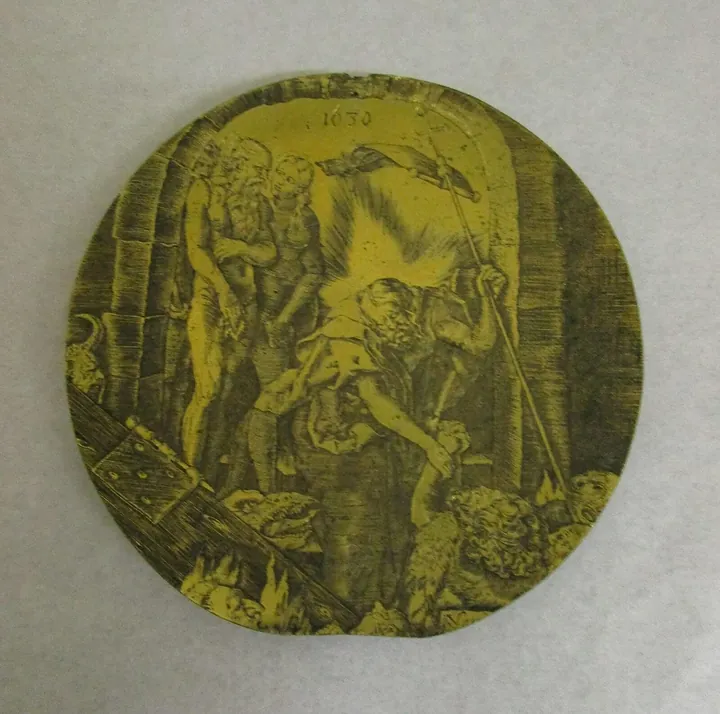
Clock-watch cover engraved with Dürer's Descent into Limbo, 1530
Victoria and Albert Museum, London
Clocks · c.1540
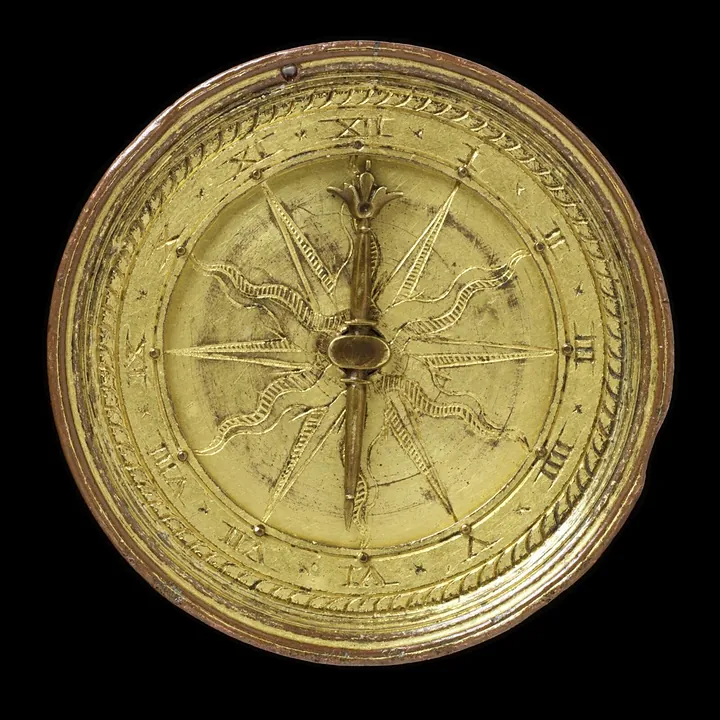
Drum clock and case, made in France or Germany, about 1540. Gilded brass, engraved with the Crucifixion
Victoria and Albert Museum, London
Clocks · 1544
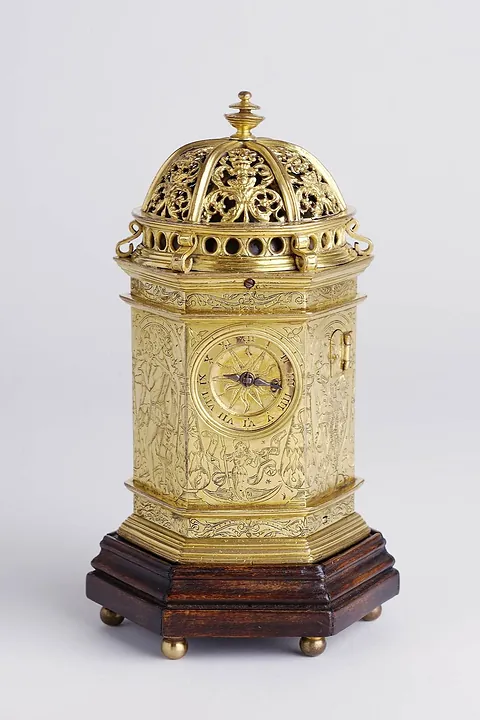
Table clock by Noel Dauville, France, 1544
German Clock Museum
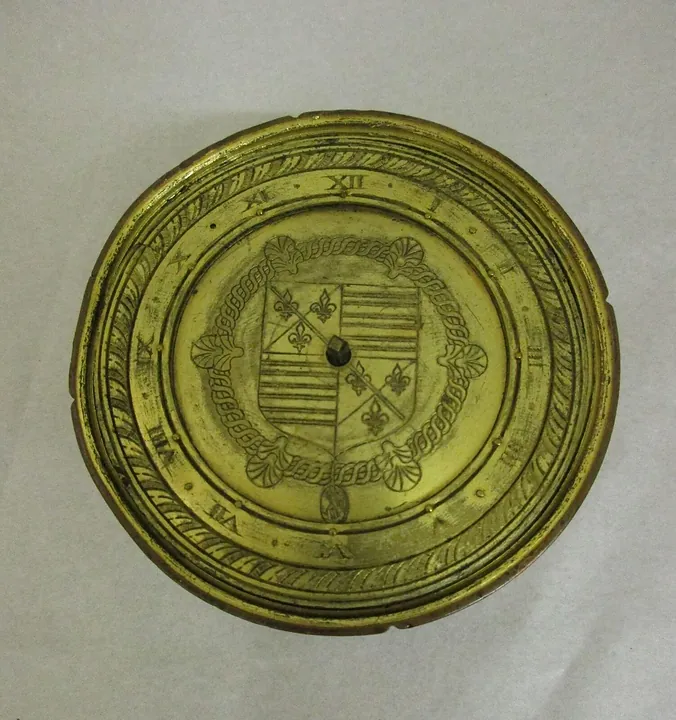
Clocks · c. 1550
Clock, gilt metal, France, c. 1550
Victoria and Albert Museum, London
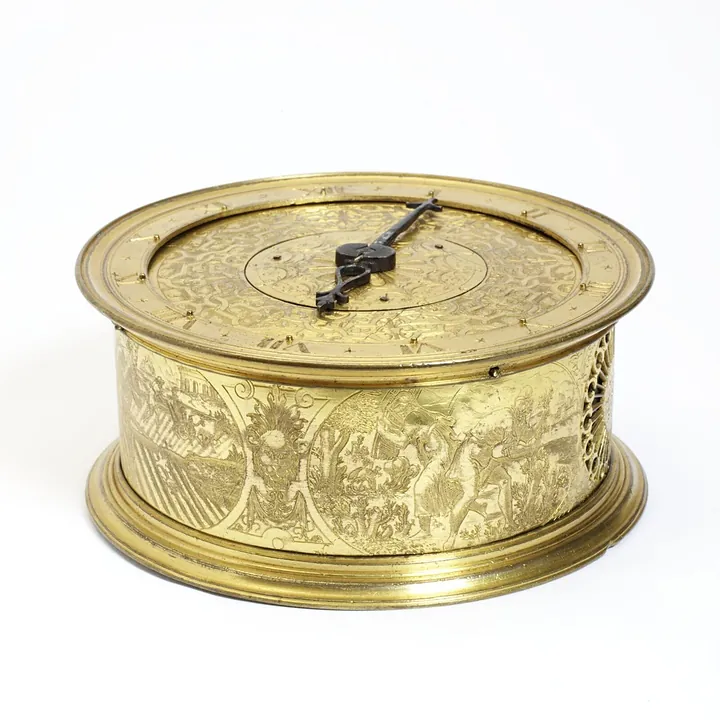
Clocks · 1560-80
Drum clock with alarm engraved with scenes representing the months. Made in France, 1560-80, movement by Félix Loubet
Victoria and Albert Museum, London
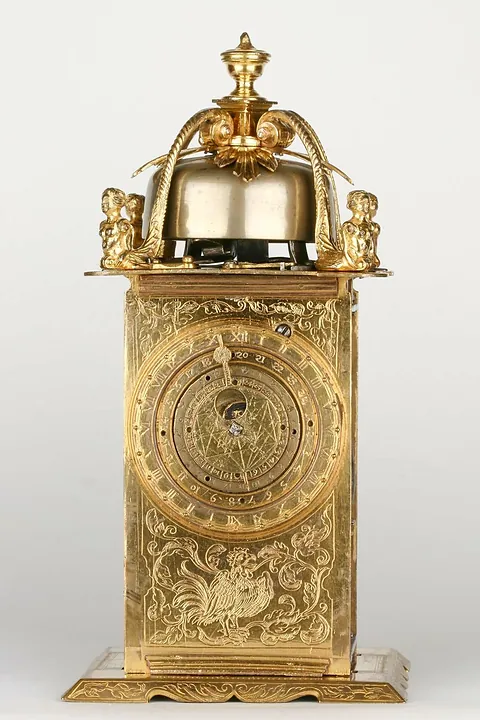
Clocks · 1573
Table clock, France, 1573
German Clock Museum
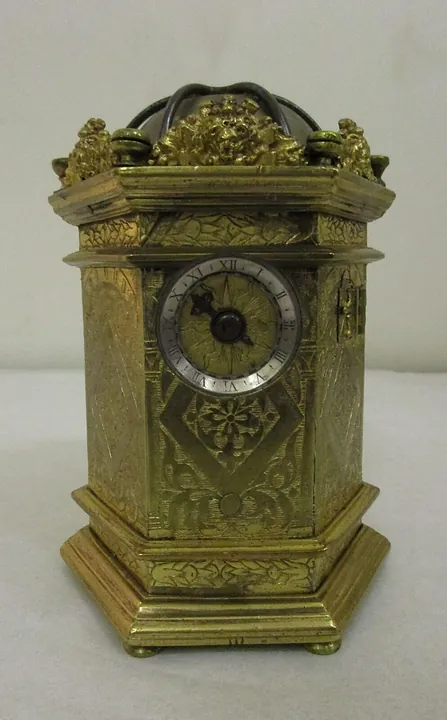
Clocks · 1580–1600
An hexagonal table clock, engraved gilt brass, French, late 16th century
Victoria and Albert Museum, London
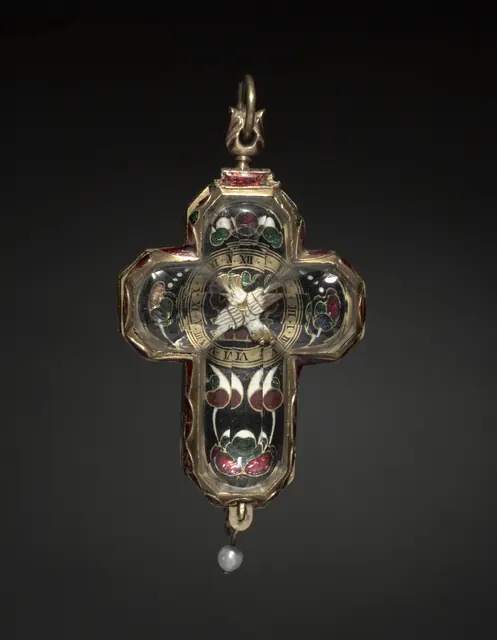
Clocks · c. 1580–1600
Cross-Shaped Clock
Cleveland Museum of Art