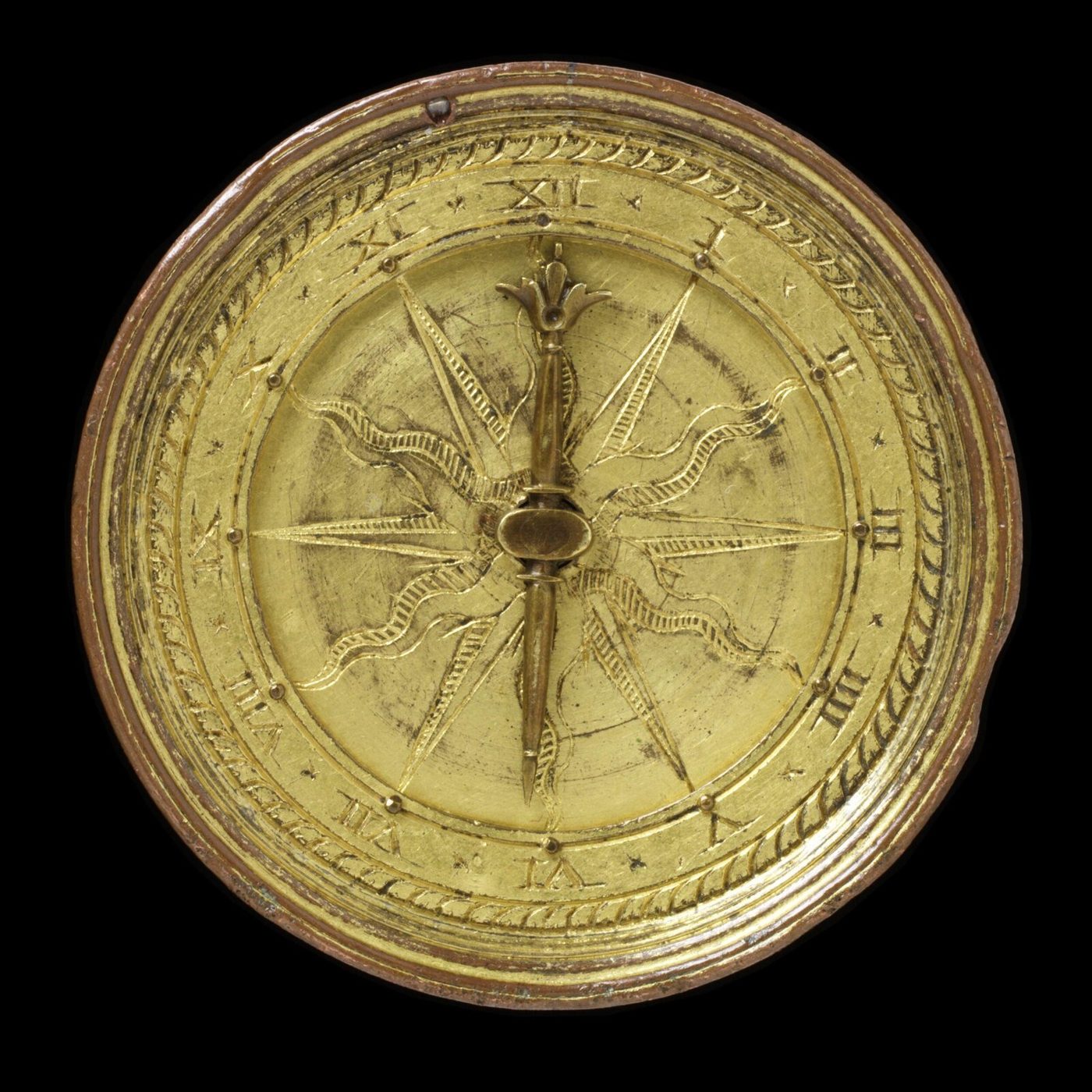
Clocks · Drum clock and case
Drum clock and case, made in France or Germany, about 1540. Gilded brass, engraved with the Crucifixion
- Maker / attribution
- Unrecorded in source
- Date
- ca.1540
- Historical period
- Renaissance Horology (1400 – 1600)
- Country of origin
- France
- Place
- France, Germany
- Object type
- Drum clock and case
- Materials / technique
- Case: gilded brass, engraved; Travelling case: leather
- Dimensions
- Height: 4 3/8 in (Leather case)
- Holding institution
- Victoria and Albert Museum, London
- Accession / object no.
- M.176-1938
- Credit line
- Given by W.E. Miller FSA
Record summary
Held and catalogued by Victoria and Albert Museum, London (object number M.176-1938), this is a drum clock and case, made in France, Germany, dated ca.1540. The Atlas places it in the Renaissance Horology period (1400 – 1600) of its Clocks collection. Materials and techniques recorded by the source: Case: gilded brass, engraved; Travelling case: leather. Recorded dimensions: Height: 4 3/8 in (Leather case). The record is illustrated with 4 photographs.
Assembled from the source record's structured fields. Dates and attributions are given as the source states them; where a field is missing the Atlas leaves it blank rather than estimating.
Catalogue description
V&A — Summary
A gilt brass alarm travelling clock with a leather case engraved with a representation of The Crucifixion of Christ between two scrolls each inscribed SPES MEA DEUS. On top a single handed dial is engraved with the sun and has touch pins for telling the time at night. French mid 16th century.
V&A — Physical description
Gilt-brass travelling clock with alarm and leather case engraved with a representation of the Crucifixion. French, 16th century. The Clock: The cylindrical case engraved with a crucifix between two scrolls each inscribed 'SPES MEA DEUS' and with two scenes of a town with tree, the three panels being divided by engraved Corinthian columns. The bottom of the case is removable. On the top is a single-handed dial engraed with the sun and fitted with pegs for night reading. The gut fusee may be inspected through a small door in the side of the case. Height 1 3/4 inchjes Diameter 1 7/8 inches. The alarm: Cylindrical plain case supported on three clawed feet which grip the rim of the clock dial, and surmounted by a bell held in position by a foliated washer and a knob. A trip release projecting below the case is worked by the hour hand of the clock. Height 3 inches The leather case with stamped and gilt decoration is of pointed cylindrical shape and fitted with four loops for carrying strap. Height 4 3/4 inches.
V&A — Object history
One of fourteen clocks and sundials given by W.E.Miller FSA
Historical context
Renaissance Horology (1400 – 1600)
Spring power makes clocks portable; Nuremberg and Augsburg produce the first watches; the Prague Orloj is built.
Spring power made the domestic clock portable. Augsburg and Nuremberg produced gilt-brass table clocks, often with astronomical dials and alarms; weight-driven Gothic wall clocks and English lantern clocks served households. Clocks of this period have foliot or balance-wheel control and usually only an hour hand.
Read the period in the timelineMore clocks from this periodEarlier: Medieval Period
Atlas type guide
Bracket, table and spring-driven clocks
Spring-driven clocks freed timekeeping from the hanging weight. The coiled mainspring, documented from the fifteenth century, made portable table clocks possible; to even out its declining force, makers used the fusee, a conical pulley connected to the barrel by a gut line or chain. Renaissance table clocks from Augsburg and Nuremberg — drum-shaped, square or tower-shaped in gilt brass — were luxury scientific objects, often with astronomical dials and alarms.
After the pendulum, English makers developed the bracket clock: a wooden case with a carrying handle, a short pendulum with a verge escapement, and often repeating work to sound the hours on demand at night. Later examples use the anchor escapement. In the nineteenth century, 'table clock' became a broad term for spring clocks of every nationality.
What to look for
- A fusee in the movement (cone-shaped pulley) and the type of line — gut or chain.
- Verge escapement with a short bob pendulum, often with a decoratively engraved backplate.
- Repeat cords or buttons that make the clock strike again on demand.
- Gilt-brass engraved cases and horizontal dials on Renaissance pieces.
- Case shapes: inverted bell, bell top, break-arch, lancet or balloon.
Dating clues
- Drum and tower table clocks: c. 1520–1650.
- Ebony veneered English bracket clocks with verge escapements: c. 1670–1800.
- Engraved backplates were usual on English clocks until c. 1800, then generally plain.
General guidance written by the Atlas editors about this kind of object. It is not a statement about this particular piece; for that, rely on the source record above and on physical examination.
Related records
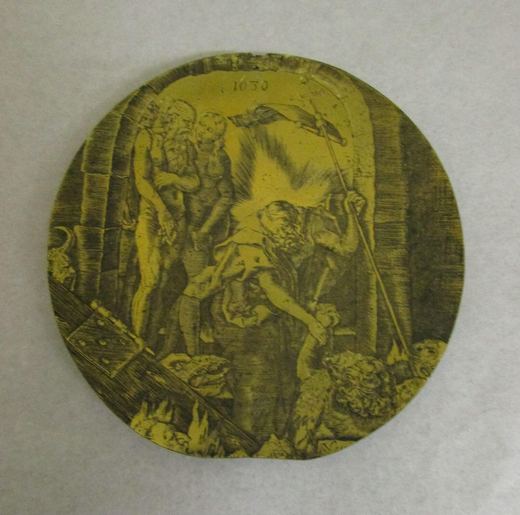
Clocks · 1530
Clock cover by Albrecht Dürer, France, 1530
Victoria and Albert Museum, London
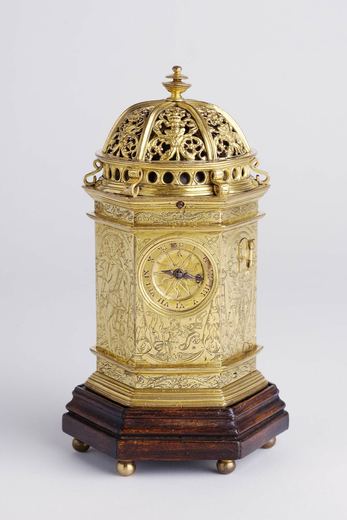
Clocks · 1544
Table clock by Noel Dauville, France, 1544
German Clock Museum
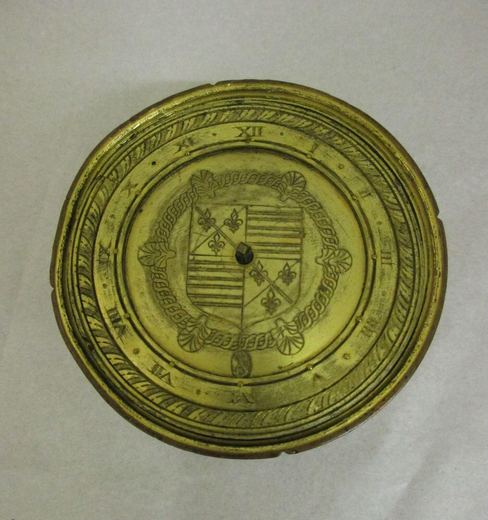
Clocks · ca. 1550
Clock, gilt metal, France, ca. 1550
Victoria and Albert Museum, London
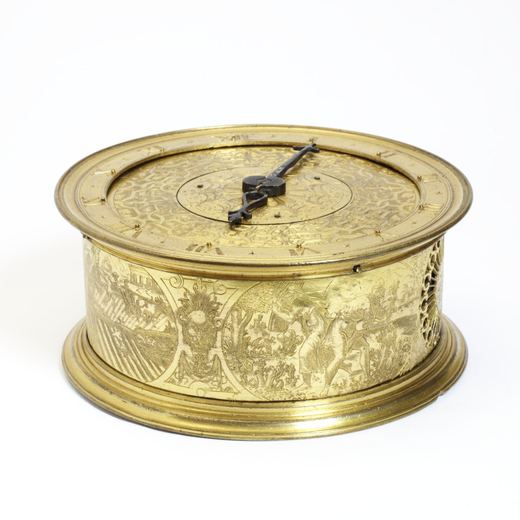
Clocks · 1560-80
Drum clock with alarm engraved with scenes representing the months. Made in France, 1560-80, movement by Félix Loubet
Victoria and Albert Museum, London
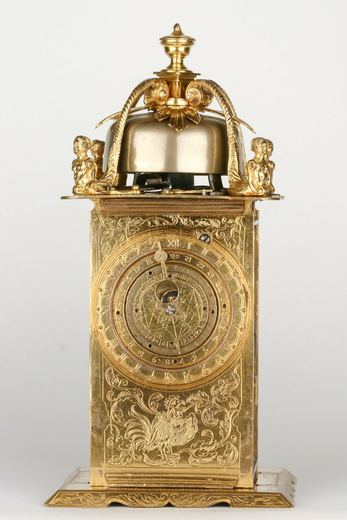
Clocks · 1573
Table clock, France, 1573
German Clock Museum
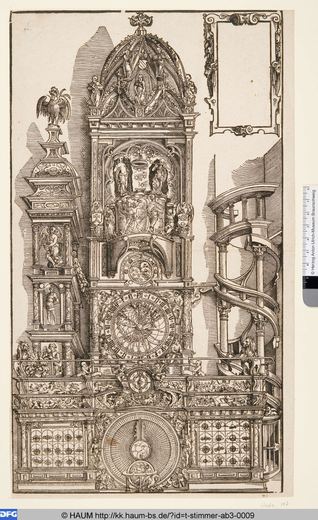
Clocks · 1574
Astronomical clock by Tobias Stimmer, France, 1574
Herzog Anton Ulrich Museum
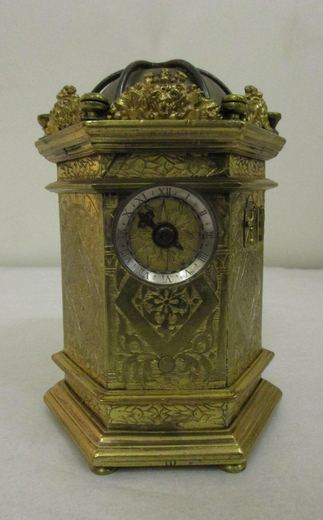
Clocks · 1580-1600
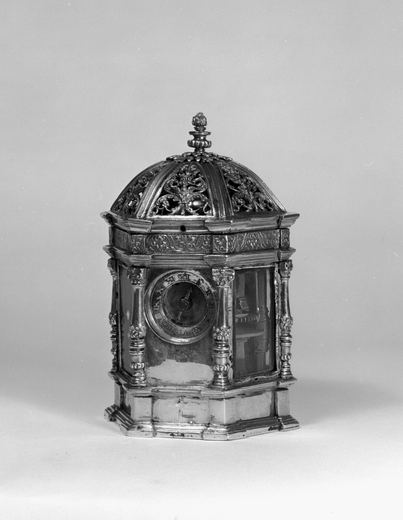
An hexagonal table clock, engraved gilt brass, French, late 16th century
Victoria and Albert Museum, London
Clocks · ca. 1600
Table Clock, sheet brass, engraved, pierced and gilt, Paris, ca.1600, signed 'B(?) Pichard, à Paris'
Victoria and Albert Museum, London