Clocks · Clock
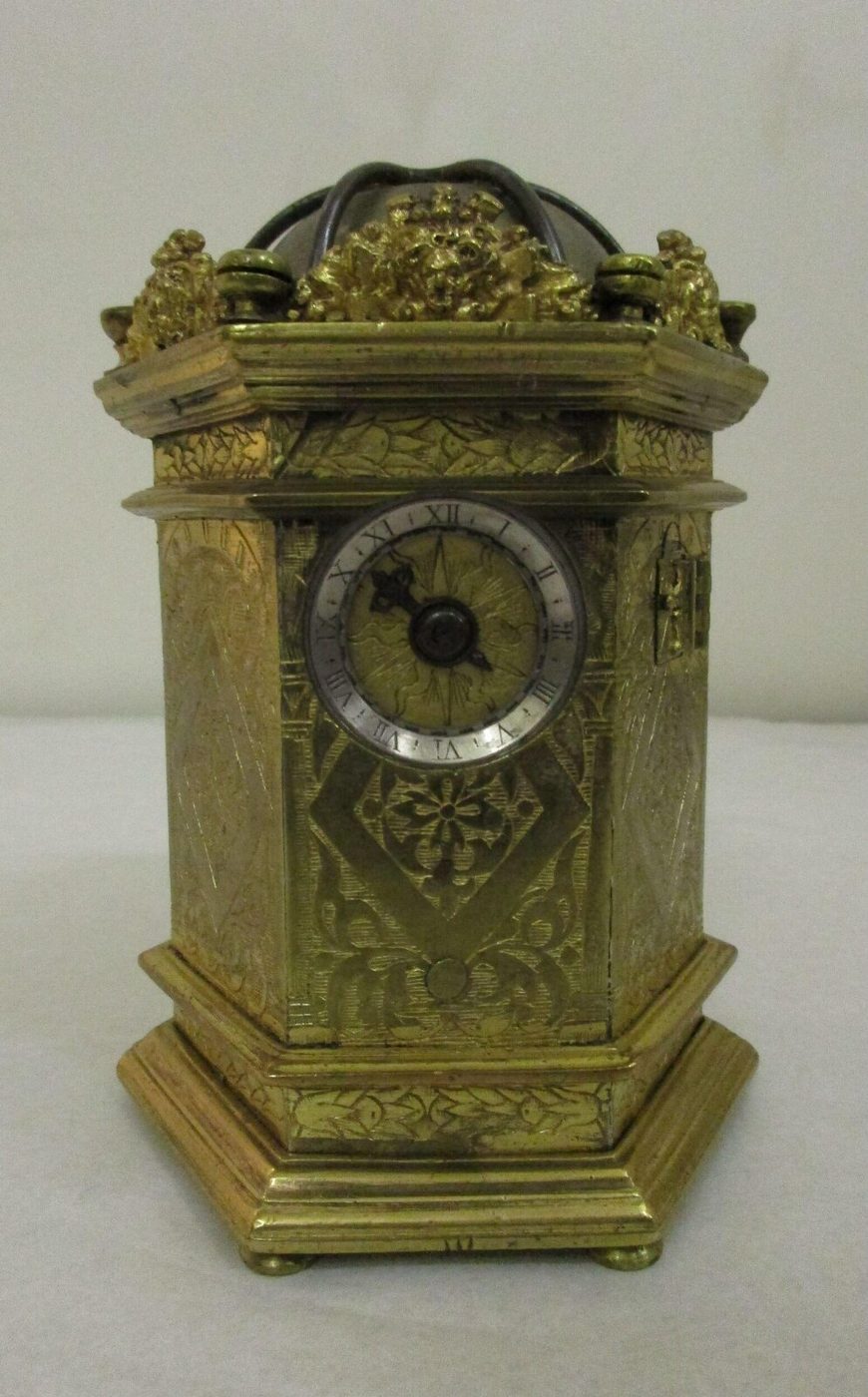
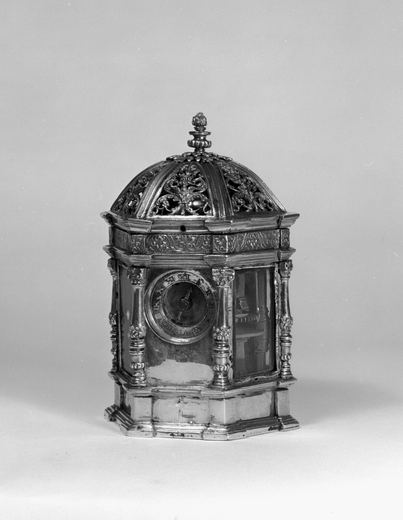
An hexagonal table clock, engraved gilt brass, French, late 16th century
- Maker / attribution
- Jacques Borlion (maker)
- Date
- 1580-1600
- Historical period
- Renaissance Horology (1400 – 1600)
- Country of origin
- France
- Place
- Paris
- Object type
- Clock
- Materials / technique
- Brass, gilded, engraved, iron and steel
- Dimensions
- Height: 15.6 cm; Width: 8.5 cm
- Holding institution
- Victoria and Albert Museum, London
- Accession / object no.
- M.173-1938
- Credit line
- Given by W.E.Miller FSA
Record summary
Held and catalogued by Victoria and Albert Museum, London (object number M.173-1938), this is a clock by Jacques Borlion, made in Paris, France, dated 1580-1600. The Atlas places it in the Renaissance Horology period (1400 – 1600) of its Clocks collection. Materials and techniques recorded by the source: Brass, gilded, engraved, iron and steel. Recorded dimensions: Height: 15.6 cm; Width: 8.5 cm. The record is illustrated with 3 photographs.
Assembled from the source record's structured fields. Dates and attributions are given as the source states them; where a field is missing the Atlas leaves it blank rather than estimating.
Catalogue description
V&A — Summary
A French gilt-brass hexagonal striking table clock signed Jacques Borlion, Paris, late 16th century
V&A — Physical description
An hexagonal gilt-brass table clock, with removable base on six small feet (one missing) engraved with lozenges and foliated scrolls between arcading and surmounted by six pediment-like relief castings of lion masks and scrollwork and six knobs. On top of the case the bell is caged by three intersecting iron arches crowned by a moulded finial. The hours on the dial which is on the side of the case, indicated by a single hand, are engraved in a steel ring VI at the top IIX at the bottom. The gut fusee may be inspected through a door in the side of the case. Dial: Silvered dial, attached to a movement, 3.2 cm diameter, with Roman numerals for the hours and dashes at half hours. Single steel hand with short tail. Movement: Three horizontal brass plates, turned iron pillars. Brass barrels and fusee, all wheels of steel except the contrate wheel of the going train, which is of brass. Going train, in top compartment, with slim fusee of 26 turns, gut line. Verge escapement, balance wheel. Bell strapped above movement. Motion work: 8T pinion coaxial with the fusee drives 8T contrate wheel. A 6-T pinion coaxial with this latter drives the hour-wheel of 48T. Locking-plate striking train with going barrel; with outside count-wheel with 78 internal teeth and sliding inside curved brass arcs, not pivoted at centre. The inside of the removable base stamped: JACQUES BORLION PARIS
V&A — Object history
The bell-straps, bell and finial mounted above are later additions. This is one of group of fourteen sun dials and clocks given by W.E.Miller FSA in 1938.
Inscriptions & marks
JACQUES BORLION PARIS
Historical context
Renaissance Horology (1400 – 1600)
Spring power makes clocks portable; Nuremberg and Augsburg produce the first watches; the Prague Orloj is built.
Spring power made the domestic clock portable. Augsburg and Nuremberg produced gilt-brass table clocks, often with astronomical dials and alarms; weight-driven Gothic wall clocks and English lantern clocks served households. Clocks of this period have foliot or balance-wheel control and usually only an hour hand.
Read the period in the timelineMore clocks from this periodEarlier: Medieval Period
Atlas type guide
Bracket, table and spring-driven clocks
Spring-driven clocks freed timekeeping from the hanging weight. The coiled mainspring, documented from the fifteenth century, made portable table clocks possible; to even out its declining force, makers used the fusee, a conical pulley connected to the barrel by a gut line or chain. Renaissance table clocks from Augsburg and Nuremberg — drum-shaped, square or tower-shaped in gilt brass — were luxury scientific objects, often with astronomical dials and alarms.
After the pendulum, English makers developed the bracket clock: a wooden case with a carrying handle, a short pendulum with a verge escapement, and often repeating work to sound the hours on demand at night. Later examples use the anchor escapement. In the nineteenth century, 'table clock' became a broad term for spring clocks of every nationality.
What to look for
- A fusee in the movement (cone-shaped pulley) and the type of line — gut or chain.
- Verge escapement with a short bob pendulum, often with a decoratively engraved backplate.
- Repeat cords or buttons that make the clock strike again on demand.
- Gilt-brass engraved cases and horizontal dials on Renaissance pieces.
- Case shapes: inverted bell, bell top, break-arch, lancet or balloon.
Dating clues
- Drum and tower table clocks: c. 1520–1650.
- Ebony veneered English bracket clocks with verge escapements: c. 1670–1800.
- Engraved backplates were usual on English clocks until c. 1800, then generally plain.
General guidance written by the Atlas editors about this kind of object. It is not a statement about this particular piece; for that, rely on the source record above and on physical examination.
Read next:Anchor (recoil) escapement
Related records
Clocks · 1530
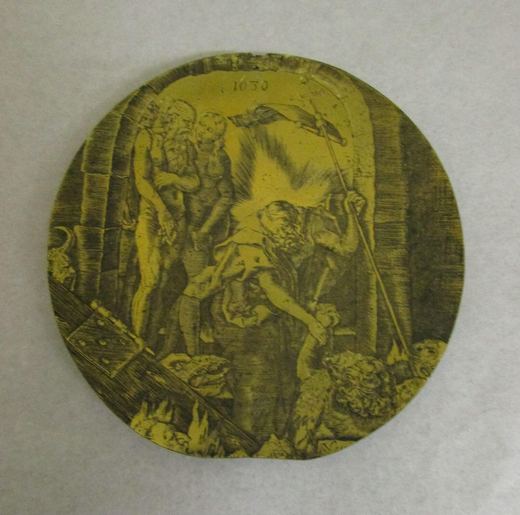
Clock cover by Albrecht Dürer, France, 1530
Victoria and Albert Museum, London
Clocks · ca.1540
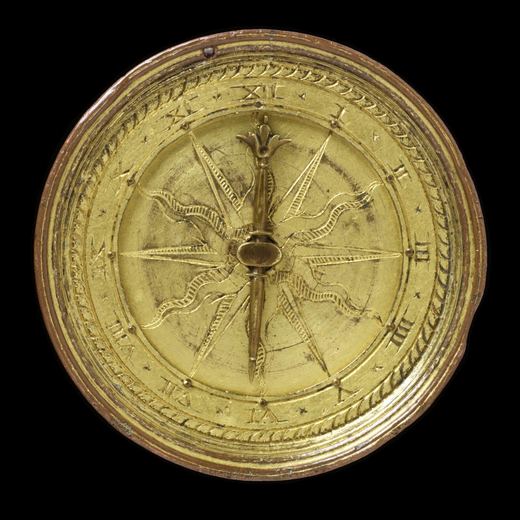
Drum clock and case, made in France or Germany, about 1540. Gilded brass, engraved with the Crucifixion
Victoria and Albert Museum, London
Clocks · 1544
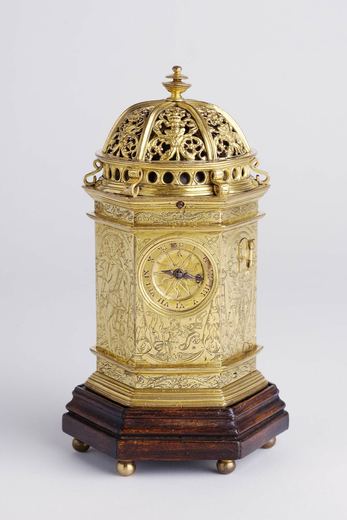
Table clock by Noel Dauville, France, 1544
German Clock Museum
Clocks · ca. 1550
Clock, gilt metal, France, ca. 1550
Victoria and Albert Museum, London
Clocks · 1560-80
Drum clock with alarm engraved with scenes representing the months. Made in France, 1560-80, movement by Félix Loubet
Victoria and Albert Museum, London
Clocks · 1573
Table clock, France, 1573
German Clock Museum
Clocks · 1574
Astronomical clock by Tobias Stimmer, France, 1574
Herzog Anton Ulrich Museum
Clocks · ca. 1600
Table Clock, sheet brass, engraved, pierced and gilt, Paris, ca.1600, signed 'B(?) Pichard, à Paris'
Victoria and Albert Museum, London