Clocks · Drum clock
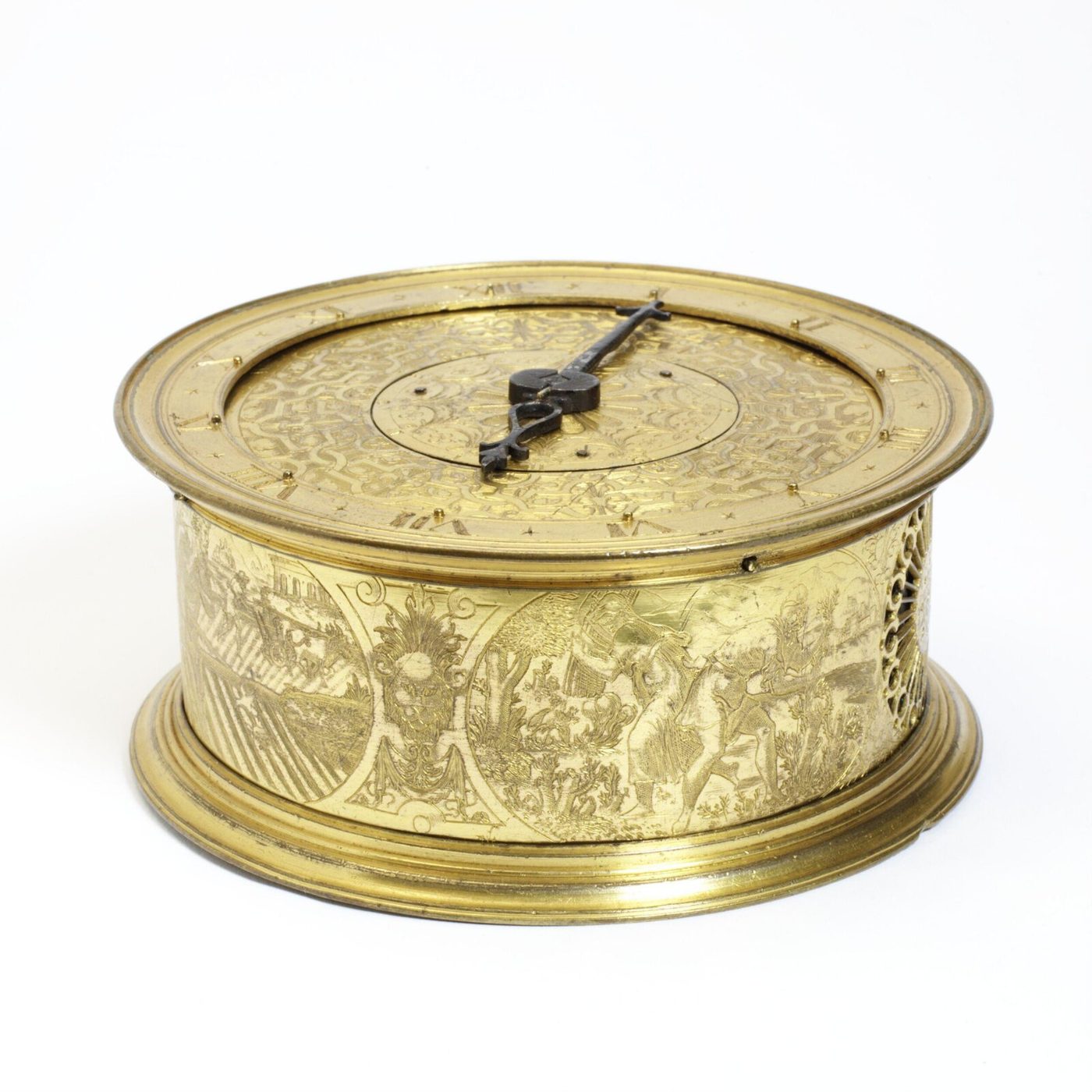
Drum clock with alarm engraved with scenes representing the months. Made in France, 1560-80, movement by Félix Loubet
- Maker / attribution
- Félix Loubet (movement made by)
- Date
- 1560-80
- Historical period
- Renaissance Horology (1400 – 1600)
- Country of origin
- France
- Place
- Paris
- Object type
- Drum clock
- Materials / technique
- Gilded brass case, engraved with scenes representing the months
- Dimensions
- Diameter: 126 mm (Engraved metal case); Height: 54 mm (Engraved metal case)
- Holding institution
- Victoria and Albert Museum, London
- Accession / object no.
- 379-1906
- Credit line
- Presented by Max Rosenheim through Art Fund
Record summary
Held and catalogued by Victoria and Albert Museum, London (object number 379-1906), this is a drum clock by Félix Loubet, made in Paris, France, dated 1560-80. The Atlas places it in the Renaissance Horology period (1400 – 1600) of its Clocks collection. Materials and techniques recorded by the source: Gilded brass case, engraved with scenes representing the months. Recorded dimensions: Diameter: 126 mm (Engraved metal case); Height: 54 mm (Engraved metal case). The record is illustrated with 4 photographs.
Assembled from the source record's structured fields. Dates and attributions are given as the source states them; where a field is missing the Atlas leaves it blank rather than estimating.
Catalogue description
V&A — Summary
An alarm table clock engraved round the sides with representations of the Seasons taken from prints by Etienne de Laune representing the twelve months. The movement is signed 'Felix Loubet au St Esprit'. Felix Loubet was working in Paris in the second half of the 16th century. The clock has an outer case of leather with gilt tooling.
V&A — Physical description
Gilded brass case, engraved with scenes representing the Four Seasons adapted from prints of the months of March, May, July and September published in 1568 by Etienne Delaune (1518-83); iron hand replaced. Accompanied by its original leather case with gold-tooled decoration. The cylindrical case has a circular dial with a steel hand. The face is engraved with strapwork and foliage and the alarm-dial in the middle is engraved with a rosette. The side is pierced with a rosette to emit the sound of the alarm struck on the bell, and is engraved with figure-subjects in four oval panels:- Spring (three young women seated in a garden, one weaving a garland, another playing a lute); Summer (two men mowing, bathers in a river in the background); Autumn (ploughing and sewing); Winter (pruning trees and gathering faggots). The bottom of the clock has decoration of strapwork and foliage. The removable base cover is also engraved on the outside with strapwork and foliage and on the inside with an illustration of a 6-arched bridge above which is the signature 'Felix Loubet au S.Esprit' Dial and Movement: Chapter ring forming a flange of the case with hours engraved in Roman figures and with small touch-pins; the half-hours marked with 6-pointed stars. The dial attached to the movement, with engraving of strapwork and foliage surrounding a central alarm disc 5.1 cm diameter; with hours 1-12 clockwise in arabic and engraved draped pattern. Single iron hand with pierced tail. The going train with fusee and gut land, verge escapement, plain iron balance wheel of three spokes and later balance cock, spring and regulator of Tompion type, with regulator dial numbers 1 to VI in Roman. The striking train with going barreland outside locking-plate; with notches number 1-11 and finally (1)2. The centre engraved with a foliate pattern. The fanfly missing. Alarm train with spring going barrel and usual verge-type action. Movement plates, spring barrels, contrate wheel and locking-plate of brass, but the square, moulded movement pillars, detents and most other wheels are of iron. The outer case is covered with dark brown and lined with red leather. It is mounted in brass and has a circular hinged panel in the lid to show the face of the clock.
V&A — Object history
Given by Mr Max Rosenheim, of 68 Belsize Park Gardens, Hampstead, N.W. through the National Art Collections Fund
V&A — Production note
Iron hand replaced
Inscriptions & marks
'Felix Loubet au St. Esprit'
Historical context
Renaissance Horology (1400 – 1600)
Spring power makes clocks portable; Nuremberg and Augsburg produce the first watches; the Prague Orloj is built.
Spring power made the domestic clock portable. Augsburg and Nuremberg produced gilt-brass table clocks, often with astronomical dials and alarms; weight-driven Gothic wall clocks and English lantern clocks served households. Clocks of this period have foliot or balance-wheel control and usually only an hour hand.
Read the period in the timelineMore clocks from this periodEarlier: Medieval Period
Atlas type guide
Bracket, table and spring-driven clocks
Spring-driven clocks freed timekeeping from the hanging weight. The coiled mainspring, documented from the fifteenth century, made portable table clocks possible; to even out its declining force, makers used the fusee, a conical pulley connected to the barrel by a gut line or chain. Renaissance table clocks from Augsburg and Nuremberg — drum-shaped, square or tower-shaped in gilt brass — were luxury scientific objects, often with astronomical dials and alarms.
After the pendulum, English makers developed the bracket clock: a wooden case with a carrying handle, a short pendulum with a verge escapement, and often repeating work to sound the hours on demand at night. Later examples use the anchor escapement. In the nineteenth century, 'table clock' became a broad term for spring clocks of every nationality.
What to look for
- A fusee in the movement (cone-shaped pulley) and the type of line — gut or chain.
- Verge escapement with a short bob pendulum, often with a decoratively engraved backplate.
- Repeat cords or buttons that make the clock strike again on demand.
- Gilt-brass engraved cases and horizontal dials on Renaissance pieces.
- Case shapes: inverted bell, bell top, break-arch, lancet or balloon.
Dating clues
- Drum and tower table clocks: c. 1520–1650.
- Ebony veneered English bracket clocks with verge escapements: c. 1670–1800.
- Engraved backplates were usual on English clocks until c. 1800, then generally plain.
General guidance written by the Atlas editors about this kind of object. It is not a statement about this particular piece; for that, rely on the source record above and on physical examination.
Read next:Anchor (recoil) escapement
Related records
Clocks · 1530
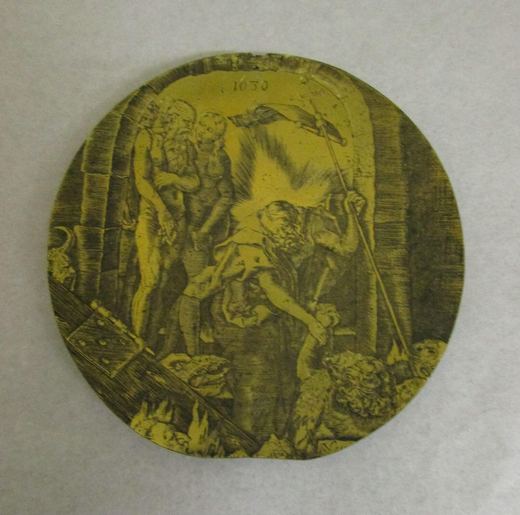
Clock cover by Albrecht Dürer, France, 1530
Victoria and Albert Museum, London
Clocks · ca.1540
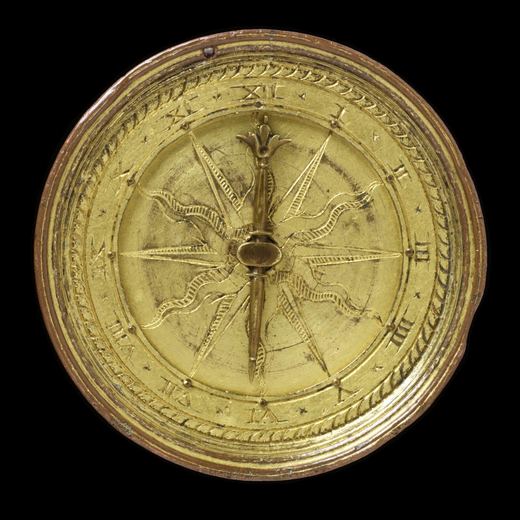
Drum clock and case, made in France or Germany, about 1540. Gilded brass, engraved with the Crucifixion
Victoria and Albert Museum, London
Clocks · 1544
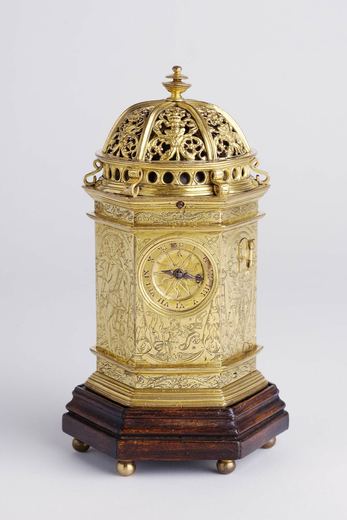
Table clock by Noel Dauville, France, 1544
German Clock Museum
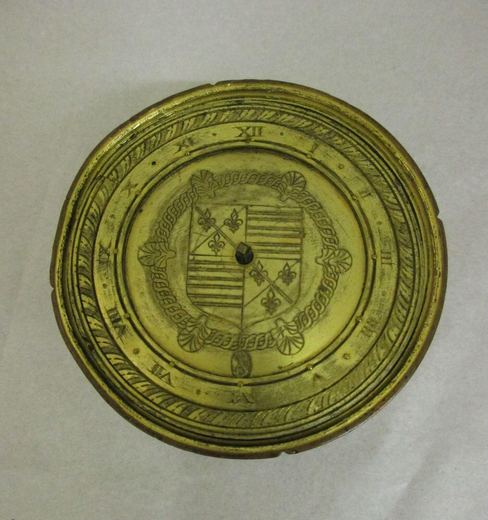
Clocks · ca. 1550
Clock, gilt metal, France, ca. 1550
Victoria and Albert Museum, London
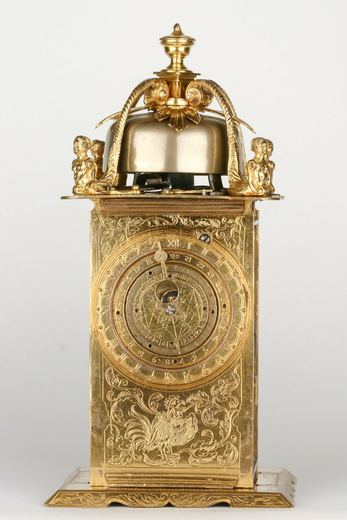
Clocks · 1573
Table clock, France, 1573
German Clock Museum
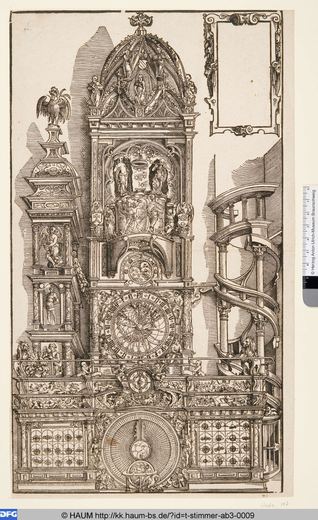
Clocks · 1574
Astronomical clock by Tobias Stimmer, France, 1574
Herzog Anton Ulrich Museum
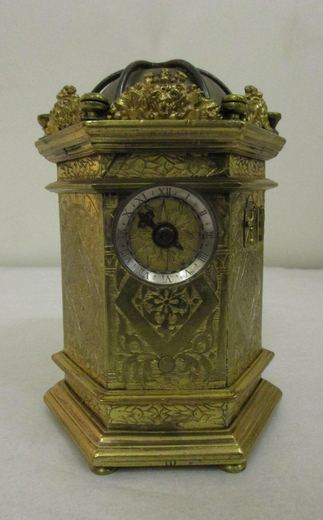
Clocks · 1580-1600
An hexagonal table clock, engraved gilt brass, French, late 16th century
Victoria and Albert Museum, London
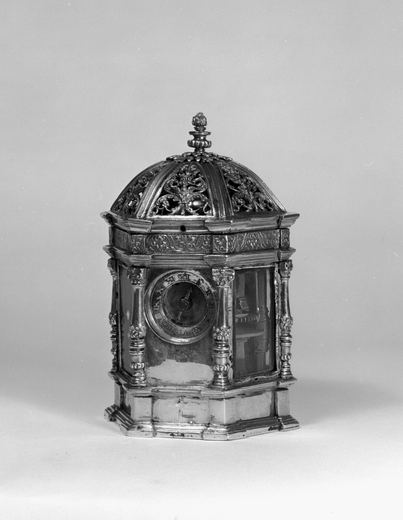
Clocks · ca. 1600
Table Clock, sheet brass, engraved, pierced and gilt, Paris, ca.1600, signed 'B(?) Pichard, à Paris'
Victoria and Albert Museum, London