
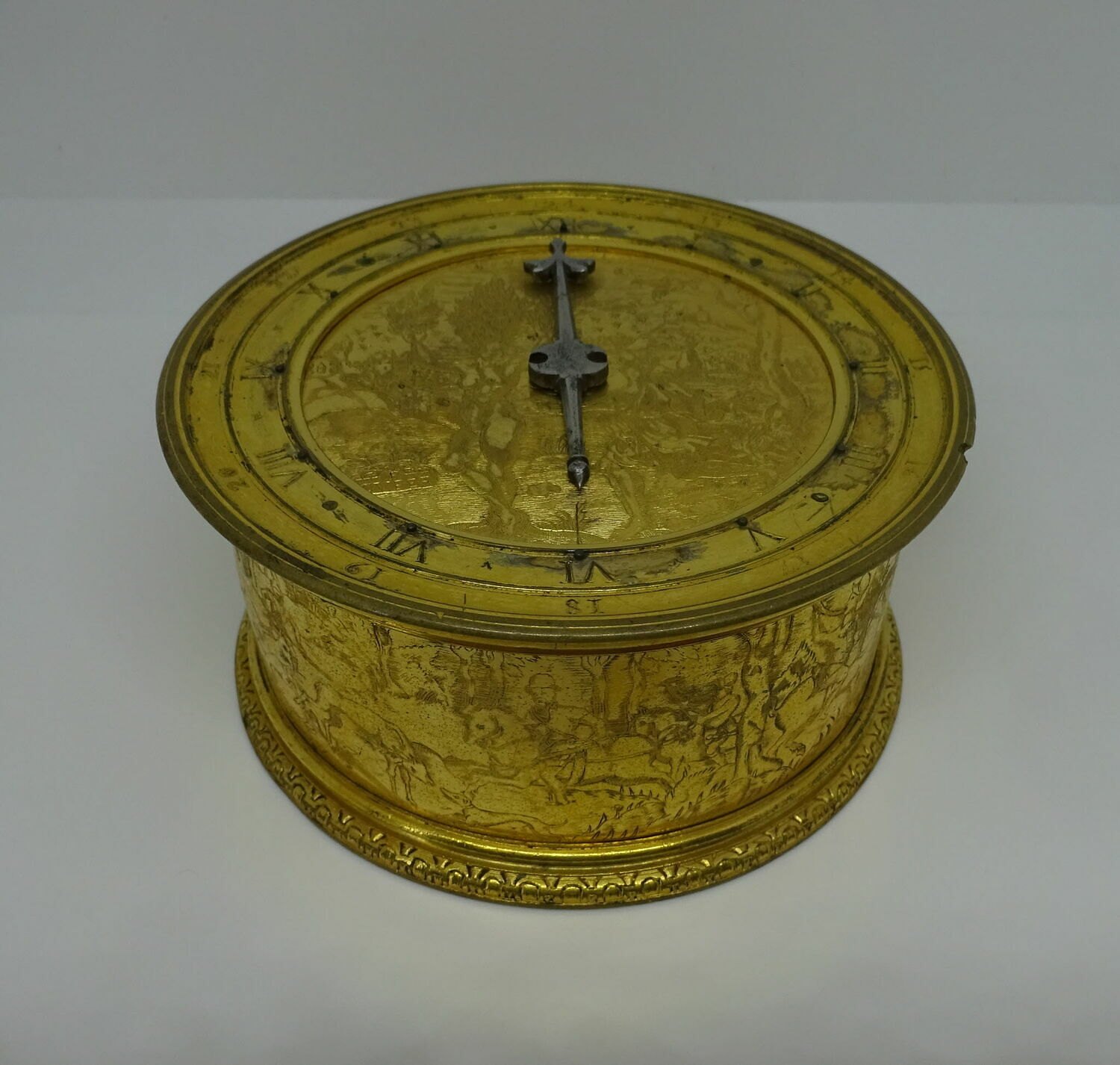
Clocks · Table clock
Table clock by Paul Cuper, France, 1600–1615
- Maker / attribution
- Paul Cuper (Horloger)
- Date
- 1600–1615
- Historical period
- Early Modern Horology (1600 – 1750)
- Country of origin
- France
- Place
- Blois
- Object type
- Table clock
- Materials / technique
- steel, brass
- Dimensions
- height 5,6 cm; diameter 11,4 cm
- Holding institution
- Musée du Louvre, Paris
- Accession / object no.
- OA 10045
- Credit line
- Musée du Louvre, Département des Objets d'art du Moyen Age, de la Renaissance et des temps modernes
- Catalogue title (original)
- Horloge de table cylindrique (French)
View the source record ↗ (opens another website in a new tab)Suggest a correction
Record summary
Held and catalogued by Musée du Louvre, Paris (object number OA 10045), this is a table clock by Paul Cuper, made in Blois, France, dated 1600–1615. The Atlas places it in the Early Modern Horology period (1600 – 1750) of its Clocks collection. Materials and techniques recorded by the source: steel, brass. Recorded dimensions: height 5,6 cm; diameter 11,4 cm. The record is illustrated with 6 photographs.
Assembled from the source record's structured fields. Dates and attributions are given as the source states them; where a field is missing the Atlas leaves it blank rather than estimating.
Catalogue description
Catalogue description — Musée du Louvre (French)
Horloge en forme de tambour aplati ; boîte gravé sur son pourtour d'une frise représentant une chasse à courre, au moment de la capture de deux cerfs. Un volet mobile dévoile l'enroulement de la corde à boyau autour de la fusée et la réserve de marche du mouvement. Couvercle inférieur orné d'une composition symétrique de quatre médaillons à fleurs de fraisier, à coquilles et à feuillages entourant un cartouche ovale dont le centre est nu. Au centre du cadran, une scène gravée tirée des Métamorphoses d'Ovide, Apollon poursuivant Daphnée ; double tour de chiffres romains et arabes ; picots permettant de connaître l'heure au toucher. Echappement à roue de rencontre, fusée avec corde à boyau. Foliot annulaire maintenu par un coq en forme de S, gravé de feuilles. Sous le foliot, quatre coeurs percés alternant avec des rinceaux de feuillage. Trois piliers cylindriques réunissent les deux platines.
Shown in the original language of the source catalogue. An editor-reviewed English translation has not yet been published; we do not publish machine translations as authoritative text.
Dating and period as catalogued (French)
Epoque / période : Henri IV (1589-1610) (Occident->Renaissance->dynastie des Bourbons) · · Date de création/fabrication : 1600 - 1615
Shown in the original language of the source catalogue. An editor-reviewed English translation has not yet been published; we do not publish machine translations as authoritative text.
Materials and techniques as catalogued (French)
Matériau : acier · Matériau : laiton
Shown in the original language of the source catalogue. An editor-reviewed English translation has not yet been published; we do not publish machine translations as authoritative text.
Inscriptions & marks
Signature : ; mouvement signé : P/CUPER ; cadran signé : P/CUPER
Provenance
Collection Paul Garnier (1834-1916), vente Paris hôtel Drouot, 18-23 décembre 1916, n° 90 ; collection Claudius Côte (1881-1956), Lyon ; legs Mme Marie-Françoise Côte, accepté par décret du 9 juillet 1961
Historical context
Early Modern Horology (1600 – 1750)
Huygens' pendulum and balance spring transform accuracy; English makers develop the anchor and deadbeat escapements.
Huygens's pendulum (1656–57) improved clock accuracy from about a quarter of an hour to under a minute a day. The anchor escapement (c. 1670) and the long seconds pendulum created the longcase clock; London makers such as Fromanteel, Knibb, Tompion and Quare led European clockmaking, and French makers created the Boulle pendule.
Read the period in the timelineMore clocks from this periodEarlier: Renaissance Horology
Atlas type guide
Bracket, table and spring-driven clocks
Spring-driven clocks freed timekeeping from the hanging weight. The coiled mainspring, documented from the fifteenth century, made portable table clocks possible; to even out its declining force, makers used the fusee, a conical pulley connected to the barrel by a gut line or chain. Renaissance table clocks from Augsburg and Nuremberg — drum-shaped, square or tower-shaped in gilt brass — were luxury scientific objects, often with astronomical dials and alarms.
After the pendulum, English makers developed the bracket clock: a wooden case with a carrying handle, a short pendulum with a verge escapement, and often repeating work to sound the hours on demand at night. Later examples use the anchor escapement. In the nineteenth century, 'table clock' became a broad term for spring clocks of every nationality.
What to look for
- A fusee in the movement (cone-shaped pulley) and the type of line — gut or chain.
- Verge escapement with a short bob pendulum, often with a decoratively engraved backplate.
- Repeat cords or buttons that make the clock strike again on demand.
- Gilt-brass engraved cases and horizontal dials on Renaissance pieces.
- Case shapes: inverted bell, bell top, break-arch, lancet or balloon.
Dating clues
- Drum and tower table clocks: c. 1520–1650.
- Ebony veneered English bracket clocks with verge escapements: c. 1670–1800.
- Engraved backplates were usual on English clocks until c. 1800, then generally plain.
General guidance written by the Atlas editors about this kind of object. It is not a statement about this particular piece; for that, rely on the source record above and on physical examination.
Related records
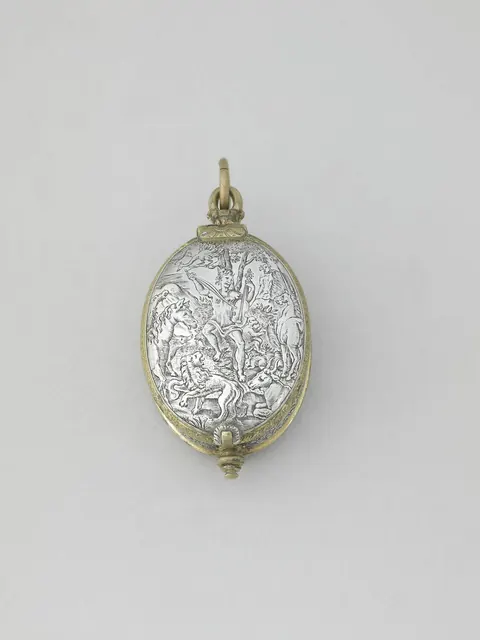
Pocket Watches · 1585–1600
Watch by Paul Cuper, France, 1585–1600
Musée du Louvre, Paris
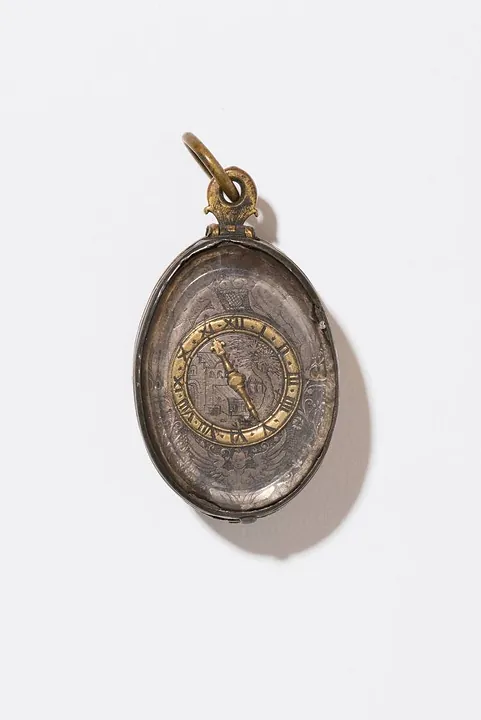
Clocks · 1590–1610
Clock, France, 1590–1610
MAK – Museum of Applied Arts
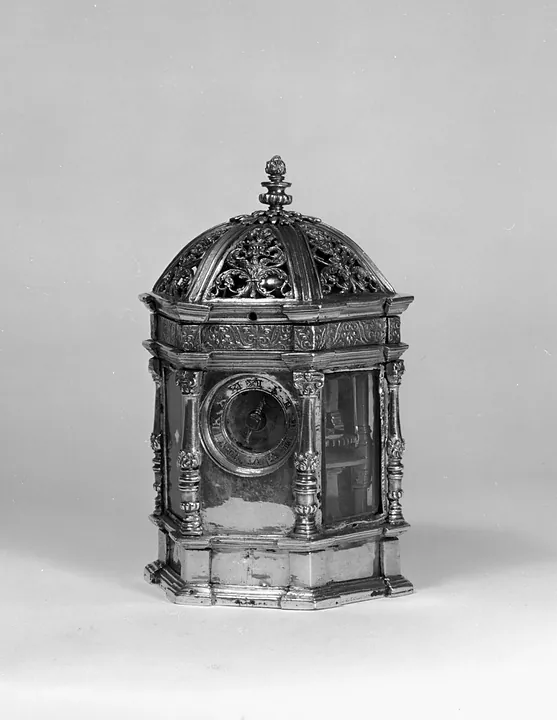
Clocks · c. 1600
Table Clock, sheet brass, engraved, pierced and gilt, Paris, ca.1600, signed 'B(?) Pichard, à Paris'
Victoria and Albert Museum, London
Clocks · 1600–1699
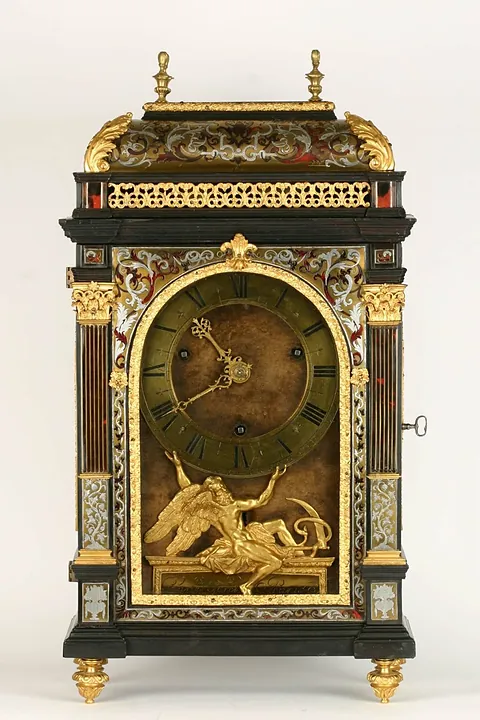
Table clock by Charles Goret, France, 1600–1699
German Clock Museum
Clocks · 1640
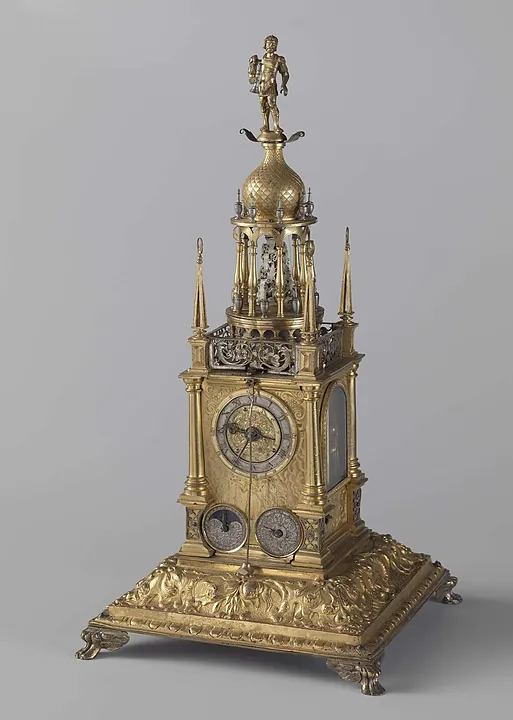
Table clock, France, 1640
Rijksmuseum
Clocks · late 17th century
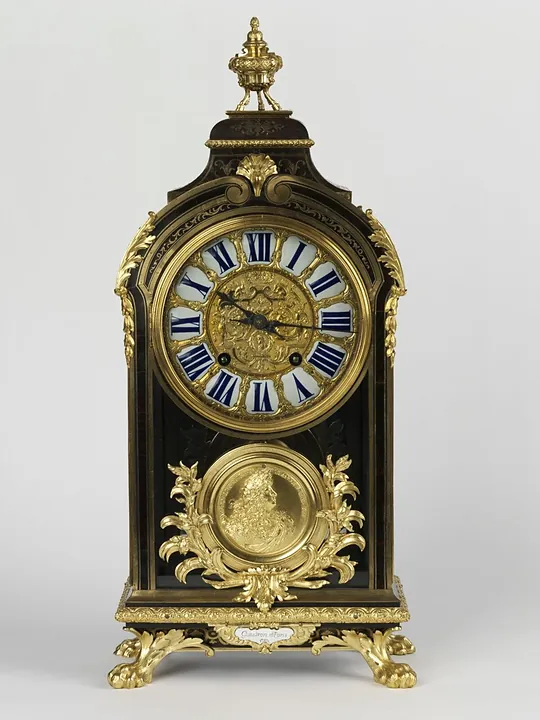
Clock with case of tortoiseshell inlaid with brass, Paris, late 17th century
Victoria and Albert Museum, London
Clocks · 1650
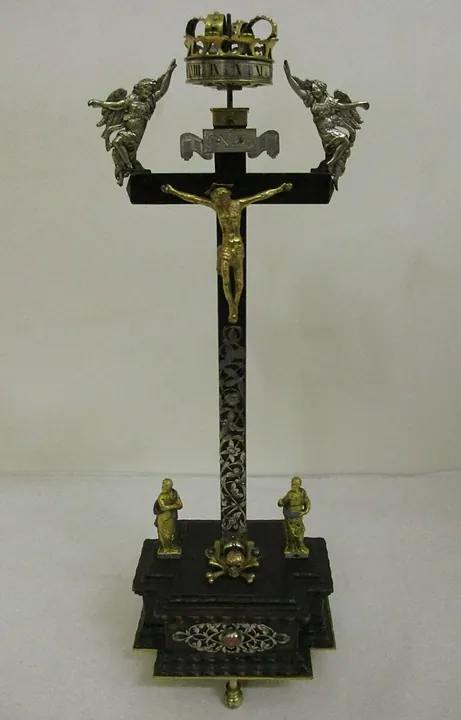
Crucifix Clock, signed W. H. Arnstad, mid- 17th century.
Victoria and Albert Museum, London
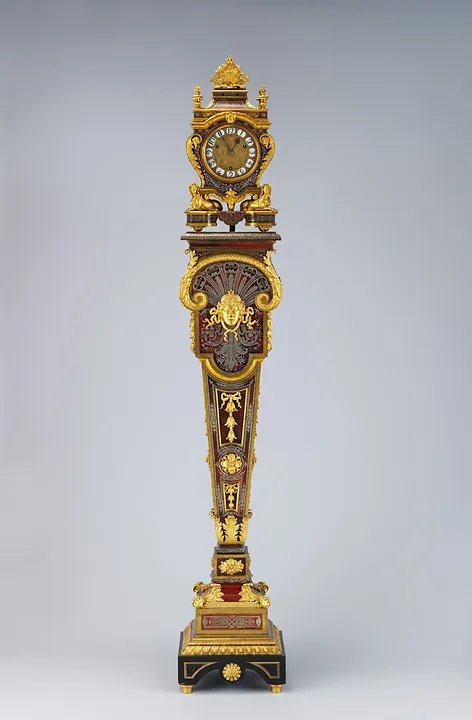
Clocks · c. 1690
Clock with pedestal, case attributed to André Charles Boulle, France, c. 1690
The Metropolitan Museum of Art, New York