
Wristwatches · Wrist-watch
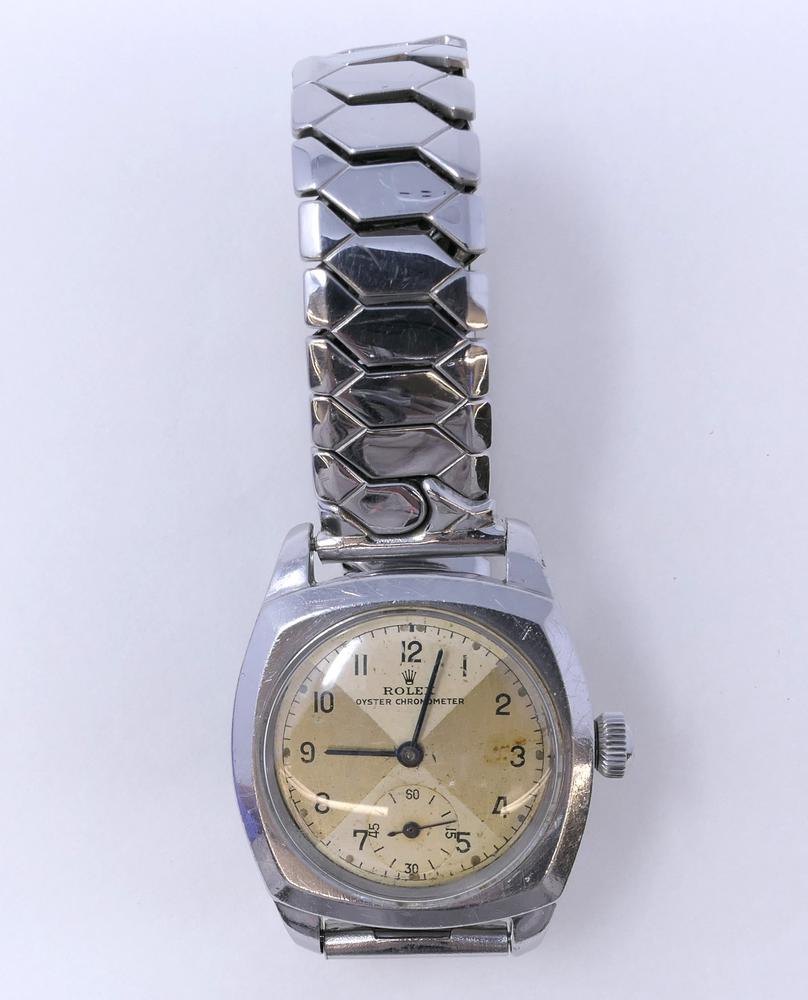
Stainless-steel Rolex Oyster chronometer wrist-watch
- Maker / attribution
- Rolex (Made by)
- Date
- 1939
- Historical period
- Golden Age of Mechanical Watchmaking (1900 – 1945)
- Country of origin
- Switzerland
- Place
- Geneva (city)
- Object type
- Wrist-watch
- Materials / technique
- steel
- Dimensions
- Length: 36 millimetres (case) Width: 29.50 millimetres (case)
- Holding institution
- British Museum
- Accession / object no.
- 1995,1205.1
- Credit line
- British Museum, London
- Catalogue title (original)
- Stainless-steel Rolex Oyster chronometer wrist-watch (English)
View the source record ↗ (opens another website in a new tab)Suggest a correction
Record summary
Held and catalogued by British Museum (object number 1995,1205.1), this is a wrist-watch by Rolex, made in Geneva (city), Switzerland, dated 1939. The Atlas places it in the Golden Age of Mechanical Watchmaking period (1900 – 1945) of its Wristwatches collection. Materials and techniques recorded by the source: steel. Recorded dimensions: Length: 36 millimetres (case) Width: 29.50 millimetres (case). The record is illustrated with 4 photographs.
Assembled from the source record's structured fields. Dates and attributions are given as the source states them; where a field is missing the Atlas leaves it blank rather than estimating.
Catalogue description
Description — British Museum
Stainless-steel Rolex Oyster chronometer wrist-watch. : CASE Rectangular stainless steel case with and expanding stainless-steel bracelet. Screw-down knurled winding/hand-set button. Screwed-on stainless steel back. : DIAL Silvered metal dial with hours 1-12 and subsidiary seconds. Blued-steel hour, minute and seconds hands. : MOVEMENT.
Curator's comments — British Museum
Comment from Richard Good, Catalogue of Watches in the British Museum. Vol. V (Unpublished manuscript) Made by Rolex Switzerland, c. 1939 Waterproof Wrist Watch with a club tooth lever escapement. Signature: On the dial 'ROLEX OYSTER CHRONOMETER' on the train bridge 'ROLEX CHRONOMETER TIMED 6 POSITIONS' on the barrel bridge '18 RUBIES' and 'SWISS MADE', on the barrel ratchet wheel is 'PATENTED SUPERBALANCE'. Case: A two part stainless steel case with the screw back with the typical edge knurl associated with Rolex.(1) The screw down button is marked 'OYSTER PATENT'. Stamped on the case back is the Rolex trade mark and two numbers 106545 and 3139. Engraved on the back is 'Francis from Susan 25 VIII 39'. On the inside of the back is 'OYSTER WATCH Co GENEVE - SWISS GREAT BRITAIN PATENTS SWISS PATENTS FRENCH PATENTS U.S.A. PATENTS GERMAN PATENTS', within an oval cartouche a balloon suspending 'RM' and within a stirrup shaped cartouche a crown and 'SAR'. With the watch is a stainless steel expanding bracelet, not original. Dial & Hands: A metal dial divided into four with two white and two silvered segments. The numerals and minute circle in black with luminous dots at the hours, a subsidiary seconds circle. On the back of the dial is stamped a star, 74 and 1151 1, and scratched Rolex 3 and 94510 and 2 Tone. Movement: Ebauche Marks: Under the dial is 'ROLEX 10 ½ HUNTER PATENT' and the number 0789. Frame: Bridges for the barrel and keyless work, for the train and the pallets and a cock for the balance. Under the cocks and bridges is stamped 0789. Barrel and Mainspring: Going barrel: I diameter 9.1 mm., height 1.65 mm. Mainspring: height 1.60 mm., thickness 0.1 mm. Barrel Arbor: diameter 2.85 mm., snailed. Hooking: Milled from the barrel wall. Train: All the brass wheels gilded, the centre, third and fourth wheels with five crossings. The steel escape wheel with four. Jewelling: Jewelled bearings from the third wheel onwards, with also a jewel at the centre in the bridge, all the jewels are rubbed in. Ruby endstones to the balance jewels and ruby endstones to the escape wheel. Escapement: A straight line layout, club tooth lever escapement with short lever, double roller and D-shaped impulse pin. The exposed pallet stones have flat acting faces. A steel escape wheel with four crossings and with very marked chamfers reducing the tip to the minimum practical thickness. An equal impulse escapement. No. of teeth embraced 3½. Balance & Spring: a monometallic balance, (known as the Superbalance(2)) with 8 broad nibs and between 4 brass screws and two platinum timing screws - the arm is divided into two limbs. Balance diameter 18.0 mm, thickness 1.6 mm. A self compensating flat spiral spring with 13 turns and a terminal curve. Means of Regulation: An index on the balance cock registers against a vernier divided scale with '+' and '-' engraved on the balance cock table. Train Counts and Beat Rate: Great wheel 70 (barrel) Centre wheel 64 pinion 10 Third wheel 60 pinion 8 Fourth wheel 60 pinion 8 Escape wheel 15 pinion 6 Beat rate: 18,000 Motion work: cannon pinion 10 minute wheel 30, minute pinion 8 hour wheel 32 Winding System: Conventional stem set positive keyless work but the button and case pendant are threaded and to wind and set hands the button must first be unscrewed from the pendant. Details of the arrangement are shown in the ills. Dimensions: Case : 29.4 mm., X 29.4 mm., without the lugs. Height 11.4 mm. over the glass. Movement: Diameter 22.7 mm., height 5.3 mm. Provenance: The gift of Lady Sandilands in 1995. The watch was owned by Sir Francis Sandilands, formerly a Trustee of the British Museum 1977 - 1985. Notes: (1) Special spanners are needed to open these cases. (2) This balance was patented in 1935, the patent number being 188977. The recessed screws were intended to streamline the balance. This was the first really successful waterproof wrist watch, in 1926 the watch was kept going for three weeks in water. In 1927 Mercedes Glietze swam the English Channel wearing a Rolex Oyster watch. There was an advertisement for these watches in 'The Practical Watch and Clock maker April 15th 1928'. See James L. Dowling and Jeffrey P. Hess 'The Best of Time ROLEX WRISTWATCHES'. Pa - u: S.A. 1996.
Inscriptions & marks
signature; ROLEX [beneath the coronet trade mark]; OYSTER CHRONOMETER [dial]; mark; ROLEX [within coronet trade mark]; 106545; 3139 [case back]; inscription; Francis; From; Susan; 25.VIII.39 [case back]; mark; EXCALIBUR; REG.860662; PATT.No.2278/55; STAINLESS STEEL; BACK [on bracelet links]
Provenance
Previous owner/ex-collection:, Sir Francis Sandilands; Donated by:, Lady Gillian Sandilands
Historical context
Golden Age of Mechanical Watchmaking (1900 – 1945)
The wristwatch displaces the pocket watch; waterproof cases, self-winding and grand complications.
The wristwatch overtook the pocket watch. Military use in the First World War, aviation, water-resistant cases (1926), automatic winding (1923–31), rectangular Art Deco designs and early chronographs and calendars defined the period.
Read the period in the timelineMore wristwatches from this periodEarlier: Industrial Revolution
Atlas type guide
Dive and water-resistant watches
Keeping water and dust out of a wristwatch was a long-standing challenge. Rolex's screw-down Oyster case (1926) and Omega's Marine (1932) were landmarks; in the early 1950s Blancpain's Fifty Fathoms and Rolex's Submariner defined the professional dive watch with rotating bezels for timing dives, luminous dials and high water resistance. The ISO 6425 standard (1982) later codified what a 'diver's watch' must do.
Dive watches became icons of post-war design and exploration, and their evolution — helium escape valves, ceramic bezels, saturation-diving depth ratings — records the history of underwater work.
What to look for
- Unidirectional or bidirectional rotating bezel with minute markings.
- Screw-down crown and case back; depth rating printed on the dial.
- Luminous hands and markers (radium before c. 1960, tritium c. 1960–1998, then Super-LumiNova).
- Reference numbers on the case between the lugs or inside the back.
Dating clues
- Screw-down Oyster cases: from 1926.
- Professional dive watches: from 1953.
- Tritium 'T' marks on dials: c. 1960–1998.
General guidance written by the Atlas editors about this kind of object. It is not a statement about this particular piece; for that, rely on the source record above and on physical examination.
Related records

Movements & Components · c. 1970s
Rolex watch movement, c. 1970s
Antiquorum auction archive, Geneva

Pocket Watches · 1982
Fake Rolex watch, gold coloured metal, possibly made in Taiwan, 1982; part of a casual outfit, UK, 1982-84.
Victoria and Albert Museum, London

Wristwatches · c. 1920s
Rolex wristwatch, c. 1920s
Antiquorum auction archive, Geneva

Wristwatches · c. 1920s
Rolex wristwatch, ref. 6194, c. 1920s
Antiquorum auction archive, Geneva

Wristwatches · 1931
Rolex 'Oyster Perpetual' rotor self-winding wrist-watch, lever escapement, in steel case with glass in back, Montres Rolex SA, Geneva, Switzerland, 1931
Science Museum Group, London

Wristwatches · 1900–1999
Wristwatch by Certina, Switzerland, 1900–1999
Nordic Museum Foundation

Wristwatches · 1900–1999
Wristwatch by Omega, Västerås, 1900–1999
Nordic Museum Foundation

Wristwatches · 1900–1999
Wristwatch by Universal, Switzerland, 1900–1999
Nordic Museum Foundation