
Wristwatches · Calendar watch
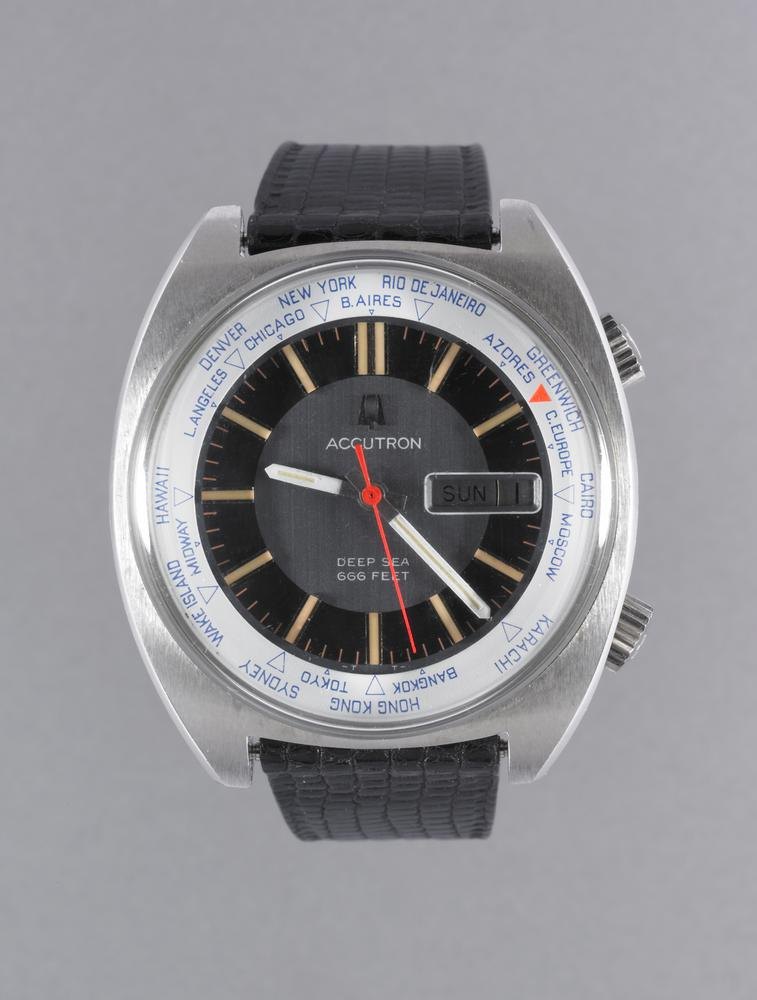
Stainless steel cased world-time centre-seconds day-date tuning-fork wrist-watch with black lizard-skin strap
- Maker / attribution
- Bulova Watch Company (Made by)
- Date
- 1972–1978
- Historical period
- Quartz Revolution (1969 – 1990)
- Country of origin
- North America
- Place
- United States
- Object type
- Calendar watch
- Materials / technique
- stainless steel, chromium, metal
- Dimensions
- Length: 45.60 millimetres Width: 41 millimetres
- Holding institution
- British Museum
- Accession / object no.
- 1989,0407.9
- Credit line
- British Museum, London
- Catalogue title (original)
- Stainless steel cased world-time centre-seconds day-date tuning-fork wrist-watch with black lizard-skin strap (English)
View the source record ↗ (opens another website in a new tab)Suggest a correction
Record summary
Held and catalogued by British Museum (object number 1989,0407.9), this is a calendar watch by Bulova Watch Company, made in United States, North America, dated 1972–1978. The Atlas places it in the Quartz Revolution period (1969 – 1990) of its Wristwatches collection. Materials and techniques recorded by the source: stainless steel, chromium, metal. Recorded dimensions: Length: 45.60 millimetres Width: 41 millimetres. The record is illustrated with 2 photographs.
Assembled from the source record's structured fields. Dates and attributions are given as the source states them; where a field is missing the Atlas leaves it blank rather than estimating.
Catalogue description
Description — British Museum
Battery powered mechanism with tuning-fork timing device/escapement. Dial with outer rotating white painted ring inscribed with locations around the world; luminous-painted baton hour marks; date aperture at 3 o'clock. White-painted hour and minute hands with luminous-painted bars; red-painted centre-seconds hand. Stainless-steel case with screw-on back. Lizard skin wrist-strap with chromium-plated buckle. When acquired contained a battery.
Curator's comments — British Museum
Text from 'Watches', by David Thompson, London, 2008, p. 156-157. Bulova Watch Company STAINLESS-STEEL, WORLD TIME 'ACCUTRON' WRISTWATCH NEW YORK, c. 1970 SIGNED: 'BULOVA PATENTED STAINLESS STEEL 666 FEET' (on the case back); ACCUTRON DEEP SEA 666 FEET' (on the dial) On 19 June 1953 the Bulova Watch Company of New York registered in Switzerland patent no. 312290 for a timekeeping device based on the oscillation of the free ends of a tuning fork. The concept had been realized by the Swiss-born engineer Max Hetzel, who at the time was working for Bulova in Bienne, Switzerland. As well as the tuning fork, an essential component of Hetzel's new timekeeping device was the newly invented transistor. In 1954 the world's first tuning-fork timekeeper - an electronic clock - was exhibited in Paris. The main obstacle to the production of a device small enough to be used in a watch was the lack of a long-life battery; this was overcome just a year later by the production of a new form of miniature zinc-mercuric oxide alkaline battery developed by Philip Rogers Mallory and Samuel Ruben at the Mallory Battery Company. The following year prototype watches were produced in Bienne. While confidence in the viability of the watch was limited in Switzerland, in America its potential was viewed differently. Max Hetzel and William Bennett perfected the design in New York, and in 1960 Bulova launched the 'Accutron' watch in that city as a viable production-model wristwatch. The Bulova calibre 214 was announced as the first fully electronic watch in the world. The tuning-fork mechanism works on the principle of using transistorized electronics to switch on and off small electromagnets, which keep the tuning fork arms vibrating at a frequency determined by their length, mass and elasticity. In the Accutron, this frequency is 360 oscillations per second. The vibration of the tuning fork is then transformed into circular motion using an extremely fine-toothed ratchet wheel and two tiny ratchet pawls. One pawl, moved by the tuning fork, pushes the wheel round in one direction, and the other, fixed to the watch plate, prevents the wheel from reversing. Production of this wheel was as much of a challenge as the electronic circuitry required for controlling and switching the electromagnets. The index wheel in the Accutron is less than five hundredths of a millimetre thick and has three hundred teeth, each just one hundredth of a millimetre high. The movement version contained in this watch, as seen from the inscription 'U.S.A. BULOVA 2182' on the case back, is the 2182 model, first made in 1968. The watch has a world-time dial with a manually adjusted outer white painted ring inscribed with locations around the world. To use this function, the normal fixed chapter ring with twelve baton markers has to be seen as a 24-hour ring; this, however, is not made easy because there are no half-hour divisions. Indeed in some models of this watch the dial is numbered with odd numbers from 1 to 23 between the baton hour marks. In order to use the watch in this way, the ring must be rotated using the button in the case band at 4 o'clock, so that the present location of the watch is indicated against the appropriate 24-hour mark on the fixed dial. For example, if it is 3 p.m. at Greenwich, the red Greenwich triangle is set to the 15 position - i.e. 7.30 - on the fixed chapter ring. The time at the other locations shown around the dial can then be read (taking into account, of course, any variations such as British Summer Time). The second button in the case band is for hand-setting in the normal way. The calibrations on the dial are luminous and there is a rectangular date aperture on the right. For divers, the inscription on the dial claims a resistance to water intrusion to a depth of 666 feet, and the sturdy stainless-steel case is complemented by a black lizard-skin wrist-strap with the name 'Accutron' on the inside.
Inscriptions & marks
signature; BULOVA PATENTED STAINLESS STEEL 666 FEET [case back]; signature; ACCUTRON DEEP SEA 666 FEET [dial]; signature; U.S.A. BULOVA 2182 [plates]; inscription; U.S.PAT.2.971.323 ETAL [plates]; inscription; LIZARD ACCUTRON [wrist-strap]; signature; BULOVA [buckle]; inscription; 343 RENATA + SWISS MADE [battery]
Provenance
Purchased from:, James Dowling
Historical context
Quartz Revolution (1969 – 1990)
Seiko's Astron begins mass quartz timekeeping; traditional industries contract sharply.
Quartz and digital watches transformed the market after 1969. Swiss employment collapsed, Japanese and Hong Kong production soared, and the Swatch (1983) helped the Swiss industry recover; mechanical watches survived as luxury goods.
Read the period in the timelineMore wristwatches from this periodEarlier: Modern Mechanical Horology
Atlas type guide
Calendar, moon-phase and perpetual calendar watches
Calendar complications range from a simple date to the perpetual calendar, which automatically allows for months of different lengths and leap years until 2100. Pocket watches with perpetual calendars were made in the eighteenth and nineteenth centuries; Patek Philippe made the first perpetual calendar wristwatch in 1925, and series production followed in 1941. The annual calendar (Patek Philippe, 1996) needs correction only once a year.
Moon-phase displays use a disc with two moons and 59 teeth advanced daily, approximating the 29.5-day lunation; more precise trains reduce the error to one day in over a century.
What to look for
- Apertures or subsidiary dials for day, date, month and leap year.
- Moon disc under a 'bosom' shaped aperture.
- Recessed correctors on the case band for setting the calendar.
Dating clues
- Triple-date wristwatches: popular c. 1940–1955.
- Perpetual calendar wristwatches: from 1925 (unique) and 1941 (series).
General guidance written by the Atlas editors about this kind of object. It is not a statement about this particular piece; for that, rely on the source record above and on physical examination.
Related records
Wristwatches · 1972–1978
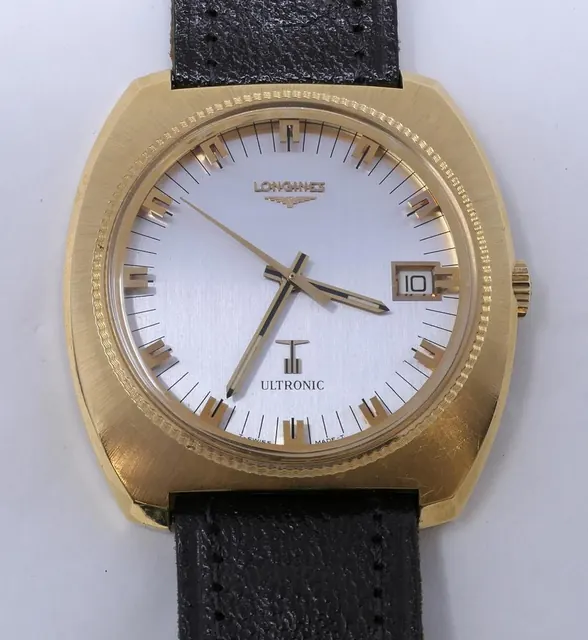
Centre-seconds quatz analogue wrist-watch with double-ended tuning fork and date mechanism. Gold-cased with brown leather strap
British Museum
Wristwatches · 1960
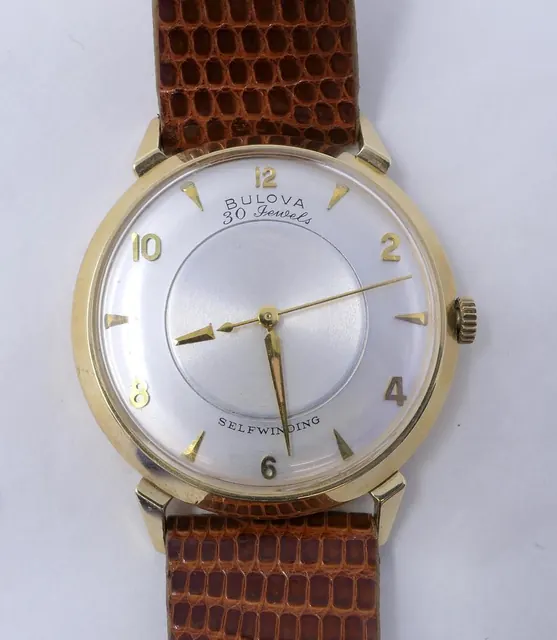
Automatic club-tooth lever centre-seconds wrist-watch with gold case and brown leather strap
British Museum
Wristwatches · 1974
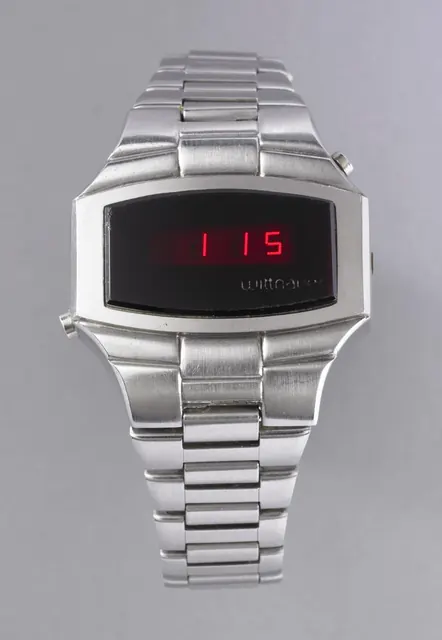
Wittnauer 'polara' quartz wrist watch
British Museum

Wristwatches · 1970
Wristwatch by Heno, Switzerland, 1970
Museum Rotterdam
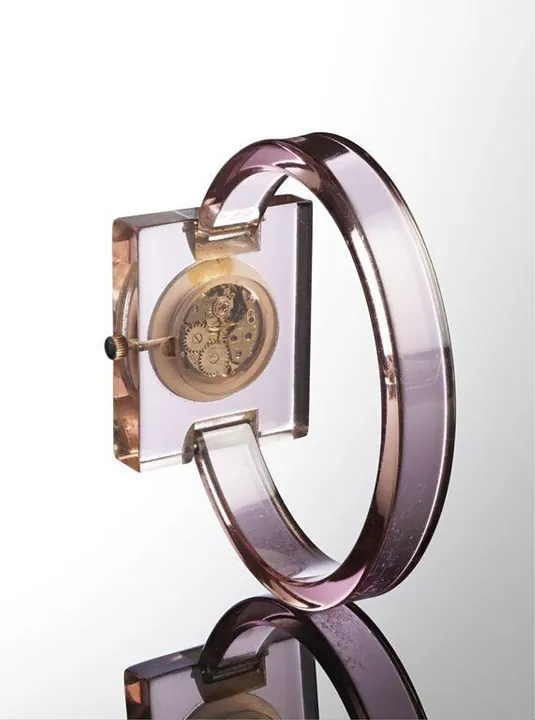
Wristwatches · 1970s
Wristwatch, plastic, by Gucci; Italy, 1970s.
Victoria and Albert Museum, London
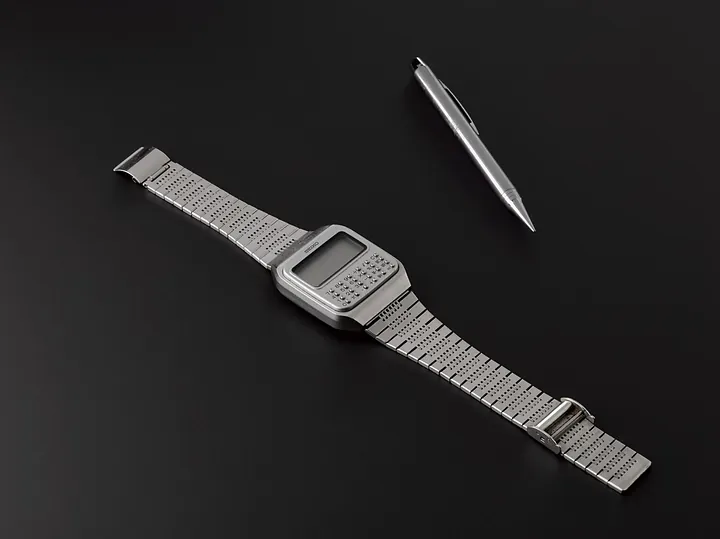
Wristwatches · 1978
Calculator wristwatch by Suwa Seikosha Co. Limited, Japan, 1978
Science Museum Group, London
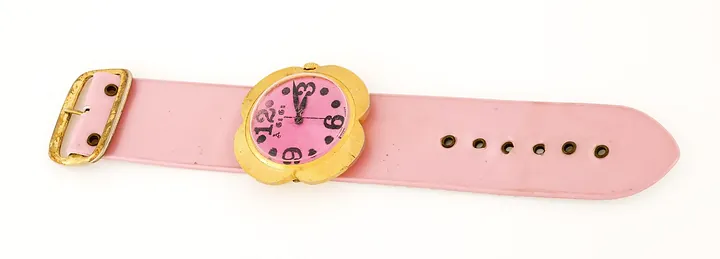
Wristwatches · 1980
Wristwatch, 1980 (no. 71413)
Museum Rotterdam
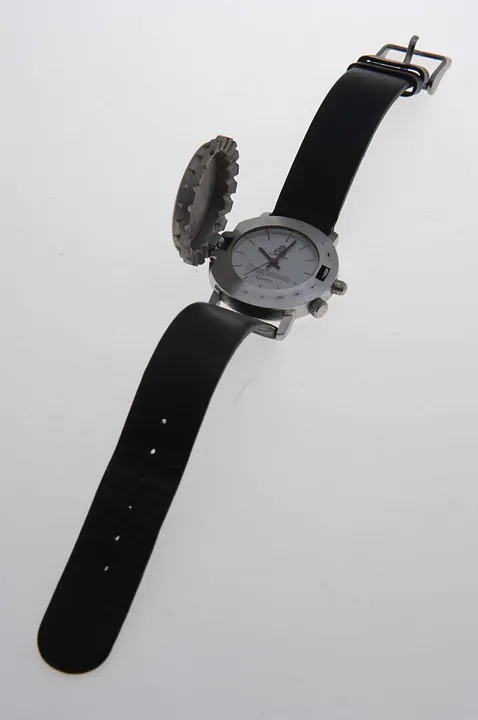
Wristwatches · 1980
Wristwatch, 1980 (no. 91477)
Museum Rotterdam