
Wristwatches · Wrist-watch
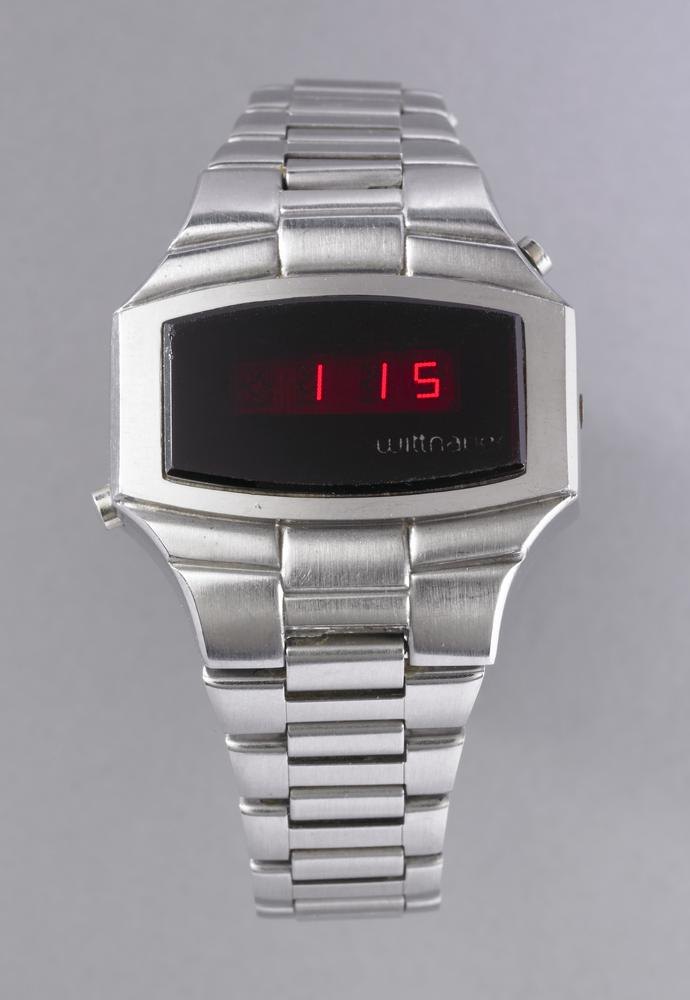
Wittnauer 'polara' quartz wrist watch
- Maker / attribution
- Hughes Aircraft Corporation (Made by); Wittenaur (Originally retailed by)
- Date
- 1974
- Historical period
- Quartz Revolution (1969 – 1990)
- Country of origin
- North America
- Place
- United States, New York (city)
- Object type
- Wrist-watch
- Materials / technique
- stainless steel
- Dimensions
- Length: 35.50 millimetres (excluding bracelet) Thickness: 14 millimetres Width: 18.50 millimetres
- Holding institution
- British Museum
- Accession / object no.
- 1998,0603.1
- Credit line
- British Museum, London
- Catalogue title (original)
- Wittnauer 'polara' quartz wrist watch (English)
View the source record ↗ (opens another website in a new tab)Suggest a correction
Record summary
Held and catalogued by British Museum (object number 1998,0603.1), this is a wrist-watch by Hughes Aircraft Corporation, made in United States, New York (city), North America, dated 1974. The Atlas places it in the Quartz Revolution period (1969 – 1990) of its Wristwatches collection. Materials and techniques recorded by the source: stainless steel. Recorded dimensions: Length: 35.50 millimetres (excluding bracelet) Thickness: 14 millimetres Width: 18.50 millimetres. The record is illustrated with 4 photographs.
Assembled from the source record's structured fields. Dates and attributions are given as the source states them; where a field is missing the Atlas leaves it blank rather than estimating.
Catalogue description
Description — British Museum
Stainless steel case with two battery compartments in the back. Satinless steel expanding bracelet. Smoked perspex cover to light emitting diode display.
Curator's comments — British Museum
Text from 'Watches', by David Thompson, London, 2008, p. 158-159. Longines-Wittnauer STAINLESS-STEEL WRISTWATCH USA, 1974 SIGNED: 'Wittnauer' (on the dial) and 'Polara' (on the bracelet clip) The first models of quartz watch, such as the Omega Megaquartz, had analogue dials with conventional hour, minute and seconds hands advanced by miniature electric motors. At the same time, however, a new form of watch with no moving parts was being developed. Following hard on the heels of the launch of the first Japanese quartz-controlled wristwatch, which had a traditional analogue dial, the Hamilton Watch Company presented their new electronic watch, the Pulsar, to the press on 6 May 1970. At the time there were only three working examples of this watch, but just one year later a limited edition gold cased watch was made available in the shops, and major production began. This watch displayed the time in an illuminated 24-hour digital form. The new technology was based around the use of a light-emitting diode, a semi-conductor that emits light on passage of an electric current. The phenomenon was first recognized by Captain Henry Joseph Round, who worked for Marconi in New York. Round published his findings in the journal 'Electrical World' in February 1907, recording in a letter to the editor that: "During an investigation of the unsymmetrical passage of current through a contact of carborundum and other substances a curious phenomenon was noted. On applying a potential of 10 volts between two points on a crystal of carborundum, the crystal gave out a yellowish light." Another pioneer in the field was Oleg Vladimirovich Losev, who published his research in 1927. Although work continued, it was not until 1962 that the first practical LED was produced by Nick Holonyak Jr, working for the General Electric Company in America. In watches, an LED display consists of four miniature panels, each usually with seven separate sections, each section containing a number of tiny light-emitting diodes. The electronics then switch electrical currents through different patterns of the sections to produce the numerical display. The major drawback of the LED system was its need for relatively large amounts of electrical power to illuminate the diodes. Many watches using the technology had to be provided with two batteries, which needed relatively frequent renewal. As a result of this shortcoming, the LED display was soon replaced by watches with liquid crystal displays, a technology first documented in 1904 by the German scientist Otto Lehmann and developed to a unit patented in 1936 by Marconi. Despite this early date, a practical liquid crystal display was not made until the late 1960s. This complex combination of molecular science, electronics and optics has now been developed to a point where production is cheap and carried out on a massive global scale, with huge numbers of applications. In watches it very quickly replaced the light-emitting diode, as it needed far less electrical power. The introduction of this new technology and improvements in the longevity of batteries means that watches now run for a number of years before requiring a battery replacement. The firm Wittnauer was founded by Albert Wittnauer, who emigrated from Switzerland to America in 1872. With his brothers Louis and Emile he established a business that imported Swiss-made watches. In later years, following a merger, the company became Longines-Wittnauer. That Wittnauer was keen to move into the new market is well demonstrated by its early marketing of this LED quartz watch. It uses a unit made by the Hughes Aircraft Corporation, responsible for very large production in America of quartz watch 'movements'. The smoked glass is dark until buttons in the case band are pushed in, either singly or in combination, to illuminate the dial to show either the time in hours and minutes or seconds, or the date.
Inscriptions & marks
inscription; Wittnauer [dial]; inscription; edge of module; ASSEMBLED IN MEXICO; inscription; front of module; 705-C; inscription; on module; HUGHES AIRCRAFT CO [partially removed]; inscription; inside case back; WITTNAUER; NEW YORK; GENEVA TORONTO; CASE 3233 - LED
Provenance
Donated by:, Joseph Bromberg, Donated by:, Ruth Bromberg, In Memory of:, Michael Bromberg
Historical context
Quartz Revolution (1969 – 1990)
Seiko's Astron begins mass quartz timekeeping; traditional industries contract sharply.
Quartz and digital watches transformed the market after 1969. Swiss employment collapsed, Japanese and Hong Kong production soared, and the Swatch (1983) helped the Swiss industry recover; mechanical watches survived as luxury goods.
Read the period in the timelineMore wristwatches from this periodEarlier: Modern Mechanical Horology
Atlas type guide
Quartz, digital and electronic watches
Electronic watches arrived in three steps. The Hamilton Electric 500 (1957) was the first battery-powered wristwatch, still with a balance; Bulova's Accutron (1960) used a tuning fork. On 25 December 1969 Seiko released the Astron 35SQ, the first quartz wristwatch, closely followed by the Swiss Beta 21 group. In 1972 Hamilton's Pulsar introduced the LED digital watch, and LCD displays soon made digital watches cheap.
The 'Quartz Crisis' that followed devastated the Swiss mechanical industry, which lost two-thirds of its workforce between 1970 and 1984 before recovering with the Swatch (1983) and the luxury mechanical revival. Solar, radio-controlled, kinetic and connected smartwatches continue the electronic line.
What to look for
- Battery hatch in the case back and calibre markings with 'Quartz' or a crystal frequency.
- Display technology: LED (red, push-button) versus LCD (always-on).
- Tuning-fork hum and a smoothly sweeping seconds hand on Accutrons.
- Model and reference numbers, often printed on the back.
Dating clues
- Electric balance watches: from 1957.
- Tuning-fork watches: 1960–c. 1977.
- Quartz analogue: from December 1969; LED digital: 1972–c. 1978; LCD from 1973.
General guidance written by the Atlas editors about this kind of object. It is not a statement about this particular piece; for that, rely on the source record above and on physical examination.
Read next:Seiko calibre 35A (Astron)
Related records
Wristwatches · 1972–1978
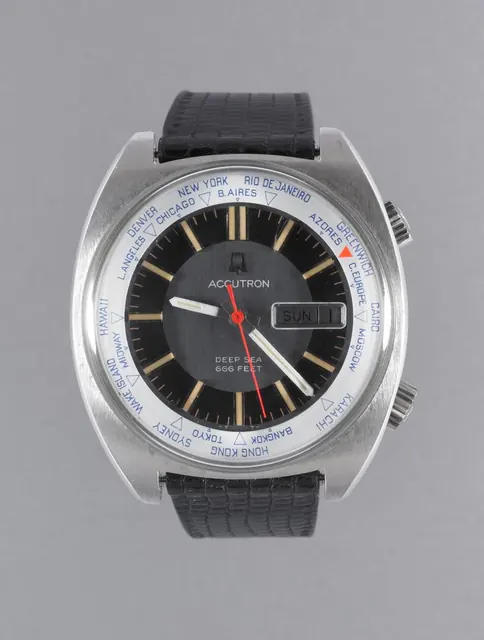
Stainless steel cased world-time centre-seconds day-date tuning-fork wrist-watch with black lizard-skin strap
British Museum

Wristwatches · 1970
Wristwatch by Heno, Switzerland, 1970
Museum Rotterdam
Wristwatches · 1970s
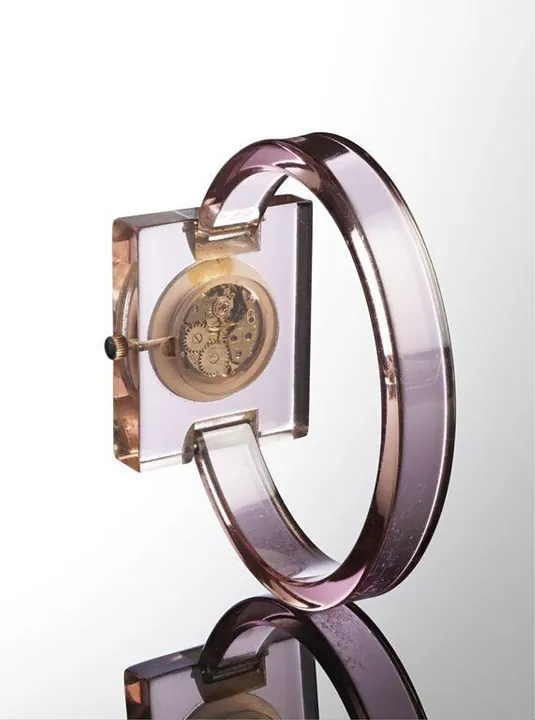
Wristwatch, plastic, by Gucci; Italy, 1970s.
Victoria and Albert Museum, London
Wristwatches · 1978
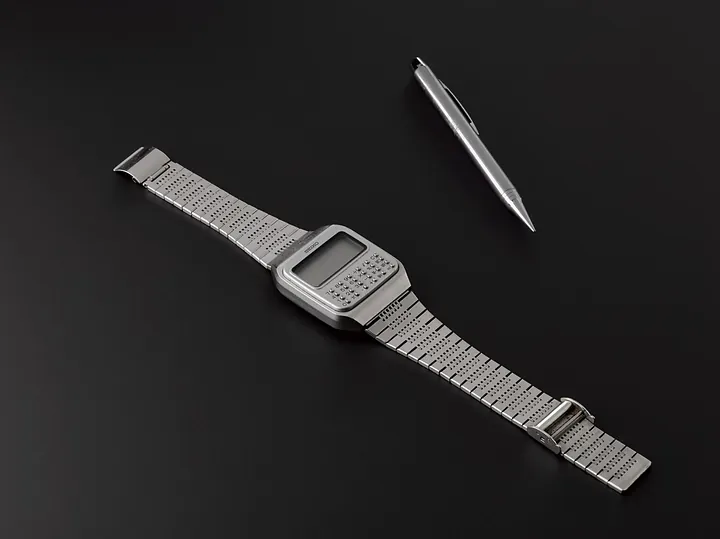
Calculator wristwatch by Suwa Seikosha Co. Limited, Japan, 1978
Science Museum Group, London
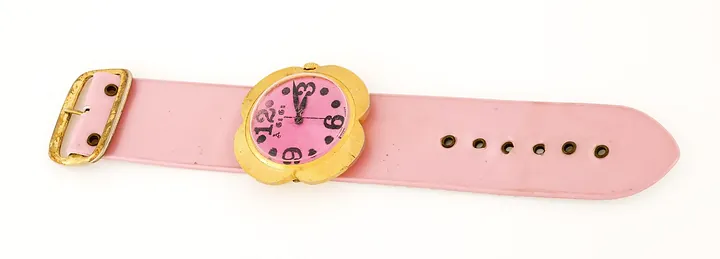
Wristwatches · 1980
Wristwatch, 1980 (no. 71413)
Museum Rotterdam
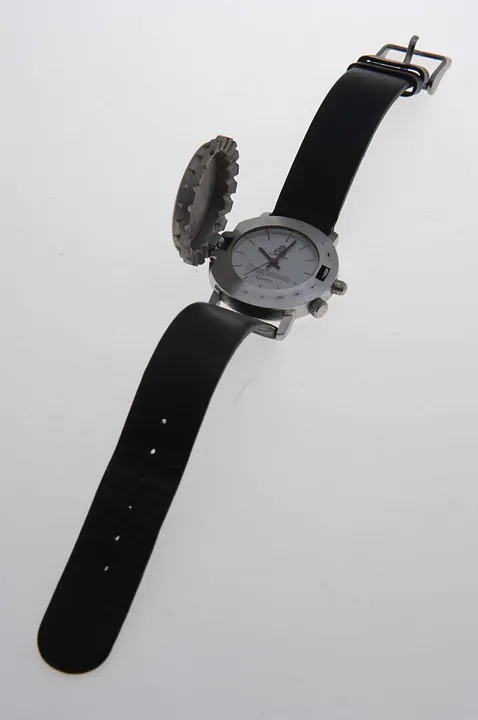
Wristwatches · 1980
Wristwatch, 1980 (no. 91477)
Museum Rotterdam
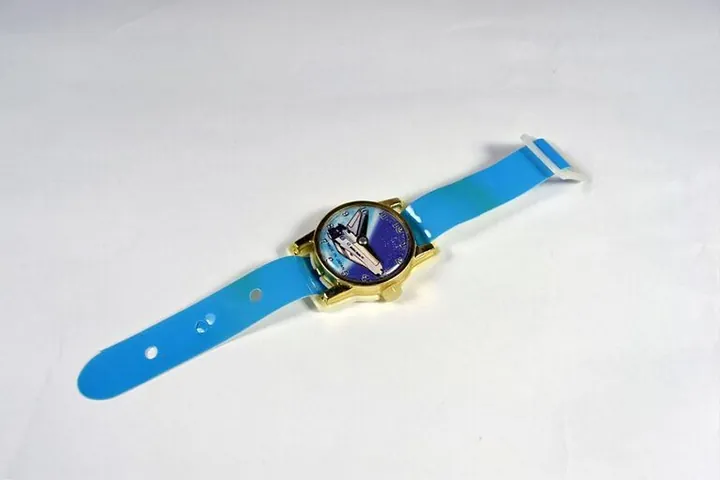
Wristwatches · 1980–1982
Wristwatch, Space Shuttle; plastic, Japan, 1970-1979?
Victoria and Albert Museum, London
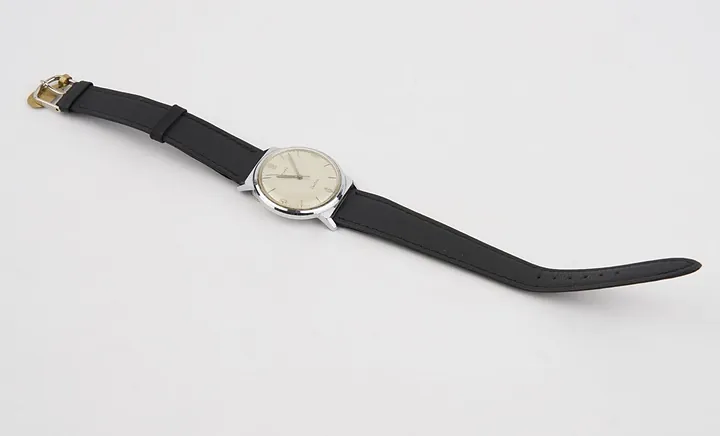
Wristwatches · 1949–1992
Timex `Electric' wristwatch, with electrically operated balance wheel mechanism, United States, 1949–1992
Science Museum Group, London