
Wristwatches · Wristwatch
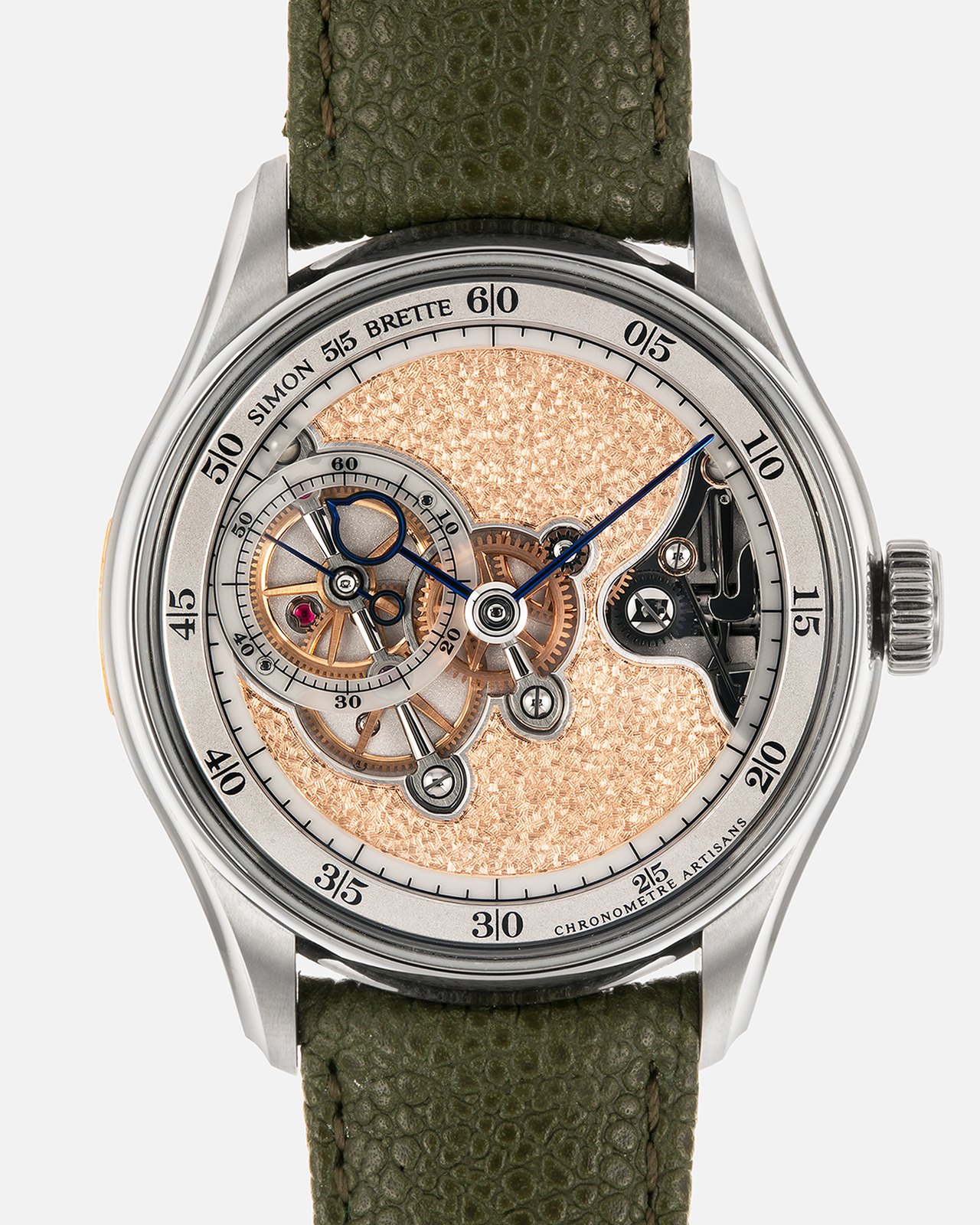
Simon Brette Chronometre Artisans Edition Titane, 2025
- Maker / attribution
- Simon Brette (maker)
- Date
- 2025
- Historical period
- Contemporary Horology (2010 – Present)
- Country of origin
- Unrecorded in source
- Object type
- Wristwatch
- Dimensions
- Case 39 mm
- Stock no.
- Product 7748336123991
- Credit line
- Dealer listing, S.Song Watches (product 7748336123991)
- Catalogue title (original)
- Simon Brette Chronometre Artisans Edition Titane (English)
View the source record (dealer listing) ↗ (opens another website in a new tab)Suggest a correction
Record summary
Catalogued by S.Song Watches (dealer), Seattle (stock number Product 7748336123991), this is a wristwatch by Simon Brette, dated 2025. The Atlas places it in the Contemporary Horology period (2010 – Present) of its Wristwatches collection. Recorded dimensions: Case 39 mm. The record is illustrated with 6 photographs.
Assembled from the source record's structured fields. Dates and attributions are given as the source states them; where a field is missing the Atlas leaves it blank rather than estimating.
Catalogue description
Dealer description — S.Song Watches
Independent watchmaking is perhaps more exciting today than it has ever been. While established names such as F.P. Journe, Philippe Dufour and Kari Voutilainen have become some of the most coveted watchmakers in the world, a new generation of independents is beginning to emerge behind them. Among this new wave, few have made an impact quite as quickly as Simon Brette. Before launching his own brand, Brette spent over a decade working behind the scenes as a movement constructor, with experience at Chronode, MCT and MB&F. In 2023, he finally unveiled his first watch, the Chronomètre Artisans, and the response was almost immediate. His inaugural 12-piece Souscription series went on to win the Horological Revelation Prize at the 2023 GPHG, firmly establishing Brette as one of the most exciting young names in independent watchmaking. The case itself measures a beautifully proportioned 39mm in diameter, 10.5mm thick and just 45mm lug-to-lug. Made from Grade 5 titanium, the overall shape appears relatively simple at first, but there is a lot going on upon closer inspection. Satin-finished surfaces contrast against polished concave bevels, while a small rose gold dovetail-shaped insert on the caseband has become something of a signature for Brette. It is a subtle reference to his father, who was a cabinetmaker, and a lovely detail that speaks to the artisanal philosophy behind the watch. The dial is undoubtedly one of the highlights. Made from solid 5N rose gold, it features Brette's distinctive "Tiger Claws" pattern, painstakingly engraved entirely by hand to create an almost three-dimensional mosaic across its surface. The asymmetrical layout places the small seconds at approximately 9:15, while portions of the dial are opened to reveal the mechanics beneath. The flame-blued steel hands are mirror-polished, rounded and bevelled by hand, and the combination of rose gold, blue steel and the darker movement underneath gives the watch an incredible amount of depth. As impressive as the dial is, turn the watch over, and things get even better. Powering the Chronomètre Artisans is the manually wound Cal. SBCA, an original movement developed specifically for the watch and built around a wonderfully symmetrical architecture dominated by its large balance wheel. Two barrels arranged in parallel provide approximately 72 hours of power reserve, while the balance beats at a wonderfully traditional 18,000 vibrations per hour. The finishing is quite extraordinary. The ruthenium-finished bridges and plate feature extensive hand finishing, with broad polished bevels, mirror-polished concave screws set within solid rose gold chatons and beautifully finished wheels with hand-polished bevels. There are 194 components in the movement alone and 226 in the completed watch, with seemingly no part overlooked. Perhaps most importantly, the name "Artisans" isn't simply marketing. Brette openly credits the specialists involved in creating each watch, with 12 artisans contributing their respective crafts and each named in the individual passport accompanying the watch. Among them are some particularly respected names in their respective fields, including master hand engraver Yasmina Anti , responsible for the extraordinary hand-engraved dial, signature and numbering; Luc Monnet , a Meilleur Ouvrier de France who produced and finished various movement components using traditional methods; and hairspring specialist Nadine Görgl , responsible for assembling the balance and hand-forming its Breguet terminal curve. I find this particularly refreshing. Watches produced at this level are rarely the work of one individual, and Brette embraces rather than hides the collective craftsmanship behind them.
Historical context
Contemporary Horology (2010 – Present)
Silicon components, connected watches, optical-lattice research clocks and a thriving independent scene.
Smartwatches became the world's best-selling watches, while mechanical watchmaking focuses on craft, innovation (silicon components, new escapements) and independent makers.
Read the period in the timelineMore wristwatches from this periodEarlier: Mechanical Renaissance
Atlas type guide
Wristwatches
Bracelet watches were worn by women from the early nineteenth century — Breguet made one for Caroline Murat, Queen of Naples, in 1810–12 — but the wristwatch only became a man's instrument with military use and aviation in the early twentieth century. Between the World Wars it overtook the pocket watch; the 1920s and 1930s brought rectangular Art Deco cases, water-resistant cases and the first automatic winding systems.
After 1945 the wristwatch became a carrier of identity — dress watches, sports and dive watches, chronographs, calendars — produced by Swiss, American, Japanese, German, Soviet and Chinese industries. The quartz revolution after 1969 and the mechanical renaissance since the 1990s, including the rise of independent watchmakers, complete the story.
What to look for
- The reference number (between the lugs or inside the case back) and serial number, the starting point for dating.
- The calibre: its maker and number are often stamped under the dial or on the bridge.
- Originality of dial, hands and crown — refinished ('redial') dials are common.
- Case material marks: 18K/750, 14K/585, stainless steel, gold-filled, plated.
Dating clues
- Wire-lug cases: before c. 1925.
- Water-resistant screw-down cases: from 1926.
- Quartz movements: from 1969; sapphire crystals widespread after c. 1980.
General guidance written by the Atlas editors about this kind of object. It is not a statement about this particular piece; for that, rely on the source record above and on physical examination.
Related records

Wristwatches · 2010
Wristwatch, 2010
Modemuseum Hasselt
Wristwatches · 2018 (Series 4 released in September 2018; '1977' in the source is the model number A1977)
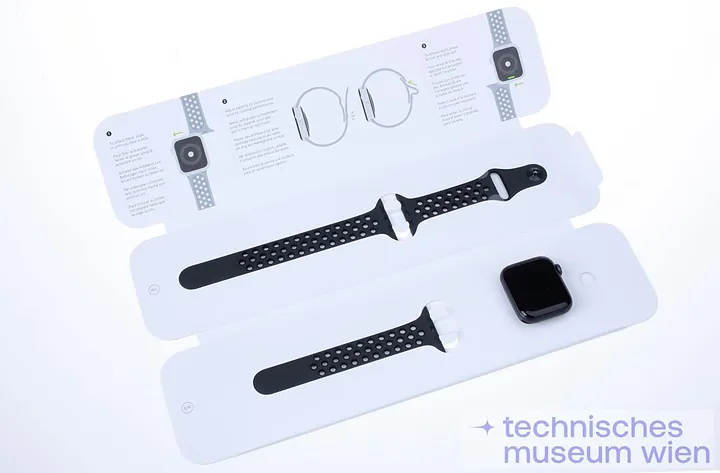
Apple Watch Series 4 (GPS, 40 mm, model A1977), 2018
Vienna Museum of Science and Technology
Wristwatches · c. 2010s
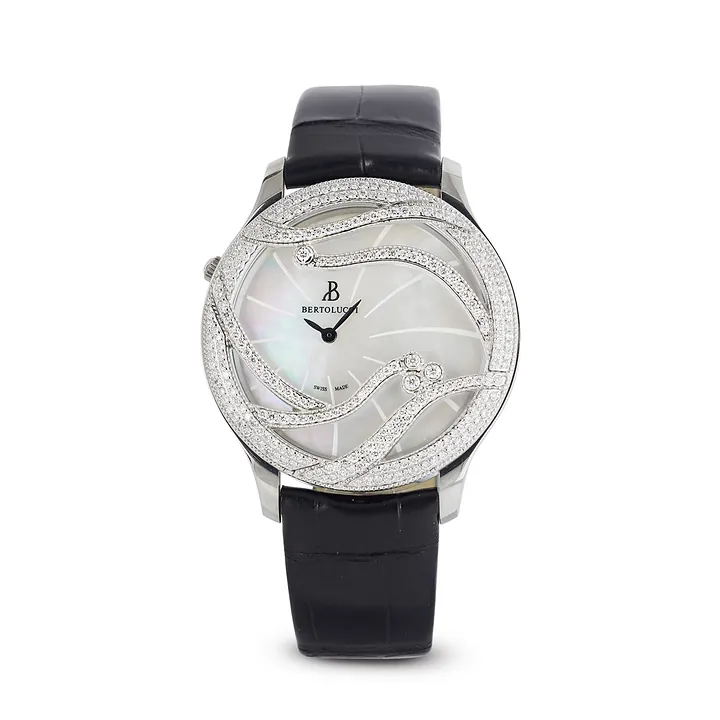
Bertolucci Stria III, ref. 11513.50.45.B88.6C1.501, c. 2010s
Antiquorum auction archive, Geneva
Wristwatches · c. 2010s
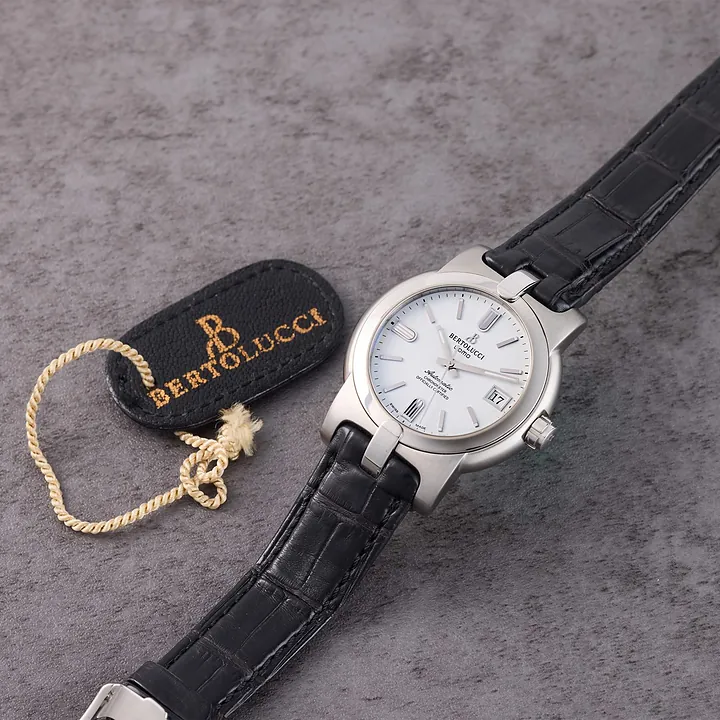
Bertolucci Uoma, ref. 824.51.41.10B, c. 2010s
Antiquorum auction archive, Geneva

Wristwatches · c. 2010s
Breguet Type XXI, ref. 3810, c. 2010s (Antiquorum Lot 381-24)
Antiquorum auction archive, Geneva

Wristwatches · c. 2010s
Breguet Type XXI, ref. 3810, c. 2010s (Antiquorum Lot 386-229)
Antiquorum auction archive, Geneva

Wristwatches · Sold in September 2010
Breitling Cosmonaute, ref. A 22322, Sold in September 2010
Antiquorum auction archive, Geneva
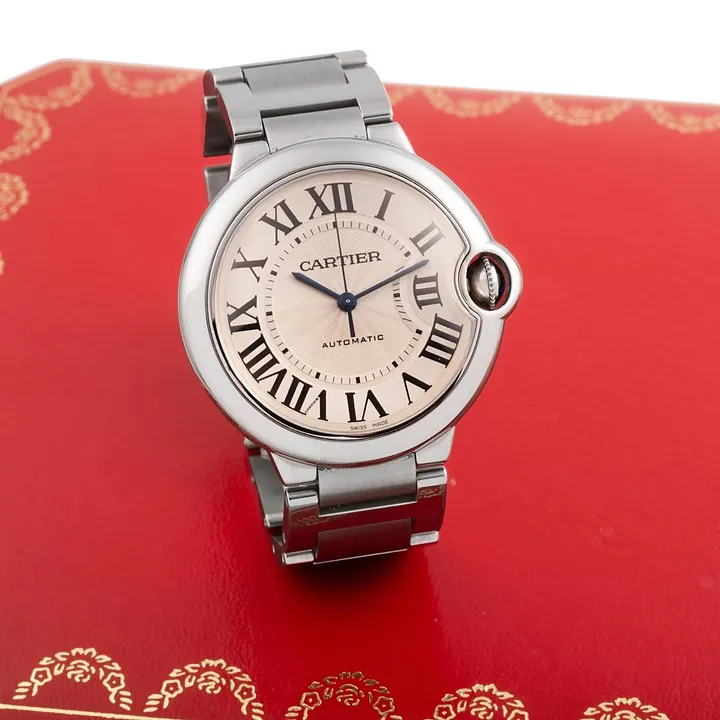
Wristwatches · c. 2010s
Cartier Ballon Bleu, ref. 3284, c. 2010s
Antiquorum auction archive, Geneva