
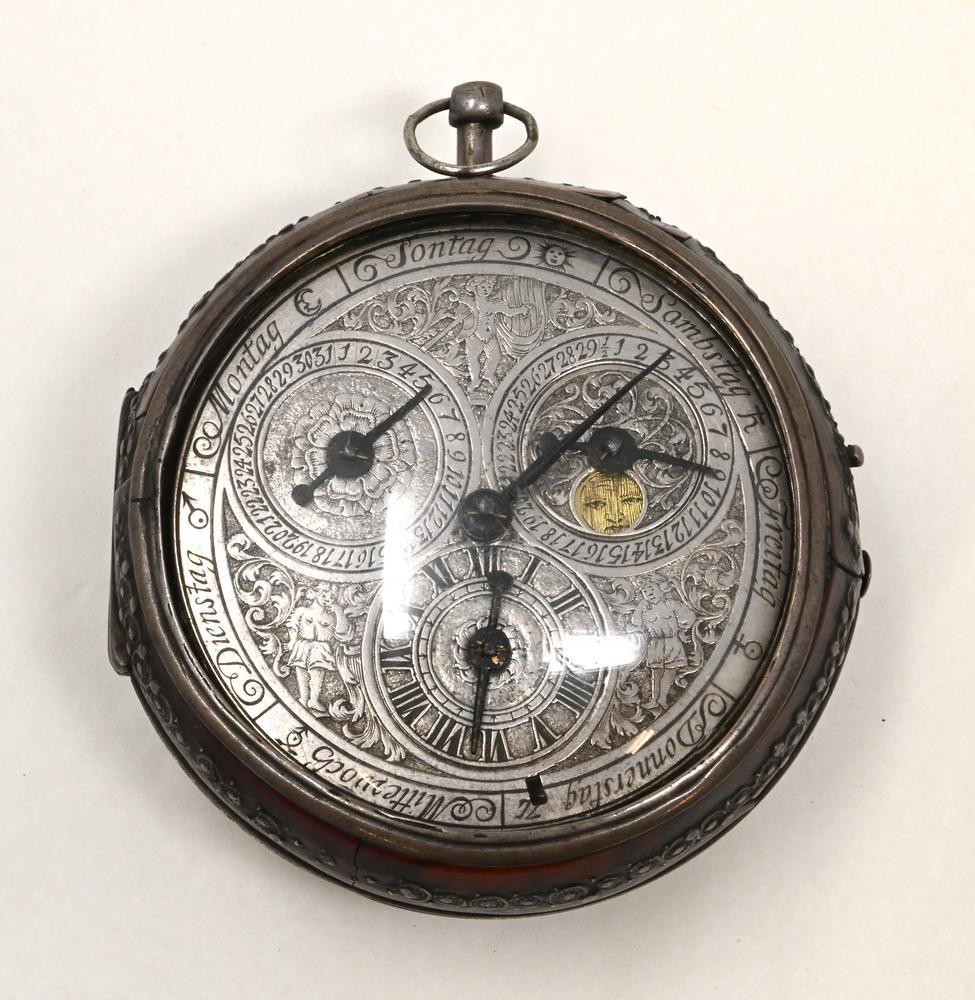
Pocket Watches · Calendar watch
Silver & tortoise-shell pair-cased verge watch with date indicator [inner case not original]
- Maker / attribution
- Ferdinandus Zolling (Made by)
- Date
- 1660–1670
- Historical period
- Early Modern Horology (1600 – 1750)
- Country of origin
- Germany
- Place
- Hamburg (city)
- Object type
- Calendar watch
- Materials / technique
- tortoise-shell, brass, silver
- Dimensions
- Diameter: 65.30 millimetres (outer case)
- Holding institution
- British Museum
- Accession / object no.
- 1958,1201.2338
- Credit line
- British Museum, London
- Catalogue title (original)
- Silver & tortoise-shell pair-cased verge watch with date indicator [inner case not original] (English)
View the source record ↗ (opens another website in a new tab)Suggest a correction
Record summary
Held and catalogued by British Museum (object number 1958,1201.2338), this is a calendar watch by Ferdinandus Zolling, made in Hamburg (city), Germany, dated 1660–1670. The Atlas places it in the Early Modern Horology period (1600 – 1750) of its Pocket Watches collection. Materials and techniques recorded by the source: tortoise-shell, brass, silver. Recorded dimensions: Diameter: 65.30 millimetres (outer case). The record is illustrated with 6 photographs.
Assembled from the source record's structured fields. Dates and attributions are given as the source states them; where a field is missing the Atlas leaves it blank rather than estimating.
Catalogue description
Description — British Museum
Movement frame: Circular gilt-brass plates with four baluster pillars. A potence-hole in the pillar-plate. Riveted potence and riveted counter-potence. Engraved decoration around the verge aperture. The perimeter of the pillar-plate engraved with a rope-twist border. Mainspring & set-up: Gilt-brass barrel with snap-in cap and riveted brass hook. There is also a square hole for hooking which is not presently used. Ratchet and click set-up mounted on the dial side of the pillar-plate. Fusee & stop-work: Gilt-brass fusee for chain [now with gut-line] and with English stop-work. Train: Four-wheel train of gilt-brass wheels, the second, third and contrate with three crossings. Escapement & balance: Verge escapement, the balance, balance-spring, regulation and balance-cock all replaced. Motion work: Pinion of report: 30 Dial wheel: 40 - pinion: 4 Day of week wheel: 56 - pinion: 14 Calendar wheel: 62 Lunar wheel: 59. Dial & hands: Gilt-brass dial plate with a pinned-on silver champlevé dial. Around the outside, a circle engraved with the days of the week with their planetary signs. The lower subsidiary chapter-ring with Roman hours I-XII surrounding half-hour circle. In the centre an engraved rosette. To the left, the subsidiary dial is engraved 1-31 for the date. To the right, the subsidiary dial is engraved 1-29.5 around the outside for the age of the moon, with a revolving silver disc in the middle which has an aperture to show the moon's age engraved on a gilt-brass disc below. The spandrel spaces are engraved with foliate scrolls and putti, the one at the top holding a banner/flag. None of the hands are original. Cases: Later plain silver inner case with a tortoise-shell outer with silver rims and silver piqué decoration consisting of a central geometric design surrounded by four coronets.
Curator's comments — British Museum
This watch has been re-cased in the late 17th century when it was also furnished with its balance spring, geared regulation and balance-cock. There is no record of a watchmaker with the name Willing. The very long winding square was probably added when the new case was fitted. Although inscribed 'London' on the regulator plate, the work is much more likely to have been done in Germany.
Inscriptions & marks
signature; Ferdinandus Zolling Hamburg [potence-plate]; inscription; Willing London [regulator plate]
Provenance
Previous owner/ex-collection:, Courtenay Adrian Ilbert; Purchased through:, Christie's; Acquired 1958
Historical context
Early Modern Horology (1600 – 1750)
Huygens' pendulum and balance spring transform accuracy; English makers develop the anchor and deadbeat escapements.
The balance spring (c. 1675) improved watches dramatically and introduced the minute hand. English pair-cased verge watches with pierced balance cocks and French oignons were typical; enamel painting at Blois and Geneva, and the repeating watch (1680s), made watches objects of great refinement.
Read the period in the timelineMore pocket watches from this periodEarlier: Renaissance Horology
Atlas type guide
Calendar, moon-phase and perpetual calendar watches
Calendar complications range from a simple date to the perpetual calendar, which automatically allows for months of different lengths and leap years until 2100. Pocket watches with perpetual calendars were made in the eighteenth and nineteenth centuries; Patek Philippe made the first perpetual calendar wristwatch in 1925, and series production followed in 1941. The annual calendar (Patek Philippe, 1996) needs correction only once a year.
Moon-phase displays use a disc with two moons and 59 teeth advanced daily, approximating the 29.5-day lunation; more precise trains reduce the error to one day in over a century.
What to look for
- Apertures or subsidiary dials for day, date, month and leap year.
- Moon disc under a 'bosom' shaped aperture.
- Recessed correctors on the case band for setting the calendar.
Dating clues
- Triple-date wristwatches: popular c. 1940–1955.
- Perpetual calendar wristwatches: from 1925 (unique) and 1941 (series).
General guidance written by the Atlas editors about this kind of object. It is not a statement about this particular piece; for that, rely on the source record above and on physical examination.
Related records
Pocket Watches · 1600–1699
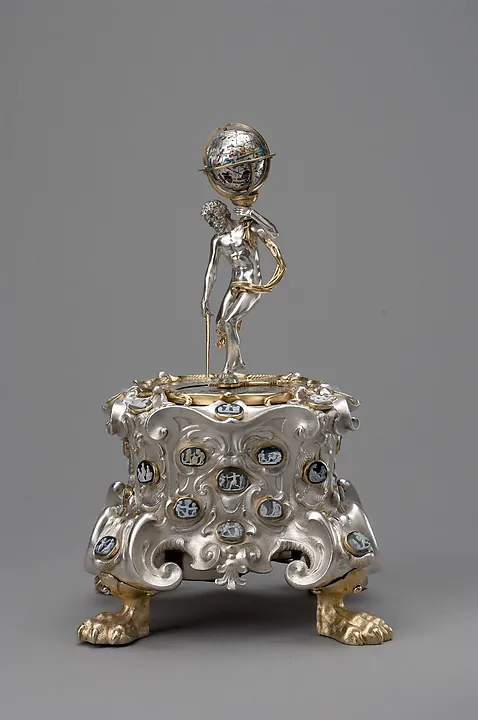
Pocket watch by Georg Ernst, Germany, 1600–1699
Fine Arts Museum Vienna
Pocket Watches · 1600–1699
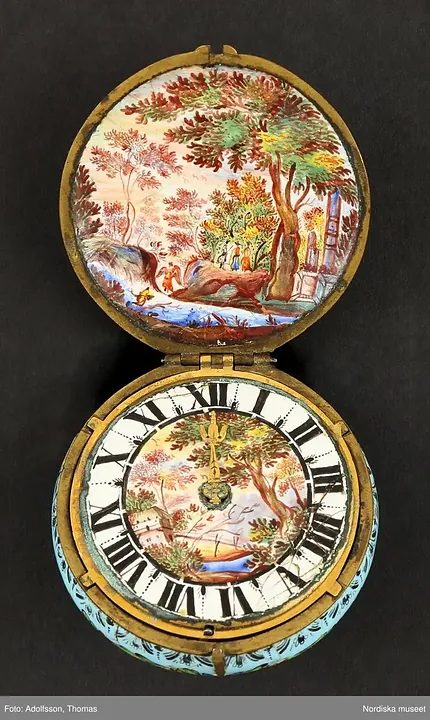
Pocket watch by Johan Etmiller, Germany, 1600–1699
Nordic Museum Foundation
Pocket Watches · early 17th century
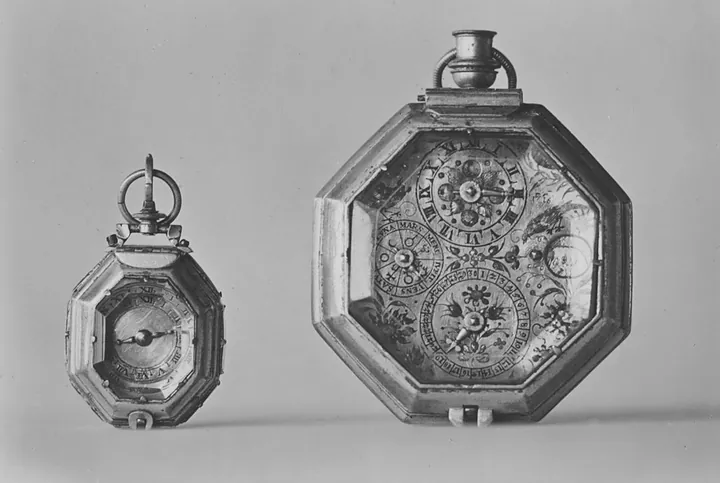
Watch with gilt brass case, crystal and blue glass panels signed 'Conradt Kreizer', Germany, early 17th century
Victoria and Albert Museum, London
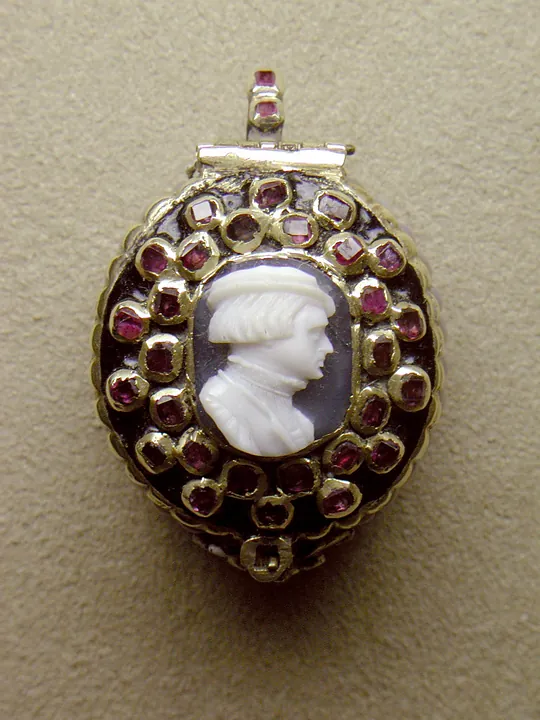
Pocket Watches · watch c. 1650, cameo 16th–17th century
Watch by Wilhelm Peffenhauser, Germany, watch c. 1650, cameo 16th–17th century
The Metropolitan Museum of Art, New York
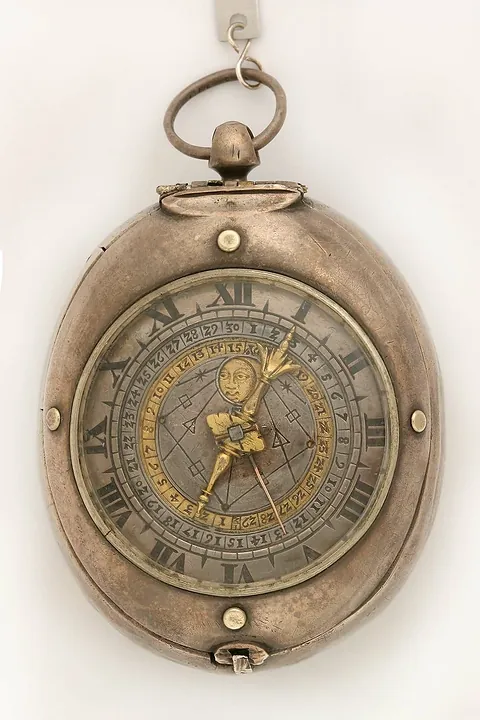
Pocket Watches · c. 1650
Pocket watch by Johann Sayller, Germany, c. 1650
German Clock Museum
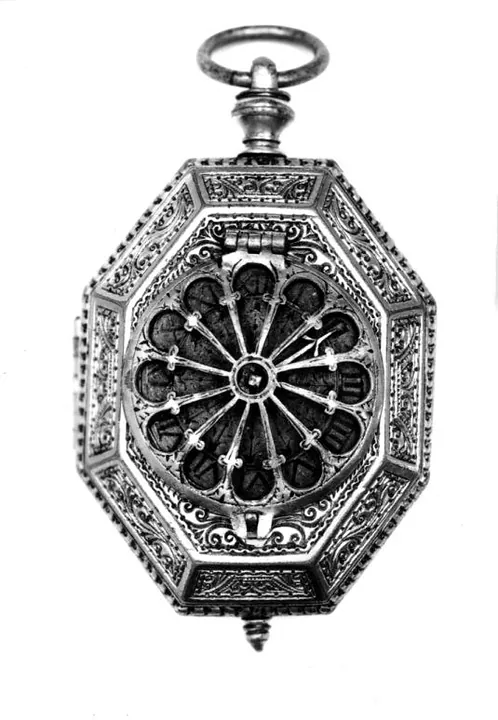
Pocket Watches · 1650–1699
Pocket watch, Germany, 1650–1699
Badisches Landesmuseum Karlsruhe
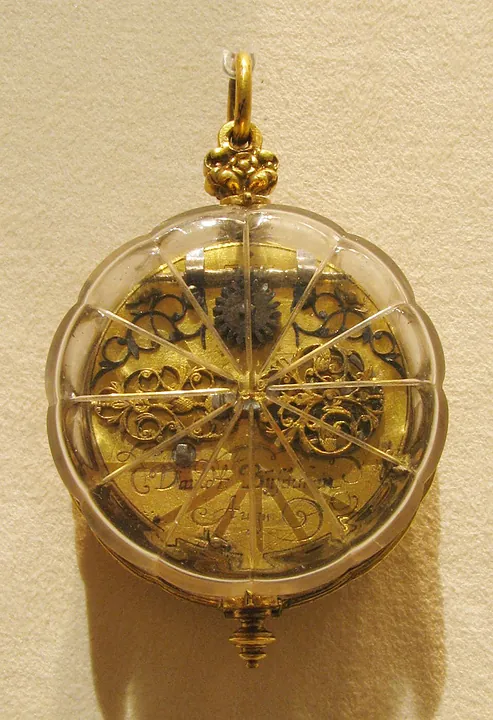
Pocket Watches · probably after 1657
Watch by David Buschman, Germany, probably after 1657
The Metropolitan Museum of Art, New York
Pocket Watches · c. 1670
Watch by Nicolaus Rugendas the Younger, Germany, c. 1670
The Metropolitan Museum of Art, New York