
Pocket Watches · Clock-watch
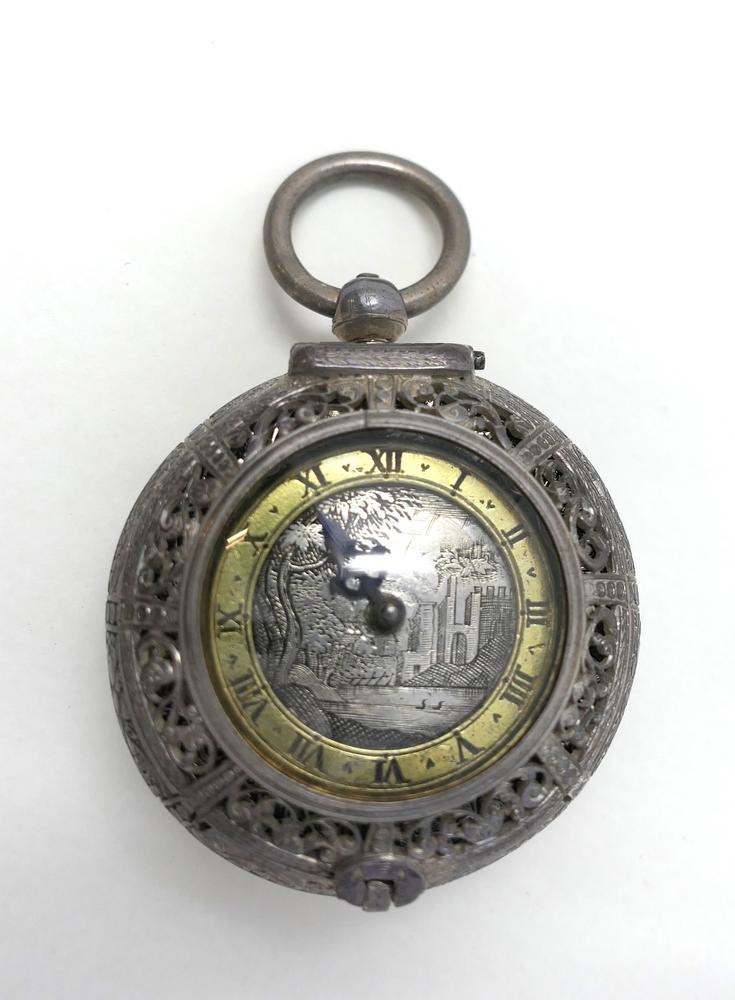
Silver cased verge clock-watch
- Maker / attribution
- André Bernard (Made by)
- Date
- 1630–1640
- Historical period
- Early Modern Horology (1600 – 1750)
- Country of origin
- France
- Place
- Paris (France)
- Object type
- Clock-watch
- Materials / technique
- silver
- Dimensions
- Diameter: 43.70 millimetres (case)
- Holding institution
- British Museum
- Accession / object no.
- 1881,0802.6
- Credit line
- British Museum, London
- Catalogue title (original)
- Silver cased verge clock-watch (English)
View the source record ↗ (opens another website in a new tab)Suggest a correction
Record summary
Held and catalogued by British Museum (object number 1881,0802.6), this is a clock-watch by André Bernard, made in Paris (France), dated 1630–1640. The Atlas places it in the Early Modern Horology period (1600 – 1750) of its Pocket Watches collection. Materials and techniques recorded by the source: silver. Recorded dimensions: Diameter: 43.70 millimetres (case). The record is illustrated with 5 photographs.
Assembled from the source record's structured fields. Dates and attributions are given as the source states them; where a field is missing the Atlas leaves it blank rather than estimating.
Catalogue description
Description — British Museum
---- MOVEMENT Frame: Circular gilt-brass plates with four baluster pillars. A separate bridge on the pillar-plate. ---- Going train ---- Mainspring & Set-up: The gilt-brass barrel with snap-on cap and square hooking is a replacement. The present ratchet and click set-up is modern. Two vacant holes in the potence-plate, one of them rectangular, provide evidence for the original set-up which was probably of the ratchet and click type with a gilt-brass elaborately pierced click. ---- Fusee and stop-work: Replacement fusee used in conjunction with the chain which is also a later modification. English stop-work. ---- Train: Three-wheel train of gilt-brass wheels which all appear to be replacements. ---- Escapement: All the components on the escapement, including the potence are replacements. Only the counter-potence is probably original but this has a new large plug. The balance-cock is of late 18th century date as also is the gilt-brass slide regulator. ---- Striking train: A train of six wheels, all replacements, the last being a plain pinion, is driven by a gilt-brass pierced and engraved fixed barrel. The brass count-wheel on the potence-plate is probably a replacement. The release consists of a 12-point star-wheel mounted on the dial wheel. Warned release provided provided by two gates which are both replacements. ---- DIAL: The silver dial-plate is engraved on the underside with a foliate design. The front is engraved with a scrolling foliate border with nude figures at the top and sides holding fruit. The hole for the case catch is also decorated with engraved fruit. Applied gilt-brass chapter-ring with Roman hour numerals I-XII and heart-shaped half-hour marks. In the middle and engraved landscape with a castle in the background and two swans on the moat in the foreground. The original bayonet fixing for the movement is now badly damaged and the dial is now retained by a screw and two pinned feet. The blued-steel hand is not original. ---- CASE: Silver case with a hinged lid and integral back. The band has an upper border of scrolling foliage and fruit in a series of panels. The back and band are pierced and engraved in a series of eight panels with a border of roundels. Each panel contains a human figure playing a musical instrument. The case was originally pierced and engraved all over but the back is now covered with a later solid silver plate with two rotating winding covers. the pendant is possibly not original and a hole at the bottom suggests a finial which is now missing. The bezel is decorated in a similar manner to the band with eight pierced and engraved foliate panels. It is likely that the lid was originally solid and engraved all over. At a later date it was glazed. The bell in the back of the case is probably original but the central square mounting boss is now missing.
Curator's comments — British Museum
The evidence suggests that the watch was at one time in a serious condition. The result is that the whole of the going train, including the barrel and set-up, have been replaced. This is also true of the striking train where only the the gilt-brass barrel is original. From the style of the balance cock etc it appears that these modifications took place in the late 18th century.
Inscriptions & marks
signature; A Bernard à Paris.
Provenance
Bequeathed by:, William Burges; Acquired 1881
Historical context
Early Modern Horology (1600 – 1750)
Huygens' pendulum and balance spring transform accuracy; English makers develop the anchor and deadbeat escapements.
The balance spring (c. 1675) improved watches dramatically and introduced the minute hand. English pair-cased verge watches with pierced balance cocks and French oignons were typical; enamel painting at Blois and Geneva, and the repeating watch (1680s), made watches objects of great refinement.
Read the period in the timelineMore pocket watches from this periodEarlier: Renaissance Horology
Atlas type guide
Early spring-driven watches
Portable spring-driven timepieces appeared in southern Germany, France and Italy in the early sixteenth century; Peter Henlein of Nuremberg is traditionally credited, although the historical record is complex. These early watches were worn as pendants or carried, had iron or brass movements with a verge escapement and a foliot or small balance, and used a stackfreed or fusee to equalise spring force. They indicated hours only and were notoriously inaccurate.
From the later sixteenth century watches were made in Blois, Paris, Geneva, London and Augsburg in oval, octagonal, cruciform, skull and other 'form' cases of rock crystal, gilt brass, silver and enamel. They were jewellery and status objects as much as timekeepers.
What to look for
- A single hour hand and often a touch-pin hour ring for feeling the time.
- Stackfreed (a cam and spring) instead of a fusee on German watches.
- Pierced and engraved cocks over the balance, fine gut fusee lines.
- Rock-crystal, enamelled or engraved form cases.
Dating clues
- Drum-shaped German watches: c. 1530–1580.
- Oval and form watches: c. 1580–1650.
- Before c. 1675 there is no balance spring; watches can vary by many minutes a day.
General guidance written by the Atlas editors about this kind of object. It is not a statement about this particular piece; for that, rely on the source record above and on physical examination.
Read next:FoliotThe Melanchthon watch
Related records
Pocket Watches · c. 1600
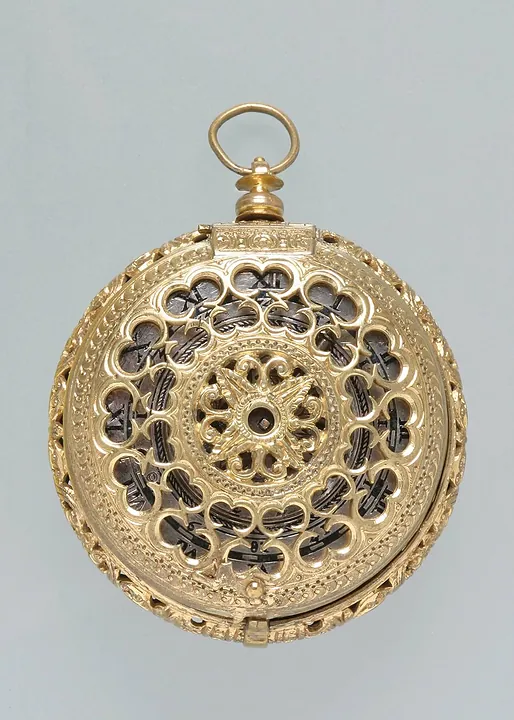
Pocket watch by Hans Reinboldt, France, c. 1600
German Clock Museum
Pocket Watches · 1600
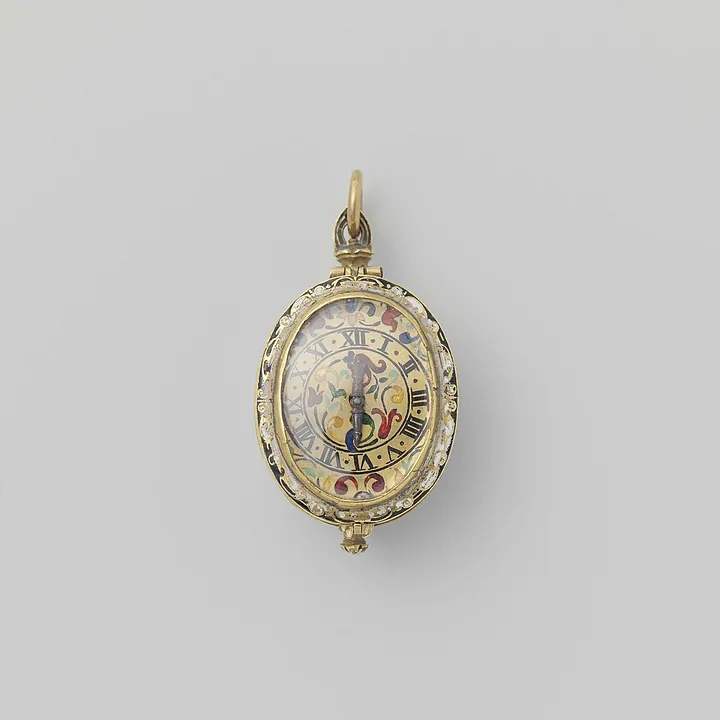
Pocket watch, France, 1600
Rijksmuseum
Pocket Watches · first quarter of 17th century
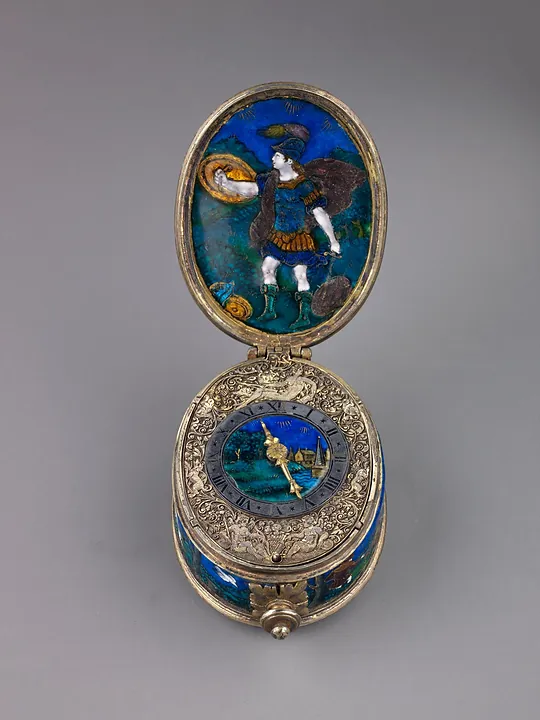
Watch by Suzanne de Court, France, first quarter of 17th century
The Metropolitan Museum of Art, New York
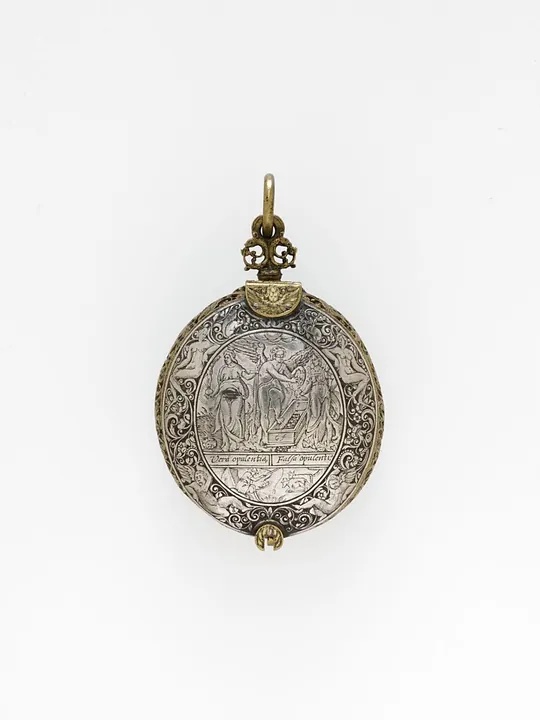
Pocket Watches · early 17th century
Watch of engraved and pierced silver and gilt brass, signed 'Noel Hubert A Rouen', France, early 17th century
Victoria and Albert Museum, London
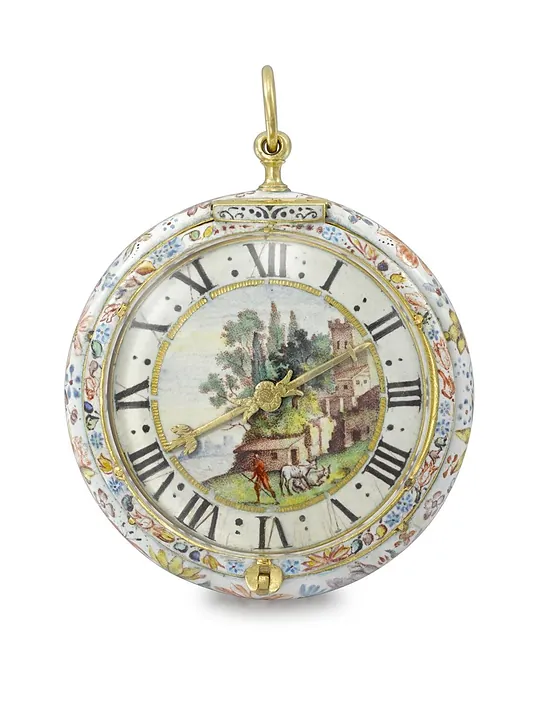
Pocket Watches · 1601–1700
Pocket watch by D Margotin, France, 1601–1700
Science Museum Group, London
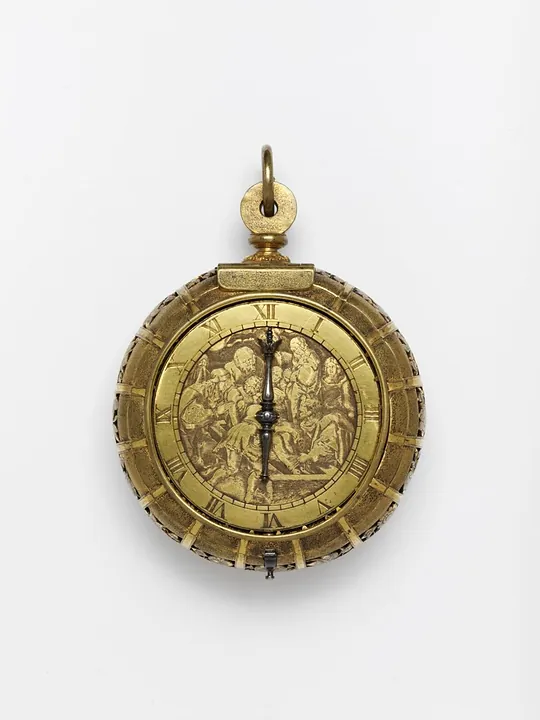
Pocket Watches · 1630
Carriage watch with gilt brass case and engraved dial by Nicolas Lemaindre, Blois, 1630
Victoria and Albert Museum, London
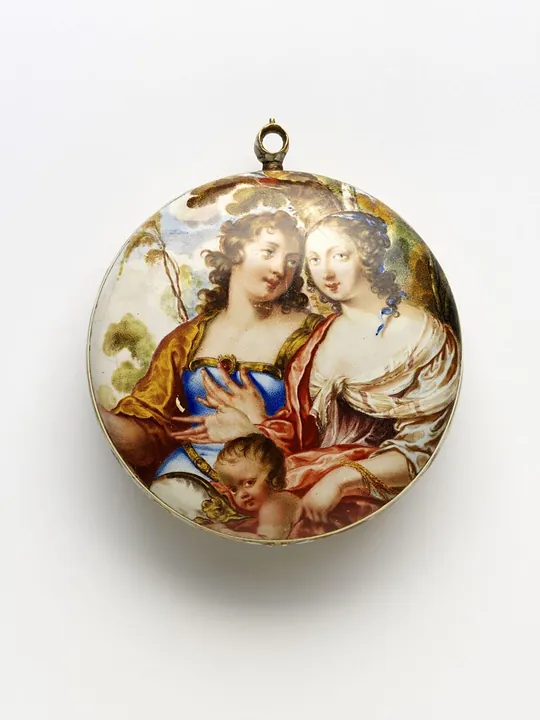
Pocket Watches · 1640–1660
Watch by Jan Bernardus Vrythoff, France, 1640–1660
Victoria and Albert Museum, London
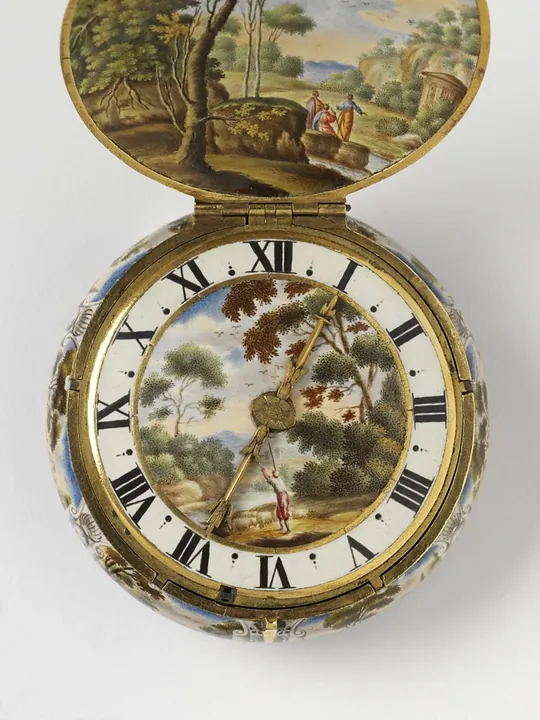
Pocket Watches · 1640–1650
Watch with enamelled gold case depicting Faith, Hope and Charity, made by Nicolas Bernard, Paris, 1640–1650
Victoria and Albert Museum, London