
Wristwatches · Wrist-watch
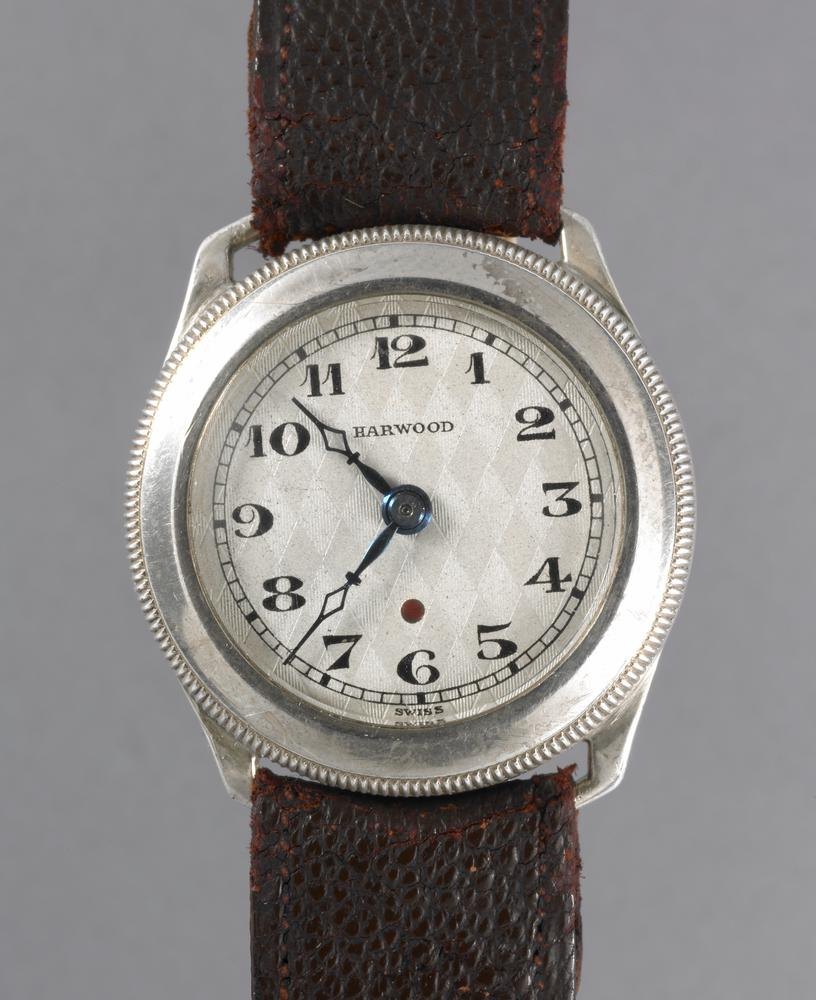
Silver-cased self-winding club-tooth lever wrist-watch with strap
- Maker / attribution
- Harwood Self Winding Watch Company Limited (Made by)
- Date
- 1929
- Historical period
- Golden Age of Mechanical Watchmaking (1900 – 1945)
- Country of origin
- Switzerland
- Place
- Switzerland
- Object type
- Wrist-watch
- Materials / technique
- silver
- Dimensions
- Diameter: 29.50 millimetres (case)
- Holding institution
- British Museum
- Accession / object no.
- 1958,1201.1179
- Credit line
- British Museum, London
- Catalogue title (original)
- Silver-cased self-winding club-tooth lever wrist-watch with strap (English)
View the source record ↗ (opens another website in a new tab)Suggest a correction
Record summary
Held and catalogued by British Museum (object number 1958,1201.1179), this is a wrist-watch by Harwood Self Winding Watch Company Limited, made in Switzerland, dated 1929. The Atlas places it in the Golden Age of Mechanical Watchmaking period (1900 – 1945) of its Wristwatches collection. Materials and techniques recorded by the source: silver. Recorded dimensions: Diameter: 29.50 millimetres (case). The record is illustrated with 3 photographs.
Assembled from the source record's structured fields. Dates and attributions are given as the source states them; where a field is missing the Atlas leaves it blank rather than estimating.
Catalogue description
Description — British Museum
Pedometer watch. Lever escapement, hands set from bezel. Silvered dial. Silver case. Brown leather strap.
Curator's comments — British Museum
Text from 'Watches', by David Thompson, London, 2008, p. 144-145. John Harwood SILVER CASED SELF-WINDING WRISTWATCH SWITZERLAND, 1929 SIGNED: 'HARWOOD SELF WINDING WATCH CO LTD. PATENT NO 106583 SWISS 15 JEWELS 2ADJ' The concept of the self-winding or automatic watch was not new when the wristwatch was introduced towards the end of the nineteenth century. Abraham-Louis Perrelet had invented his pedometer winding system as early as 1770, and Abraham Louis Breguet was making perpétuels, with two mainsprings wound by an oscillating platinum winding weight, in the 1780s. A similar system was patented in London by Louis Recordon in 1780. From then on, numerous makers produced pocket watches with automatic winding by using variations on the basic oscillating weight principle. However, such pieces were never commonplace compared to ordinary key-wound and, later, stem-wound watches. The wristwatch presented a new challenge. While a similar oscillating winding weight was the obvious choice, there were problems in both arranging the relative proportions of the winding weight to the size of the mainspring, and relating to the size of the central bearing and pivot on which the winding weight would be mounted. It was not until 1926 that these problems were overcome by John Harwood. Born in Bolton, Lancashire, in 1893, Harwood trained as a watch repairer. It is said that he first conceived of a self-winding wristwatch while serving in the trenches of the Western Front during the First World War. In a published recollection, Harwood explained how in 1922 he began to work on a Swiss-made 13-ligne wristwatch movement: "The first experimental model, I must say, was by no means efficient, and it was only after much research and patient endeavour that I was successful in working out the ratios of weight movements in relation to the winding train in the limited space available inside the case of a wrist-watch of normal size." However, Harwood was successful with his second version in which he incorporated a new form of hand-setting. With his automatic winding system he had done away with a winding stem and button and therefore needed another way to set the hands. His solution was to arrange the hand-set mechanism to be operated by turning the case front bezel. A small aperture in the front showed either red or white depending on whether the hand-set was engaged. In 1923 Harwood was granted patent no. 218,487 for his watch design. It was another four years before Harwood was to find suitable financial backing in order to make his automatic wristwatch a commercial reality, and in due course the Harwood Self-Winding Watch Company was established. In his search for a Swiss manufacturer he eventually made an agreement with A. Schild of Grenchen, who would make the necessary specialist tools for the making of the watch. Production, however, was relatively short. The slump of the 1930s took its toll and the company was forced into liquidation. In the years to come the automatic wristwatch would be developed and improved by various manufacturers. In 1957 Harwood was at last honoured by the British Horological Institute, who awarded him their prestigious Gold Medal. He died in 1964. This silver cased watch is one of the production models made in 1929. It is marked with the Glasgow Assay Office import mark and the date letter for that year. It has the usual features of a Harwood watch, with the oscillating winding weight with spring-loaded buffers at the ends, and the Harwood system of rotating bezel hand-setting. View more about curator's comments Comment from Richard Good, Catalogue of Watches in the British Museum. Vol. V (Unpublished manuscript) Made by Harwood Self Winding Watch Co Ltd Switzerland, c. 1929 Silver cased self winding wrist watch with a club tooth lever escapement. Signature: On the dial 'HARWOOD'. On the barrel bridge 'SWISS'. On the self winding weight 'HARWOOD SELF WINDING WATCH CO LTD'. On the self winding work bridge 'PATENT NO 106583'.( ) On the train bridge '15 JEWELS 2 ADJ.' Case: A silver case with the import marks for Glasgow and the date mark for 1929. The bezel is knurled so as to assist in the act of hand setting, there is no winding button as there is no provision for manual winding. Dial & Hands: A silvered brass dial, black skeletonised Arabic numerals filled luminous and a black minute circle. A red dot shows through a hole on the dial which, with the watch not in the hand set position. The dial has two dial feet and is retained by dog screws mounted on the inside of the front plate. Blued-steel hour and minute hands, skeletonised and filled luminous. Movement: Ebauche Marks: 30135 AS(2) in a shield partly cut away as is also another mark in a shield cut through by a screw hole. Frame: The frame is of nickel silver, spotted on the dial side and with circular grained bands on the back. The frame is in two parts with a separate annular disc screwed onto the main movement and of larger diameter. This has a circular cut out for part of its circumference which allows the weight carrying arm on the dial side of the movement to pass through to the back of the movement. This is required because the weight is supported on both sides of the movement. The weight has restricted motion there are buffers set into its ends which bank on the keyless block. The basic movement is bar layout with a bridge for the barrel, one for the centre, third and fourth wheels and with cocks for the escape wheel and balance. To dismantle the watch the weight bridge on the back of the movement has to be removed. When this bridge is removed the self winding wheel becomes free. Next the annular disc on the dial side of the movement is removed, this is held on by four screws and once these have been removed the keyless weight block is also free. One of these four screws also holds one end of the weight supporting bridge on the dial side of the movement. Barrel and Mainspring: The going barrel has a recessed cover. B.
Inscriptions & marks
signature; Harwood [dial]; inscription; HARWOOD SELF WINDING WATCH CO LTD.; PATENT No. 106583; SWISS; 15 JEWELS 2ADJ; [movement]; hallmark; inside case back; Glasgow import mark and date letter for 1929; mark; inside case; A5M 11248
Provenance
Previous owner/ex-collection:, Courtenay Adrian Ilbert
Historical context
Golden Age of Mechanical Watchmaking (1900 – 1945)
The wristwatch displaces the pocket watch; waterproof cases, self-winding and grand complications.
The wristwatch overtook the pocket watch. Military use in the First World War, aviation, water-resistant cases (1926), automatic winding (1923–31), rectangular Art Deco designs and early chronographs and calendars defined the period.
Read the period in the timelineMore wristwatches from this periodEarlier: Industrial Revolution
Atlas type guide
Automatic (self-winding) watches
Self-winding watches use the wearer's motion to wind the mainspring. Abraham-Louis Perrelet and Breguet made 'perpétuelle' pocket watches with oscillating weights in the late eighteenth century, but the principle only became practical in the wristwatch. John Harwood patented a bumper automatic in 1923; Rolex's Perpetual rotor (1931) winding in one direction, and later bidirectional rotors (Eterna, Felsa Bidynator), established the modern form. Micro-rotors (Universal Genève, Buren) and peripheral rotors made automatic watches thinner.
What to look for
- A semicircular rotor turning 360° over the movement, or a 'bumper' weight that rebounds between springs.
- 'Automatic', 'Perpetual' or 'Self-winding' on the dial.
- A sealed screw-back case, since automatic watches are wound less often by the crown.
Dating clues
- Bumper automatics: 1923–c. 1955.
- Full rotors: from 1931 (Rolex); widespread after c. 1950.
- Micro-rotors: from 1954–1958.
General guidance written by the Atlas editors about this kind of object. It is not a statement about this particular piece; for that, rely on the source record above and on physical examination.
Related records

Wristwatches · 1931
Rolex 'Oyster Perpetual' rotor self-winding wrist-watch, lever escapement, in steel case with glass in back, Montres Rolex SA, Geneva, Switzerland, 1931
Science Museum Group, London

Wristwatches · 1900–1999
Wristwatch by Certina, Switzerland, 1900–1999
Nordic Museum Foundation

Wristwatches · 1900–1999
Wristwatch by Omega, Västerås, 1900–1999
Nordic Museum Foundation

Wristwatches · 1900–1999
Wristwatch by Universal, Switzerland, 1900–1999
Nordic Museum Foundation
Wristwatches · c. 1900
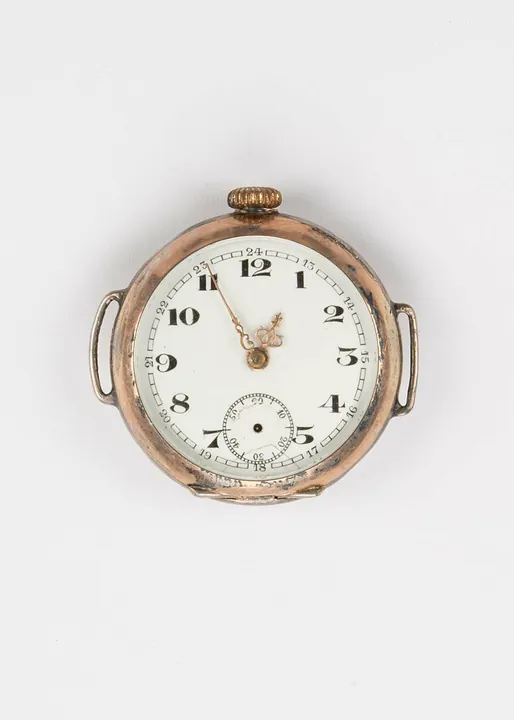
Wristwatch, probably Switzerland, c. 1900 (no. 57124)
German Clock Museum
Wristwatches · c. 1900
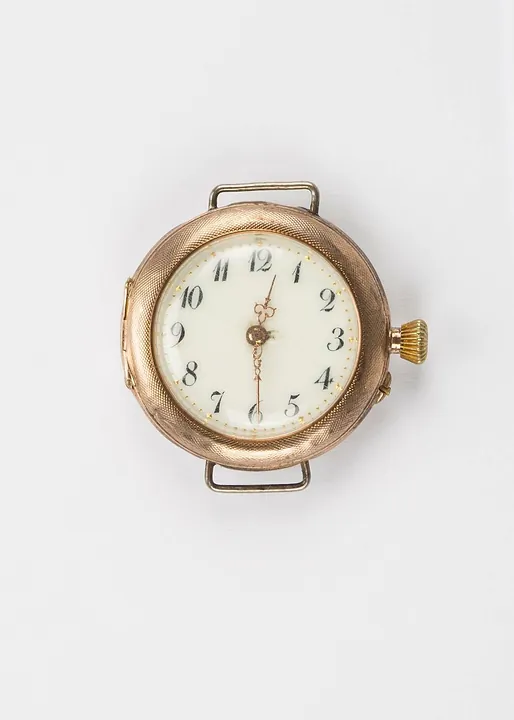
Wristwatch, probably Switzerland, c. 1900 (no. 57216)
German Clock Museum
Wristwatches · c. 1915
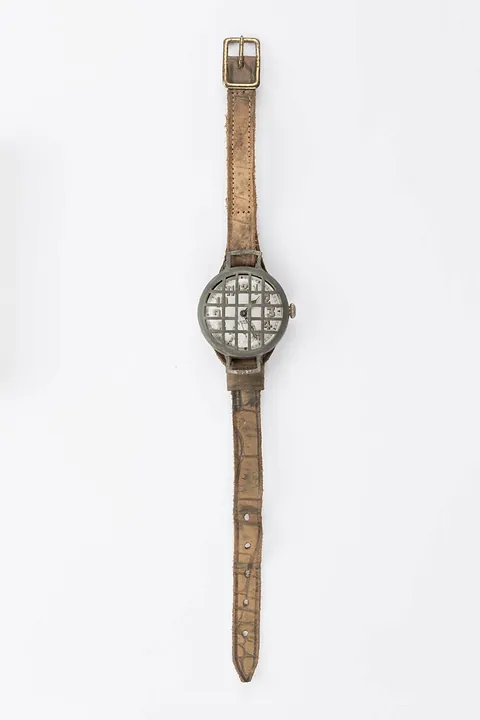
Wristwatch by S.S.und Co., Stauffer, Son und Co., Switzerland, c. 1915
German Clock Museum
Wristwatches · c. 1920s
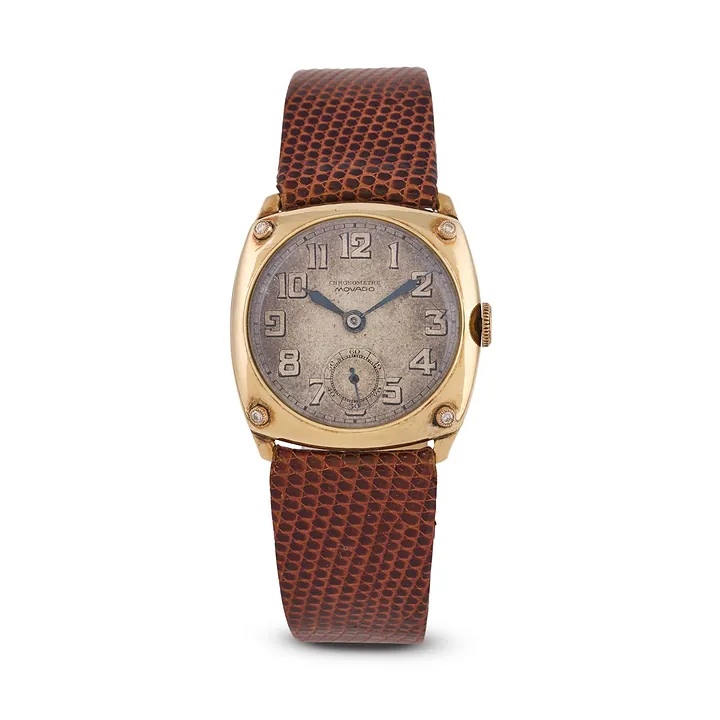
Movado Chronometre, ref. 41536, c. 1920s
Antiquorum auction archive, Geneva