
Wristwatches · Wristwatch
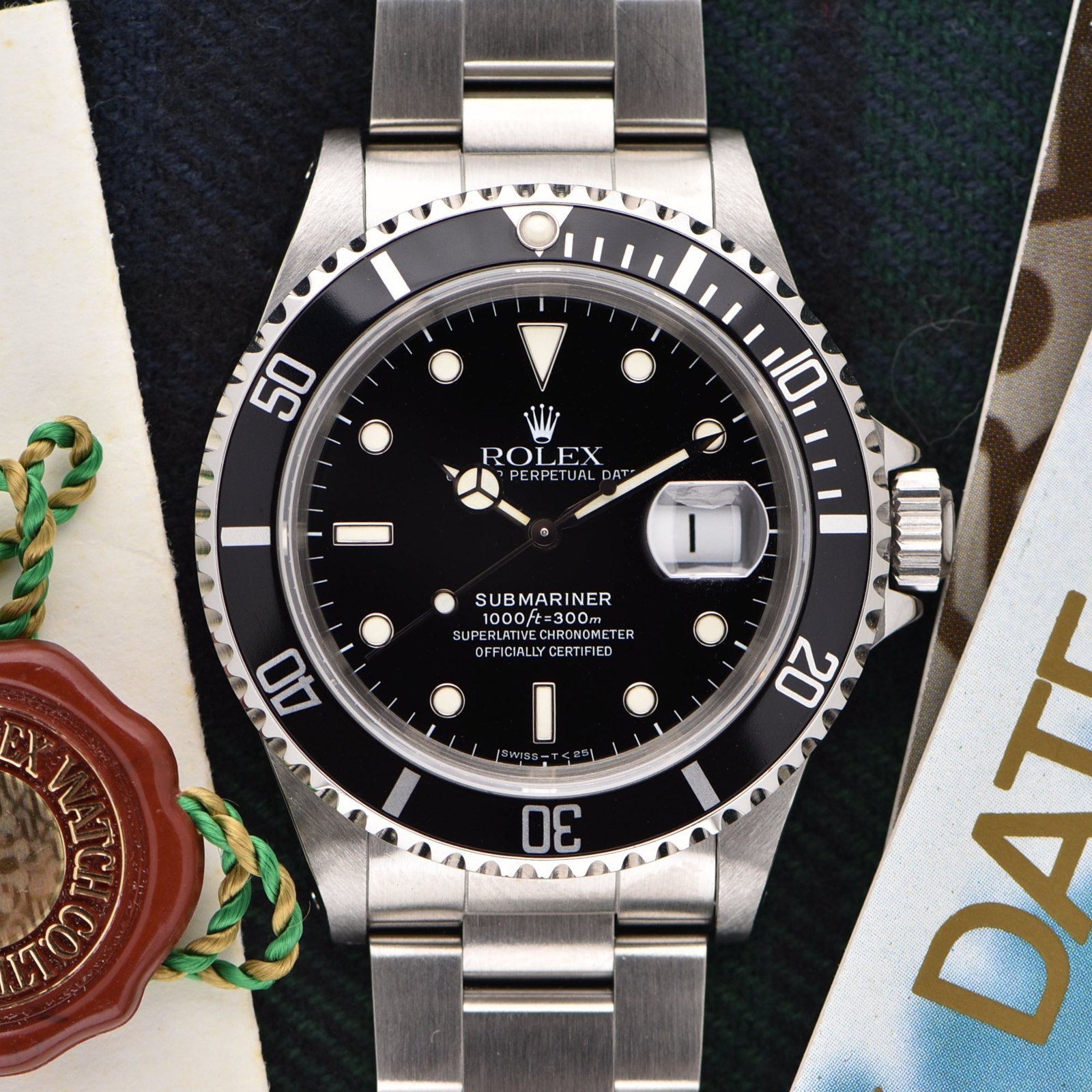
Rolex Submariner Tritium Dial, 1991
- Maker / attribution
- Rolex (maker)
- Date
- 1991
- Historical period
- Mechanical Renaissance (1990 – 2010)
- Country of origin
- Switzerland
- Object type
- Wristwatch
- Dimensions
- Case 40 mm
- Stock no.
- Product 7437607927991
- Credit line
- Dealer listing, Huntington Company (product 7437607927991)
- Catalogue title (original)
- 1991 Rolex Submariner Tritium Dial - Box & Papers (English)
View the source record (dealer listing) ↗ (opens another website in a new tab)Suggest a correction
Record summary
Catalogued by Huntington Company (dealer) (stock number Product 7437607927991), this is a wristwatch by Rolex, made in Switzerland, dated 1991. The Atlas places it in the Mechanical Renaissance period (1990 – 2010) of its Wristwatches collection. Recorded dimensions: Case 40 mm. The record is illustrated with 6 photographs.
Assembled from the source record's structured fields. Dates and attributions are given as the source states them; where a field is missing the Atlas leaves it blank rather than estimating.
Catalogue description
Dealer description — Huntington Company
Reference 16610 Box, Papers, Booklets, Red Hangtags Specifications Year: 1991 Model: Datejust Case Diameter: 40mm Lug to Lug: 48mm Case: Stainless steel Condition: No significant wear as seen Dial: Black Movement: Automatic Condition The case is very sharp and has even lugs. The case holes have no distortion that would happen if it was polished. That is why we believe this is unpolished. The bracelet is in just as good of condition. The bezel is clean with the original tritium pip. The dial and hands have a light custard patina on the tritium lume. The watch comes with its original box and papers. The Story In 1954, Rolex introduced the first Submariner model, which became the most recognized luxury sports watch. The watch was water-resistant up to 100 meters and became the most sought-after watch. Since then, Rolex has made numerous changes and developments, including the introduction of the 6204 and 6205 models, the 6536 and 6538 references, and the 1030 reference. The company has made significant contributions to the watchmaking industry. In the early 1960s, Rolex introduced several models, including the 5508 and 5510, with numerous dial changes. The 5512 and 5513 models featured lacquered dials with gold or silver printing. The Submariner 1680 introduced a date display in 1968, following the Sea-Dweller. The first Submariner 1680 had a collector's item "Red Submariner" dial, with six dial versions. The Submariner 1680 was produced until 1979. The first Submariner in solid yellow gold was the Submariner Date, a success in Italy and the US market. Over the next 40 years, the Submariner underwent technical developments, improved water-resistance, new movements, and aesthetic changes. The Brand Wilsdorf & Davis was initially a watch importer, but by 1908, Wilsdorf had registered 'Rolex' as a trademark. The name was chosen after trial and error, with some believing it was taken from the phrase 'horological Excellence' or because the word sounds like a watch being wound. Wilsdorf was aware of the power of branding and began a long campaign to get the new company name on the watches he exported. The relationship between Rolex and Aegler started the same year that Wilsdorf & Davis set up the business, placing the largest order for wristwatches ever seen. Wilsdorf was attracted by Aegler's commitment to the highest quality, as their movements were extremely accurate and small. In 1910, one of Rolex's models won a First Class Chronometer Certificate from the rating office in Bienne, Switzerland, and in 1914, another piece became the first ever wristwatch to be granted a Class A Chronometer Certificate from the Kew Observatory in England, the only non-marine timepiece to ever achieve it. The firm of Wilsdorf & Davis became synonymous with a commitment to uncompromising excellence. WWI in 1914 led to the rebranding of Wilsdorf & Davis as Rolex in 1915. The British government imposed a 33.3% tax on luxury goods, forcing Rolex to relocate to Bienne. Despite the war, the wristwatch proved its utility, as it was used by soldiers during combat and in the field. Rolex produced trench watches, using Aegler's small movements for wearability. By the end of the war, wristwatches became a utilitarian accessory for men. In the years between the wars, Rolex asserted its independence, partnering with Carl F. Bucherer to resist the Federation of Swiss Watch Manufacturers. In 1926, Rolex introduced the Oyster case, making wristwatches waterproof, dustproof, and robust. Wilsdorf capitalized on this innovation by installing Rolex Ambassadors, or 'Testimonies', with celebrities as a marketing masterstroke. During WWII, Switzerland retained its neutrality, meaning that it was one of the few countries not forced to shut down watch manufacturing to supply the war effort. As a result, by the end of hostilities, the Swiss watch industry was way ahead of other nations. Rolex truly came of age in the 1950s by launching some of the most enduring legends in watchmaking, such as the Explorer, Submariner, GMT-Master, Day-Date, and Milgauss. The quartz crisis of the 1970s and 80s forced the company to change tactics but ultimately repositioned itself as the purveyor of the ultimate luxury lifestyle. Today, the name Rolex is synonymous with refinement, opulence, and personal accomplishment. The Rolex brand as we know it today is the byproduct of an unrelenting drive for excellence and over a hundred years of refinement and development, all in pursuit of the brand’s singular goal of making the world’s best wristwatch.
Historical context
Mechanical Renaissance (1990 – 2010)
Mechanical watches return as cultural objects; independent watchmaking flourishes.
Mechanical watches returned as cultural and luxury objects. Complications, tourbillons and new materials proliferated; independent watchmakers such as George Daniels, F.P. Journe and Philippe Dufour revived artisanal watchmaking; collecting vintage watches became a major field.
Read the period in the timelineMore wristwatches from this periodEarlier: Quartz Revolution
Atlas type guide
Dive and water-resistant watches
Keeping water and dust out of a wristwatch was a long-standing challenge. Rolex's screw-down Oyster case (1926) and Omega's Marine (1932) were landmarks; in the early 1950s Blancpain's Fifty Fathoms and Rolex's Submariner defined the professional dive watch with rotating bezels for timing dives, luminous dials and high water resistance. The ISO 6425 standard (1982) later codified what a 'diver's watch' must do.
Dive watches became icons of post-war design and exploration, and their evolution — helium escape valves, ceramic bezels, saturation-diving depth ratings — records the history of underwater work.
What to look for
- Unidirectional or bidirectional rotating bezel with minute markings.
- Screw-down crown and case back; depth rating printed on the dial.
- Luminous hands and markers (radium before c. 1960, tritium c. 1960–1998, then Super-LumiNova).
- Reference numbers on the case between the lugs or inside the back.
Dating clues
- Screw-down Oyster cases: from 1926.
- Professional dive watches: from 1953.
- Tritium 'T' marks on dials: c. 1960–1998.
General guidance written by the Atlas editors about this kind of object. It is not a statement about this particular piece; for that, rely on the source record above and on physical examination.
Related records

Movements & Components · c. 1970s
Rolex watch movement, c. 1970s
Antiquorum auction archive, Geneva

Pocket Watches · 1982
Fake Rolex watch, gold coloured metal, possibly made in Taiwan, 1982; part of a casual outfit, UK, 1982-84.
Victoria and Albert Museum, London

Wristwatches · c. 1920s
Rolex wristwatch, c. 1920s
Antiquorum auction archive, Geneva

Wristwatches · c. 1920s
Rolex wristwatch, ref. 6194, c. 1920s
Antiquorum auction archive, Geneva

Wristwatches · 2008
Wristwatch by Breitling?, 2008
Museum Rotterdam

Wristwatches · c. 1990s
Audemars Piguet Bamboo, c. 1990s
Antiquorum auction archive, Geneva

Wristwatches · c. 1990
Audemars Piguet Huitieme Perpetual Calendar, ref. 25696PT, c. 1990
Antiquorum auction archive, Geneva

Wristwatches · c. 1990
Breitling Chronomat, ref. b13050.1, c. 1990
Antiquorum auction archive, Geneva