
Wristwatches · Wristwatch
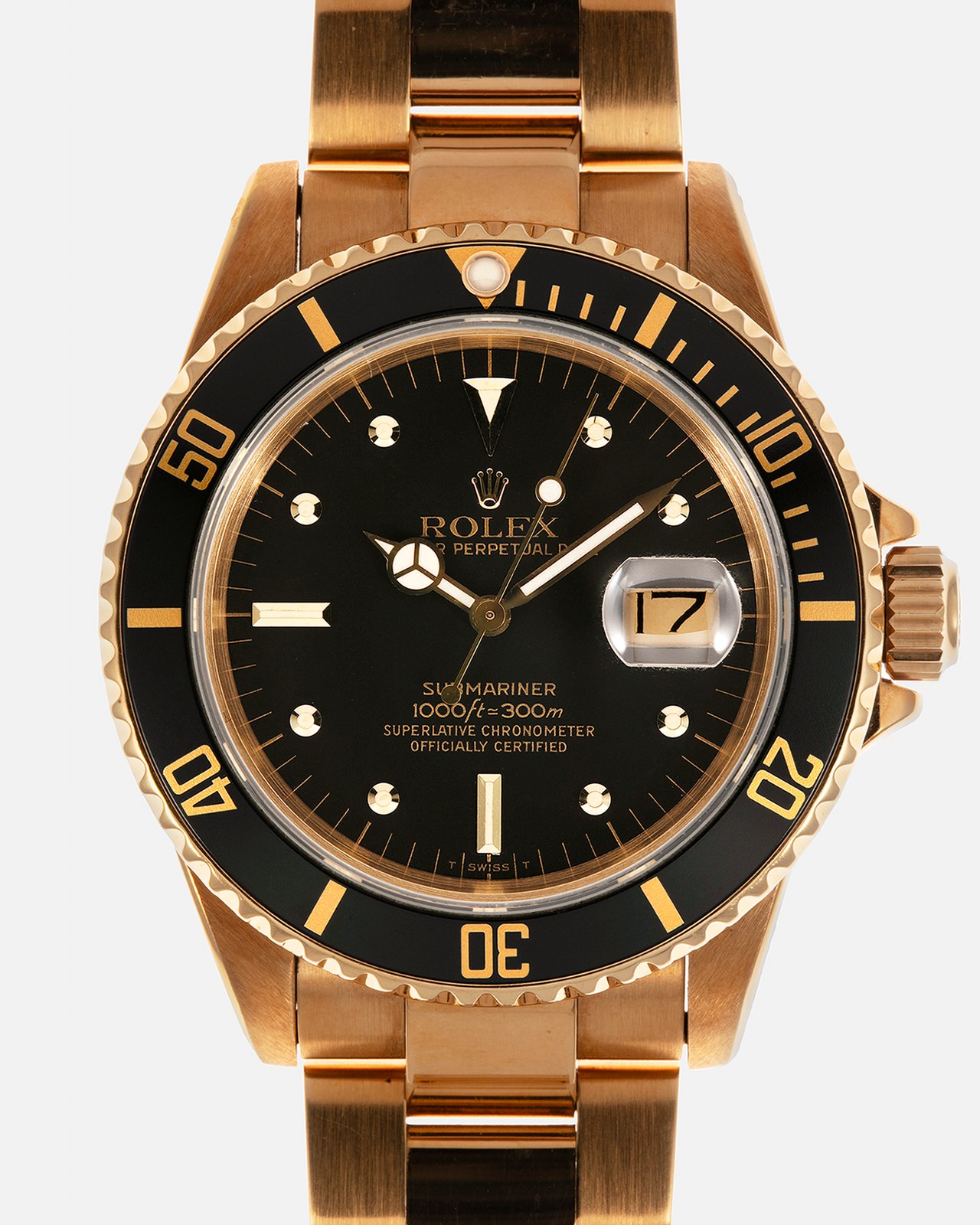
Rolex Submariner 16808 Nipple Dial YG, 1984
- Maker / attribution
- Rolex (maker)
- Date
- 1984
- Historical period
- Quartz Revolution (1969 – 1990)
- Country of origin
- Switzerland
- Object type
- Wristwatch
- Stock no.
- Product 7551654297687
- Credit line
- Dealer listing, S.Song Watches (product 7551654297687)
- Catalogue title (original)
- Rolex Submariner 16808 Nipple Dial YG (English)
View the source record (dealer listing) ↗ (opens another website in a new tab)Suggest a correction
Record summary
Catalogued by S.Song Watches (dealer), Seattle (stock number Product 7551654297687), this is a wristwatch by Rolex, made in Switzerland, dated 1984. The Atlas places it in the Quartz Revolution period (1969 – 1990) of its Wristwatches collection. The record is illustrated with 6 photographs.
Assembled from the source record's structured fields. Dates and attributions are given as the source states them; where a field is missing the Atlas leaves it blank rather than estimating.
Catalogue description
Dealer description — S.Song Watches
I think it goes without saying that the Rolex Submariner is historically one of the most recognisable and collectable watches ever produced—period. At some point in every enthusiast’s journey, a Submariner, whether modern or vintage, automatically becomes a benchmark for quality and collectability. However, what makes the early examples especially compelling is how clearly they reflect an era when Rolex prioritised durability and purpose-built design over luxury. That purity shaped the Submariner’s identity for decades, and even as the reference evolved through countless iterations, its lineage remains unmistakable. This brings us to the Submariner 16808—a standout from the 16800 series and a reference that signalled Rolex’s shift from a strictly utilitarian dive watch to something more refined and luxurious. Produced from 1979 to 1988, it represents a transitional period where the Submariner blueprint began to embrace modernity, with a tougher sapphire crystal rated to 1000ft/300m, crisper case lines, and a new high-beat calibre with a quick-set date function. To understand its place in the lineage, it helps to look back at its predecessor, the yellow-gold 1680/8, a reference that faced plenty of criticism when it debuted back in 1969. You see, many purists struggled with the idea of a solid-gold dive watch, arguing that it diluted the Submariner’s tool-watch roots. Rolex, however, recognised the direction the market was heading, refined the concept, pushed ahead and introduced the 16808—a reference that ultimately reshaped the identity of the gold Submariner and laid the groundwork for the modern luxury dive-watch archetype as we know it today. This particular example we have here is especially attractive thanks to its excellent overall condition and its matte black “nipple” dial, where the luminous plots sit in raised, domed gold surrounds, giving each hour marker that distinctive “nipple” profile collectors recognise immediately. As briefly mentioned earlier, the 16808 houses an upgraded Cal. 3035, which was Rolex’s first high-beat, quick-set Submariner movement. Running at 28,800 vph with improved shock resistance and a larger balance wheel, it firmly laid down the foundational basis for the Cal. 3135 introduced later in 1988. As far as power reserve goes, the Cal. 3035 offers a 50-hour capacity on a full wind and remains a robust, easily serviced movement even to this day. After handling more modern and vintage Rolexes than I can count, I can confidently say that the allure of early Submariners is hard to ignore. There’s a certain raw clarity to their design as well as its case proportions. Like most Submariners, both old and new, the 16808 is remarkably versatile, which says a lot about its enduring appeal. The 16808 carries that spirit while adding the presence of yellow gold and the clean punch of a black dial and bezel. I’ve said it before and will say it here again: black and yellow gold is one of those effortless combinations that never goes out of style, and on a vintage Rolex dive watch like this 16808, for some reason, it simply feels like a match made in heaven. In the end, the 16808 represents a turning point in the Submariner’s evolution. Produced for just under a decade, it blends the warmth and character of early gold models with the technical refinements that would eventually go on to define the modern lineup. Where the 1680/8 stands as the quintessential plexi-era diver, the 16808 marks the moment Rolex fully embraced the Submariner’s design duality: a no-frills, capable tool watch with the presence and sophistication of a true luxury timepiece.
Historical context
Quartz Revolution (1969 – 1990)
Seiko's Astron begins mass quartz timekeeping; traditional industries contract sharply.
Quartz and digital watches transformed the market after 1969. Swiss employment collapsed, Japanese and Hong Kong production soared, and the Swatch (1983) helped the Swiss industry recover; mechanical watches survived as luxury goods.
Read the period in the timelineMore wristwatches from this periodEarlier: Modern Mechanical Horology
Atlas type guide
Dive and water-resistant watches
Keeping water and dust out of a wristwatch was a long-standing challenge. Rolex's screw-down Oyster case (1926) and Omega's Marine (1932) were landmarks; in the early 1950s Blancpain's Fifty Fathoms and Rolex's Submariner defined the professional dive watch with rotating bezels for timing dives, luminous dials and high water resistance. The ISO 6425 standard (1982) later codified what a 'diver's watch' must do.
Dive watches became icons of post-war design and exploration, and their evolution — helium escape valves, ceramic bezels, saturation-diving depth ratings — records the history of underwater work.
What to look for
- Unidirectional or bidirectional rotating bezel with minute markings.
- Screw-down crown and case back; depth rating printed on the dial.
- Luminous hands and markers (radium before c. 1960, tritium c. 1960–1998, then Super-LumiNova).
- Reference numbers on the case between the lugs or inside the back.
Dating clues
- Screw-down Oyster cases: from 1926.
- Professional dive watches: from 1953.
- Tritium 'T' marks on dials: c. 1960–1998.
General guidance written by the Atlas editors about this kind of object. It is not a statement about this particular piece; for that, rely on the source record above and on physical examination.
Related records

Movements & Components · c. 1970s
Rolex watch movement, c. 1970s
Antiquorum auction archive, Geneva

Pocket Watches · 1982
Fake Rolex watch, gold coloured metal, possibly made in Taiwan, 1982; part of a casual outfit, UK, 1982-84.
Victoria and Albert Museum, London

Wristwatches · c. 1920s
Rolex wristwatch, c. 1920s
Antiquorum auction archive, Geneva

Wristwatches · c. 1920s
Rolex wristwatch, ref. 6194, c. 1920s
Antiquorum auction archive, Geneva

Wristwatches · 1970
Wristwatch by Heno, Switzerland, 1970
Museum Rotterdam

Wristwatches · 1960–1986
'Tri-Compax' calendar chronograph wristwatch in gold case, by Universal, Geneva, Switzerland, 1960–1986.
Science Museum Group, London

Wristwatches · 1969–1970
Beta 21 Quartz wristwatch movement, made in Switzerland, 1970.
Science Museum Group, London

Wristwatches · c. 1969
Omega Speedmaster Moonwatch, ref. 145022-69st, c. 1969
Antiquorum auction archive, Geneva