
Wristwatches · Wristwatch
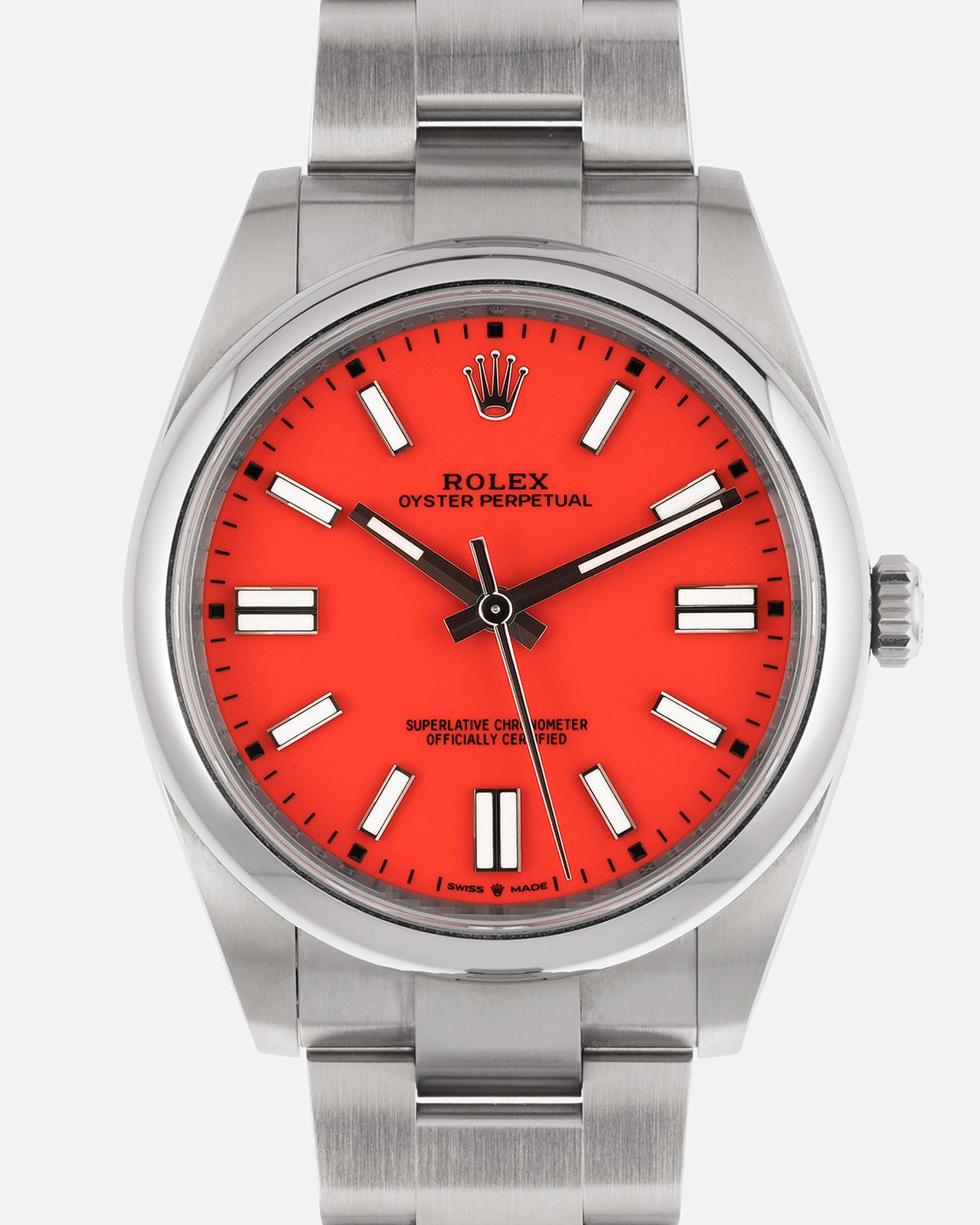
Rolex Oyster Perpetual 41 124300 Coral Red, 2021
- Maker / attribution
- Rolex (maker)
- Date
- 2021
- Historical period
- Contemporary Horology (2010 – Present)
- Country of origin
- Switzerland
- Object type
- Wristwatch
- Dimensions
- Case 39 mm
- Stock no.
- Product 7853804617815
- Credit line
- Dealer listing, S.Song Watches (product 7853804617815)
- Catalogue title (original)
- Rolex Oyster Perpetual 41 124300 Coral Red (English)
View the source record (dealer listing) ↗ (opens another website in a new tab)Suggest a correction
Record summary
Catalogued by S.Song Watches (dealer), Seattle (stock number Product 7853804617815), this is a wristwatch by Rolex, made in Switzerland, dated 2021. The Atlas places it in the Contemporary Horology period (2010 – Present) of its Wristwatches collection. Recorded dimensions: Case 39 mm. The record is illustrated with 6 photographs.
Assembled from the source record's structured fields. Dates and attributions are given as the source states them; where a field is missing the Atlas leaves it blank rather than estimating.
Catalogue description
Dealer description — S.Song Watches
The Oyster Perpetual represents one of the most fundamental collections in Rolex's history, tracing its origins to the introduction of the waterproof Oyster case in 1926 and the self-winding Perpetual movement in 1931. Combining these two innovations, the Oyster Perpetual would become the foundation upon which many of Rolex's most recognisable watches were subsequently developed. Despite its simple time-only configuration, the collection has remained an important part of the brand's catalogue. In 2020, Rolex introduced a new generation of Oyster Perpetual watches, including the reference 124300, which replaced the previous 39mm reference 114300. Measuring 41mm in diameter, the new model featured an updated case design, a new movement and, most notably, a collection of unusually vibrant lacquered dials. These included yellow, green, turquoise blue and coral red, representing a significant departure from the more conservative colours traditionally associated with the collection. The colourful dials were reminiscent of the celebrated Stella dials produced by Rolex during the 1970s and 1980s. Originally associated with the Day-Date, these brightly coloured lacquered dials were produced in relatively small quantities and have since become highly desirable among collectors. While the modern Oyster Perpetual dials were not direct reproductions, they shared a similar philosophy of introducing bold colours to an otherwise traditional Rolex design. Here, we have the reference 124300 featuring the particularly attractive coral red dial. Unlike a conventional deep red, the colour has a distinct orange undertone, appearing almost vermilion under certain lighting conditions. Its glossy lacquered finish gives the dial a remarkable intensity, particularly when contrasted against the polished stainless steel bezel and brushed Oyster bracelet. The applied white gold hour markers and matching hands are filled with Chromalight, while the double baton markers at 3, 6 and 9 o'clock provide a distinctive and highly legible layout. The 41mm case is crafted from Oystersteel, featuring a smooth polished bezel, brushed upper surfaces and polished case sides. It is complemented by the familiar three-link Oyster bracelet, equipped with a folding Oysterclasp and Easylink extension system. Water-resistant to 100 metres, the watch retains the durability and practicality expected of a modern Rolex. Powering the reference 124300 is the self-winding calibre 3230, introduced in 2020. Featuring Rolex's Chronergy escapement, blue Parachrom hairspring and Paraflex shock absorbers, the movement operates at 28,800 vibrations per hour and provides approximately 70 hours of power reserve. It also carries the Superlative Chronometer certification, guaranteeing an accuracy of within minus two and plus two seconds per day after casing. Perhaps most interestingly, the coral red dial was discontinued in 2022, just two years after its introduction. Alongside the yellow dial, its relatively short production period distinguishes it from the more conventional colours that remained available for longer. What I find particularly appealing about the coral red 124300 is how dramatically a simple change of dial colour transforms one of Rolex's most straightforward watches. With its short production period and historical connection to the colourful Stella dials, it is one of the more interesting modern interpretations of the Oyster Perpetual collection.
Historical context
Contemporary Horology (2010 – Present)
Silicon components, connected watches, optical-lattice research clocks and a thriving independent scene.
Smartwatches became the world's best-selling watches, while mechanical watchmaking focuses on craft, innovation (silicon components, new escapements) and independent makers.
Read the period in the timelineMore wristwatches from this periodEarlier: Mechanical Renaissance
Atlas type guide
Dive and water-resistant watches
Keeping water and dust out of a wristwatch was a long-standing challenge. Rolex's screw-down Oyster case (1926) and Omega's Marine (1932) were landmarks; in the early 1950s Blancpain's Fifty Fathoms and Rolex's Submariner defined the professional dive watch with rotating bezels for timing dives, luminous dials and high water resistance. The ISO 6425 standard (1982) later codified what a 'diver's watch' must do.
Dive watches became icons of post-war design and exploration, and their evolution — helium escape valves, ceramic bezels, saturation-diving depth ratings — records the history of underwater work.
What to look for
- Unidirectional or bidirectional rotating bezel with minute markings.
- Screw-down crown and case back; depth rating printed on the dial.
- Luminous hands and markers (radium before c. 1960, tritium c. 1960–1998, then Super-LumiNova).
- Reference numbers on the case between the lugs or inside the back.
Dating clues
- Screw-down Oyster cases: from 1926.
- Professional dive watches: from 1953.
- Tritium 'T' marks on dials: c. 1960–1998.
General guidance written by the Atlas editors about this kind of object. It is not a statement about this particular piece; for that, rely on the source record above and on physical examination.
Related records

Movements & Components · c. 1970s
Rolex watch movement, c. 1970s
Antiquorum auction archive, Geneva

Pocket Watches · 1982
Fake Rolex watch, gold coloured metal, possibly made in Taiwan, 1982; part of a casual outfit, UK, 1982-84.
Victoria and Albert Museum, London

Wristwatches · c. 1920s
Rolex wristwatch, c. 1920s
Antiquorum auction archive, Geneva

Wristwatches · c. 1920s
Rolex wristwatch, ref. 6194, c. 1920s
Antiquorum auction archive, Geneva

Wristwatches · c. 2010s
Breguet Type XXI, ref. 3810, c. 2010s (Antiquorum Lot 381-24)
Antiquorum auction archive, Geneva

Wristwatches · c. 2010s
Breguet Type XXI, ref. 3810, c. 2010s (Antiquorum Lot 386-229)
Antiquorum auction archive, Geneva

Wristwatches · Sold in September 2010
Breitling Cosmonaute, ref. A 22322, Sold in September 2010
Antiquorum auction archive, Geneva

Wristwatches · c. 2010
Corum Bubble Chrono, ref. 396.150.20, c. 2010
Antiquorum auction archive, Geneva