
Wristwatches · Wristwatch
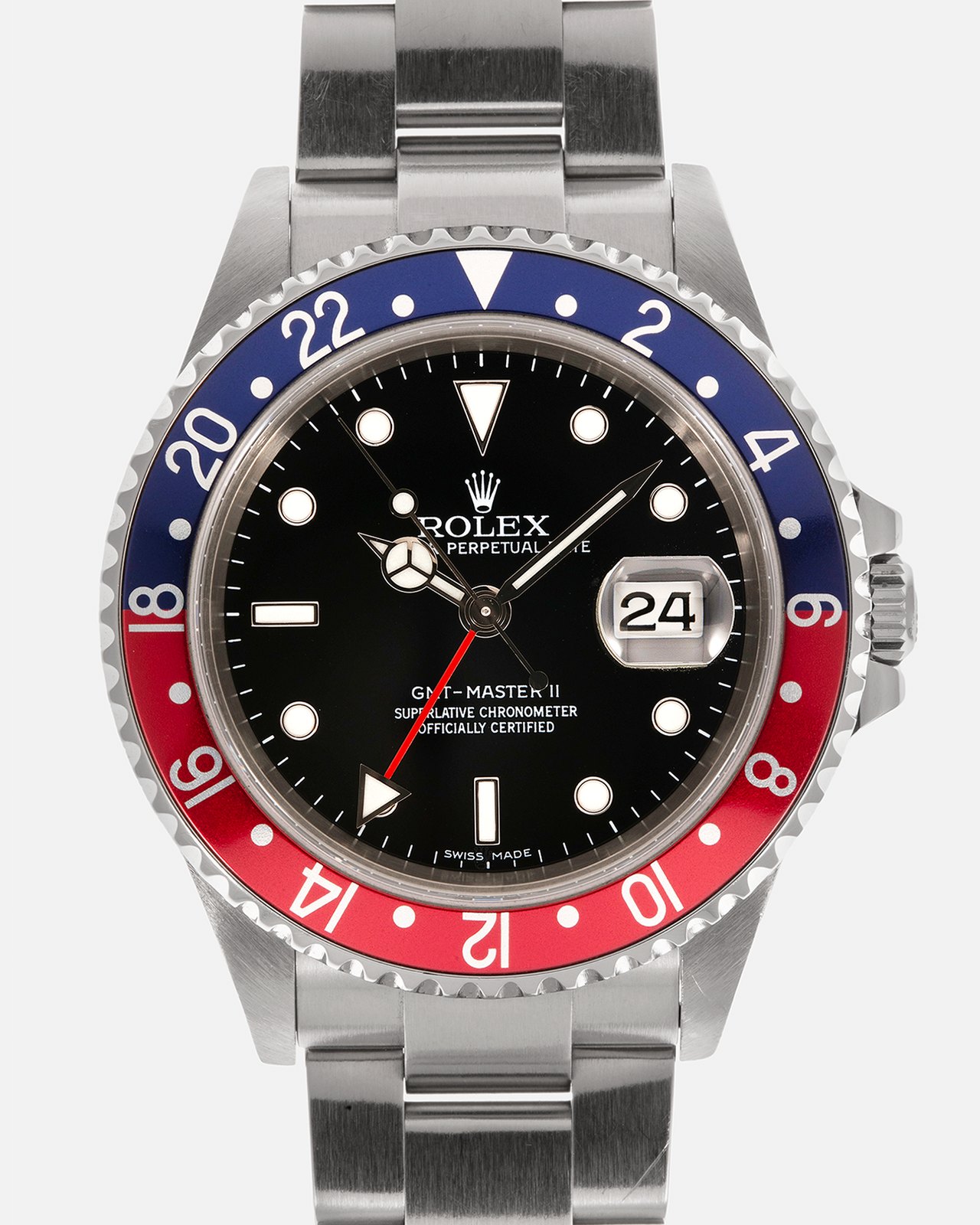
Rolex GMT-Master II 16710 Pepsi ‘Error / Stick Dial’, 2007
- Maker / attribution
- Rolex (maker)
- Date
- 2007
- Historical period
- Mechanical Renaissance (1990 – 2010)
- Country of origin
- Switzerland
- Object type
- Wristwatch
- Dimensions
- Case 40 mm
- Stock no.
- Product 7527019970647
- Credit line
- Dealer listing, S.Song Watches (product 7527019970647)
- Catalogue title (original)
- Rolex GMT-Master II 16710 Pepsi ‘Error / Stick Dial’ (English)
View the source record (dealer listing) ↗ (opens another website in a new tab)Suggest a correction
Record summary
Catalogued by S.Song Watches (dealer), Seattle (stock number Product 7527019970647), this is a wristwatch by Rolex, made in Switzerland, dated 2007. The Atlas places it in the Mechanical Renaissance period (1990 – 2010) of its Wristwatches collection. Recorded dimensions: Case 40 mm. The record is illustrated with 6 photographs.
Assembled from the source record's structured fields. Dates and attributions are given as the source states them; where a field is missing the Atlas leaves it blank rather than estimating.
Catalogue description
Dealer description — S.Song Watches
The Rolex GMT-Master is a watch that speaks for itself. It stands as an undisputed icon in the world of timepieces, effortlessly enabling its wearer to keep track of two separate time zones concurrently. Initially conceived in the 1950s to cater to the needs of Pan Am pilots who were embarking on increasingly frequent transatlantic flights, this invaluable instrument watch served a multitude of purposes. It not only ensured precise monitoring of both home and local time but also played a pivotal role in minimizing scheduling discrepancies, mitigating jet lag, and even boosting pilot morale. Offered here today is a later example of a 16710 ‘Pepsi’, which saw a production run from 1989 up until 2007. Within the lineage of Rolex GMT Masters, the 16710 stands out as a significant transitional reference alongside the 16700, which was released a year earlier in 1988 and remained in production until 1999. It played a pivotal role in shaping the foundation for many of the design traits seen in today’s modern GMT Masters lineup, featuring a slimmer case profile of 40mm x 12.5mm compared to its bulkier predecessor—the 16760, as well as marking Rolex’s shift from the usage of tritium to Luminova between 1998 and 1999, and subsequently to Superluminova after 2000. Our example here features what collectors call the ‘stick dial’, a rare variant produced briefly between 2006 and 2007. It replaces the serifed Roman “II” in GMT-Master II with two simple vertical lines, giving the text a cleaner, more modern typeface. This subtle change marked the quiet transition towards the ceramic GMT-Master era. Notably, this generation of the 16710 was also the last ‘Pepsi’ to feature an aluminium bezel insert before Rolex moved fully to ceramic inserts. I think it’s the little nuances like this that make Rolex collecting so fascinating. The stick dial appeals to a very specific kind of enthusiast—someone who enjoys uncovering subtle, transitional quirks that set certain examples apart. While it doesn’t yet command a significant premium, its rarity adds a quiet sense of intrigue, especially since these late dials often coincide with other end-of-production updates. Some examples, like this one, were even fitted with the upgraded Cal. 3186 featuring Rolex’s blue Parachrom hairspring for improved shock and temperature resistance, creating an unusual crossover of modern engineering within a classic five-digit case. Additionally, what makes the presence of the Cal. 3186 particularly unexpected in this reference is that this movement is typically found only in the six-digit GMT-Master II generation (11671X), not within a transitional five-digit model with an aluminium bezel. Yet, as mentioned earlier, this example is indeed powered by the Cal. 3186, a robust self-winding GMT movement derived from the Cal. 3135 and equipped with an independently adjustable 24-hour hand. Collectors have even discovered a simple way to identify the earlier Cal. 3185: when adjusting the hour hand, the GMT hand on that movement tends to exhibit a slight “wiggle”, a quirk absent here, further confirming that this example houses the newer calibre. To travel with any GMT-Master on the wrist is to travel in style, combining practicality with that mid-century cool. As John Mayer once said, “The GMT-Master is the best contemporary watch that Rolex makes”, a sentiment I share because the GMT function remains one of the most practical modern-day complications. A quick glance tells you the time in another zone—something that never stops being useful, whether you’re crossing continents or conducting business abroad. It’s certainly faster than fumbling with your phone. Overall, what makes this particular example quietly remarkable is how it captures a defining moment in Rolex’s evolution. With its rare ‘stick dial’, final-generation aluminium bezel insert, and upgraded Cal. 3186, it sits squarely at the crossroads between vintage and modern GMT-Masters. It’s a watch that rewards those who appreciate subtle transitions and thoughtful intricacies—proof that sometimes, the smallest details tell the biggest stories.
Historical context
Mechanical Renaissance (1990 – 2010)
Mechanical watches return as cultural objects; independent watchmaking flourishes.
Mechanical watches returned as cultural and luxury objects. Complications, tourbillons and new materials proliferated; independent watchmakers such as George Daniels, F.P. Journe and Philippe Dufour revived artisanal watchmaking; collecting vintage watches became a major field.
Read the period in the timelineMore wristwatches from this periodEarlier: Quartz Revolution
Atlas type guide
Military, pilot and travel watches
The wristwatch owes much of its adoption by men to warfare and aviation. Wristlets — small pocket watches soldered with lugs and worn on a strap — were used in colonial campaigns and became standard equipment in the First World War, with protective grilles over the crystal ('shrapnel guards'). Louis Cartier's Santos (1904), designed for the aviator Alberto Santos-Dumont, is often cited as an early purpose-made pilot's watch.
In the Second World War governments specified watches in detail: the German B-Uhr observation watches, the American A-11, and the British 'W.W.W.' (the 'Dirty Dozen' set of 1945). After the war, jet travel brought GMT and world-time watches, which show two or more time zones at once — Louis Cottier's world-time mechanism and the Rolex GMT-Master (1955) are examples.
What to look for
- Military markings on the case back: broad arrow, issue numbers, 'W.W.W.', 'A.T.P.'
- High-legibility black dials with luminous Arabic numerals; oversized crowns for gloved hands.
- 24-hour hands and rotating 24-hour bezels or city rings on GMT/world-time watches.
- Wire lugs on early wristlets converted from pocket watches.
Dating clues
- Wire-lug wristlets: c. 1900–1925.
- Military specifications of the Second World War: 1939–1945.
- GMT and world-time wristwatches: mainly after 1950.
General guidance written by the Atlas editors about this kind of object. It is not a statement about this particular piece; for that, rely on the source record above and on physical examination.
Related records

Movements & Components · c. 1970s
Rolex watch movement, c. 1970s
Antiquorum auction archive, Geneva

Pocket Watches · 1982
Fake Rolex watch, gold coloured metal, possibly made in Taiwan, 1982; part of a casual outfit, UK, 1982-84.
Victoria and Albert Museum, London

Wristwatches · c. 1920s
Rolex wristwatch, c. 1920s
Antiquorum auction archive, Geneva

Wristwatches · c. 1920s
Rolex wristwatch, ref. 6194, c. 1920s
Antiquorum auction archive, Geneva

Wristwatches · 2008
Wristwatch by Breitling?, 2008
Museum Rotterdam

Wristwatches · c. 1990s
Audemars Piguet Bamboo, c. 1990s
Antiquorum auction archive, Geneva

Wristwatches · c. 1990
Audemars Piguet Huitieme Perpetual Calendar, ref. 25696PT, c. 1990
Antiquorum auction archive, Geneva

Wristwatches · c. 1990
Breitling Chronomat, ref. b13050.1, c. 1990
Antiquorum auction archive, Geneva