
Wristwatches · Wristwatch
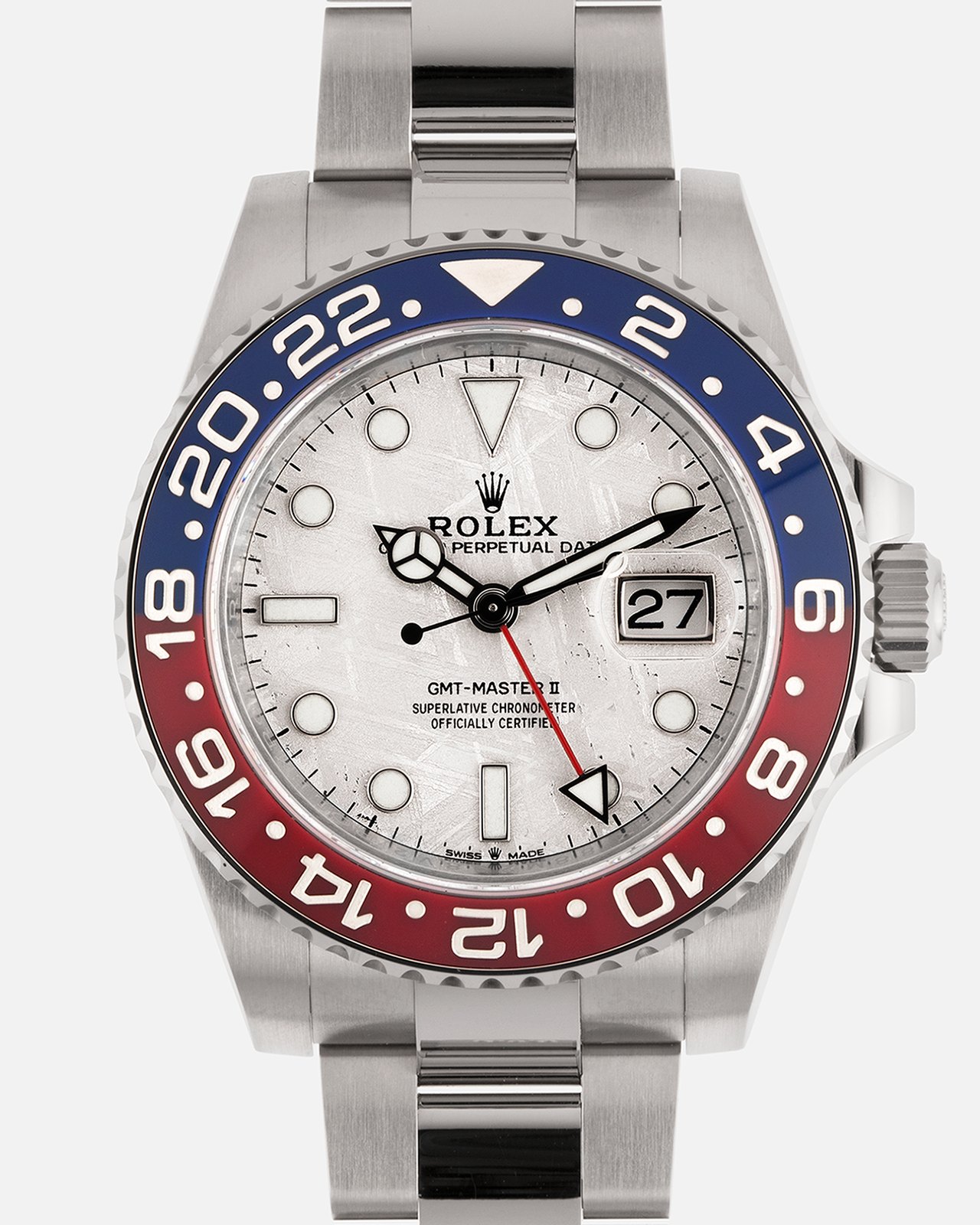
Rolex GMT-Master II 126719BLRO Meteorite, 2022
- Maker / attribution
- Rolex (maker)
- Date
- 2022
- Historical period
- Contemporary Horology (2010 – Present)
- Country of origin
- Switzerland
- Object type
- Wristwatch
- Dimensions
- Case 40 mm
- Stock no.
- Product 7834265780311
- Credit line
- Dealer listing, S.Song Watches (product 7834265780311)
- Catalogue title (original)
- Rolex GMT-Master II 126719BLRO Meteorite (English)
View the source record (dealer listing) ↗ (opens another website in a new tab)Suggest a correction
Record summary
Catalogued by S.Song Watches (dealer), Seattle (stock number Product 7834265780311), this is a wristwatch by Rolex, made in Switzerland, dated 2022. The Atlas places it in the Contemporary Horology period (2010 – Present) of its Wristwatches collection. Recorded dimensions: Case 40 mm. The record is illustrated with 6 photographs.
Assembled from the source record's structured fields. Dates and attributions are given as the source states them; where a field is missing the Atlas leaves it blank rather than estimating.
Catalogue description
Dealer description — S.Song Watches
Few watches are as closely associated with international travel as the Rolex GMT-Master. Originally developed in collaboration with Pan American World Airways and introduced in 1955, the reference 6542 was designed to allow pilots to simultaneously track two different time zones through an additional 24-hour hand and a rotating bezel. Its distinctive red and blue bezel, later affectionately nicknamed the 'Pepsi' by collectors, was originally intended to provide a clear distinction between daytime and nighttime hours. Over the following seven decades, the GMT-Master would evolve through numerous references, movements and materials, becoming one of Rolex's most recognisable and enduring designs. Introduced in 2019, the reference 126719BLRO with meteorite dial represents one of the most unusual interpretations of the GMT-Master II. While precious metal GMT-Masters have existed since the earliest years of the collection, Rolex has generally reserved its more exotic dial materials for the Day-Date and Daytona. The introduction of a meteorite dial to the GMT-Master II was therefore particularly significant, bringing an entirely different visual character to what has traditionally been one of Rolex's most functional and utilitarian sports watches. The 126719BLRO is housed in a 40mm case crafted entirely from 18-carat white gold, paired with a matching Oyster bracelet. At first glance, its proportions and overall appearance are almost identical to those of the stainless steel 126710BLRO, although the additional weight of the precious metal case and bracelet immediately distinguishes the two on the wrist. The familiar bidirectional rotating bezel features a two-colour red and blue Cerachrom insert, a modern interpretation of the original aluminium Pepsi bezels. The real attraction, however, is undoubtedly the meteorite dial. Cut from genuine iron meteorite, the surface displays the distinctive Widmanstätten pattern, a naturally occurring crystalline structure formed through the extremely slow cooling of iron and nickel over millions of years in space. When the material is cut and chemically treated, these interlocking crystalline formations become visible, creating an intricate geometric pattern that cannot be artificially reproduced in precisely the same manner. As each slice of meteorite reveals a different arrangement of crystalline structures, no two dials are ever identical. Some display broad, clearly defined intersecting lines, while others exhibit a finer, more intricate pattern. The silvery grey surface also changes considerably under different lighting conditions, appearing almost white in direct light before revealing darker, contrasting geometric formations at certain angles. Rolex has retained the familiar applied white gold hour markers and Mercedes hands, ensuring that the dial remains unmistakably a GMT-Master despite its unconventional material. Powering the watch is Rolex's in-house automatic calibre 3285, introduced to the GMT-Master II collection in 2018. Featuring the Chronergy escapement, a blue Parachrom hairspring and approximately 70 hours of power reserve, the movement offers independently adjustable local hours, a 24-hour hand and an instantaneous date display. Combined with the rotating 24-hour bezel, the watch is capable of displaying three time zones, preserving the practical functionality that originally defined the GMT-Master. What makes the 126719BLRO particularly appealing is the contrast between the familiar, almost utilitarian design of the GMT-Master and the extraordinary nature of its dial. Unlike the more overtly luxurious gem-set Rolex sports watches, the meteorite GMT-Master remains relatively understated, with its white gold construction almost indistinguishable from stainless steel to the casual observer. The naturally occurring geometric patterns of the meteorite introduce a degree of individuality rarely encountered in modern Rolex production, while the red and blue bezel provides a welcome contrast against the otherwise monochromatic case and dial. It is a particularly successful combination of one of Rolex's most historically significant sports watch designs with one of its most unusual dial materials.
Historical context
Contemporary Horology (2010 – Present)
Silicon components, connected watches, optical-lattice research clocks and a thriving independent scene.
Smartwatches became the world's best-selling watches, while mechanical watchmaking focuses on craft, innovation (silicon components, new escapements) and independent makers.
Read the period in the timelineMore wristwatches from this periodEarlier: Mechanical Renaissance
Atlas type guide
Military, pilot and travel watches
The wristwatch owes much of its adoption by men to warfare and aviation. Wristlets — small pocket watches soldered with lugs and worn on a strap — were used in colonial campaigns and became standard equipment in the First World War, with protective grilles over the crystal ('shrapnel guards'). Louis Cartier's Santos (1904), designed for the aviator Alberto Santos-Dumont, is often cited as an early purpose-made pilot's watch.
In the Second World War governments specified watches in detail: the German B-Uhr observation watches, the American A-11, and the British 'W.W.W.' (the 'Dirty Dozen' set of 1945). After the war, jet travel brought GMT and world-time watches, which show two or more time zones at once — Louis Cottier's world-time mechanism and the Rolex GMT-Master (1955) are examples.
What to look for
- Military markings on the case back: broad arrow, issue numbers, 'W.W.W.', 'A.T.P.'
- High-legibility black dials with luminous Arabic numerals; oversized crowns for gloved hands.
- 24-hour hands and rotating 24-hour bezels or city rings on GMT/world-time watches.
- Wire lugs on early wristlets converted from pocket watches.
Dating clues
- Wire-lug wristlets: c. 1900–1925.
- Military specifications of the Second World War: 1939–1945.
- GMT and world-time wristwatches: mainly after 1950.
General guidance written by the Atlas editors about this kind of object. It is not a statement about this particular piece; for that, rely on the source record above and on physical examination.
Related records

Movements & Components · c. 1970s
Rolex watch movement, c. 1970s
Antiquorum auction archive, Geneva

Pocket Watches · 1982
Fake Rolex watch, gold coloured metal, possibly made in Taiwan, 1982; part of a casual outfit, UK, 1982-84.
Victoria and Albert Museum, London

Wristwatches · c. 1920s
Rolex wristwatch, c. 1920s
Antiquorum auction archive, Geneva

Wristwatches · c. 1920s
Rolex wristwatch, ref. 6194, c. 1920s
Antiquorum auction archive, Geneva

Wristwatches · c. 2010s
Breguet Type XXI, ref. 3810, c. 2010s (Antiquorum Lot 381-24)
Antiquorum auction archive, Geneva

Wristwatches · c. 2010s
Breguet Type XXI, ref. 3810, c. 2010s (Antiquorum Lot 386-229)
Antiquorum auction archive, Geneva

Wristwatches · Sold in September 2010
Breitling Cosmonaute, ref. A 22322, Sold in September 2010
Antiquorum auction archive, Geneva

Wristwatches · c. 2010
Corum Bubble Chrono, ref. 396.150.20, c. 2010
Antiquorum auction archive, Geneva