
Wristwatches · Wristwatch
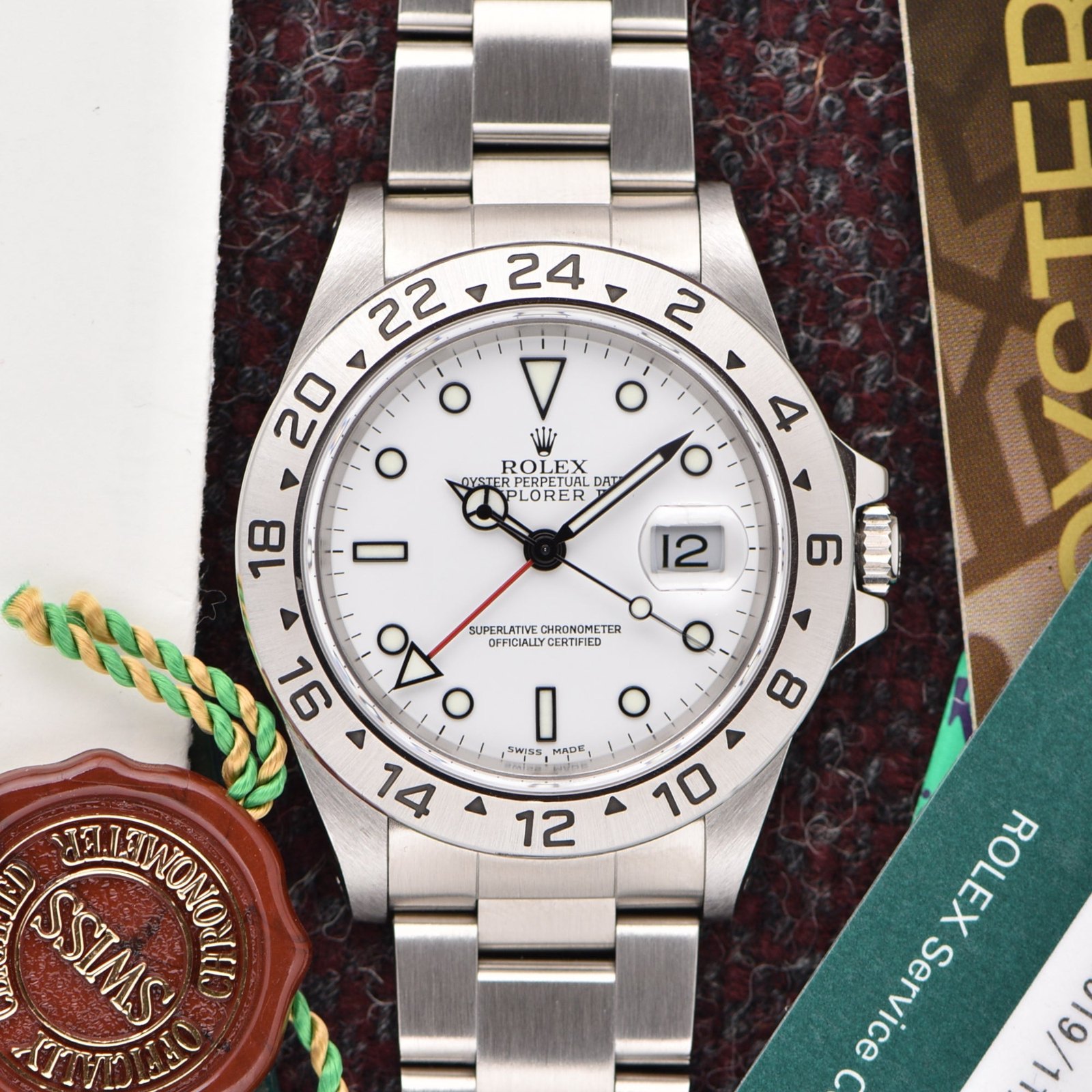
Rolex Explorer 2 Polar Dial - Box, Papers & RSC •PENDING•, 1999
- Maker / attribution
- Rolex (maker)
- Date
- 1999
- Historical period
- Mechanical Renaissance (1990 – 2010)
- Country of origin
- Switzerland
- Object type
- Wristwatch
- Dimensions
- Case 39 mm
- Stock no.
- Product 7453973348535
- Credit line
- Dealer listing, Huntington Company (product 7453973348535)
- Catalogue title (original)
- 1999 Rolex Explorer 2 Polar Dial - Box, Papers & RSC •PENDING• (English)
View the source record (dealer listing) ↗ (opens another website in a new tab)Suggest a correction
Record summary
Catalogued by Huntington Company (dealer) (stock number Product 7453973348535), this is a wristwatch by Rolex, made in Switzerland, dated 1999. The Atlas places it in the Mechanical Renaissance period (1990 – 2010) of its Wristwatches collection. Recorded dimensions: Case 39 mm. The record is illustrated with 6 photographs.
Assembled from the source record's structured fields. Dates and attributions are given as the source states them; where a field is missing the Atlas leaves it blank rather than estimating.
Catalogue description
Dealer description — Huntington Company
Reference 16570 Box, Booklets, Booklet Holder, Papers, RSC, Red Tag Specifications Year: 1999 Model: Explorer 2 Case Diameter: 39mm Lug to Lug: 47mm Case: Stainless Steel Condition: No significant wear as seen Dial: White Movement: Automatic Condition The case looks great with sharp champers and looks unpolished. The dial and lume are both perfect. The bracelet is in nice condition with close to zero stretch. The watch comes with everything shown, including the papers and the Rolex Service Certificate from 2019. The Story In 1971, Rolex introduced the Explorer II as a larger sibling to the original Explorer I wristwatch. The first reference was the Explorer II ref. 1655, featuring a 39mm stainless steel case and matching steel bracelet. These watches were designed for spelunkers, with key features such as an extra 24-hour hand that points to a fixed bezel with 24-hour markings. The watch was not a dual-time timepiece, but later changed to become a dual-time timepiece. Transitional references, such as the Explorer II ref. 16550, introduced features of preceding versions along with additional modifications that pave the way for future references. The 1985 model introduced the larger 40mm case size, sapphire crystal, and Caliber 3085, revamping the dial to look similar to other sports models with Mercedes-style hands and the combo of triangular, round, and rectangular lume-filled hour markers. In 1989, Rolex unveiled the ref. 16570, which had many of the same features as the preceding ref. 16550 with notable upgrades. The ref. 16570 was made for 22 years and underwent several changes over its production run. Early models ran on Caliber 3185, later models housed Caliber 3186, and the luminescent material changed several times. Rolex began engraving the rehaut (space between the dial and the crystal) with "ROLEX" starting in the mid-2000s as an anti-counterfeiting measure. Later examples of the Explorer II ref. 16570 are notably different from early examples of the same model. The Brand Wilsdorf & Davis was initially a watch importer, but by 1908, Wilsdorf had registered 'Rolex' as a trademark. The name was chosen after trial and error, with some believing it was taken from the phrase 'horological Excellence' or because the word sounds like a watch being wound. Wilsdorf was aware of the power of branding and began a long campaign to get the new company name on the watches he exported. The relationship between Rolex and Aegler started the same year that Wilsdorf & Davis set up the business, placing the largest order for wristwatches ever seen. Wilsdorf was attracted by Aegler's commitment to the highest quality, as their movements were extremely accurate and small. In 1910, one of Rolex's models won a First Class Chronometer Certificate from the rating office in Bienne, Switzerland, and in 1914, another piece became the first ever wristwatch to be granted a Class A Chronometer Certificate from the Kew Observatory in England, the only non-marine timepiece to ever achieve it. The firm of Wilsdorf & Davis became synonymous with a commitment to uncompromising excellence. WWI in 1914 led to the rebranding of Wilsdorf & Davis as Rolex in 1915. The British government imposed a 33.3% tax on luxury goods, forcing Rolex to relocate to Bienne. Despite the war, the wristwatch proved its utility, as it was used by soldiers during combat and in the field. Rolex produced trench watches, using Aegler's small movements for wearability. By the end of the war, wristwatches became a utilitarian accessory for men. In the years between the wars, Rolex asserted its independence, partnering with Carl F. Bucherer to resist the Federation of Swiss Watch Manufacturers. In 1926, Rolex introduced the Oyster case, making wristwatches waterproof, dustproof, and robust. Wilsdorf capitalized on this innovation by installing Rolex Ambassadors, or 'Testimonies', with celebrities as a marketing masterstroke. During WWII, Switzerland retained its neutrality, meaning that it was one of the few countries not forced to shut down watch manufacturing to supply the war effort. As a result, by the end of hostilities, the Swiss watch industry was way ahead of other nations. Rolex truly came of age in the 1950s by launching some of the most enduring legends in watchmaking, such as the Explorer, Submariner, GMT-Master, Day-Date, and Milgauss. The quartz crisis of the 1970s and 80s forced the company to change tactics but ultimately repositioned itself as the purveyor of the ultimate luxury lifestyle. Today, the name Rolex is synonymous with refinement, opulence, and personal accomplishment. The Rolex brand as we know it today is the byproduct of an unrelenting drive for excellence and over a hundred years of refinement and development, all in pursuit of the brand’s singular goal of making the world’s best wristwatch.
Historical context
Mechanical Renaissance (1990 – 2010)
Mechanical watches return as cultural objects; independent watchmaking flourishes.
Mechanical watches returned as cultural and luxury objects. Complications, tourbillons and new materials proliferated; independent watchmakers such as George Daniels, F.P. Journe and Philippe Dufour revived artisanal watchmaking; collecting vintage watches became a major field.
Read the period in the timelineMore wristwatches from this periodEarlier: Quartz Revolution
Atlas type guide
Wristwatches
Bracelet watches were worn by women from the early nineteenth century — Breguet made one for Caroline Murat, Queen of Naples, in 1810–12 — but the wristwatch only became a man's instrument with military use and aviation in the early twentieth century. Between the World Wars it overtook the pocket watch; the 1920s and 1930s brought rectangular Art Deco cases, water-resistant cases and the first automatic winding systems.
After 1945 the wristwatch became a carrier of identity — dress watches, sports and dive watches, chronographs, calendars — produced by Swiss, American, Japanese, German, Soviet and Chinese industries. The quartz revolution after 1969 and the mechanical renaissance since the 1990s, including the rise of independent watchmakers, complete the story.
What to look for
- The reference number (between the lugs or inside the case back) and serial number, the starting point for dating.
- The calibre: its maker and number are often stamped under the dial or on the bridge.
- Originality of dial, hands and crown — refinished ('redial') dials are common.
- Case material marks: 18K/750, 14K/585, stainless steel, gold-filled, plated.
Dating clues
- Wire-lug cases: before c. 1925.
- Water-resistant screw-down cases: from 1926.
- Quartz movements: from 1969; sapphire crystals widespread after c. 1980.
General guidance written by the Atlas editors about this kind of object. It is not a statement about this particular piece; for that, rely on the source record above and on physical examination.
Related records

Movements & Components · c. 1970s
Rolex watch movement, c. 1970s
Antiquorum auction archive, Geneva

Pocket Watches · 1982
Fake Rolex watch, gold coloured metal, possibly made in Taiwan, 1982; part of a casual outfit, UK, 1982-84.
Victoria and Albert Museum, London

Wristwatches · c. 1920s
Rolex wristwatch, c. 1920s
Antiquorum auction archive, Geneva

Wristwatches · c. 1920s
Rolex wristwatch, ref. 6194, c. 1920s
Antiquorum auction archive, Geneva

Wristwatches · 2008
Wristwatch by Breitling?, 2008
Museum Rotterdam

Wristwatches · c. 1990s
Audemars Piguet Bamboo, c. 1990s
Antiquorum auction archive, Geneva

Wristwatches · c. 1990
Audemars Piguet Huitieme Perpetual Calendar, ref. 25696PT, c. 1990
Antiquorum auction archive, Geneva

Wristwatches · c. 1990
Breitling Chronomat, ref. b13050.1, c. 1990
Antiquorum auction archive, Geneva