
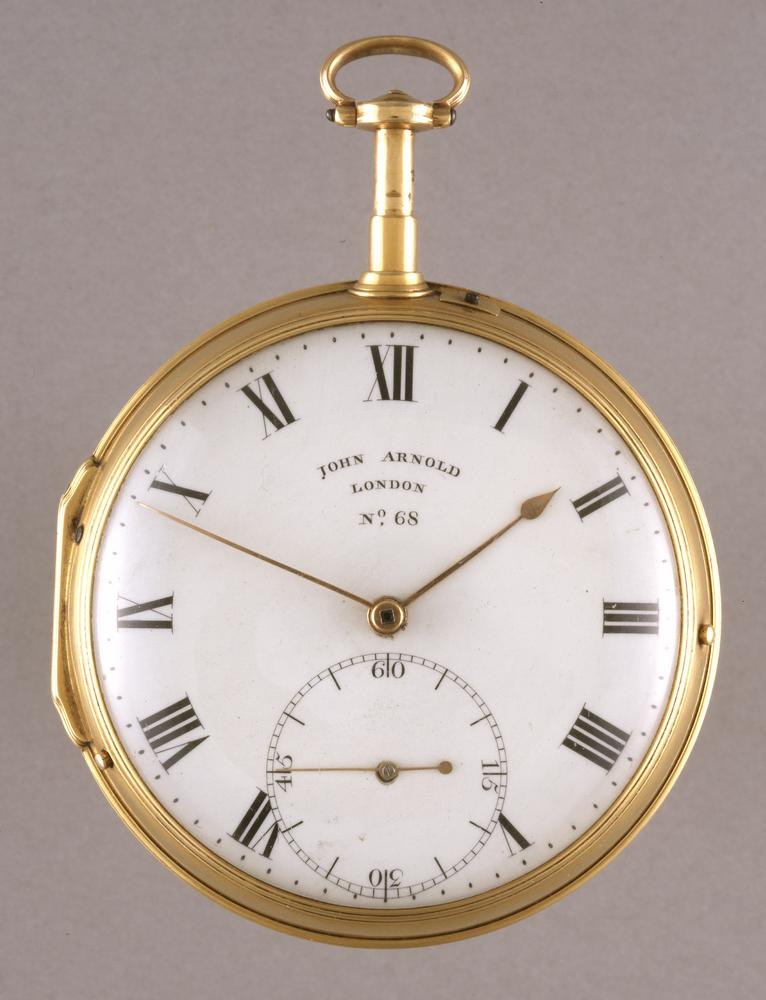
Instruments · Chronometer watch
Repeating pocket chronometer
- Maker / attribution
- John Arnold (Made by); Mary Aveline (Case made by); Gideon Macaire (Case made by)
- Date
- 1780 (case)
- Historical period
- Precision & Scientific Horology (1750 – 1850)
- Country of origin
- England
- Place
- London (England)
- Object type
- Chronometer watch
- Materials / technique
- gold
- Dimensions
- Diameter: 58.50 millimetres (back plate) Diameter: 73.80 millimetres (case) Diameter: 63.50 millimetres (dial plate) Diameter: 59.40 millimetres (front plate) Height: 31.10 millimetres (case) Thickness: 10 millimetres (movement)
- Holding institution
- British Museum
- Accession / object no.
- 1958,1201.301
- Credit line
- British Museum, London
- Catalogue title (original)
- Repeating pocket chronometer (English)
View the source record ↗ (opens another website in a new tab)Suggest a correction
Record summary
Held and catalogued by British Museum (object number 1958,1201.301), this is a chronometer watch by John Arnold, made in London (England), dated 1780 (case). The Atlas places it in the Precision & Scientific Horology period (1750 – 1850) of its Instruments collection. Materials and techniques recorded by the source: gold. Recorded dimensions: Diameter: 58.50 millimetres (back plate) Diameter: 73.80 millimetres (case) Diameter: 63.50 millimetres (dial plate) Diameter: 59.40 millimetres (front plate) Height: 31.10 millimetres (case) Thickness: 10 millimetres (movement). The record is illustrated with 6 photographs.
Assembled from the source record's structured fields. Dates and attributions are given as the source states them; where a field is missing the Atlas leaves it blank rather than estimating.
Catalogue description
Description — British Museum
Repeating pocket chronometer. Full-plate; fusee. Spring detent escapement. White enamel dial, hours I-XII, subsidiary seconds. Gold hands. Gold case; hallmarked; casemaker's mark. Half/quarter dumb repeat.
Curator's comments — British Museum
Text from 'Watches', by David Thompson, London, 2008, p. 96-97. John Arnold GOLD CASED POCKET CHRONOMETER WITH DUMB QUARTER REPEAT LONDON, 1780 SIGNED: 'John Arnold London Invt et Fecit No. 21/68' John Arnold is without doubt one of the most celebrated makers in the history of the marine chronometer. Born in Bodmin, Cornwall, in 1736, he was apprenticed to his father, a watchmaker, and is known to have spent time in Holland before settling in London. His first business premises were at Devereux Court, Fleet Street, where he worked from as early as 1760. His rise to recognition as one of the most accomplished watchmakers in London was without doubt aided by two watches that he made for King George III. In the 1770s, following the success of John Harrison's marine timekeeper H4, Arnold turned his attentions to developing a viable machine for determining longitude in maritime navigation. In defence of his claim to have invented the spring-detent escapement for chronometers, in preference to that of Thomas Earnshaw, in 1791 Arnold published a pamphlet entitled 'Certificates and Circumstances relative to the going of Mr Arnold's Chronometers'. This particular pocket chronometer features in the pamphlet, where its remarkable rate was checked and recorded by its owner, Edward Everard, a wine merchant from Kings Lynn. Everard wrote to Arnold, saying: 'The following comparisons were made with a regulator, the going of which was examined by a transit instrument, and the errors of the regulator accounted for in the rate of the chronometer. When I have not been at home to make daily comparisons, the mean rate of the chronometer, for that interval is inserted in the register. Having travelled with it some thousands of miles on horseback and in carriages, I can with truth assert, that neither the motion of the one or the other has ever, as far as I have seen able to discover, altered the rate of this chronometer.' The daily rate of the chronometer as it was recorded between November 1785 and March 1790 is then listed and it is, to say the least, impressive considering the treatment it received. Between 11 March and 1 April 1786, for instance, it ranged between a losing rate of 0.7 seconds per day to a maximum gaining rate of 0.6 seconds, and on many occasions its daily rate did not vary at all. The watch was also mentioned by Arnold's rival Thomas Earnshaw in 'An Appeal to the Public', his 1808 published account of his life and work, where he criticized the watch and denounced Mr Everard's account as a mistake. He also claimed that Arnold had tried to buy the watch back from Everard, writing: 'Is this not full acknowledgement on the part of Mr Arnold, that he could not make its equal? Mr Arnold, the famous boasting watch-maker, offers 500 guineas for a watch which he made, and which did not cost him more than 30 guineas.' Whether or not Everard's testimonial was accurate, this watch is nevertheless a fine example of Arnold's work, although it was updated by him at a later date when he fitted a spring-detent escapement to replace the original pivoted-detent version. As well as being an exceptionally well-made pocket chronometer, the watch is also fitted with a dumb quarter repeat mechanism. When the pendant is pushed down, the mechanism causes a hammer to strike a block in the case, first the hour as single blows and then the quarter as double blows. Depressing a small stud in the case band allows the repeat to be felt 'silently' by preventing the hammers from hitting the case block. The repeating work is of the finest quality and a pleasure to look at, with mirror polish to all the flat steel components. The large 22-carat plain gold case was made by the watch-case makers Mary Aveline and Gideon Macaire, whose business was at 5 Denmark Street, St Giles, Covent Garden. Their mark, 'MA GM', together with the London hallmark for 1780, appears inside the case back. View more about curator's comments Comment from Anthony G. Randall and Richard Good, Catalogue of Watches in the British Museum. Vol. VI (1990) Made by John Arnold, 1780 Chronometer Signature: On the back plate 'John Arnold London Invt et Fecit No 21/68' On the dial 'John Arnold N°68'. Case: Fine 22-carat gold consular, with the London hallmark for 1780 and the casemaker's marks MA over GM (Mary Aveline and Gideon Macaire, 5 Denmark St, St Giles. Mark entered with Goldsmiths' Company, 19 July 1779). Pump pendant with fluted stirrup bow and the remains of an applied rosette decoration and having a locking slide beside the pendant tube. A touch piece is fitted at 8 o'clock operating through the case to feel the dumb repeating. Diam. 73.8 mm, overall h. 31.3 mm. Dial and hands: Flat enamel dial attached to the dial plate by three short feet and pins, the back marked '68' in red enamel. The divisions of the subsidiary seconds dial show signs of having been marked with a scriber under the enamel. Gold hands, the minute hand held by a screw set in the boss, the seconds with a threaded hole in the boss and steel pipe with a screw head. Movement: Dial plate diam. 63.5 mm; front plate diam. 59.4 mm; back plate diam. 58.5 mm; frame h. 10.0 mm. Frame, going train, fusee: Similar to John Arnold No. 37 and of exceptional quality and finish. There is a wedge-shaped cut-out in the front plate for the table of the escape potence. The movement hinge, case catch and spring carried on the dial plate which clips bayonet fashion on the front plate and is secured by a single screw in the edge. Scratched on the mainspring 'Brookes Aug 92'. Jewelling: Similar to John Arnold No. 37, the flat jewels have small but distinct oil sinks and are of a white or pale pink colour. Near the fourth pivot in the back plate is an unused brass plate held by two screws as if for a bearing. There is a single filled hole nearby. The fourth upper jewel is a later replacement with large oil sink and curved face against the pivot shoulder. Escapement: Originally a pivoted detent, but con.
Inscriptions & marks
signature; movement; John Arnold, London. Inv et Fecit. No.21/68.; casemaker's mark; MA GM; hallmark; London, 1780.
Provenance
Previous owner/ex-collection:, Courtenay Adrian Ilbert; Acquired 1958
Historical context
Precision & Scientific Horology (1750 – 1850)
Harrison solves longitude; Mudge invents the lever; Breguet's Paris workshop defines the modern watch.
The longitude problem was solved by the marine chronometer and lunar distance methods; dividing engines made precision scales possible, and observatories set time by transit instruments.
Read the period in the timelineMore instruments from this periodEarlier: Early Modern Horology
Atlas type guide
Marine chronometers
A marine chronometer is a precision timekeeper carried at sea to find longitude: the navigator compares local noon, observed with a sextant, with the time at a reference meridian kept by the chronometer. Each hour of difference corresponds to fifteen degrees of longitude. John Harrison proved the method in the 1760s; Pierre Le Roy, Ferdinand Berthoud, John Arnold and Thomas Earnshaw then developed the detent escapement and the compensation balance that made chronometers practical to manufacture.
By the nineteenth century London, Liverpool, Le Locle and Glashütte supplied navies and merchant fleets. A typical box chronometer has a spring-detent escapement, a fusee to equalise mainspring torque, a bimetallic compensation balance with a helical balance spring, and is mounted in gimbals inside a wooden box so that it stays level.
What to look for
- Gimbals and a three-tier wooden box with a glazed inner lid.
- A power-reserve ('up and down') indicator on the dial, usually showing 56 hours on two-day instruments.
- Spring-detent escapement and a cylindrical (helical) balance spring visible through the movement.
- Admiralty or navy marks (broad arrow), and rating certificates from observatories.
- The maker's number on the dial and movement; many makers' registers survive, allowing dating.
Dating clues
- Earnshaw-type spring-detent chronometers became standard after about 1800.
- Auxiliary compensation devices on the balance appear from the mid-nineteenth century.
- Quartz and radio time signals ended routine use of mechanical chronometers in the 1970s and 1980s.
General guidance written by the Atlas editors about this kind of object. It is not a statement about this particular piece; for that, rely on the source record above and on physical examination.
Related records
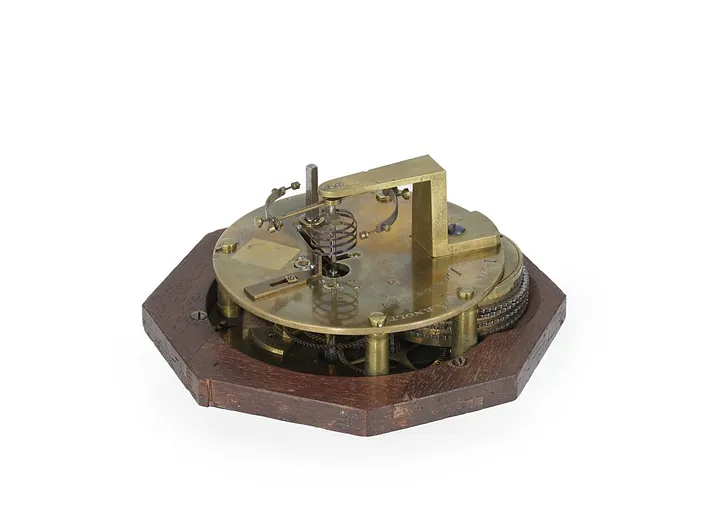
Instruments · 1771
Marine chronometer by John Arnold, England, 1771
Science Museum Group, London
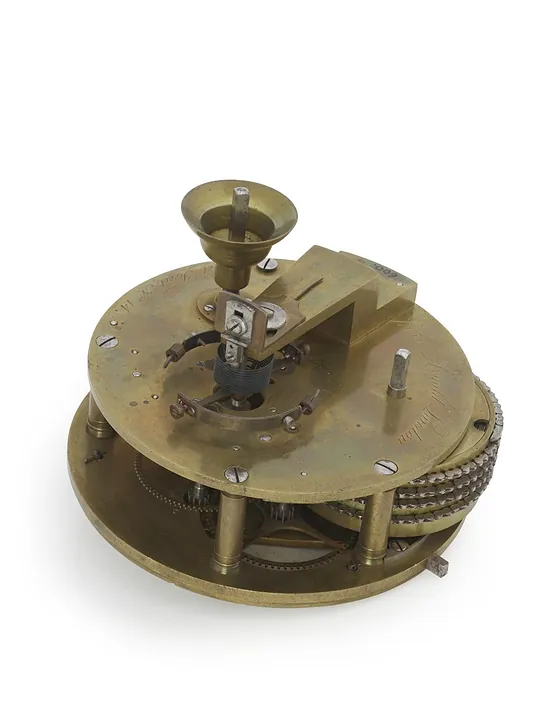
Instruments · 1775
Marine chronometer by John Arnold, England, 1775
Science Museum Group, London
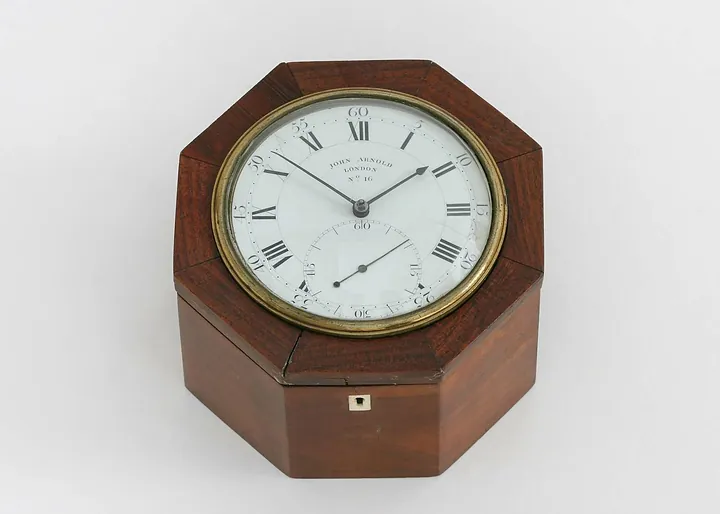
Instruments · c. 1783
Marine chronometer by John Arnold, England, c. 1783
German Clock Museum
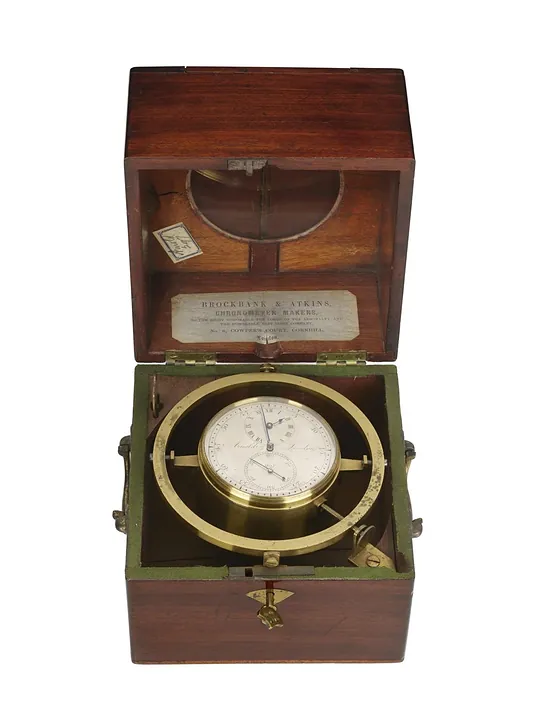
Instruments · 1802
Marine chronometer by John Arnold, England, 1802
Science Museum Group, London
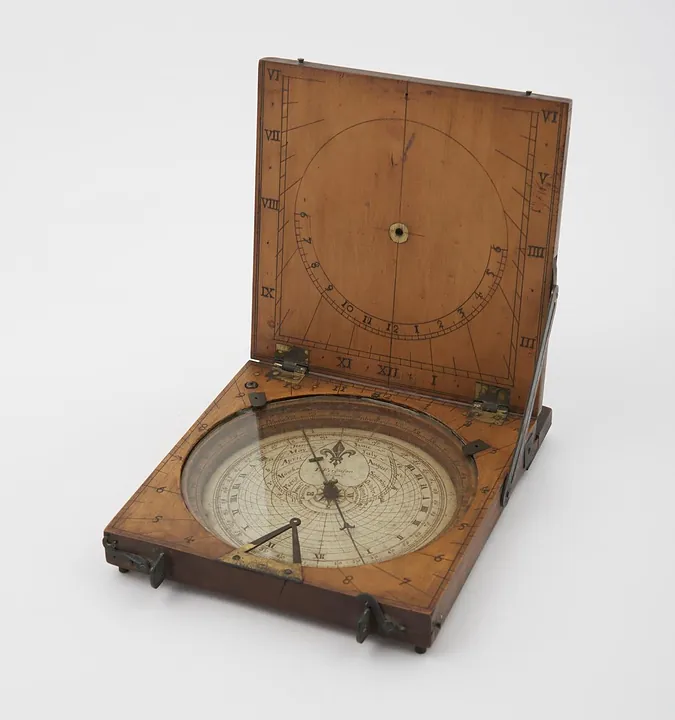
Instruments · 1731–1776
Azimuth compass sundial by James Ferguson, London, England, 1731–1776. Could also be used as a tablet sundial - string gnomon is missing (see note).
Science Museum Group, London
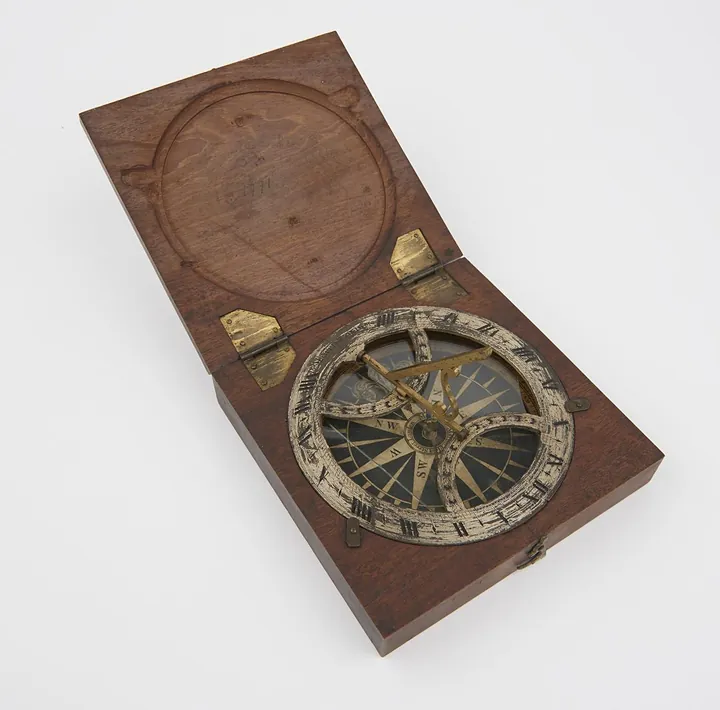
Instruments · 1738–1777
Azimuth sundial 4 3/8" diam, with folding gnomon fitted in mahogany case, made by B. Martin
Science Museum Group, London
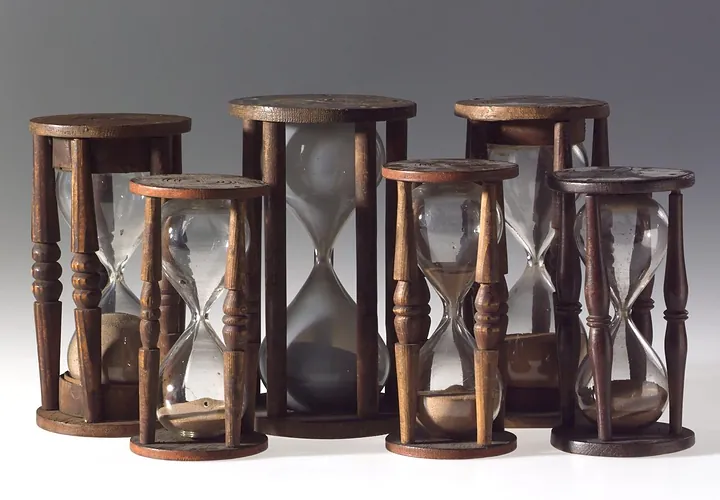
Instruments · 1750–1800
Single sand glass in four pillared wooden mount. 17 minutes. Horne Type B. Second half of the 18th century
Science Museum Group, London
Instruments · 1751–1825
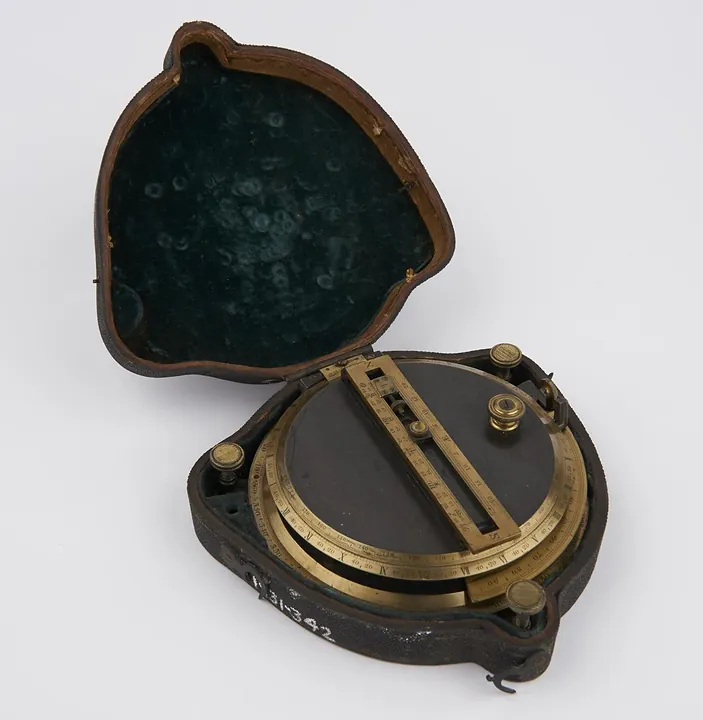
Sundial, by Troughton, in case. Invented and made by Troughton
Science Museum Group, London