
Wristwatches · Wristwatch
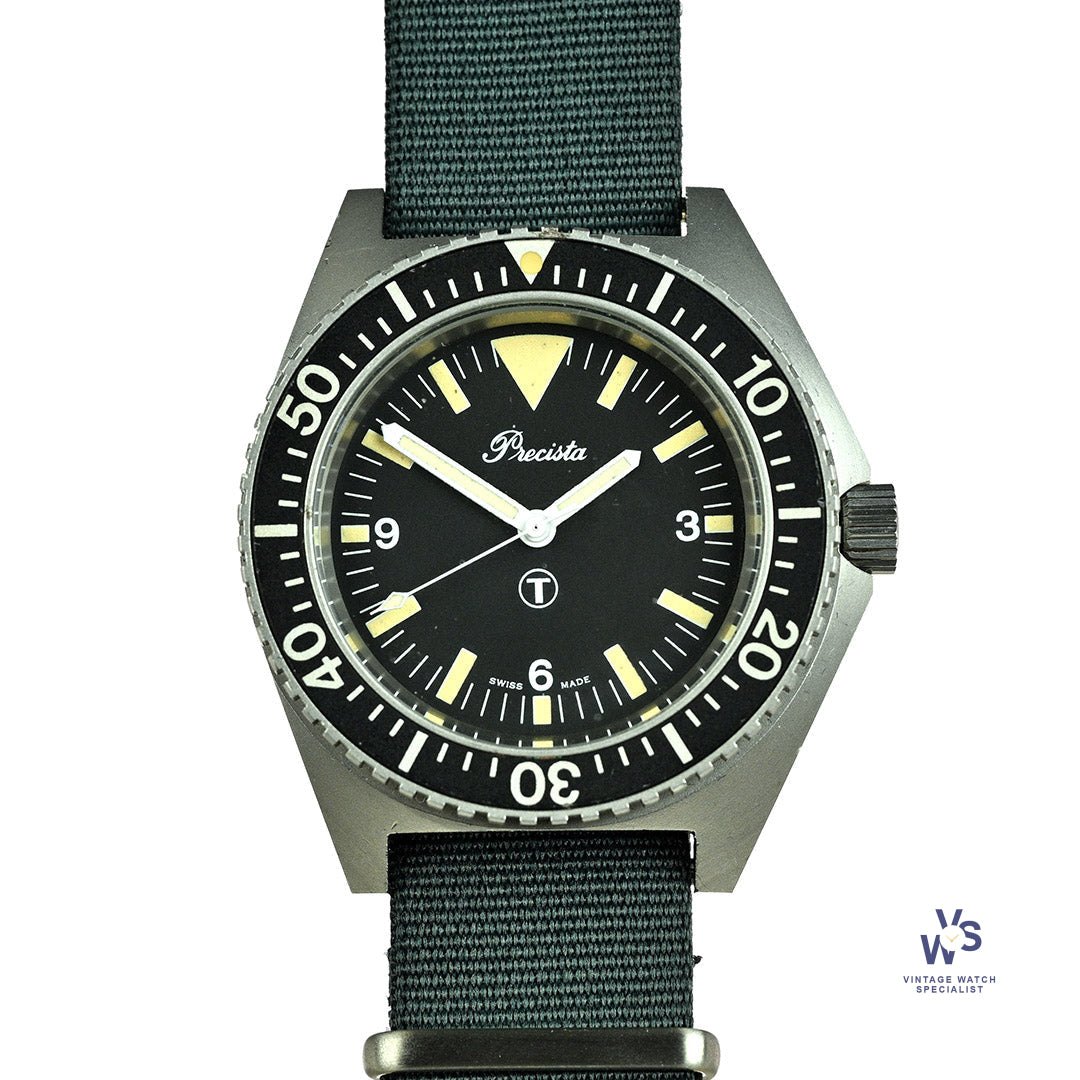
Precista Royal Navy Diver, Quartz, Asymmetric Case, Original Military Markings, 1993
- Maker / attribution
- Precista (maker)
- Date
- 1993
- Historical period
- Mechanical Renaissance (1990 – 2010)
- Country of origin
- Unrecorded in source
- Object type
- Wristwatch
- Stock no.
- vws3997
- Credit line
- Dealer listing, Vintage Watch Specialist (vws3997)
- Catalogue title (original)
- Precista Royal Navy Diver - Quartz - Asymmetric Case - Original Military Markings - 1993 (English)
View the source record (dealer listing) ↗ (opens another website in a new tab)Suggest a correction
Record summary
Catalogued by Vintage Watch Specialist (dealer), United Kingdom (stock number vws3997), this is a wristwatch by Precista, dated 1993. The Atlas places it in the Mechanical Renaissance period (1990 – 2010) of its Wristwatches collection. The record is illustrated with 6 photographs.
Assembled from the source record's structured fields. Dates and attributions are given as the source states them; where a field is missing the Atlas leaves it blank rather than estimating.
Catalogue description
Dealer description — Vintage Watch Specialist
The elusive 1993 Precista Royal Navy Diver in superb condition with the iconic big triangle and asymmetric case, very limited numbers produced - 1993 Precista is a British brand with deep connections to the military, particularly through supplying watches to the Ministry of Defence in the mid-20th century. Known for their rugged reliability, Precista produced timepieces that met strict MoD specifications, often for the Royal Navy and RAF. Their divers’ watches and chronographs became trusted instruments for service personnel. Today, vintage Precista models are highly regarded by collectors for their no-nonsense design, durability, and authentic link to Britain’s military heritage. What's on Offer We’re proud to present this highly rare Precista Royal Navy Diver from 1993 — one of the most elusive British military divers you’re likely to encounter. With an asymmetric stainless-steel case and rotating bezel, it features the bold “Big Triangle” at 12, quarter-Arabic numerals, block hour markers, and exceptionally strong original lume. The bulletproof 3 mm mineral crystal (the thickest ever used in an RN-issued diver) and screw-down crown add to its durability. Inside, the watch runs a robust ISA 1198 quartz movement, fully serviceable and dependable. Out of only about 300 ever issued, and with far fewer surviving today, this example in superb condition is a rare jewel in any collection and an absolute joy to military collectors - we don't expect it to be around for long.
Historical context
Mechanical Renaissance (1990 – 2010)
Mechanical watches return as cultural objects; independent watchmaking flourishes.
Mechanical watches returned as cultural and luxury objects. Complications, tourbillons and new materials proliferated; independent watchmakers such as George Daniels, F.P. Journe and Philippe Dufour revived artisanal watchmaking; collecting vintage watches became a major field.
Read the period in the timelineMore wristwatches from this periodEarlier: Quartz Revolution
Atlas type guide
Dive and water-resistant watches
Keeping water and dust out of a wristwatch was a long-standing challenge. Rolex's screw-down Oyster case (1926) and Omega's Marine (1932) were landmarks; in the early 1950s Blancpain's Fifty Fathoms and Rolex's Submariner defined the professional dive watch with rotating bezels for timing dives, luminous dials and high water resistance. The ISO 6425 standard (1982) later codified what a 'diver's watch' must do.
Dive watches became icons of post-war design and exploration, and their evolution — helium escape valves, ceramic bezels, saturation-diving depth ratings — records the history of underwater work.
What to look for
- Unidirectional or bidirectional rotating bezel with minute markings.
- Screw-down crown and case back; depth rating printed on the dial.
- Luminous hands and markers (radium before c. 1960, tritium c. 1960–1998, then Super-LumiNova).
- Reference numbers on the case between the lugs or inside the back.
Dating clues
- Screw-down Oyster cases: from 1926.
- Professional dive watches: from 1953.
- Tritium 'T' marks on dials: c. 1960–1998.
General guidance written by the Atlas editors about this kind of object. It is not a statement about this particular piece; for that, rely on the source record above and on physical examination.
Related records
Wristwatches · 1982
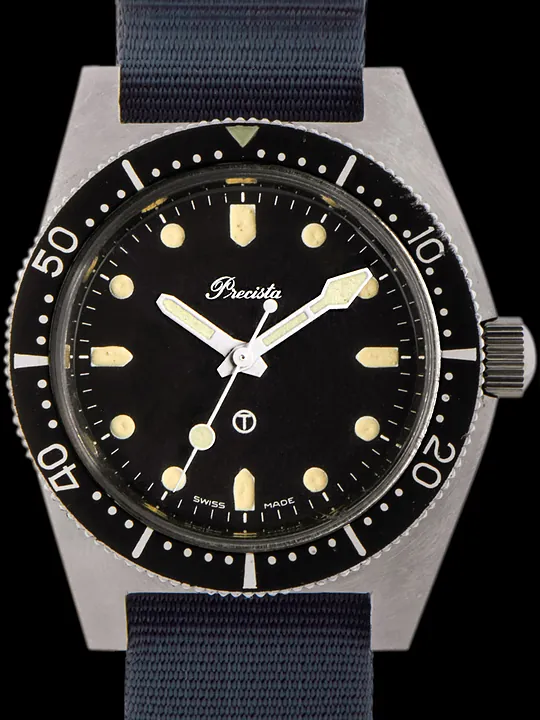
Precista Royal Navy Issue Diver "Snake Head" 0552/923-7697, 1982
Craft & Tailored (dealer), Los Angeles
Wristwatches · 1982
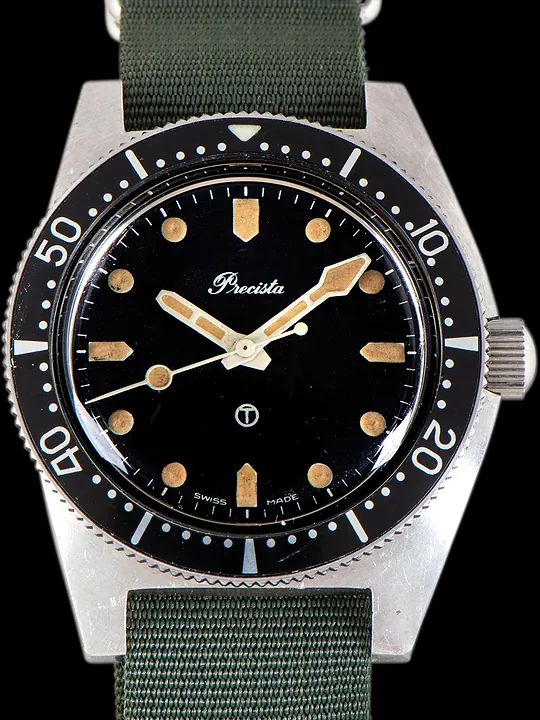
Precista Royal Navy Issue Diver "Snake Head" 0552/923-7697, 1982
Craft & Tailored (dealer), Los Angeles
Wristwatches · 1990s
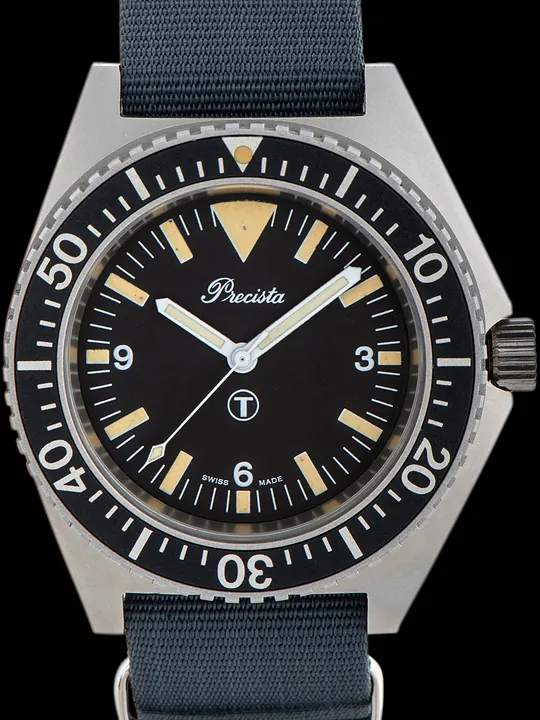
Precista Royal Navy Diver (6645-99-757-3314) “Sterile Case Back”, 1990s
Craft & Tailored (dealer), Los Angeles
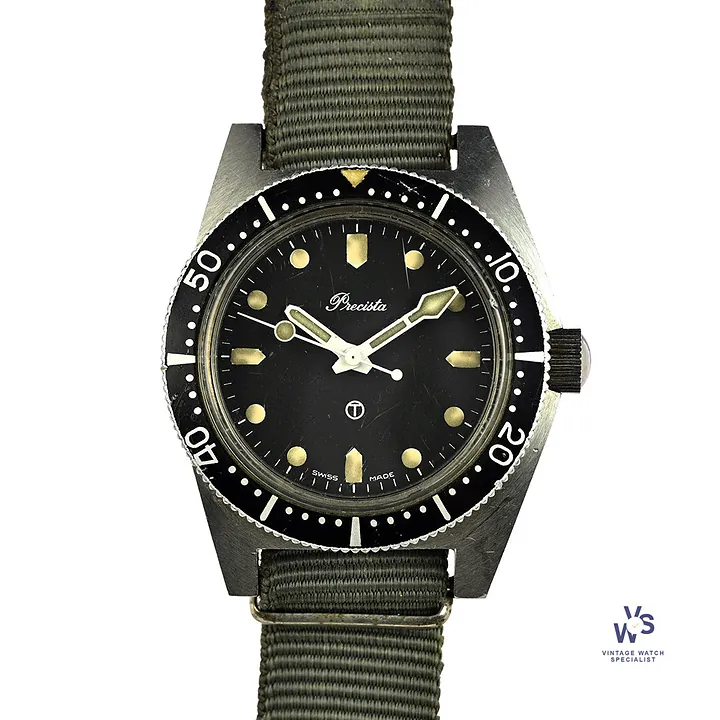
Wristwatches · c. 1982
Royal Navy Issued Precista Dive Watch with 0552 Case Back Markings, 'Snakehead' Minute Hand, circa 1982
Vintage Watch Specialist (dealer), United Kingdom
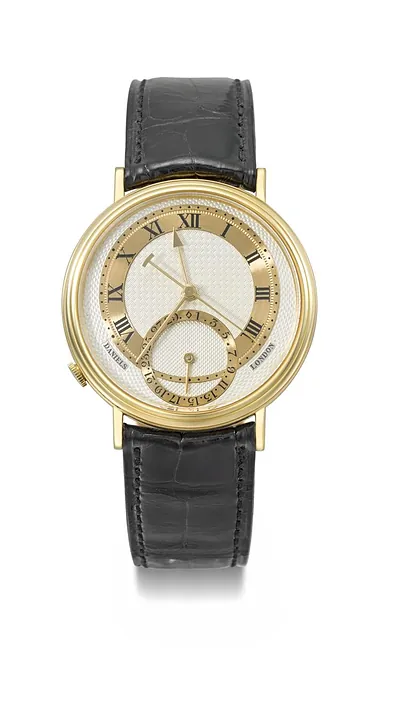
Wristwatches · 1999
'Millennium' co-axial wristwatch by George Daniels and Omega, England, 1999
Science Museum Group, London

Wristwatches · 2008
Wristwatch by Breitling?, 2008
Museum Rotterdam
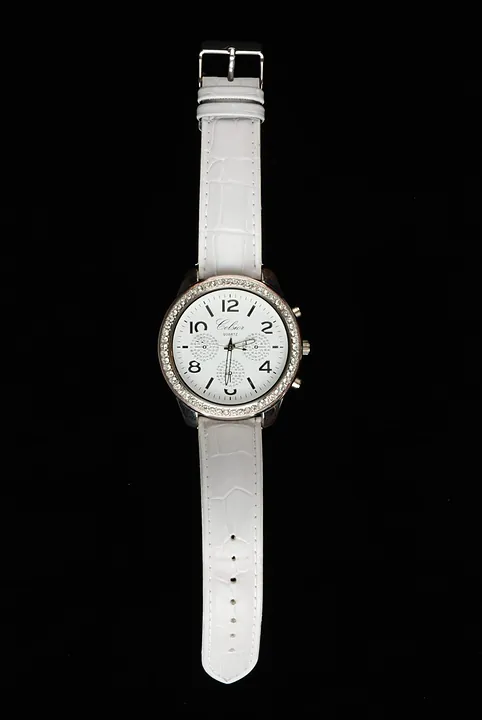
Wristwatches · 2008
Wristwatch by Celsior Quartz, 2008
Museum Rotterdam
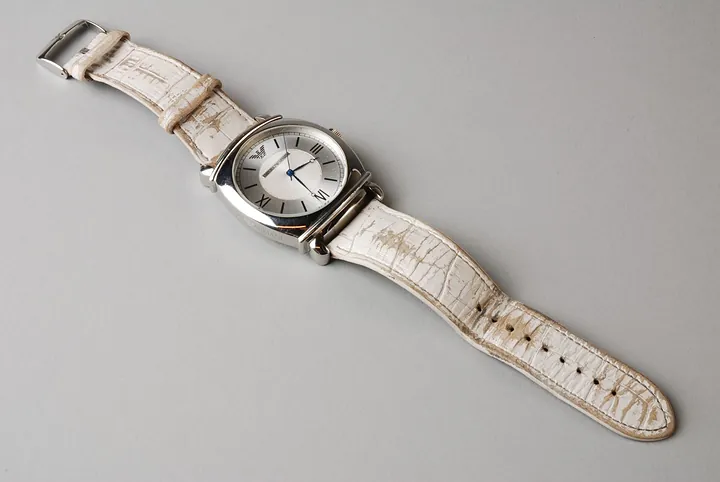
Wristwatches · 2008
Wristwatch possibly by Emporio Armani, 2008
Museum Rotterdam