
Wristwatches · Wristwatch
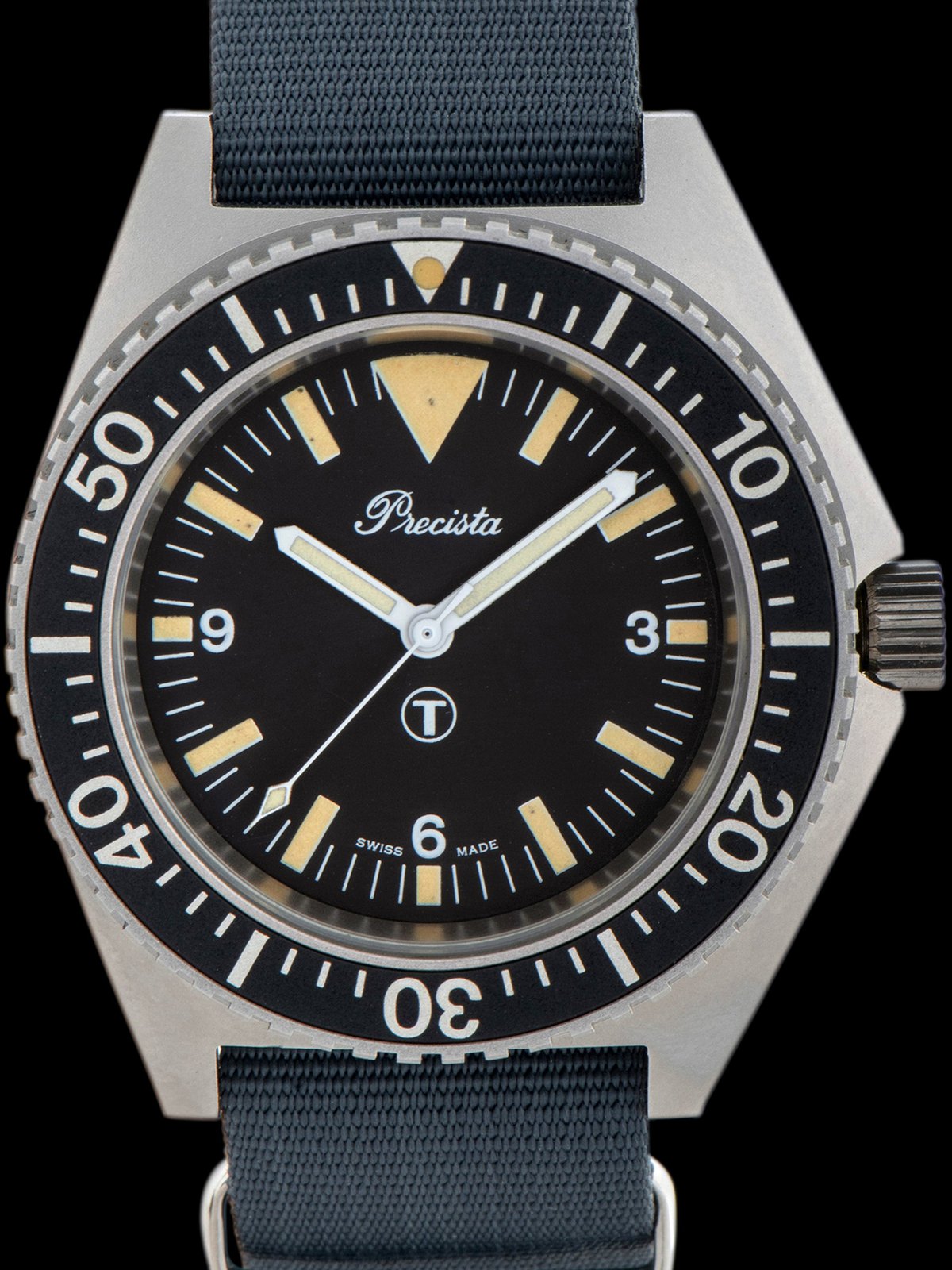
Precista Royal Navy Diver (6645-99-757-3314) “Sterile Case Back”, 1990s
- Maker / attribution
- Precista (maker)
- Date
- 1990s
- Historical period
- Mechanical Renaissance (1990 – 2010)
- Country of origin
- Unrecorded in source
- Object type
- Wristwatch
- Stock no.
- PRRNDST
- Credit line
- Dealer listing, Craft & Tailored (PRRNDST)
- Catalogue title (original)
- 1990s Precista Royal Navy Diver (6645-99-757-3314) “Sterile Case Back” (English)
View the source record (dealer listing) ↗ (opens another website in a new tab)Suggest a correction
Record summary
Catalogued by Craft & Tailored (dealer), Los Angeles (stock number PRRNDST), this is a wristwatch by Precista, dated 1990s. The Atlas places it in the Mechanical Renaissance period (1990 – 2010) of its Wristwatches collection. The record is illustrated with 6 photographs.
Assembled from the source record's structured fields. Dates and attributions are given as the source states them; where a field is missing the Atlas leaves it blank rather than estimating.
Catalogue description
Dealer description — Craft & Tailored
Precista occupies an interesting and often overlooked position in the history of British military watches. Originally associated with the British watch and clock supplier Southern Watch & Clock Supplies Ltd., the company was among a relatively small group of manufacturers that produced watches for the British Ministry of Defense, including general-service watches and purpose-built divers for the Royal Navy. While Precista's military diving watches can be traced back to the early 1980s, the present watch belongs to the later generation of quartz-powered divers produced during the late 1980s and early 1990s. These watches followed the utilitarian requirements that had come to define the British military dive watch: a stainless-steel case with fixed strap bars, screw-down crown, rotating timing bezel, highly legible matte-black dial, and tritium luminous material identified by the circled "T" prominently displayed on the dial. There was little here that wasn't dictated by function. The present example carries NATO Stock Number 6645-99-757-3314 , an NSN associated with British military quartz diving watches and found on documented Royal Navy-issued Precista examples from the period. Unlike many surviving examples, however, this watch is unusual in that its case back carries the NATO Stock Number without the individual issue and year markings normally found beneath it. Issued examples are typically encountered with a sequential number followed by the year of issue, for example, documented Precista divers from 1988, 1989, and 1993 are known with this NSN and corresponding military issue numbers. Collectors commonly refer to examples such as the present watch, which lack these individual issue markings, as having a "sterile" case back . Precisely why these sterile examples exist is less clear. They may represent unissued contract watches, replacement or service stock, or watches that otherwise remained outside the normal individual-issue marking process. Without surviving documentation connecting this particular watch to one of those scenarios, however, we prefer not to speculate beyond what can be established from the watch itself. What remains is an exceptionally well-preserved example of a lesser-known British military diver of the period. Its matte-black 3-6-9 dial, oversized circled "T," sword-shaped hands, fully graduated bezel, fixed bars, and bead-blasted case give it an unmistakably military character, while its scarcity relative to the considerably better-known CWC divers makes the Precista a fascinating component of the post-MilSub Royal Navy dive-watch story. SPECS Stock # PRRNDST Brand Precista Style Military Diver Model 6645-99-757-3314 Serial N/A Size Men's Material Stainless Steel Dial Matte Black Millimeters 39.5 Strap New Phoenix Admiralty Grey Strap CASE & BRACELET The case remains in sharp and unpolished condition, retaining the original bead-blasted matte finish. The fixed strap bars remain fully intact, showing no evidence of bending or damage. The original bezel and fully graduated insert remain in sharp condition, with no major fading or marks, and the tritium lume pip is fully intact. The screw-down case back retains legible NATO NSN numbers, but the case back is free of an issuance number, and this is commonly referred to as a "sterile case back." This example also retains its original mineral glass crystal, free of scratches or blemishes. The watch will come with a new gray Phoenix strap. DIAL & HANDS The original matte black "Circle T" dial remains in perfect vintage condition; under magnification, it shows no marks or blemishes. The tritium lume on both the dial and hands has aged evenly to a rich custard-like patina. When examined under ultraviolet light, the original tritium lume on the dial and in the hands exhibits no evidence of lume degradation or prior repairs. ACCESSORIES None. The watch is running exceptionally well and keeping accurate time. It recently received a fresh battery and a new case back gasket to ensure reliable operation. While the case retains its original water-resistant design, due to the age of the watch, we do not recommend swimming or diving with it.
Historical context
Mechanical Renaissance (1990 – 2010)
Mechanical watches return as cultural objects; independent watchmaking flourishes.
Mechanical watches returned as cultural and luxury objects. Complications, tourbillons and new materials proliferated; independent watchmakers such as George Daniels, F.P. Journe and Philippe Dufour revived artisanal watchmaking; collecting vintage watches became a major field.
Read the period in the timelineMore wristwatches from this periodEarlier: Quartz Revolution
Atlas type guide
Dive and water-resistant watches
Keeping water and dust out of a wristwatch was a long-standing challenge. Rolex's screw-down Oyster case (1926) and Omega's Marine (1932) were landmarks; in the early 1950s Blancpain's Fifty Fathoms and Rolex's Submariner defined the professional dive watch with rotating bezels for timing dives, luminous dials and high water resistance. The ISO 6425 standard (1982) later codified what a 'diver's watch' must do.
Dive watches became icons of post-war design and exploration, and their evolution — helium escape valves, ceramic bezels, saturation-diving depth ratings — records the history of underwater work.
What to look for
- Unidirectional or bidirectional rotating bezel with minute markings.
- Screw-down crown and case back; depth rating printed on the dial.
- Luminous hands and markers (radium before c. 1960, tritium c. 1960–1998, then Super-LumiNova).
- Reference numbers on the case between the lugs or inside the back.
Dating clues
- Screw-down Oyster cases: from 1926.
- Professional dive watches: from 1953.
- Tritium 'T' marks on dials: c. 1960–1998.
General guidance written by the Atlas editors about this kind of object. It is not a statement about this particular piece; for that, rely on the source record above and on physical examination.
Related records
Wristwatches · 1982
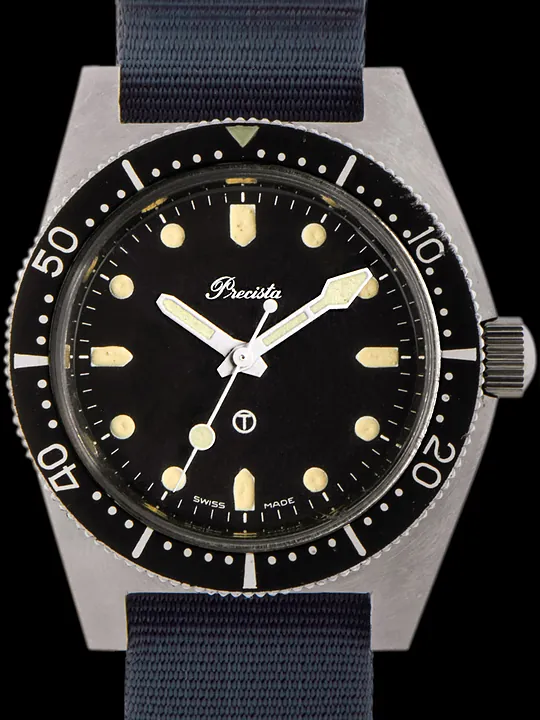
Precista Royal Navy Issue Diver "Snake Head" 0552/923-7697, 1982
Craft & Tailored (dealer), Los Angeles
Wristwatches · 1982
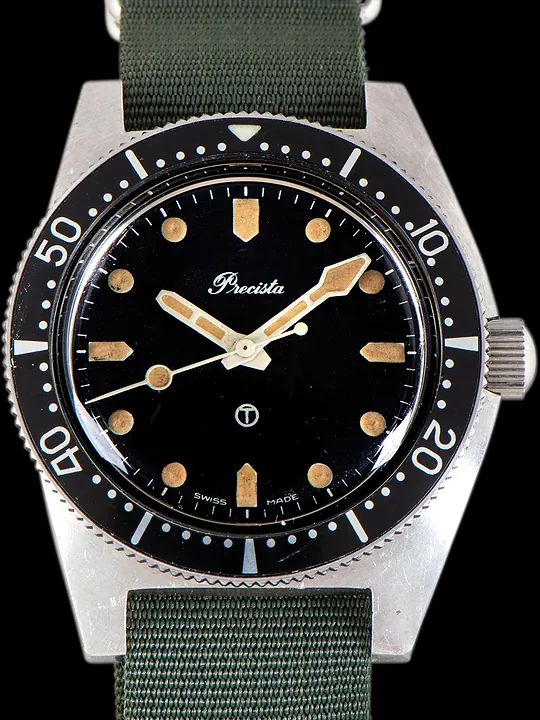
Precista Royal Navy Issue Diver "Snake Head" 0552/923-7697, 1982
Craft & Tailored (dealer), Los Angeles
Wristwatches · c. 1982
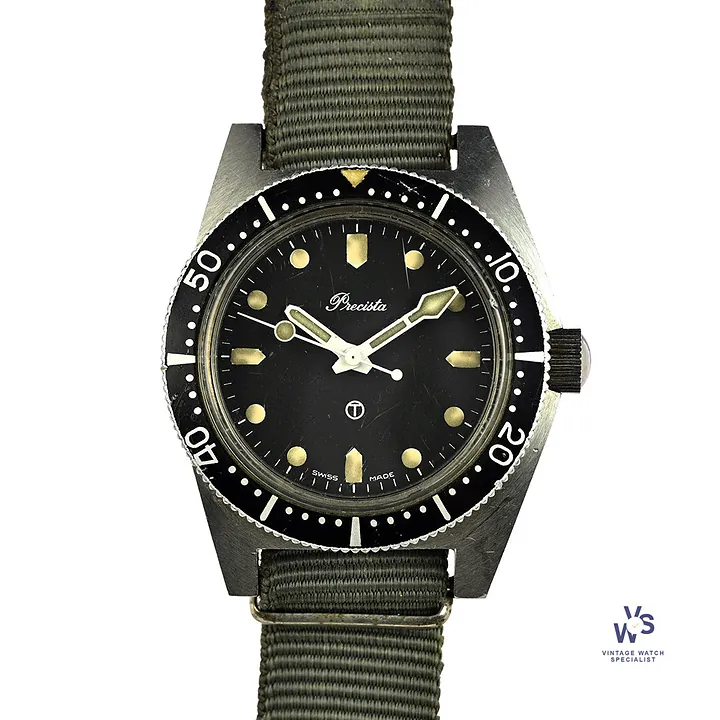
Royal Navy Issued Precista Dive Watch with 0552 Case Back Markings, 'Snakehead' Minute Hand, circa 1982
Vintage Watch Specialist (dealer), United Kingdom
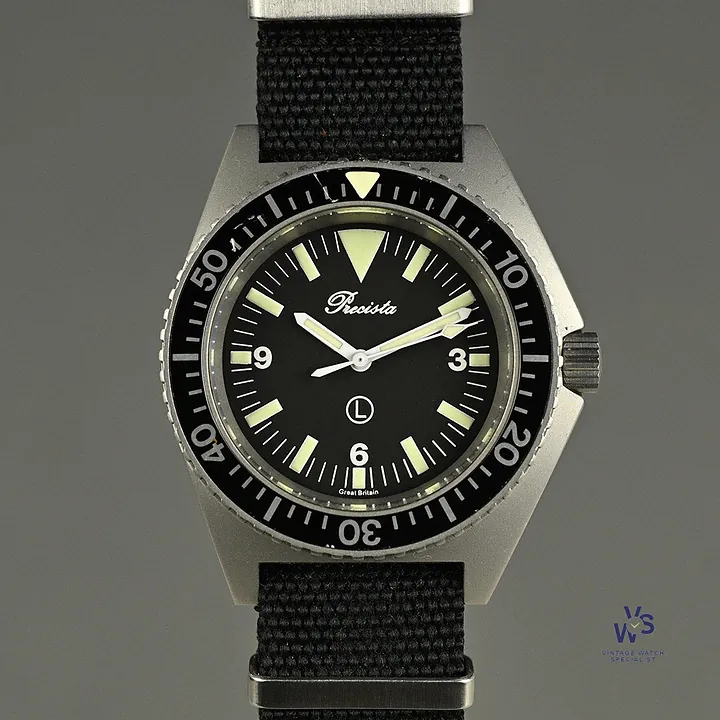
Wristwatches · c. 2011
Precista PRS-18Q 'Military' Diver, Royal Navy Inspired, ref. PRS-18-Q, circa 2011
Vintage Watch Specialist (dealer), United Kingdom
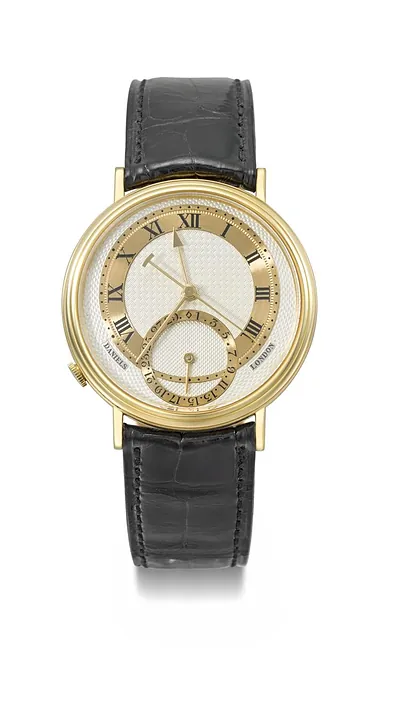
Wristwatches · 1999
'Millennium' co-axial wristwatch by George Daniels and Omega, England, 1999
Science Museum Group, London

Wristwatches · 2008
Wristwatch by Breitling?, 2008
Museum Rotterdam
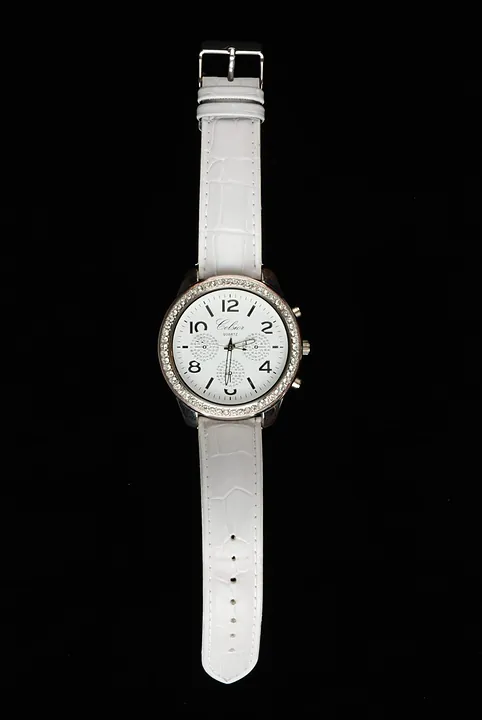
Wristwatches · 2008
Wristwatch by Celsior Quartz, 2008
Museum Rotterdam
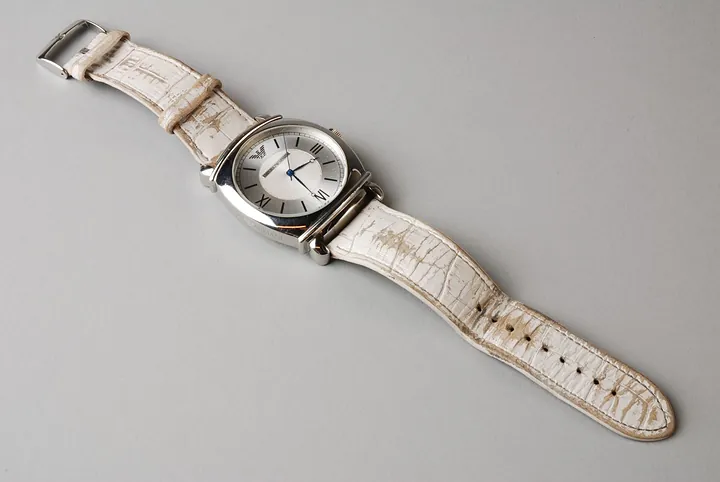
Wristwatches · 2008
Wristwatch possibly by Emporio Armani, 2008
Museum Rotterdam