
Wristwatches · Wristwatch
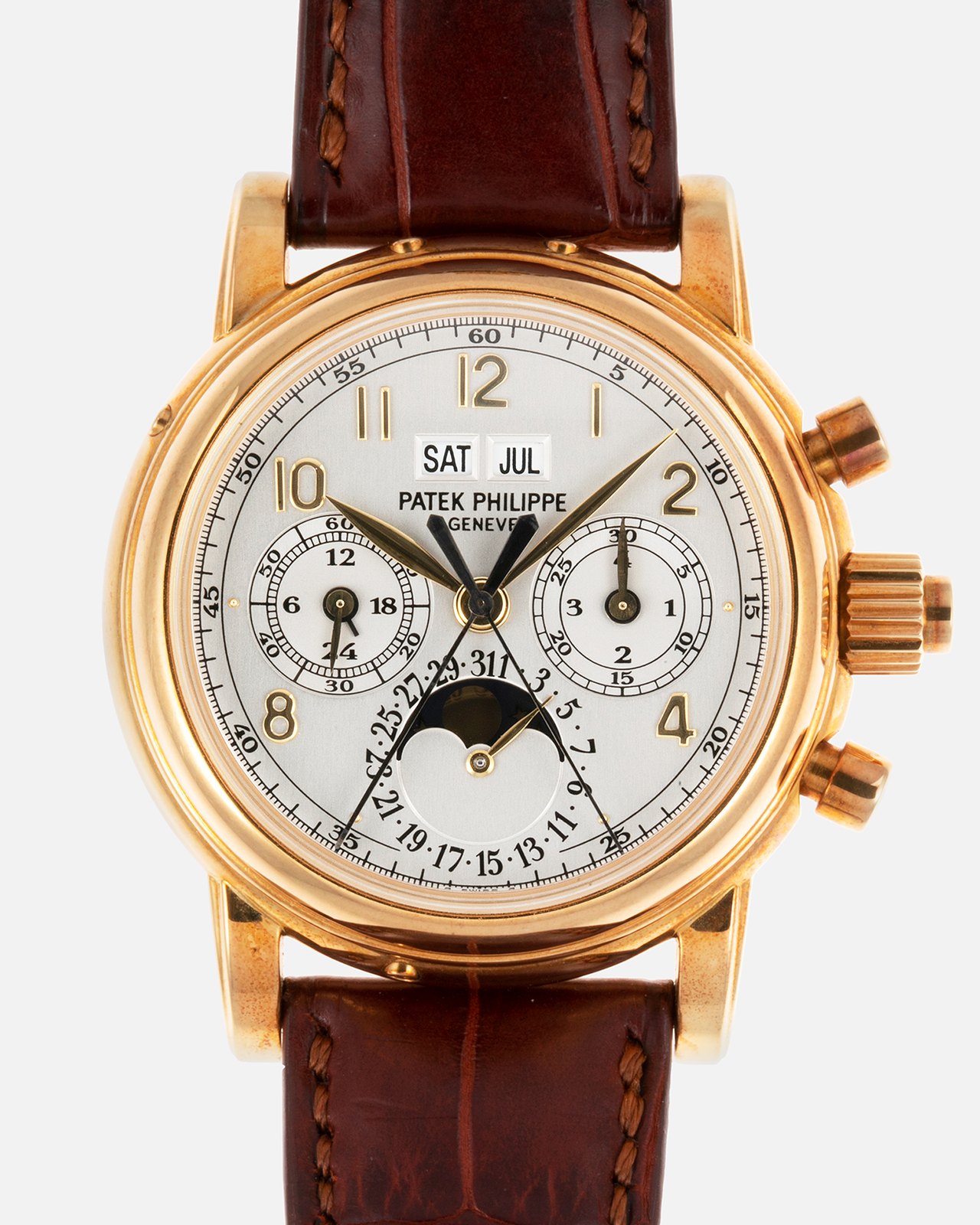
Patek Philippe Perpetual Calendar Split Seconds Chronograph 5004J, 2000s
- Maker / attribution
- Patek Philippe (maker)
- Date
- 2000s
- Historical period
- Mechanical Renaissance (1990 – 2010)
- Country of origin
- Switzerland
- Object type
- Wristwatch
- Dimensions
- Case 36 mm
- Stock no.
- Product 6834908332119
- Credit line
- Dealer listing, S.Song Watches (product 6834908332119)
- Catalogue title (original)
- Patek Philippe Perpetual Calendar Split Seconds Chronograph 5004J (English)
View the source record (dealer listing) ↗ (opens another website in a new tab)Suggest a correction
Record summary
Catalogued by S.Song Watches (dealer), Seattle (stock number Product 6834908332119), this is a wristwatch by Patek Philippe, made in Switzerland, dated 2000s. The Atlas places it in the Mechanical Renaissance period (1990 – 2010) of its Wristwatches collection. Recorded dimensions: Case 36 mm. The record is illustrated with 6 photographs.
Assembled from the source record's structured fields. Dates and attributions are given as the source states them; where a field is missing the Atlas leaves it blank rather than estimating.
Catalogue description
Dealer description — S.Song Watches
Every industry seems to have a brand within it that captures the imagination of every customer, competing brand, and member of the public that gazes upon its designs. In the automotive world, you have Ferrari, in the world of jewelry, you have Tiffany & Co., and in the world of watchmaking, you have Patek Philippe. If any name deserves top billing in the watch industry, it is Patek Philippe. It is the undisputable king and shows no signs of relinquishing its throne anytime soon. Over the past century, Patek Philippe has created some of the most historically important and technically significant timepieces of all time. This 5004J Perpetual Calendar Split Seconds Chronograph here is one such example and we are absolutely delighted to be able to offer one on the site today. Let me preface this by saying this watch right here, is my dream watch. Launched in 1996 and produced up until 2012, the Ref. 5004J is the final complicated reference (along with the chronograph-only Ref. 5070), to be manufactured by Patek Philippe with an outsourced caliber as its base movement. It is said that approximately only 200 to 300 examples have ever been produced in various metals during its production run, making this reference one of the most desirable watches by collectors and connoisseurs around the world. Before we dive any deeper into what makes this example such a desirable reference to aficionados, let me first briefly explain what a split-seconds chronograph is. It is essentially a chronograph with a pair of hands that are superimposed onto each other and run together when engaged. When you first engage the top pusher (as you would with a regular chronograph), both hands will begin running concurrently. Engaging the integrated pusher on the crown would cause both chronograph hands to “split” where the first hand will stop while the latter hand will continue to run imperiously which allows the user to time two different events individually, such as recording multiple interval lap times. If you engage the split pusher a second time, the idling first hand will instantly catch up to the running hand. This is also why split seconds chronographs are usually called “Rattrapante”, which means “to catch up” in French. When designing the Ref. 5004J, Philippe Stern remarked that this reference was exceptionally difficult to fabricate, primarily due to the Lemania base caliber used here as it was never intended to be a split-seconds chronograph in the first place. At the time, the design team at Patek Philippe faced two major challenges- firstly, the pinion holding all the hands (hours, minutes, chronograph seconds, and split seconds) had to be elongated ever so slightly to accommodate this requirement and the slightest mistake could potentially bend the pinion itself; and secondly, the movement would experience Rattrapante drag each time the split function is engaged. Despite these challenges, the design team managed to overcome them all and stretched the limits beyond what was technically possible at the time, which fully demonstrates Patek Philippe’s incredible technical mastery of watchmaking. The Ref. 5004J’s three-part, 36mm case is crafted in 18-carat yellow gold and features a gorgeous stepped bezel and a screw-down transparent case back, which houses the absolutely stunning 28-jeweled, manual-wound Cal. CHR27-70Q, with impeccable finishing and bears the Geneva seal hallmark. As for the Ref. 5004J’s beautiful opaline dial, I think it is one of the most beautiful dials ever made by Patek Philippe. It features the indexes of the Ref. 1518 and the first two series Ref. 2499 watches, merging them with a classic-looking minute and seconds track on the periphery with a slight abbreviation at the bottom section to accommodate the date display from the 13 th to the 19 th . You will also find applied gold dots at the 3, 5, 7, and 9 o ‘clock positions, 18-carat yellow gold feuille (leaf) hands, a pair of apertures at 12 o ‘clock just above the “Patek Philippe” text to indicate the day and the month, three individual subsidiary dials for a small seconds counter with a 24-hour indicator, a 30-minute counter with an embedded leap year indicator as well as an entrancing moon phase. The example we have on here also comes with a charming 18-carat yellow gold Patek Philippe deployant clasp. In the eyes of many Patek Philippe collectors and enthusiasts today, the Ref. 5004J is considered a modern classic because it embodies the true essence and core values of Patek’s traditional design legacy of the post-war world, including the savoir-faire of their skilled artisans and watchmakers. On top of that, it also has the quintessential, old-school Patek Philippe perpetual chronograph style and exudes an old-world charm that many collectors have come to love and appreciate over the years. What more could one ask for? Again, this Ref. 5004J is undoubtedly a dream watch and an essential timepiece for any serious Patek collection.
Historical context
Mechanical Renaissance (1990 – 2010)
Mechanical watches return as cultural objects; independent watchmaking flourishes.
Mechanical watches returned as cultural and luxury objects. Complications, tourbillons and new materials proliferated; independent watchmakers such as George Daniels, F.P. Journe and Philippe Dufour revived artisanal watchmaking; collecting vintage watches became a major field.
Read the period in the timelineMore wristwatches from this periodEarlier: Quartz Revolution
Atlas type guide
Chronographs and split-seconds watches
A chronograph is a watch with an additional seconds hand that can be started, stopped and returned to zero independently of the timekeeping. Louis Moinet built an early example in 1816 and Nicolas Rieussec a recording 'chronographe' in 1821; Adolphe Nicole's heart-shaped reset cam (patented 1862) made the modern return-to-zero possible. Split-seconds (rattrapante) chronographs add a second hand that can be stopped for intermediate times; flyback chronographs restart instantly.
Chronographs were essential tools for doctors (pulsometer scales), artillery (telemeter), engineers and sport. In wristwatches, Valjoux, Venus, Lemania and later the automatic chronographs of 1969 (Zenith El Primero, the Chronomatic Calibre 11 group and Seiko 6139) are milestones.
What to look for
- Push-pieces on the case band or a single button in the crown (monopusher).
- Subsidiary registers for minutes and hours; tachymeter, telemeter or pulsometer scales.
- Column wheel versus cam control visible in the movement.
- Calibre markings of specialist makers (Valjoux, Lemania, Venus, Landeron).
Dating clues
- Pocket chronographs with heart cam reset: after 1862.
- Wrist chronographs: from c. 1910; two-button designs from the 1930s.
- Automatic chronographs: from 1969.
General guidance written by the Atlas editors about this kind of object. It is not a statement about this particular piece; for that, rely on the source record above and on physical examination.
Read next:Flyback chronographChronograph
Related records
Clocks · 1965–1975
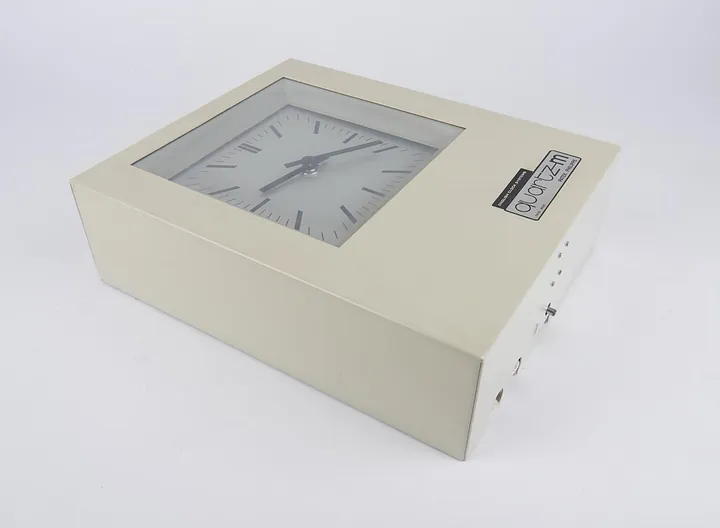
Quartz master clock QM 1, with movement by Patek Phillippe, Switzerland, 1965–1975. Supplied by English Clock Systems.
Science Museum Group, London
Instruments · 1965–1984
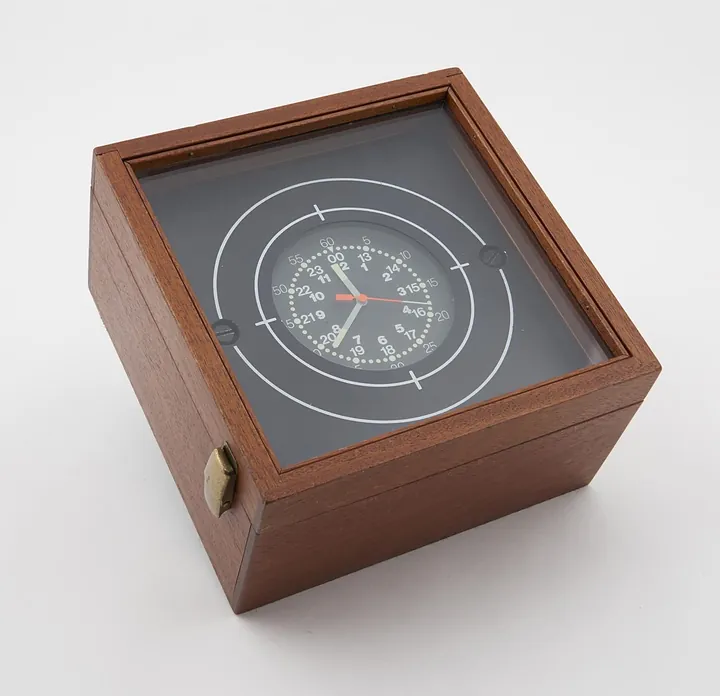
Chronometer by Patek Philippe and Kelvin Hughes, England, 1965–1984
Science Museum Group, London
Pocket Watches · c. 1895
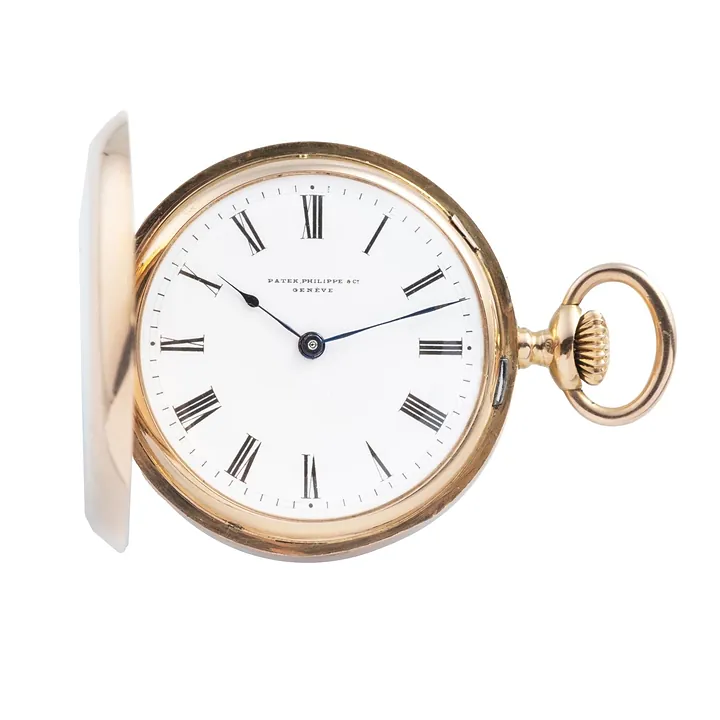
Patek Philippe pocket watch, c. 1895
Antiquorum auction archive, Geneva

Pocket Watches · c. 1900
Patek Philippe Chronometro Gondolo, c. 1900
Antiquorum auction archive, Geneva

Wristwatches · 2008
Wristwatch by Breitling?, 2008
Museum Rotterdam

Wristwatches · c. 1990s
Audemars Piguet Bamboo, c. 1990s
Antiquorum auction archive, Geneva

Wristwatches · c. 1990
Audemars Piguet Huitieme Perpetual Calendar, ref. 25696PT, c. 1990
Antiquorum auction archive, Geneva

Wristwatches · c. 1990
Breitling Chronomat, ref. b13050.1, c. 1990
Antiquorum auction archive, Geneva