
Wristwatches · Wristwatch
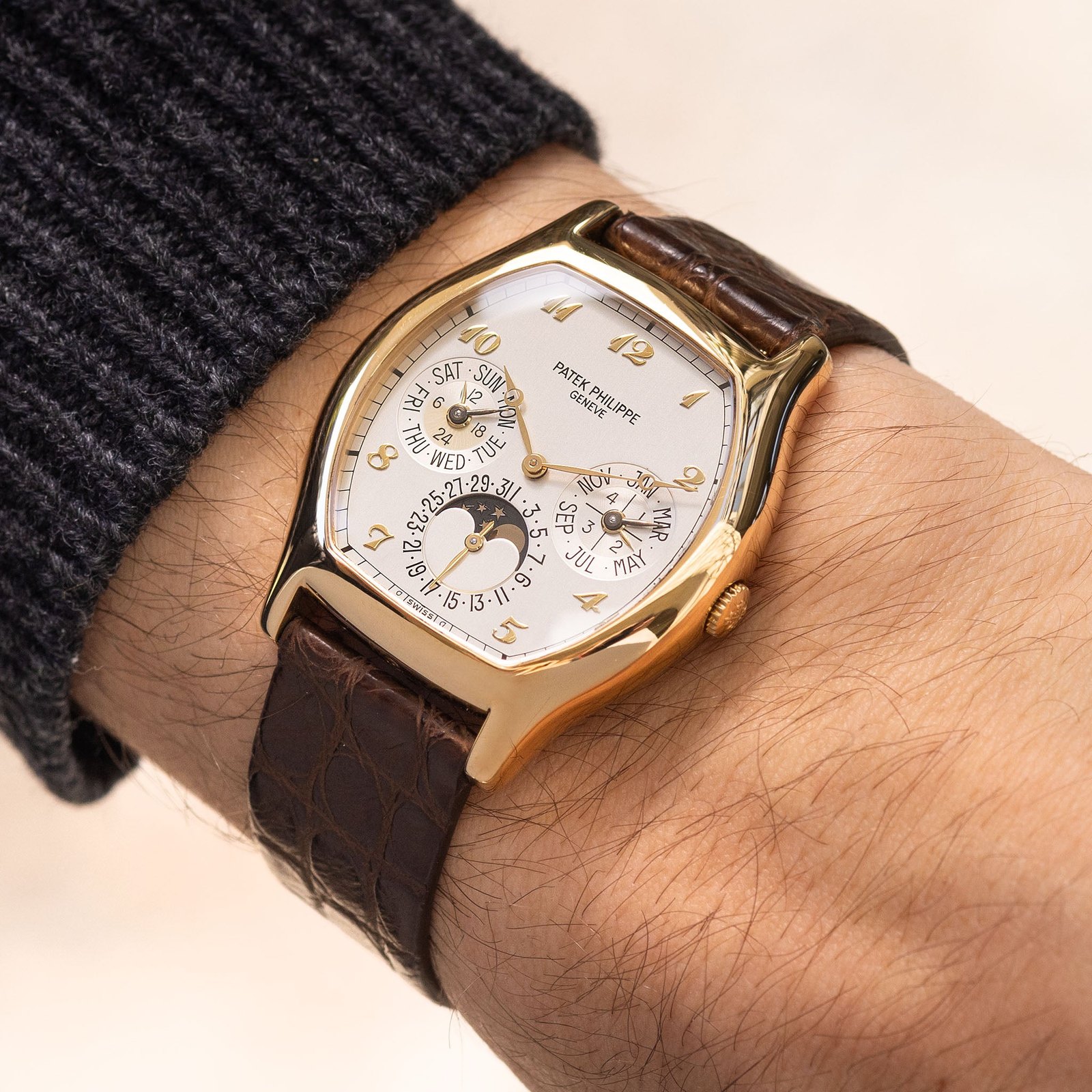
Patek Philippe Perpetual Calendar 5040J in 18k yellow gold Tonneau case with, 2001
- Maker / attribution
- Patek Philippe (maker)
- Date
- 2001
- Historical period
- Mechanical Renaissance (1990 – 2010)
- Country of origin
- Switzerland
- Object type
- Wristwatch
- Materials / technique
- 18k yellow gold
- Dimensions
- Case 35 mm
- Stock no.
- W-3247
- Credit line
- Dealer listing, Bulang & Sons (W-3247)
- Catalogue title (original)
- Patek Philippe Perpetual Calendar 5040J in 18k yellow gold Tonneau case with box and papers (English)
View the source record (dealer listing) ↗ (opens another website in a new tab)Suggest a correction
Record summary
Catalogued by Bulang & Sons (dealer), Copenhagen (stock number W-3247), this is a wristwatch by Patek Philippe, made in Switzerland, dated 2001. The Atlas places it in the Mechanical Renaissance period (1990 – 2010) of its Wristwatches collection. Materials and techniques recorded by the source: 18k yellow gold. Recorded dimensions: Case 35 mm. The record is illustrated with 6 photographs.
Assembled from the source record's structured fields. Dates and attributions are given as the source states them; where a field is missing the Atlas leaves it blank rather than estimating.
Catalogue description
Dealer description — Bulang & Sons
The demand for neo-vintage complicated watches with leather straps continues to soar—so how could it get any better than this grand complication from the prestigious Patek Philippe? This is a remarkable example of one of the most overlooked references, the 5040 in yellow gold, boasting a distinctive tonneau-shaped case and an elegant Breguet numeral dial. While most perpetual calendars are traditionally housed in round cases, Patek Philippe made a bold statement in 1992 by introducing the 5040. Drawing inspiration from timepieces of the interwar period, the 5040 became the brand's first perpetual calendar with a tonneau-shaped case, measuring 35 mm in diameter and 42 mm lug-to-lug. We’re completely captivated by this design! While many would opt for a conventional round case, this unique shape wears incredibly well on the wrist. The profile and lugs are impeccably balanced, lending a youthful, sporty energy to an otherwise classic design. This particular timepiece features what Patek Philippe refers to as an “Argenté” dial with Breguet numerals and an English calendar. The dial’s tone and quality are truly exceptional. It currently features a display caseback, offering a full view of the cal. 240q movement with its 21k gold rotor, although the original 18k yellow gold caseback is also included. Each sub-dial provides two sets of information: the right-hand sub-dial shows the leap year indicator and the day of the week, the 6 o’clock sub-dial displays the moon phase and the day of the month, and the left-hand sub-dial shows the 24-hour clock and the month. The sub-dials are arranged in concentric circles, with the day, month, and date on the outer track, and the leap year indicator, moon phase, and 24-hour clock placed more centrally. We’ve chosen to pair it with one of our own super thin and elegant straps, as it complements the watch beautifully. It’s secured with an 18k yellow gold Patek Philippe pin buckle. This timepiece also includes its original inner and outer boxes—an intriguing detail: the leather inner box also doubles as a battery-powered watch winder! Additionally, it comes with the leather paper holder, the second 18k yellow gold caseback, two booklets, the yellow gold corrector pins, and a “Beyer Zürich” card, completing the set. The original certificate of origin shows a 2001 sale.This fine Perpetual Calendar has been fully serviced by our watchmaker. While the 3940 is often considered underrated, the 5040 is perhaps even more so, offering outstanding value for those wanting to join the Patek Philippe Grand Complication family. It’s a truly elegant piece that wears beautifully on the wrist and stands as one of Patek Philippe’s iconic classics. Don’t miss out—get in touch! Specifications: Patek Philippe 5040 J 35mm x 42mm 18k yellow gold tonneau case Movement no. 312xxxx / Case no 29xxxxx Dates to 2001 Original second 18k yellow gold caseback Argenté dial with Breguet numerals English calendar Automatic movement Cal. 240Q Patek Philippe 18k gold pin buckle Certificate of origin, stating sale in 2001, leather folder, booklets, and original boxes plus PP 18 k gold corrector pin Fully serviced by our watchmaker
Historical context
Mechanical Renaissance (1990 – 2010)
Mechanical watches return as cultural objects; independent watchmaking flourishes.
Mechanical watches returned as cultural and luxury objects. Complications, tourbillons and new materials proliferated; independent watchmakers such as George Daniels, F.P. Journe and Philippe Dufour revived artisanal watchmaking; collecting vintage watches became a major field.
Read the period in the timelineMore wristwatches from this periodEarlier: Quartz Revolution
Atlas type guide
Calendar, moon-phase and perpetual calendar watches
Calendar complications range from a simple date to the perpetual calendar, which automatically allows for months of different lengths and leap years until 2100. Pocket watches with perpetual calendars were made in the eighteenth and nineteenth centuries; Patek Philippe made the first perpetual calendar wristwatch in 1925, and series production followed in 1941. The annual calendar (Patek Philippe, 1996) needs correction only once a year.
Moon-phase displays use a disc with two moons and 59 teeth advanced daily, approximating the 29.5-day lunation; more precise trains reduce the error to one day in over a century.
What to look for
- Apertures or subsidiary dials for day, date, month and leap year.
- Moon disc under a 'bosom' shaped aperture.
- Recessed correctors on the case band for setting the calendar.
Dating clues
- Triple-date wristwatches: popular c. 1940–1955.
- Perpetual calendar wristwatches: from 1925 (unique) and 1941 (series).
General guidance written by the Atlas editors about this kind of object. It is not a statement about this particular piece; for that, rely on the source record above and on physical examination.
Related records
Clocks · 1965–1975
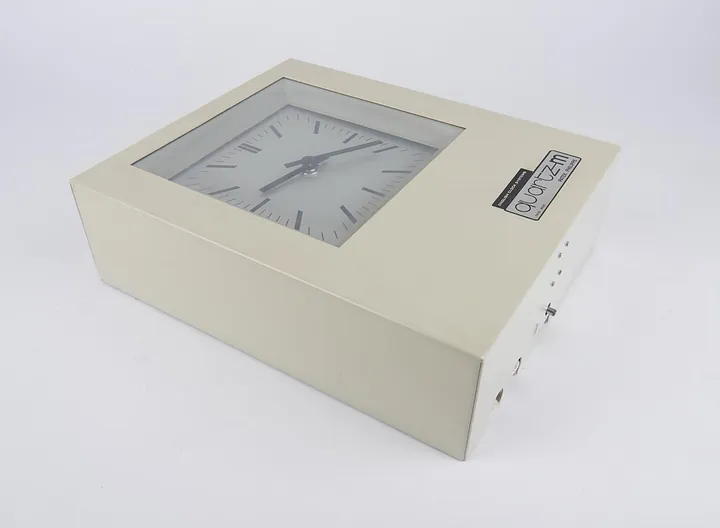
Quartz master clock QM 1, with movement by Patek Phillippe, Switzerland, 1965–1975. Supplied by English Clock Systems.
Science Museum Group, London
Instruments · 1965–1984
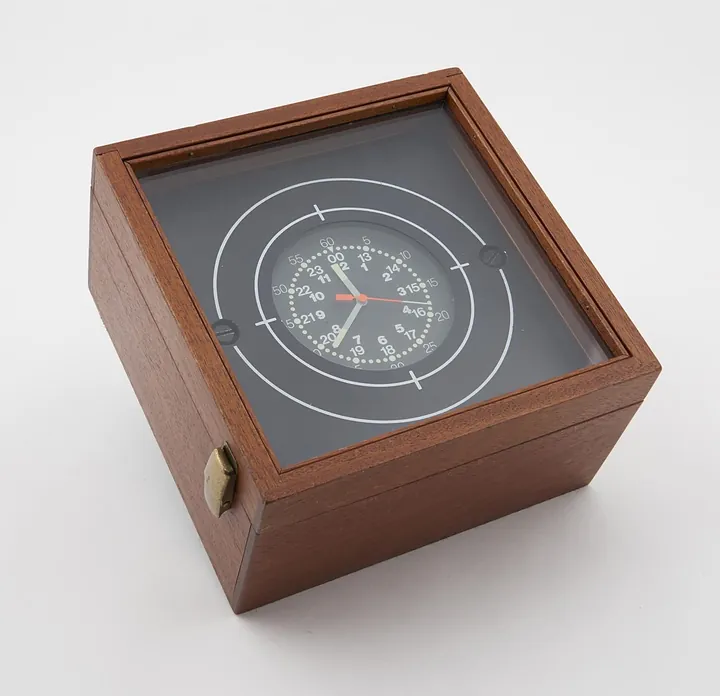
Chronometer by Patek Philippe and Kelvin Hughes, England, 1965–1984
Science Museum Group, London
Pocket Watches · c. 1895
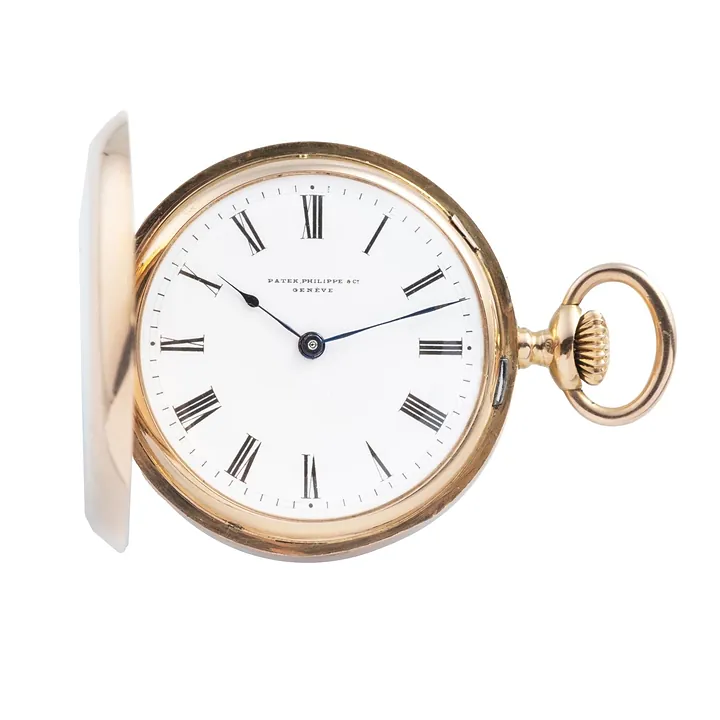
Patek Philippe pocket watch, c. 1895
Antiquorum auction archive, Geneva
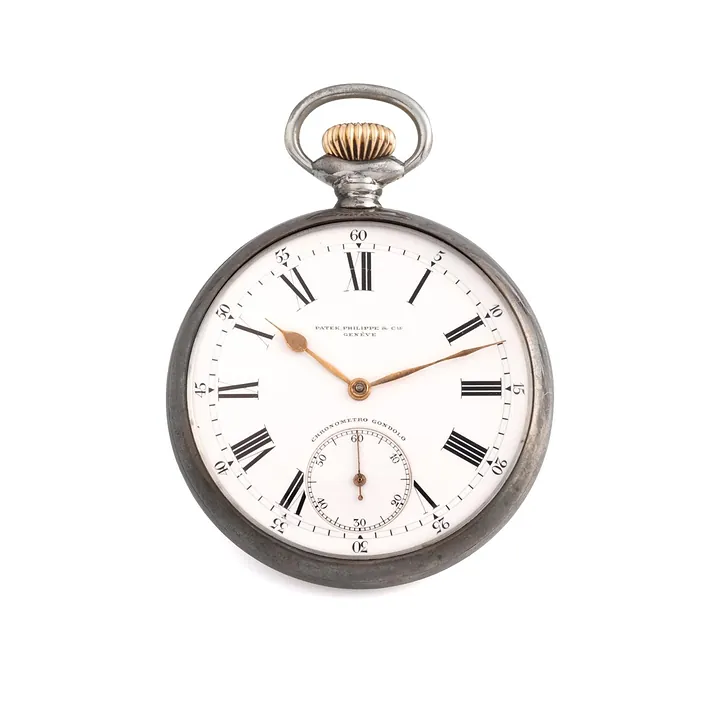
Pocket Watches · c. 1900
Patek Philippe Chronometro Gondolo, c. 1900
Antiquorum auction archive, Geneva

Wristwatches · 2008
Wristwatch by Breitling?, 2008
Museum Rotterdam

Wristwatches · c. 1990s
Audemars Piguet Bamboo, c. 1990s
Antiquorum auction archive, Geneva

Wristwatches · c. 1990
Audemars Piguet Huitieme Perpetual Calendar, ref. 25696PT, c. 1990
Antiquorum auction archive, Geneva

Wristwatches · c. 1990
Breitling Chronomat, ref. b13050.1, c. 1990
Antiquorum auction archive, Geneva