
Wristwatches · Wristwatch
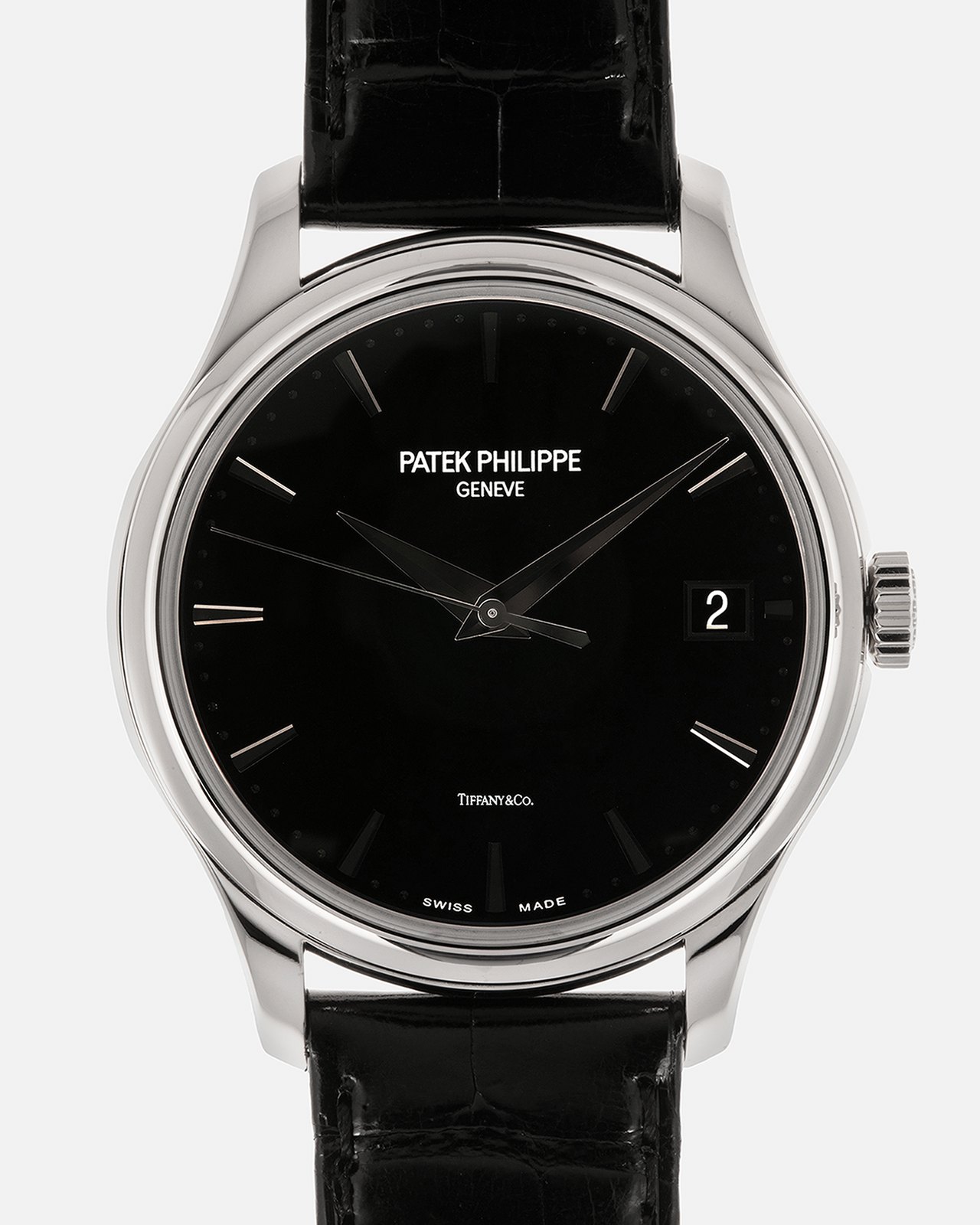
Patek Philippe Calatrava 5227G Tiffany & Co, 2017
- Maker / attribution
- Patek Philippe (maker)
- Date
- 2017
- Historical period
- Contemporary Horology (2010 – Present)
- Country of origin
- Switzerland
- Object type
- Wristwatch
- Dimensions
- Case 39 mm
- Stock no.
- Product 7387526725719
- Credit line
- Dealer listing, S.Song Watches (product 7387526725719)
- Catalogue title (original)
- Patek Philippe Calatrava 5227G Tiffany & Co (English)
View the source record (dealer listing) ↗ (opens another website in a new tab)Suggest a correction
Record summary
Catalogued by S.Song Watches (dealer), Seattle (stock number Product 7387526725719), this is a wristwatch by Patek Philippe, made in Switzerland, dated 2017. The Atlas places it in the Contemporary Horology period (2010 – Present) of its Wristwatches collection. Recorded dimensions: Case 39 mm. The record is illustrated with 6 photographs.
Assembled from the source record's structured fields. Dates and attributions are given as the source states them; where a field is missing the Atlas leaves it blank rather than estimating.
Catalogue description
Dealer description — S.Song Watches
Arguably the most iconic dress watch collection in history, the Patek Philippe Calatrava represents the true essence of a classically designed timepiece. First introduced in 1932, it defined the dress watch category and has remained a cornerstone of Patek Philippe’s catalog ever since. Revered by collectors and enthusiasts worldwide, the Calatrava is widely regarded as the quintessential dress watch, setting the standard for many brands that followed. Patek Philippe continues to honor and build upon this legacy with each new iteration. For some historical context, let’s go back to the 1930s when Charles and Henri Stern acquired the Patek Philippe brand. To revitalize the company, they introduced their first model, the iconic Calatrava. The Ref. 96 was launched in 1932, at a time when wristwatches were beginning to replace pocket watches, solidifying Patek Philippe's position as one of the world’s premier watchmakers. Today, the Stern family still owns Patek Philippe, and the Calatrava remains a cornerstone offering in the Maison’s collection of timepieces. Over the years, the Calatrava has undergone numerous iterations, featuring different case sizes and dial styles. The 5227G, in particular, stands out as one of the most attractive variants in Patek Philippe’s modern Calatrava collection. There’s something about the simple, minimalist and traditional-looking design of the Calatrava that resonates with many—especially in a piece like this, with its hunter-style caseback and a rare Tiffany & Co. stamped dial. It doesn’t get much better than this. To provide some context on the significance of Tiffany & Co. stamped dials, it's important to note that Tiffany & Co. was Patek Philippe’s very first official retailer in the United States, having sold Patek Philippe timepieces in its boutiques since 1851. Over time, this partnership evolved into a unique collaboration, with both brands producing timepieces featuring double-stamped dials—like the one seen here, displaying both the Patek Philippe and Tiffany & Co. logos. While Patek Philippe has had double-stamped dials from various distributors worldwide in the past, today, Tiffany & Co. in New York is the only retailer still granted this privilege. Starting with its contemporarily-sized 39mm x 9.24mm white gold case, the 5227G exhibits a level of dimensionality rarely seen in what is typically considered a simple dress watch. This is achieved through its finely sculpted case and the two pairs of scalloped lugs at each end, which introduce a sense of depth and complexity to its visual appeal. Encased within is a deep black lacquered dial, outlined by individual hour markers and a minutes-track around the periphery, which is complemented by a pair of faceted, polished white gold dauphine hands at the centre. A discreet date window with a matching black date wheel sits at 3:00. Staring at the dial almost feels like gazing into the abyss—it has a certain hypnotic quality that fosters a delicate sense of balance, adding an unexpected layer of complexity to such a minimal design. That said, there’s little more to say about the dial, as the Calatrava has always prioritized visual balance and clean aesthetics. Powering the 5227G is Patek Philippe’s in-house, self-winding Cal. 324 SC, discreetly hidden beneath a hunter-style caseback, which is elegantly and almost invisibly hinged to the case itself. When opened, it reveals the Cal. 324 SC in all its splendour. As expected from a brand residing within the Holy Trinity, the movement bears the prestigious Poinçon de Genève (Geneva Seal) and is beautifully finished to the highest standards. The 21-carat gold central rotor sits atop its meticulously finished bridges, gears, screws, and jewels. Comprising 213 parts, the Cal. 324 SC also features a free-sprung Gyromax balance wheel and silicon Spiromax balance spring. In terms of power reserve, it can hold a charge for up to 45 hours on a full wind. "Look closer, look closer still. Look inside the ‘A’ of Tiffany and you’ll see a small photo of myself as a child." These were the famous words shared by John Mayer during Hodinkee’s inaugural episode of Talking Watches more than a decade ago, as he reflected on his Aquanaut 5164A ‘Travel Time’ with a similar Tiffany & Co. stamped dial. Strange as it may sound, his words kept coming to mind during my time spent with this rare Tiffany dial 5227G. Anyway, I mention all this to highlight the added layer of exclusivity that comes with Tiffany-stamped Patek dials; you just don’t see too many of these out in the wild. At the end of the day, when it comes to dress watches, no one does it quite like Patek Philippe with the Calatrava. Its design language is pure, refined, and simple, yet incredibly easy to love and appreciate. With excellent contemporary proportions and timeless elegance, this impeccable and rare Tiffany-stamped 5227G is a superb example of a contemporary dress watch—one that remains elusive and understated, until someone with a discerning eye notices.
Historical context
Contemporary Horology (2010 – Present)
Silicon components, connected watches, optical-lattice research clocks and a thriving independent scene.
Smartwatches became the world's best-selling watches, while mechanical watchmaking focuses on craft, innovation (silicon components, new escapements) and independent makers.
Read the period in the timelineMore wristwatches from this periodEarlier: Mechanical Renaissance
Atlas type guide
Wristwatches
Bracelet watches were worn by women from the early nineteenth century — Breguet made one for Caroline Murat, Queen of Naples, in 1810–12 — but the wristwatch only became a man's instrument with military use and aviation in the early twentieth century. Between the World Wars it overtook the pocket watch; the 1920s and 1930s brought rectangular Art Deco cases, water-resistant cases and the first automatic winding systems.
After 1945 the wristwatch became a carrier of identity — dress watches, sports and dive watches, chronographs, calendars — produced by Swiss, American, Japanese, German, Soviet and Chinese industries. The quartz revolution after 1969 and the mechanical renaissance since the 1990s, including the rise of independent watchmakers, complete the story.
What to look for
- The reference number (between the lugs or inside the case back) and serial number, the starting point for dating.
- The calibre: its maker and number are often stamped under the dial or on the bridge.
- Originality of dial, hands and crown — refinished ('redial') dials are common.
- Case material marks: 18K/750, 14K/585, stainless steel, gold-filled, plated.
Dating clues
- Wire-lug cases: before c. 1925.
- Water-resistant screw-down cases: from 1926.
- Quartz movements: from 1969; sapphire crystals widespread after c. 1980.
General guidance written by the Atlas editors about this kind of object. It is not a statement about this particular piece; for that, rely on the source record above and on physical examination.
Related records

Clocks · 1965–1975
Quartz master clock QM 1, with movement by Patek Phillippe, Switzerland, 1965–1975. Supplied by English Clock Systems.
Science Museum Group, London

Instruments · 1965–1984
Chronometer by Patek Philippe and Kelvin Hughes, England, 1965–1984
Science Museum Group, London

Pocket Watches · c. 1895
Patek Philippe pocket watch, c. 1895
Antiquorum auction archive, Geneva

Pocket Watches · c. 1900
Patek Philippe Chronometro Gondolo, c. 1900
Antiquorum auction archive, Geneva

Wristwatches · c. 2010s
Breguet Type XXI, ref. 3810, c. 2010s (Antiquorum Lot 381-24)
Antiquorum auction archive, Geneva

Wristwatches · c. 2010s
Breguet Type XXI, ref. 3810, c. 2010s (Antiquorum Lot 386-229)
Antiquorum auction archive, Geneva

Wristwatches · Sold in September 2010
Breitling Cosmonaute, ref. A 22322, Sold in September 2010
Antiquorum auction archive, Geneva

Wristwatches · c. 2010
Corum Bubble Chrono, ref. 396.150.20, c. 2010
Antiquorum auction archive, Geneva