
Wristwatches · Wristwatch
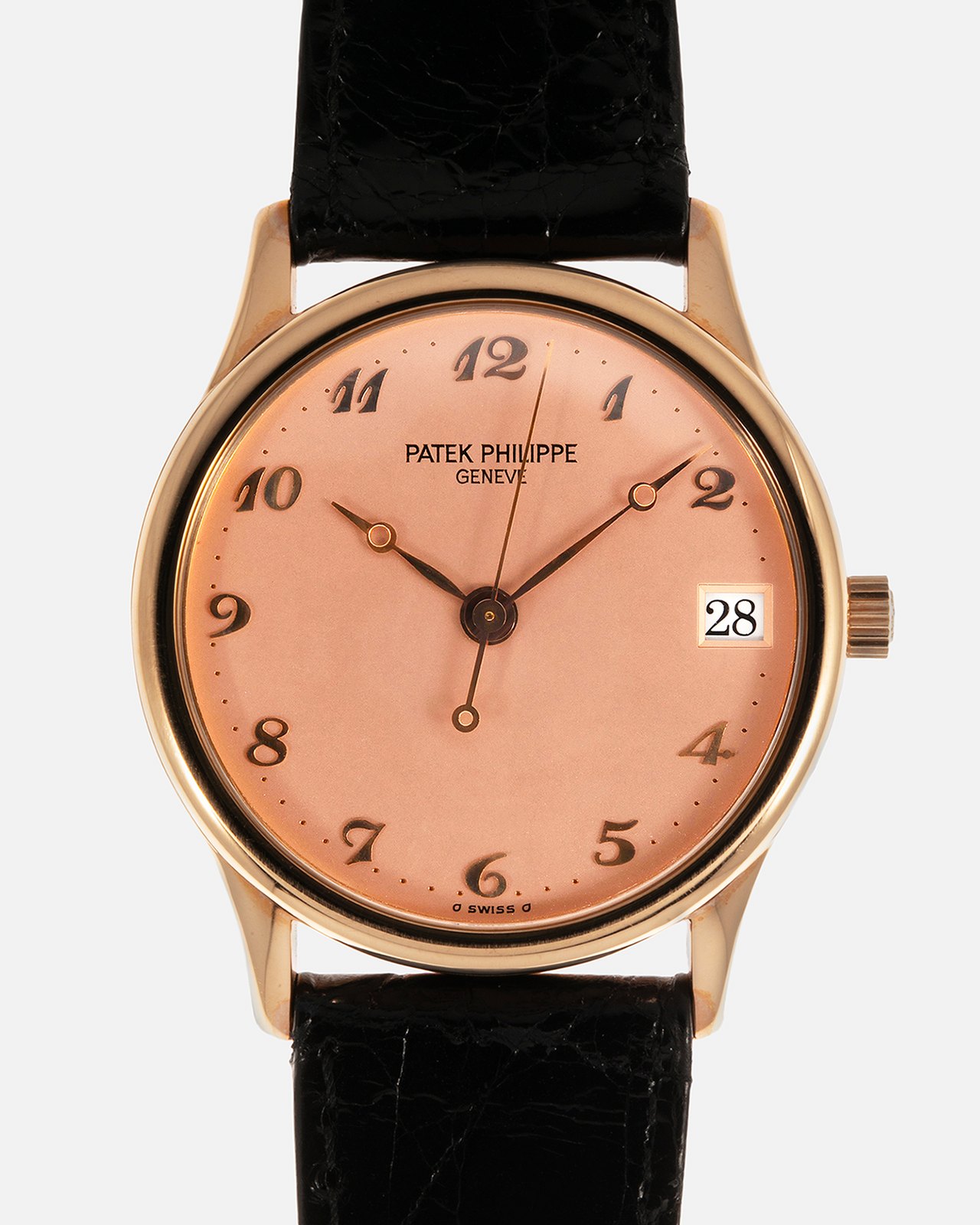
Patek Philippe Calatrava 3998SR Garrard 150th Anniversary, 1993
- Maker / attribution
- Patek Philippe (maker)
- Date
- 1993
- Historical period
- Mechanical Renaissance (1990 – 2010)
- Country of origin
- Switzerland
- Object type
- Wristwatch
- Dimensions
- Case 33.5 mm
- Stock no.
- Product 7468708790359
- Credit line
- Dealer listing, S.Song Watches (product 7468708790359)
- Catalogue title (original)
- Patek Philippe Calatrava 3998SR Garrard 150th Anniversary (English)
View the source record (dealer listing) ↗ (opens another website in a new tab)Suggest a correction
Record summary
Catalogued by S.Song Watches (dealer), Seattle (stock number Product 7468708790359), this is a wristwatch by Patek Philippe, made in Switzerland, dated 1993. The Atlas places it in the Mechanical Renaissance period (1990 – 2010) of its Wristwatches collection. Recorded dimensions: Case 33.5 mm. The record is illustrated with 6 photographs.
Assembled from the source record's structured fields. Dates and attributions are given as the source states them; where a field is missing the Atlas leaves it blank rather than estimating.
Catalogue description
Dealer description — S.Song Watches
One of the bedrocks of the Patek Philippe collection is its classic dress watch—the Calatrava. A necessary foundation piece for any Haute Horlogerie brand, the dress watch archetype is a must and with the Calatrava, Patek Philippe continues to build on its rich tradition to this day. For a bit of historical context, we go back to the ’30s when Charles and Henri Stern purchased the Patek Philippe brand. To revamp the manufacture, the first model they produced is, of course, the Calatrava. The reference 96 came in 1932, at a time when wristwatches were beginning to take over pocket watches, and it was a move that cemented their status as one of the eminent watch brands of the world. To this day, the Stern family still owns Patek Philippe, and you can tell that the Calatrava is still very important. Speaking of importance, what we have here is arguably one of the finest Calatrava references to come out of the 1990s. This is the 3998, a reference that masterfully bridges the classic dress watch design with contemporary sensibilities, all while maintaining the cohesive, timeless aesthetic that defines the Calatrava lineage. Introduced in 1989, the 3998 remained in production until the mid-2000s and has evolved through three distinct series. The first, produced from 1989 to 1993, was powered by the Cal. 310 SC. The second series—of which this specimen is a part—featured the later-updated Cal. 315 SC. The third and final iteration began in 1996 and carried through to the end of the reference's production run. That said, this particular example is no regular 3998. This is the Calatrava 3998SR ‘Garrard 150th Anniversary’, released in 1993 as part of a 150-piece limited edition commemorating the 150th anniversary of Garrard, the prestigious British Crown Jeweller, who was also one of the Maison’s long-time retail partners in the United Kingdom. Starting with its modest 33.5mm x 8mm rose gold case, the 3998SR might initially seem petite by today’s standards. However, the long, elegantly sculpted lugs allow it to wear noticeably larger than the dimensions suggest. In fact, this size strikes what I believe is the perfect balance for a dress watch like the Calatrava, as anything larger would risk compromising the classic, understated elegance that defines its enduring charm. It is also worth highlighting that the case was manufactured by Ateliers Réunis, Patek Philippe’s legendary in-house casemaker based in Geneva, and features hallmarks at both 9:00 and 6:00. As you can see from the pictures, the latter are particularly large and beautiful, reminiscent of the prominent hallmarks found on some of Patek’s second-series 3970 Perpetual Calendars. Encased within this nicely proportioned rose gold case is a stunning salmon-colored dial adorned with beautifully raised Breguet hour markers and a matching set of Breguet hands. At a glance, you can easily tell there is something exceptionally synergistic about this combination; it imparts a great sense of visual balance and refinement to what is otherwise a simple dress watch, just as it does with the 3998SR. This level of nuance is a hallmark of Stern Créations, Patek Philippe’s longtime dial manufacturer, whose craftsmanship is evident in the way the rose gold and salmon tones are paired. It’s no accident; achieving this delicate balance takes generations of experience and expertise. In the past, we’ve seen and handled watches with this same color-metal combination, and it is truly a challenging balancing act: lean too far in either direction and the watch risks appearing overly ostentatious or gaudy. But the 3998SR gets it just right. The hue of the salmon dial is soft yet delightfully vibrant, perfectly complementing the radiance and warmth of the rose gold case without overwhelming it. The result is a simple yet coherent piece of watch design that feels both refined and quietly confident despite its seemingly dainty proportions. As I briefly touched on earlier, powering this 3998R from within is Patek’s Cal. 315 SC, a self-winding movement with a central seconds configuration, produced from 1984 to 2005. Like most Patek calibres, the Cal. 315 SC is impeccably finished, showcasing Côtes de Genève (Geneva stripes), polished bevels, and a beautifully crafted gold rotor. All of this can be admired through the specially personalised exhibition caseback created for Garrard. The movement offers a power reserve of up to 48 hours when fully wound. The Calatrava is widely regarded as the epitome of the ideal dress watch—a sentiment I wholeheartedly share. But mind you: not all Calatravas are created equal. Some, like this 3998SR, were crafted with a specific commemorative purpose in mind and imbued with a touch of design flair that speaks directly to collectors’ hearts. This particular example stands out not only for its tasteful execution but also for its status as a limited edition, complete with an individually numbered caseback. And if that weren’t enough, it’s preserved in remarkably new old stock condition and comes as a super full set. Coming with its original presentation box (bearing royal warrants), newspaper advertisement cut-outs, booklets, original invoices, and an extract from the archives, this 3998SR is without a doubt the most complete and best example ever to come to market.
Historical context
Mechanical Renaissance (1990 – 2010)
Mechanical watches return as cultural objects; independent watchmaking flourishes.
Mechanical watches returned as cultural and luxury objects. Complications, tourbillons and new materials proliferated; independent watchmakers such as George Daniels, F.P. Journe and Philippe Dufour revived artisanal watchmaking; collecting vintage watches became a major field.
Read the period in the timelineMore wristwatches from this periodEarlier: Quartz Revolution
Atlas type guide
Wristwatches
Bracelet watches were worn by women from the early nineteenth century — Breguet made one for Caroline Murat, Queen of Naples, in 1810–12 — but the wristwatch only became a man's instrument with military use and aviation in the early twentieth century. Between the World Wars it overtook the pocket watch; the 1920s and 1930s brought rectangular Art Deco cases, water-resistant cases and the first automatic winding systems.
After 1945 the wristwatch became a carrier of identity — dress watches, sports and dive watches, chronographs, calendars — produced by Swiss, American, Japanese, German, Soviet and Chinese industries. The quartz revolution after 1969 and the mechanical renaissance since the 1990s, including the rise of independent watchmakers, complete the story.
What to look for
- The reference number (between the lugs or inside the case back) and serial number, the starting point for dating.
- The calibre: its maker and number are often stamped under the dial or on the bridge.
- Originality of dial, hands and crown — refinished ('redial') dials are common.
- Case material marks: 18K/750, 14K/585, stainless steel, gold-filled, plated.
Dating clues
- Wire-lug cases: before c. 1925.
- Water-resistant screw-down cases: from 1926.
- Quartz movements: from 1969; sapphire crystals widespread after c. 1980.
General guidance written by the Atlas editors about this kind of object. It is not a statement about this particular piece; for that, rely on the source record above and on physical examination.
Related records

Clocks · 1965–1975
Quartz master clock QM 1, with movement by Patek Phillippe, Switzerland, 1965–1975. Supplied by English Clock Systems.
Science Museum Group, London

Instruments · 1965–1984
Chronometer by Patek Philippe and Kelvin Hughes, England, 1965–1984
Science Museum Group, London

Pocket Watches · c. 1895
Patek Philippe pocket watch, c. 1895
Antiquorum auction archive, Geneva

Pocket Watches · c. 1900
Patek Philippe Chronometro Gondolo, c. 1900
Antiquorum auction archive, Geneva

Wristwatches · 2008
Wristwatch by Breitling?, 2008
Museum Rotterdam

Wristwatches · c. 1990s
Audemars Piguet Bamboo, c. 1990s
Antiquorum auction archive, Geneva

Wristwatches · c. 1990
Audemars Piguet Huitieme Perpetual Calendar, ref. 25696PT, c. 1990
Antiquorum auction archive, Geneva

Wristwatches · c. 1990
Breitling Chronomat, ref. b13050.1, c. 1990
Antiquorum auction archive, Geneva