
Wristwatches · Wristwatch
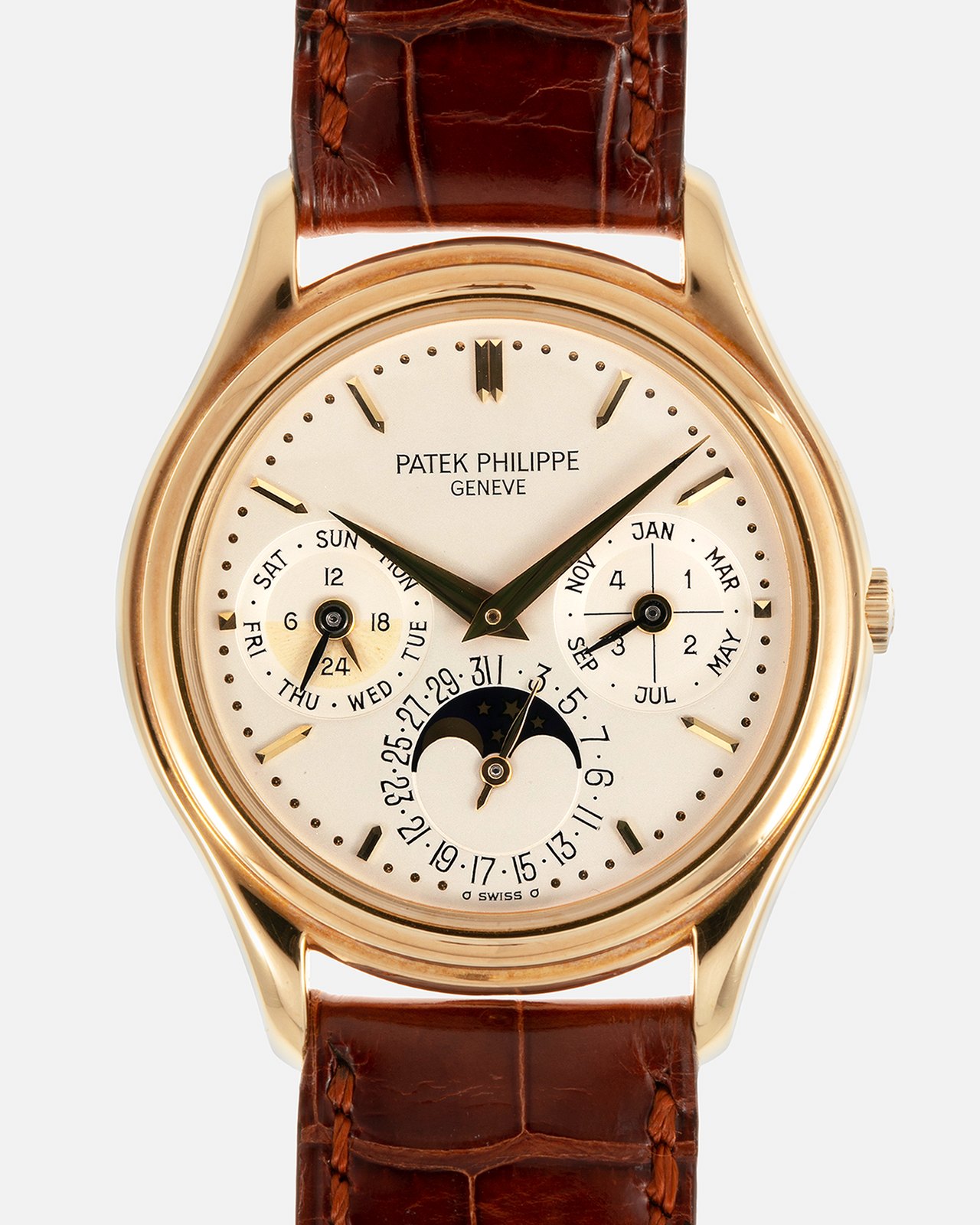
Patek Philippe 3940J Perpetual Calendar, 1990s
- Maker / attribution
- Patek Philippe (maker)
- Date
- 1990s
- Historical period
- Mechanical Renaissance (1990 – 2010)
- Country of origin
- Switzerland
- Object type
- Wristwatch
- Dimensions
- Case 36 mm
- Stock no.
- Product 7004824895575
- Credit line
- Dealer listing, S.Song Watches (product 7004824895575)
- Catalogue title (original)
- Patek Philippe 3940J Perpetual Calendar (English)
View the source record (dealer listing) ↗ (opens another website in a new tab)Suggest a correction
Record summary
Catalogued by S.Song Watches (dealer), Seattle (stock number Product 7004824895575), this is a wristwatch by Patek Philippe, made in Switzerland, dated 1990s. The Atlas places it in the Mechanical Renaissance period (1990 – 2010) of its Wristwatches collection. Recorded dimensions: Case 36 mm. The record is illustrated with 6 photographs.
Assembled from the source record's structured fields. Dates and attributions are given as the source states them; where a field is missing the Atlas leaves it blank rather than estimating.
Catalogue description
Dealer description — S.Song Watches
The Patek Philippe Ref. 3940 is considered to be one of the most important pieces in Patek’s modern history, as it was the first highly complicated serially produced timepiece with a perpetual calendar alongside the perpetual calendar chronograph Ref. 3970. When looked at in context, the Ref. 3940 is significant in the sense that when it was released in 1985, Switzerland was in absolute turmoil. An economic crisis in the Swiss watchmaking industry set upon by the Quartz crisis (or revolution, depending on how you look at it), mechanical watches, a significant driver of the Swiss economy for the longest time, had, on paper become redundant. As an indicator of the drastic times and the effects felt, the number of people working in the Swiss watch industry dwindled from 90,000 to around 28,000 in the space of 18 years. Amidst a period marked by uncertainty, Patek Philippe, under the leadership of Philippe Stern, made a surprising move by introducing the Ref. 3940 and Ref. 3970 as a duo. At that time, major Swiss companies were generally reluctant to produce intricate timepieces due to industry downturns, leaving little room for bold investments in innovation and focusing primarily on preserving existing market shares. Patek's decision to unveil both a perpetual calendar and perpetual calendar chronograph simultaneously represented a daring step, especially considering the prevailing economic climate. This move proved timely, coinciding with a gradual shift in consumer sentiment towards a renewed appreciation for mechanical watches. Unlike their quartz counterparts, which operate on inscrutable electronic circuitry, mechanical watches offer a tangible connection through their visible movements, fostering a deeper appreciation for craftsmanship. This appreciation, perhaps rooted in our universal admiration for skilled artistry, underscores the significance of these timepieces in Patek Philippe's enduring legacy despite the challenges it encountered. It is no coincidence that Philippe Stern himself, who despite being in the position to wear any and as many Patek Philippe watches he wished, chose to wear a Ref. 3940 every day. Stepping back from the contextual significance of the Ref. 3940, the watch in itself is a marvel both in its design and movement. Housing the fantastically finished in-house perpetual calendar Cal. 240 Q, one of its defining aspects is the integrated off-centre micro-rotor, allowing this incredibly complicated watch to come in at an unbelievably slim 9mm. To ensure that a rotor that small could power the watch, it was made in 22-carat gold, with the extra weight providing more force to wind the watch. Making a perpetual calendar is no easy task, with 275 different parts and as a testament to this, at the time it was released, there were only two people in the manufacture allowed to make watches this complicated. Sure, a perpetual calendar does not enjoy the same status as a chronograph, despite being more difficult to manufacture, as it lacks the tactile experience. But for a watch to have a memory of 4 years, accounting for the days in every month including February and the leap year, involves a large measure of skill. Add a moon phase and a 24-hour clock on top and you start to understand the complexity of this. The aesthetics of the Ref. 3940 is a masterful exercise in restraint, a timeless design combining the need for legibility with a beautiful symmetry of subdials. It has a white opaline dial with yellow gold applied index markers and dauphine hands. Each sub-dial provides two sets of information, with the 3 o’clock sub-dial showing the leap year indicator and the day of the week, the 6 o’clock sub-dial showing the enamel moon phase and the day of the month, and finally, the 9 o’clock sub-dial showing the 24-hour clock and the month. The sub-dials are systemized within concentric circles and in an obvious hierarchy, with the day, month, and date on the outer track of the sub-dial, with the less important leap year indicator, moon phase, and 24-hour clock inside it. A cool little quirk of these Ref. 3940’s is in the 24-hour subsidiary dial. In what looks to be discolouration, the orange tint of the bottom half is actually a subtle indicator to show that it is nighttime. The 36mm curved case sits proportionately elegant on the wrist and its ultra-slim profile completes what is perhaps one of the most understated and elegant timepieces. This watch comes with the angular tang buckle, which I much prefer to the more ornamental Calatrava deployant clasp. While it is true that the Ref. 3940 does not shout out, it is for this reason I love the watch so much. This idea that you can wear this watch with barely anyone noticing, but knowing you have something truly special on is very, very appealing to me. There is a real purity to the design where perfect symmetry was achieved, balancing both undeniable elegant aesthetics with a fantastic movement. It is no wonder this watch was in production from 1985-2006, one of the longest run in Patek’s history. P.S – Sean: Several years ago, I wrote about the Patek Philippe Ref. 3940 here ( https://www.bexsonn.com/patek-philippe-3940/ ) and it was one of my most personal articles due to the fact that I myself own a piece, which was passed down to me by my father. This written description is from that article.
Historical context
Mechanical Renaissance (1990 – 2010)
Mechanical watches return as cultural objects; independent watchmaking flourishes.
Mechanical watches returned as cultural and luxury objects. Complications, tourbillons and new materials proliferated; independent watchmakers such as George Daniels, F.P. Journe and Philippe Dufour revived artisanal watchmaking; collecting vintage watches became a major field.
Read the period in the timelineMore wristwatches from this periodEarlier: Quartz Revolution
Atlas type guide
Calendar, moon-phase and perpetual calendar watches
Calendar complications range from a simple date to the perpetual calendar, which automatically allows for months of different lengths and leap years until 2100. Pocket watches with perpetual calendars were made in the eighteenth and nineteenth centuries; Patek Philippe made the first perpetual calendar wristwatch in 1925, and series production followed in 1941. The annual calendar (Patek Philippe, 1996) needs correction only once a year.
Moon-phase displays use a disc with two moons and 59 teeth advanced daily, approximating the 29.5-day lunation; more precise trains reduce the error to one day in over a century.
What to look for
- Apertures or subsidiary dials for day, date, month and leap year.
- Moon disc under a 'bosom' shaped aperture.
- Recessed correctors on the case band for setting the calendar.
Dating clues
- Triple-date wristwatches: popular c. 1940–1955.
- Perpetual calendar wristwatches: from 1925 (unique) and 1941 (series).
General guidance written by the Atlas editors about this kind of object. It is not a statement about this particular piece; for that, rely on the source record above and on physical examination.
Related records
Clocks · 1965–1975
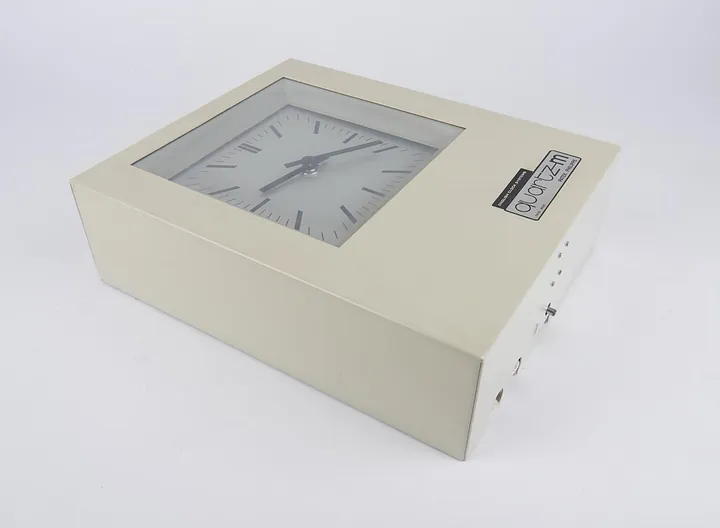
Quartz master clock QM 1, with movement by Patek Phillippe, Switzerland, 1965–1975. Supplied by English Clock Systems.
Science Museum Group, London
Instruments · 1965–1984
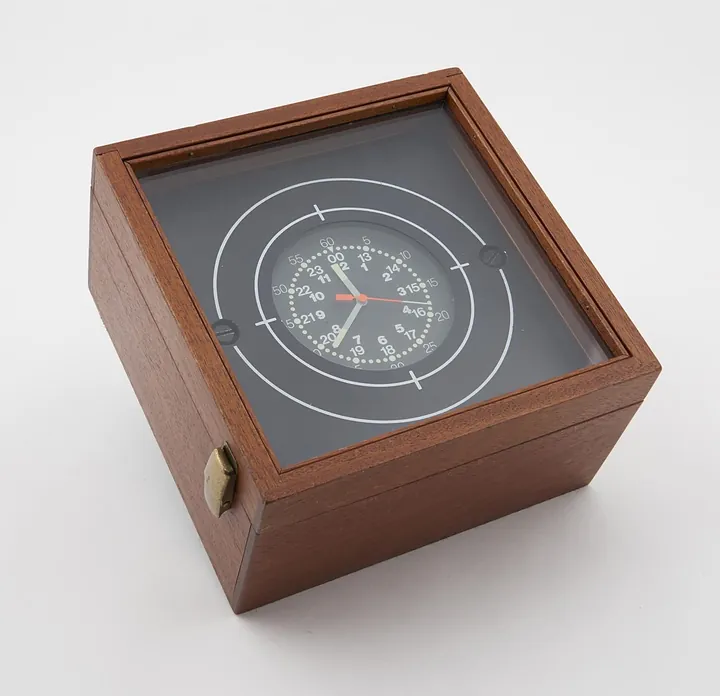
Chronometer by Patek Philippe and Kelvin Hughes, England, 1965–1984
Science Museum Group, London
Pocket Watches · c. 1895
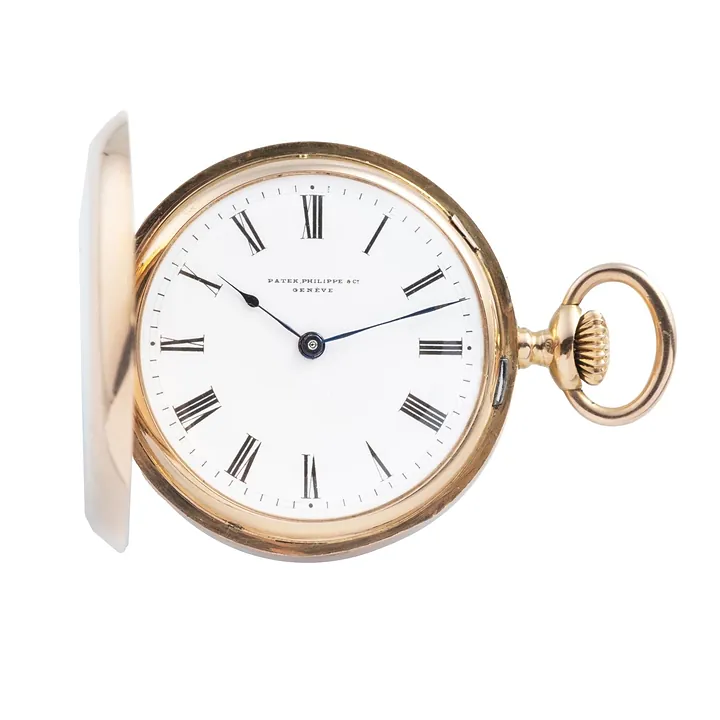
Patek Philippe pocket watch, c. 1895
Antiquorum auction archive, Geneva
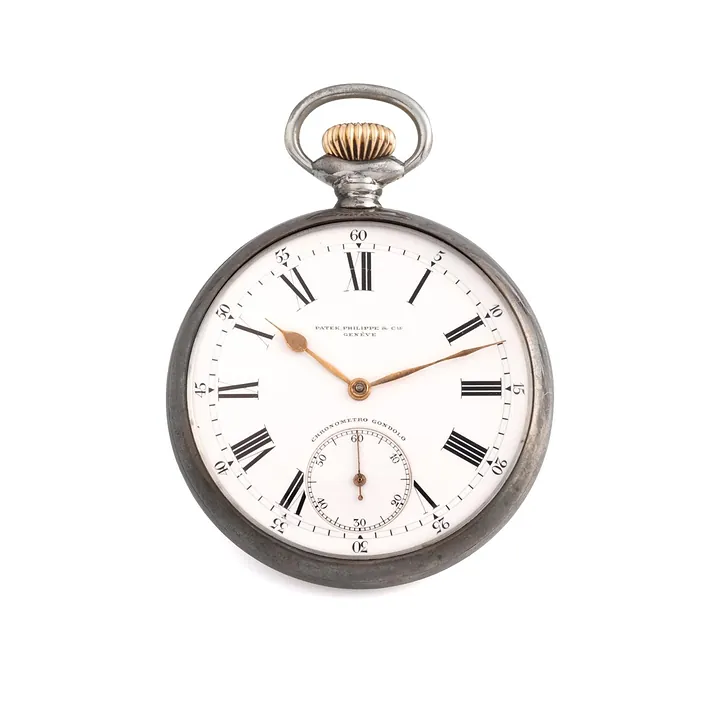
Pocket Watches · c. 1900
Patek Philippe Chronometro Gondolo, c. 1900
Antiquorum auction archive, Geneva

Wristwatches · 2008
Wristwatch by Breitling?, 2008
Museum Rotterdam

Wristwatches · c. 1990s
Audemars Piguet Bamboo, c. 1990s
Antiquorum auction archive, Geneva

Wristwatches · c. 1990
Audemars Piguet Huitieme Perpetual Calendar, ref. 25696PT, c. 1990
Antiquorum auction archive, Geneva

Wristwatches · c. 1990
Breitling Chronomat, ref. b13050.1, c. 1990
Antiquorum auction archive, Geneva