
Wristwatches · Wristwatch
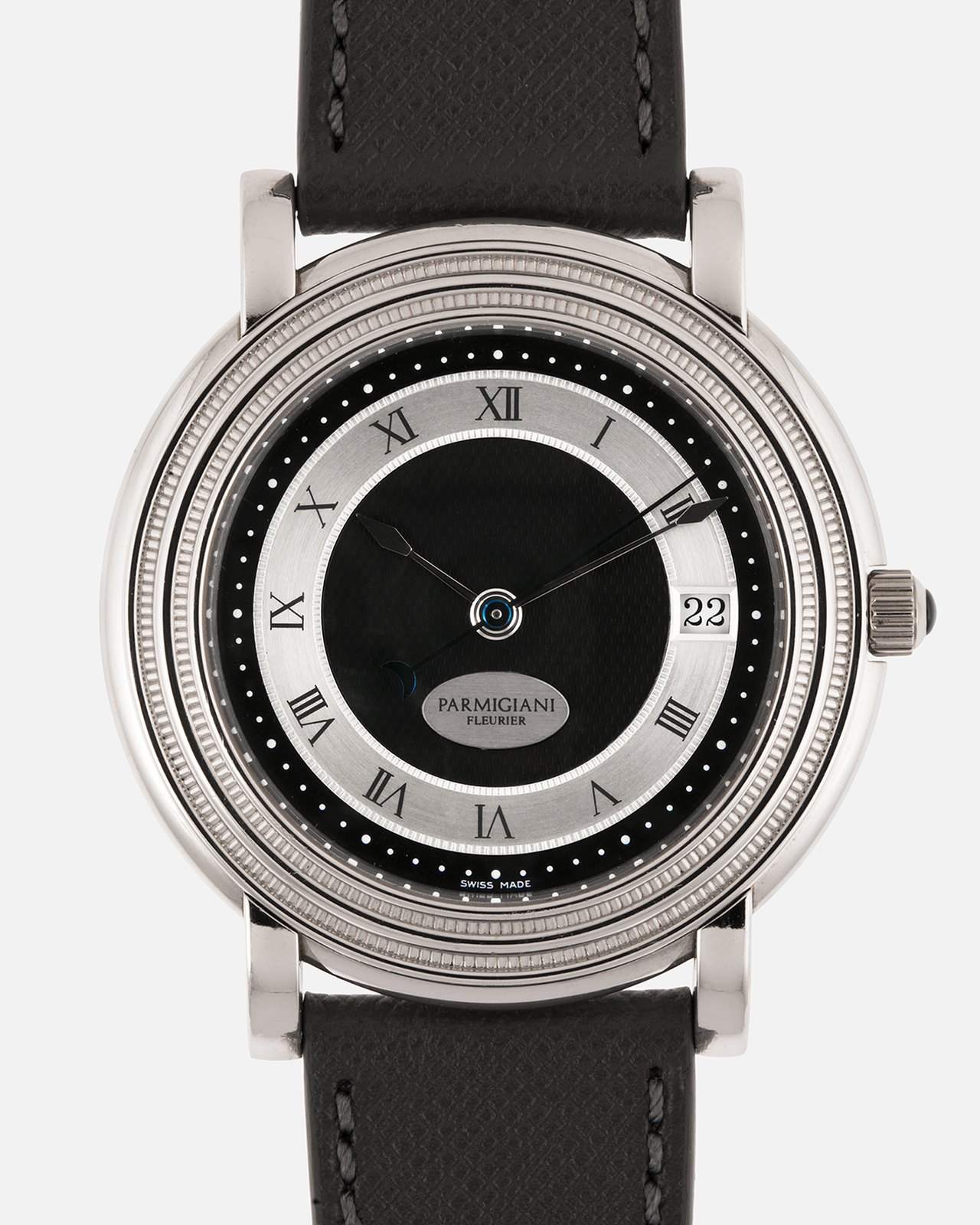
Parmigiani Fleurier Toric Automatic Platinum, 2000s
- Maker / attribution
- Parmigiani Fleurier (maker)
- Date
- 2000s
- Historical period
- Mechanical Renaissance (1990 – 2010)
- Country of origin
- Switzerland
- Object type
- Wristwatch
- Materials / technique
- platinum
- Dimensions
- Case 40 mm
- Stock no.
- Product 7791956885591
- Credit line
- Dealer listing, S.Song Watches (product 7791956885591)
- Catalogue title (original)
- Parmigiani Fleurier Toric Automatic Platinum (English)
View the source record (dealer listing) ↗ (opens another website in a new tab)Suggest a correction
Record summary
Catalogued by S.Song Watches (dealer), Seattle (stock number Product 7791956885591), this is a wristwatch by Parmigiani Fleurier, made in Switzerland, dated 2000s. The Atlas places it in the Mechanical Renaissance period (1990 – 2010) of its Wristwatches collection. Materials and techniques recorded by the source: platinum. Recorded dimensions: Case 40 mm. The record is illustrated with 6 photographs.
Assembled from the source record's structured fields. Dates and attributions are given as the source states them; where a field is missing the Atlas leaves it blank rather than estimating.
Catalogue description
Dealer description — S.Song Watches
Parmigiani Fleurier occupies an interesting position within modern independent watchmaking. Founded in 1996 by Michel Parmigiani with the backing of the Sandoz Family Foundation, the manufacture was built around someone who had already spent two decades restoring some of the most important watches, clocks and automata in existence. The first watch introduced under the Parmigiani Fleurier name was the Toric Memory Time in 1996. It established many of the design elements that would come to define the brand, most notably its distinctive stepped case and finely knurled bezel, inspired by classical architecture and designed around Michel Parmigiani's fascination with the Golden Ratio. The Toric Automatic followed shortly afterwards and appears in Parmigiani Fleurier catalogues from as early as 1998, making it one of the earliest watches produced by the newly established brand. While considerably simpler than the Memory Time, it retained much of the same distinctive design language in a more restrained time and date format. The case measures 40mm and is remarkably slim at approximately 8.5mm thick. Despite being a relatively simple three-hand watch, there is an enormous amount of detail in the case itself. The double-stepped bezel features the distinctive knurled finish inspired by Greek Doric columns, while the long curved lugs and almost complete absence of straight lines give the case a far more architectural appearance than most dress watches of the period. The dial is equally distinctive. Its black centre is decorated with a fine grain d'orge, or barleycorn, guilloché pattern, surrounded by a vertically brushed silver chapter ring carrying black Roman numerals. Around this sits a contrasting black minute track with white dot markers, creating several concentric layers that mirror the stepped construction of the case itself. The date is positioned at 3 o'clock, while the small oval Parmigiani Fleurier signature at 6 is another particularly recognisable detail of these early Torics. Javelin-shaped hour and minute hands are joined by a long thermally blued seconds hand, providing just enough colour against an otherwise monochromatic dial. The present example, however, is something considerably more unusual. While the early Toric Automatic is most commonly encountered in rose gold, this watch is cased entirely in platinum. Information surrounding these early platinum Torics is virtually non-existent, and examples almost never appear publicly. While exact production numbers are unknown, I have seen very few other platinum examples, making this an exceptionally rare configuration of an already early Parmigiani Fleurier. Platinum also works particularly well with this particular dial. Where the rose gold version gives the Toric a much warmer and more classical appearance, the combination of platinum with the black guilloché and silver chapter ring makes the watch feel considerably more restrained. The weight of the platinum also gives what is otherwise a relatively slim dress watch a surprising amount of presence on the wrist. Inside is the self-winding Calibre 13301, a 25-jewel movement with a date complication and approximately 38 hours of power reserve. Visible through the sapphire caseback, it is decorated with Côtes de Genève and paired with a 22-carat rose gold rotor bearing the PF signature. As with much of Parmigiani Fleurier's early work, there is a level of movement finishing and attention to detail that is easy to overlook from the relatively restrained appearance of the watch itself. For me, these earliest Torics remain some of the most interesting watches Parmigiani Fleurier has produced. The design is unmistakably Michel Parmigiani, with the stepped case, knurled bezel, guilloché dial and javelin hands creating something that feels classical without looking like anything else from the period. This platinum Toric Automatic takes that a step further. It is an exceptionally rare version of one of the earliest watches from Parmigiani Fleurier, carrying much of the design language established by the original Toric Memory Time in a considerably simpler form. Given how seldom these early Torics are seen in platinum, I struggle to think of a more interesting configuration of the first-generation Toric Automatic.
Historical context
Mechanical Renaissance (1990 – 2010)
Mechanical watches return as cultural objects; independent watchmaking flourishes.
Mechanical watches returned as cultural and luxury objects. Complications, tourbillons and new materials proliferated; independent watchmakers such as George Daniels, F.P. Journe and Philippe Dufour revived artisanal watchmaking; collecting vintage watches became a major field.
Read the period in the timelineMore wristwatches from this periodEarlier: Quartz Revolution
Atlas type guide
Automatic (self-winding) watches
Self-winding watches use the wearer's motion to wind the mainspring. Abraham-Louis Perrelet and Breguet made 'perpétuelle' pocket watches with oscillating weights in the late eighteenth century, but the principle only became practical in the wristwatch. John Harwood patented a bumper automatic in 1923; Rolex's Perpetual rotor (1931) winding in one direction, and later bidirectional rotors (Eterna, Felsa Bidynator), established the modern form. Micro-rotors (Universal Genève, Buren) and peripheral rotors made automatic watches thinner.
What to look for
- A semicircular rotor turning 360° over the movement, or a 'bumper' weight that rebounds between springs.
- 'Automatic', 'Perpetual' or 'Self-winding' on the dial.
- A sealed screw-back case, since automatic watches are wound less often by the crown.
Dating clues
- Bumper automatics: 1923–c. 1955.
- Full rotors: from 1931 (Rolex); widespread after c. 1950.
- Micro-rotors: from 1954–1958.
General guidance written by the Atlas editors about this kind of object. It is not a statement about this particular piece; for that, rely on the source record above and on physical examination.
Related records
Wristwatches · c. 2000s
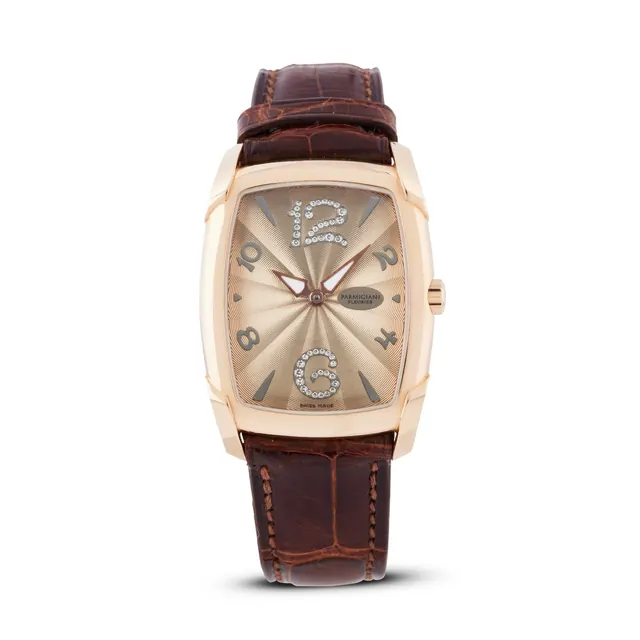
Parmigiani Fleurier wristwatch, Kalpa, circa 2000s
Antiquorum auction archive, Geneva
Wristwatches · c. 2010s
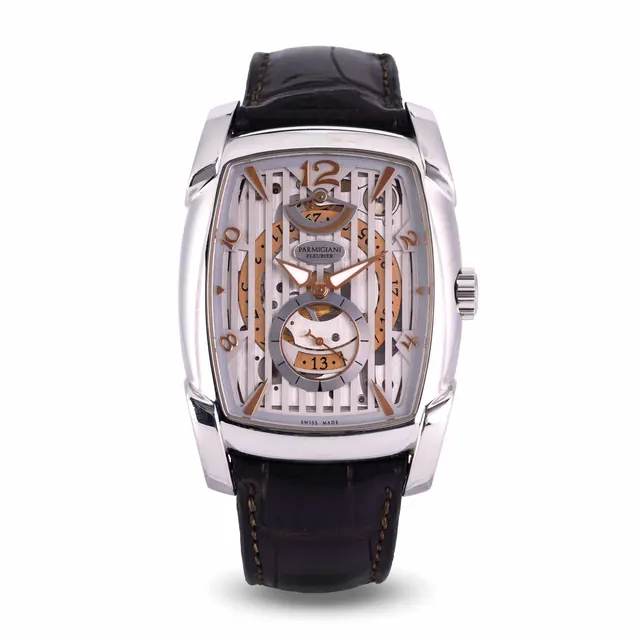
Parmigiani Fleurier wristwatch, Kalpa Xl Hebdomadaire, circa 2010s
Antiquorum auction archive, Geneva
Wristwatches · 2025
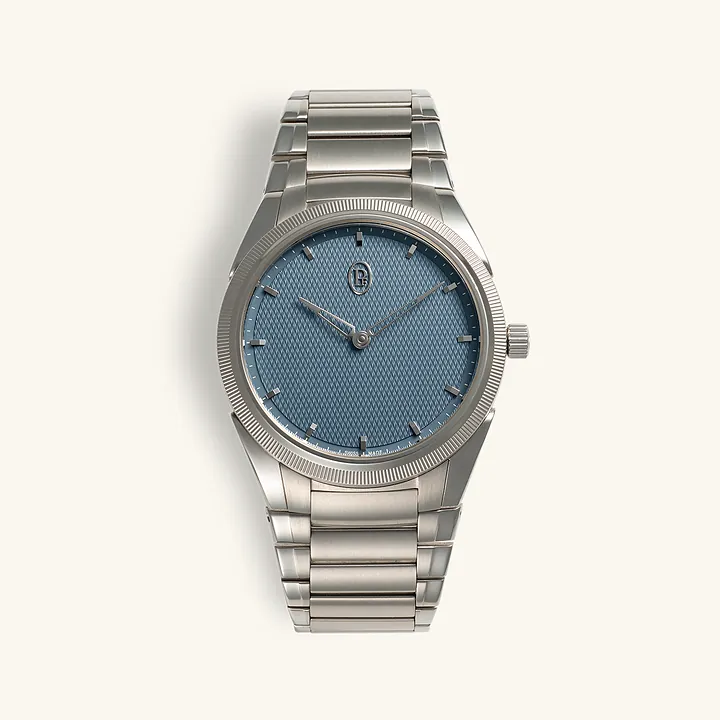
Parmigiani Fleurier Tonda PF 36mm Stone Blue, 2025
Watches of Knightsbridge (dealer), London
Wristwatches · 2023
Parmigiani Fleurier Toric Hemisphères Rétrograde Steel Sealed, 2023
S.Song Watches (dealer), Seattle

Wristwatches · 2008
Wristwatch by Breitling?, 2008
Museum Rotterdam

Wristwatches · c. 1990s
Audemars Piguet Bamboo, c. 1990s
Antiquorum auction archive, Geneva

Wristwatches · c. 1990
Audemars Piguet Huitieme Perpetual Calendar, ref. 25696PT, c. 1990
Antiquorum auction archive, Geneva

Wristwatches · c. 1990
Breitling Chronomat, ref. b13050.1, c. 1990
Antiquorum auction archive, Geneva