
Wristwatches · Wristwatch
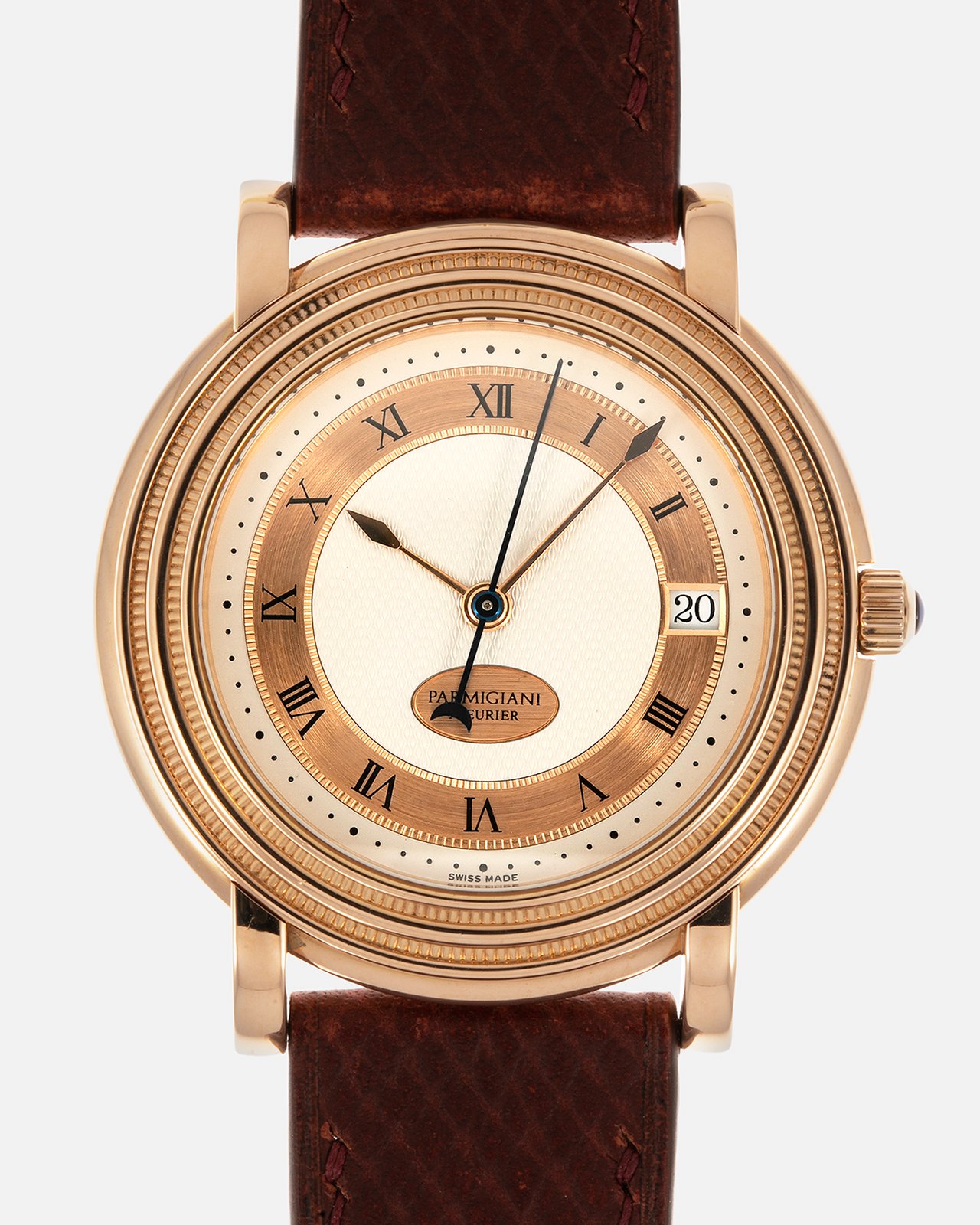
Parmigiani Fleurier Toric Automatic First Generation RG Silver Dial, 2000s
- Maker / attribution
- Parmigiani Fleurier (maker)
- Date
- 2000s
- Historical period
- Mechanical Renaissance (1990 – 2010)
- Country of origin
- Switzerland
- Object type
- Wristwatch
- Materials / technique
- silver
- Dimensions
- Case 40 mm
- Stock no.
- Product 7486546673751
- Credit line
- Dealer listing, S.Song Watches (product 7486546673751)
- Catalogue title (original)
- Parmigiani Fleurier Toric Automatic First Generation RG Silver Dial (English)
View the source record (dealer listing) ↗ (opens another website in a new tab)Suggest a correction
Record summary
Catalogued by S.Song Watches (dealer), Seattle (stock number Product 7486546673751), this is a wristwatch by Parmigiani Fleurier, made in Switzerland, dated 2000s. The Atlas places it in the Mechanical Renaissance period (1990 – 2010) of its Wristwatches collection. Materials and techniques recorded by the source: silver. Recorded dimensions: Case 40 mm. The record is illustrated with 6 photographs.
Assembled from the source record's structured fields. Dates and attributions are given as the source states them; where a field is missing the Atlas leaves it blank rather than estimating.
Catalogue description
Dealer description — S.Song Watches
Parmigiani Fleurier is an independent brand that can be described as a manufacturer that goes beyond surface appearances. Often only talked about within enthusiast circles, the brand has garnered a reputation as somewhat of an underdog in the realm of independent watchmaking. Before its eventual establishment in 1996, Michel Parmigiani operated a small Mesure et Art du Temps (restoration workshop) in Couvet, Switzerland, where he was renowned for his expertise in the art of timepiece restoration. As time went on, Michel began crafting unique watches for clients, and the Parmigiani restoration workshop became a training ground for some of the most accomplished and highly regarded independent watchmakers who have since made their mark in the industry. Most notably, Kari Voutilainen, Stepan Sarpaneva and Raúl Pagès. Today, Parmigiani Fleurier has garnered recognition as one of the most extensively vertically integrated watch manufacturers globally. Its facilities have assumed a crucial role within the Swiss watch industry's supply chain due to their extensive involvement in the production of various essential components for watch manufacturing, including balance springs, movements, etc. Additionally, the brand's expertise also extends to the restoration of historically significant clocks and timepieces from around the world. These are a few of Michel Parmigiani’s many achievements, which have contributed to his recognition as one of the pioneers of the industry, earning him the moniker of one of the "fathers" of independent watchmaking. The neo-vintage timepiece being offered today is a first-generation Parmigiani Fleurier Toric Automatic crafted in 18-carat rose gold. It is a slightly later iteration of the Toric Memory Time. For those who do not know, the Toric Memory Time is somewhat of a pivotal and keystone design for the brand, symbolising Parmigiani Fleurier's inaugural timepiece and showcasing the technical savoir-faire of Michel Parmigiani at the time. Similar to the reference on offer today, the Toric Memory Time bears a complex case design reminiscent of the curvature of a seashell when viewed from a specific angle. In an interview, Michel interestingly said he discovered this during a stroll on a beach in Malaysia and had since wanted to bring this optical illusion to life via his first official Parmigiani Fleurier design. It should also be mentioned that the Toric collection hails from the remarkable '90s era, which witnessed the introduction of renowned and influential timepieces, including notable examples like those by Daniel Roth, that have left a lasting impact on the industry in the decades that followed. Starting with the case design of the Toric Automatic, Parmigiani Fleurier’s cases are all designed in accordance with the Golden Ratio. As you may have noticed, their watches across the board have sharp but balanced case designs with very few straight lines, and especially evident with the Toric Automatic’s 40mm x 8mm rose gold case. At first glance, the case may seem simple and straightforward, but closer examination would reveal a plethora of intricate details and subtleties. The rose gold case stands out with its double-stepped bezel, adding a touch of vintage charm that evokes the Art Deco era. When viewed from a distance, the case exudes a lavish and ornamental flair, which draws inspiration from Greek Doric columns—an element from ancient Greece that represents one of the five orders of classical architecture. Moreover, when observed at an angle, the bezel reveals the exact optical illusion, as mentioned earlier, Michel Parmigiani wanted to capture in his inaugural design, the Toric Memory Time. The silver dial of the Toric timepiece is no slouch either. It showcases a captivating guilloché grain d’orge (barleycorn) pattern, complemented by a brushed matching gold ring that houses the Roman numerals and contrasting black dots which mark the minutes-track along the periphery. Positioned at 6:00, there is an oval cartouche ring that proudly displays the Parmigiani Fleurier brand signature. Completing the dial are a set of javelin-styled hands and a thermally-blued seconds hand, adding a touch of elegance and a nice little contrast to the overall aesthetic. The Toric Automatic is equipped with a 25-jewelled, self-winding Cal. 13301. This remarkable movement boasts a date complication and a power reserve of 38 hours. Encased within the open-display sapphire caseback, the Cal. 13301 also exhibits exquisite Côtes de Genève decoration and is meticulously finished to an exceptionally high standard by Parmigiani Fleurier. A noteworthy feature of the movement is its 22-carat rose gold rotor, elegantly embellished with the PF signature at its centre. What can I say? The Toric Automatic is undeniably an extraordinary and charming timepiece. The seamless fusion of traditional elements with modern touches and subtle nuances here is a testament to the creative brilliance of Michel Parmigiani, resulting in a sophisticated design that truly comes to life when viewed and handled in person. Ultimately, the Toric Automatic presents an overall aesthetic that is truly unparalleled.
Historical context
Mechanical Renaissance (1990 – 2010)
Mechanical watches return as cultural objects; independent watchmaking flourishes.
Mechanical watches returned as cultural and luxury objects. Complications, tourbillons and new materials proliferated; independent watchmakers such as George Daniels, F.P. Journe and Philippe Dufour revived artisanal watchmaking; collecting vintage watches became a major field.
Read the period in the timelineMore wristwatches from this periodEarlier: Quartz Revolution
Atlas type guide
Automatic (self-winding) watches
Self-winding watches use the wearer's motion to wind the mainspring. Abraham-Louis Perrelet and Breguet made 'perpétuelle' pocket watches with oscillating weights in the late eighteenth century, but the principle only became practical in the wristwatch. John Harwood patented a bumper automatic in 1923; Rolex's Perpetual rotor (1931) winding in one direction, and later bidirectional rotors (Eterna, Felsa Bidynator), established the modern form. Micro-rotors (Universal Genève, Buren) and peripheral rotors made automatic watches thinner.
What to look for
- A semicircular rotor turning 360° over the movement, or a 'bumper' weight that rebounds between springs.
- 'Automatic', 'Perpetual' or 'Self-winding' on the dial.
- A sealed screw-back case, since automatic watches are wound less often by the crown.
Dating clues
- Bumper automatics: 1923–c. 1955.
- Full rotors: from 1931 (Rolex); widespread after c. 1950.
- Micro-rotors: from 1954–1958.
General guidance written by the Atlas editors about this kind of object. It is not a statement about this particular piece; for that, rely on the source record above and on physical examination.
Related records
Wristwatches · c. 2000s
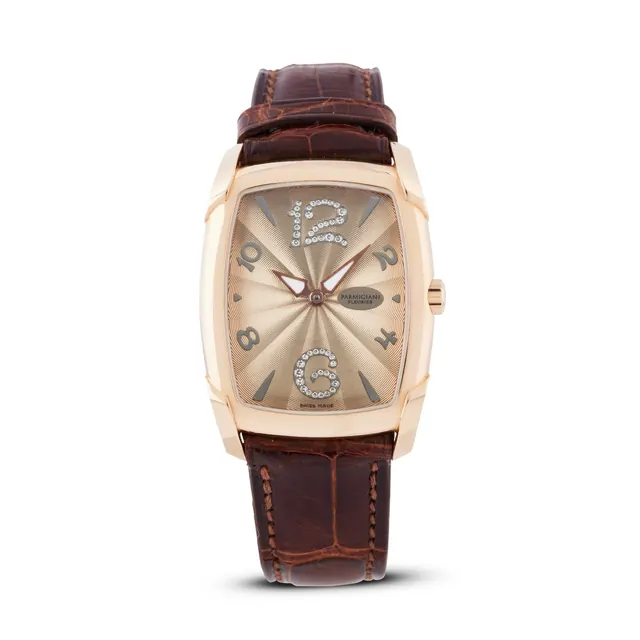
Parmigiani Fleurier wristwatch, Kalpa, circa 2000s
Antiquorum auction archive, Geneva
Wristwatches · c. 2010s
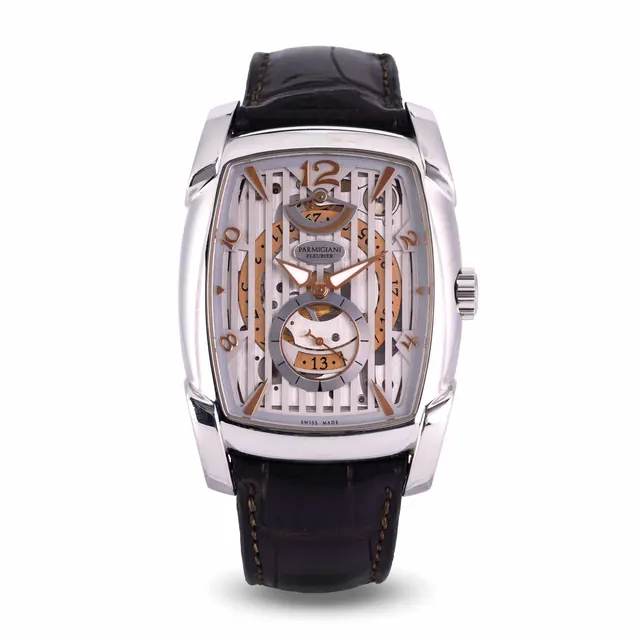
Parmigiani Fleurier wristwatch, Kalpa Xl Hebdomadaire, circa 2010s
Antiquorum auction archive, Geneva
Wristwatches · 2025
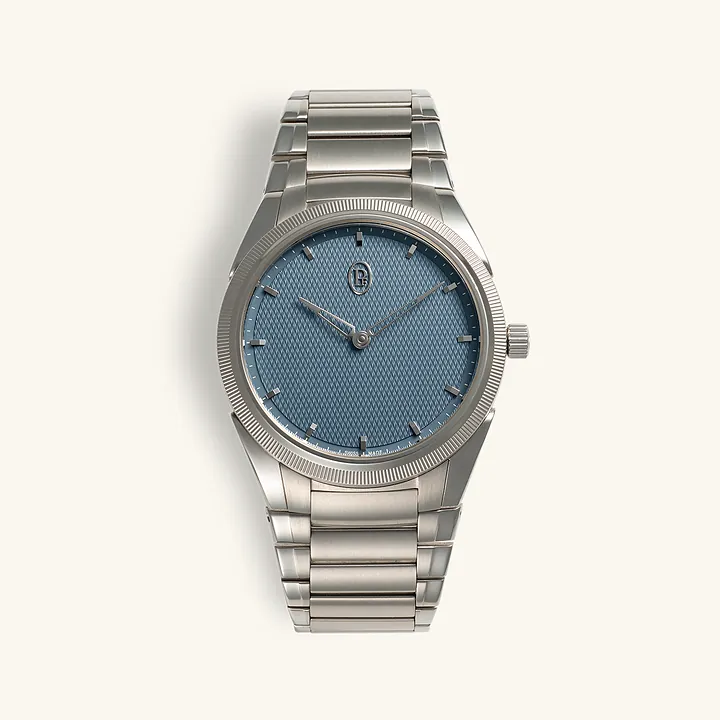
Parmigiani Fleurier Tonda PF 36mm Stone Blue, 2025
Watches of Knightsbridge (dealer), London
Wristwatches · 2023
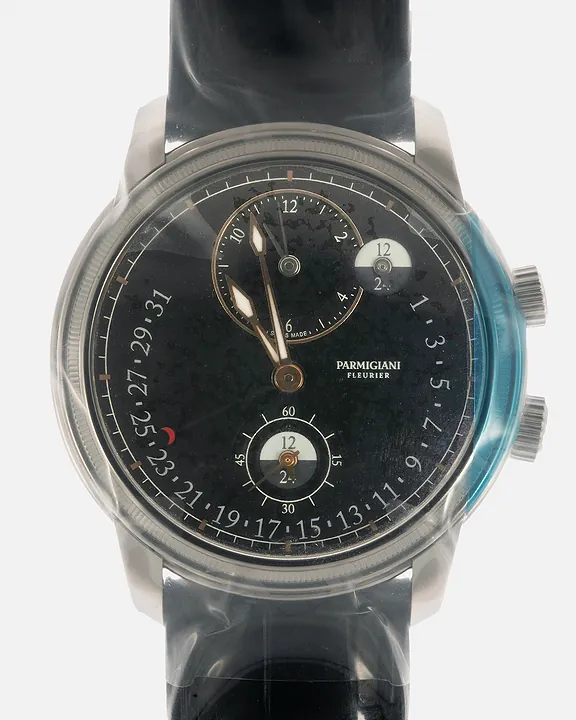
Parmigiani Fleurier Toric Hemisphères Rétrograde Steel Sealed, 2023
S.Song Watches (dealer), Seattle

Wristwatches · 2008
Wristwatch by Breitling?, 2008
Museum Rotterdam

Wristwatches · c. 1990s
Audemars Piguet Bamboo, c. 1990s
Antiquorum auction archive, Geneva

Wristwatches · c. 1990
Audemars Piguet Huitieme Perpetual Calendar, ref. 25696PT, c. 1990
Antiquorum auction archive, Geneva

Wristwatches · c. 1990
Breitling Chronomat, ref. b13050.1, c. 1990
Antiquorum auction archive, Geneva