
Wristwatches · Wristwatch
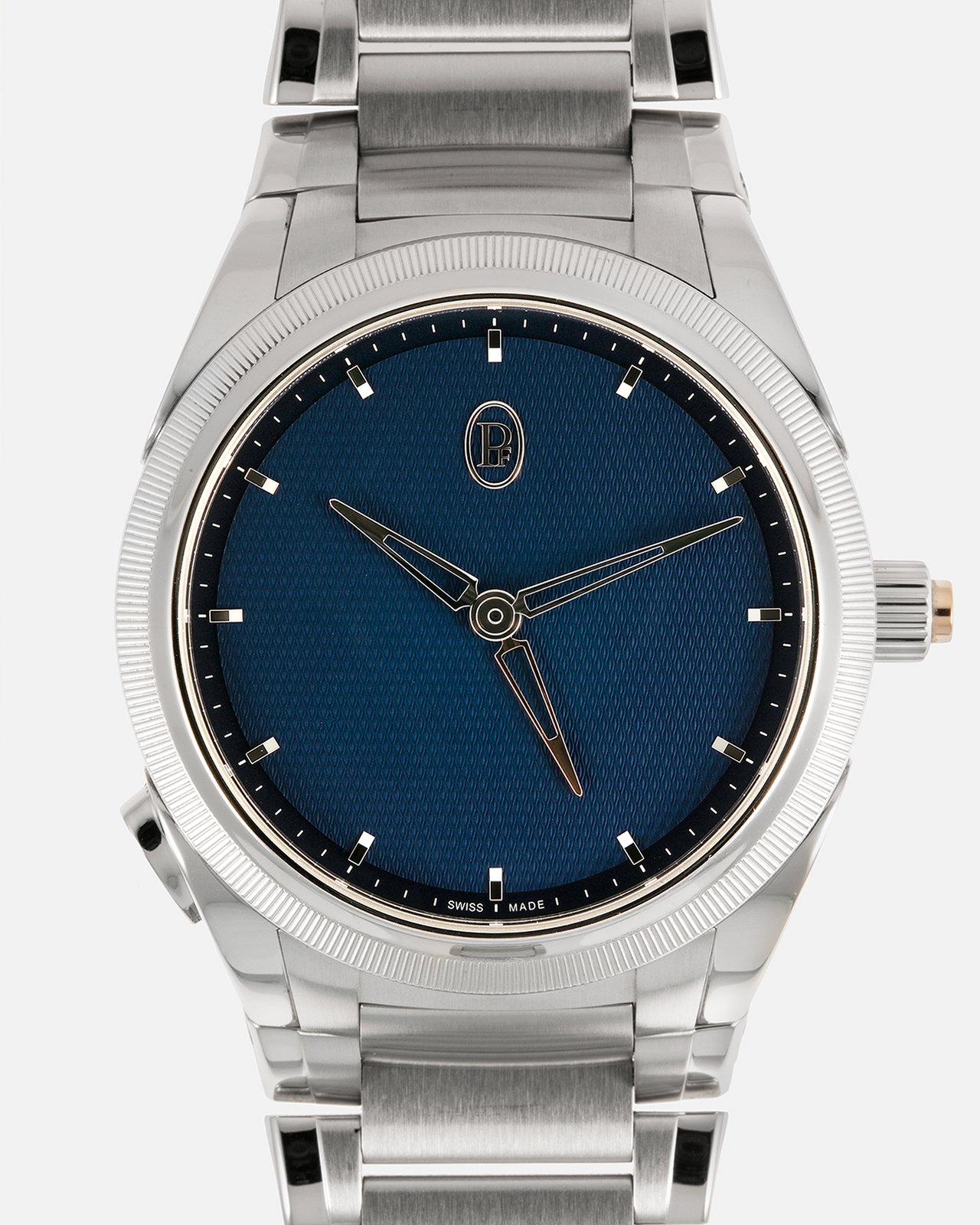
Parmigiani Fleurier Tonda PF GMT Rattrapante, 2023
- Maker / attribution
- Parmigiani Fleurier (maker)
- Date
- 2023
- Historical period
- Contemporary Horology (2010 – Present)
- Country of origin
- Switzerland
- Object type
- Wristwatch
- Dimensions
- Case 40 mm
- Stock no.
- Product 7208898789463
- Credit line
- Dealer listing, S.Song Watches (product 7208898789463)
- Catalogue title (original)
- Parmigiani Fleurier Tonda PF GMT Rattrapante (English)
View the source record (dealer listing) ↗ (opens another website in a new tab)Suggest a correction
Record summary
Catalogued by S.Song Watches (dealer), Seattle (stock number Product 7208898789463), this is a wristwatch by Parmigiani Fleurier, made in Switzerland, dated 2023. The Atlas places it in the Contemporary Horology period (2010 – Present) of its Wristwatches collection. Recorded dimensions: Case 40 mm. The record is illustrated with 6 photographs.
Assembled from the source record's structured fields. Dates and attributions are given as the source states them; where a field is missing the Atlas leaves it blank rather than estimating.
Catalogue description
Dealer description — S.Song Watches
Parmigiani Fleurier is an independent brand that has, in recent years, gained its status as an underdog in the world of watchmaking. They occupy a very interesting space within the world of Swiss watch brands. In my mind, Parmigiani Fleurier is a “more than meets the eye” kind of manufacturer. In other words, ‘understatement’ is their design mantra. They are also a brand that draws most of its watchmaking expertise from the art of restoration. For that reason, Parmigiani Fleurier is not a brand you typically hear watch collectors often rave about, but what makes the manufacture so special is the fact they have produced some absolutely stunning watches over the past two decades. Refined lines, an exquisite case profile, ergonomically correct proportions, and a timeless aesthetic with subtle elegance — these physical attributes define the essence of the Parmigiani Fleurier Tonda collection. Today, we proudly introduce the Maison ’s take on perhaps one of the most popular archetypes in contemporary watchmaking — the Tonda PF GMT Rattrapante. With this Tonda PF GMT Rattrapante coming in an ergonomic and contemporarily sized 40mm x 10.4mm stainless steel case, it may initially appear unassuming from a distance. However, upon closer examination, it becomes evident that this timepiece possesses hidden depths; there is more to this Tonda PF GMT Rattrapante than meets the eye. It exhibits many of the distinct stylistic elements that Parmigiani Fleurier had so deftly established for its predecessors: a meticulously hand-knurled bezel, beautiful flared lugs, and in this case, a well-made integrated bracelet with alternating finishing on the links that interplays with the light wonderfully. While we’re on the topic of hidden depths, as the name implies, the Tonda PF GMT Rattrapante also features a GMT function. However, it diverges from the typical GMT complication many are accustomed to. Eschewing the conventional date window aperture, the AM/PM indicator, and the 24-hour hand we typically expect to see on GMT watches, the Tonda PF GMT Rattrapante uses a subtle method to indicate its second-time zone. A semi-concealed, open-worked hour hand in rose gold, nestled just beneath its white gold counterpart, serves as the home time indicator. Meanwhile, the white gold hour hand, which indicates the local time, can be adjusted (in one-hour increments) using the elegantly discreet pusher located on the outer side of the bottom left lug. When you engage the rose gold pusher atop its crown, the two hands will then merge seamlessly. Additionally, adorning its masterfully crafted blue dial, you’ll also find an oval ‘PF’ cartouche at 12 o ‘clock, as well as a refined hand-guilloché grain d’orge (barleycorn) motif on the dial – which is, one of the finest forms of guilloché finishing in modern watchmaking today. Breathing life into this Tonda PF GMT Rattrapante is Parmigiani Fleurier’s magnificent in-house, self-winding Cal. PF051. It features enticing architecture and a gorgeous gold micro-rotor with the same matching guilloché grain d’orge that is found on the dial. As far as power reserve is concerned, the Cal. PF051 holds a capacity of 48 hours on a full wind. In the realm of watchmaking, the GMT complication has long been associated with practicality and functionality above all else. But here, Parmigiani Fleurier has boldly attempted to reimagine what a GMT complication could look like within their highly acclaimed Tonda PF collection. The result? A fresh and novel interpretation of the GMT complication that not only transcends its utilitarian origins, but also highlights Parmigiani Fleurier’s watchmaking pedigree as a well-respected independent luxury watch brand. All I can say is that the Tonda PF GMT Rattrapante exudes a deceptive simplicity for a GMT watch, yet it embodies much more than mere aesthetics. It stands as a testament to Parmigiani Fleurier’s steadfast commitment to its design principles, encapsulating innovation and serving as a masterclass in restrained design. For all of the reasons I have elaborated above, this particular Tonda PF GMT Rattrapante right here is, in my mind, a compelling masterpiece of a modern sports watch that can effortlessly complement any serious collector’s watch box and daily rotation.
Historical context
Contemporary Horology (2010 – Present)
Silicon components, connected watches, optical-lattice research clocks and a thriving independent scene.
Smartwatches became the world's best-selling watches, while mechanical watchmaking focuses on craft, innovation (silicon components, new escapements) and independent makers.
Read the period in the timelineMore wristwatches from this periodEarlier: Mechanical Renaissance
Atlas type guide
Chronographs and split-seconds watches
A chronograph is a watch with an additional seconds hand that can be started, stopped and returned to zero independently of the timekeeping. Louis Moinet built an early example in 1816 and Nicolas Rieussec a recording 'chronographe' in 1821; Adolphe Nicole's heart-shaped reset cam (patented 1862) made the modern return-to-zero possible. Split-seconds (rattrapante) chronographs add a second hand that can be stopped for intermediate times; flyback chronographs restart instantly.
Chronographs were essential tools for doctors (pulsometer scales), artillery (telemeter), engineers and sport. In wristwatches, Valjoux, Venus, Lemania and later the automatic chronographs of 1969 (Zenith El Primero, the Chronomatic Calibre 11 group and Seiko 6139) are milestones.
What to look for
- Push-pieces on the case band or a single button in the crown (monopusher).
- Subsidiary registers for minutes and hours; tachymeter, telemeter or pulsometer scales.
- Column wheel versus cam control visible in the movement.
- Calibre markings of specialist makers (Valjoux, Lemania, Venus, Landeron).
Dating clues
- Pocket chronographs with heart cam reset: after 1862.
- Wrist chronographs: from c. 1910; two-button designs from the 1930s.
- Automatic chronographs: from 1969.
General guidance written by the Atlas editors about this kind of object. It is not a statement about this particular piece; for that, rely on the source record above and on physical examination.
Related records
Wristwatches · c. 2000s
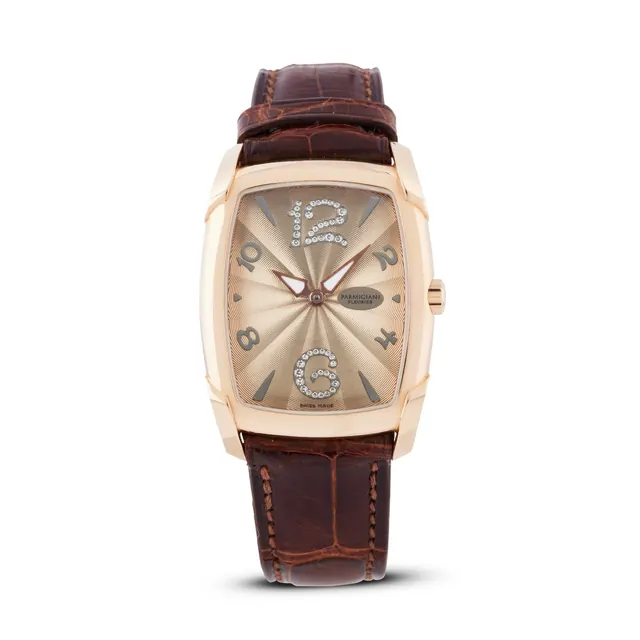
Parmigiani Fleurier wristwatch, Kalpa, circa 2000s
Antiquorum auction archive, Geneva
Wristwatches · c. 2010s
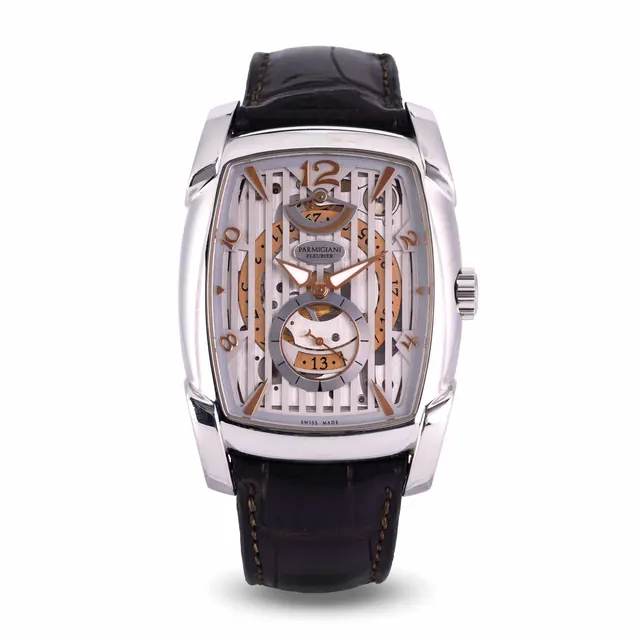
Parmigiani Fleurier wristwatch, Kalpa Xl Hebdomadaire, circa 2010s
Antiquorum auction archive, Geneva
Wristwatches · 2025
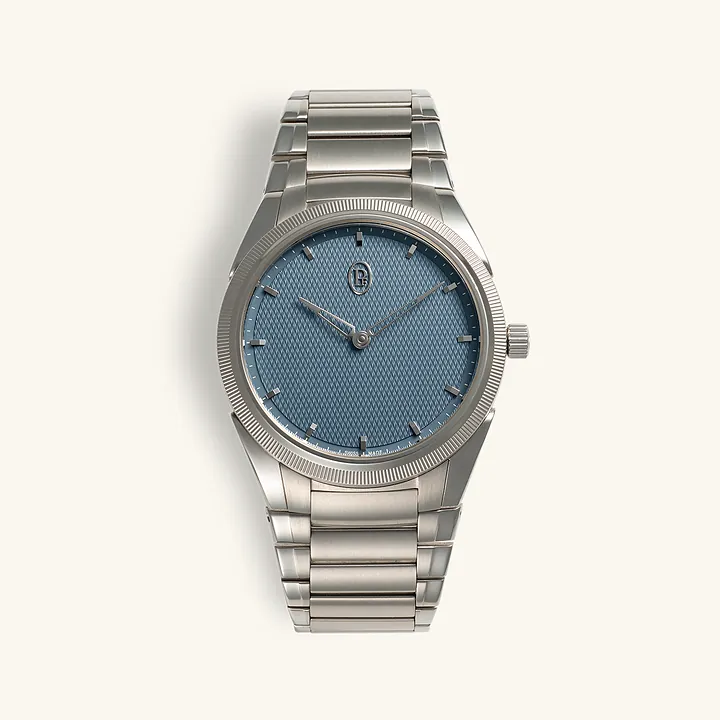
Parmigiani Fleurier Tonda PF 36mm Stone Blue, 2025
Watches of Knightsbridge (dealer), London
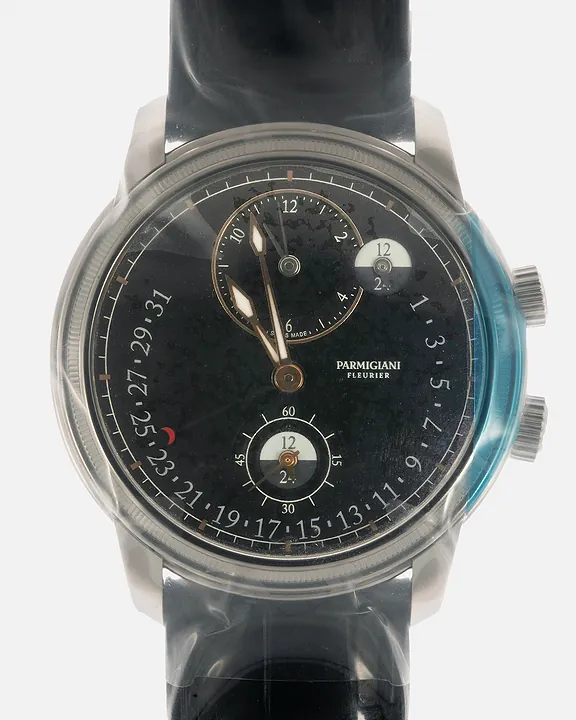
Wristwatches · 2023
Parmigiani Fleurier Toric Hemisphères Rétrograde Steel Sealed, 2023
S.Song Watches (dealer), Seattle

Wristwatches · c. 2010s
Breguet Type XXI, ref. 3810, c. 2010s (Antiquorum Lot 381-24)
Antiquorum auction archive, Geneva

Wristwatches · c. 2010s
Breguet Type XXI, ref. 3810, c. 2010s (Antiquorum Lot 386-229)
Antiquorum auction archive, Geneva

Wristwatches · Sold in September 2010
Breitling Cosmonaute, ref. A 22322, Sold in September 2010
Antiquorum auction archive, Geneva

Wristwatches · c. 2010
Corum Bubble Chrono, ref. 396.150.20, c. 2010
Antiquorum auction archive, Geneva