
Wristwatches · Diver's watch
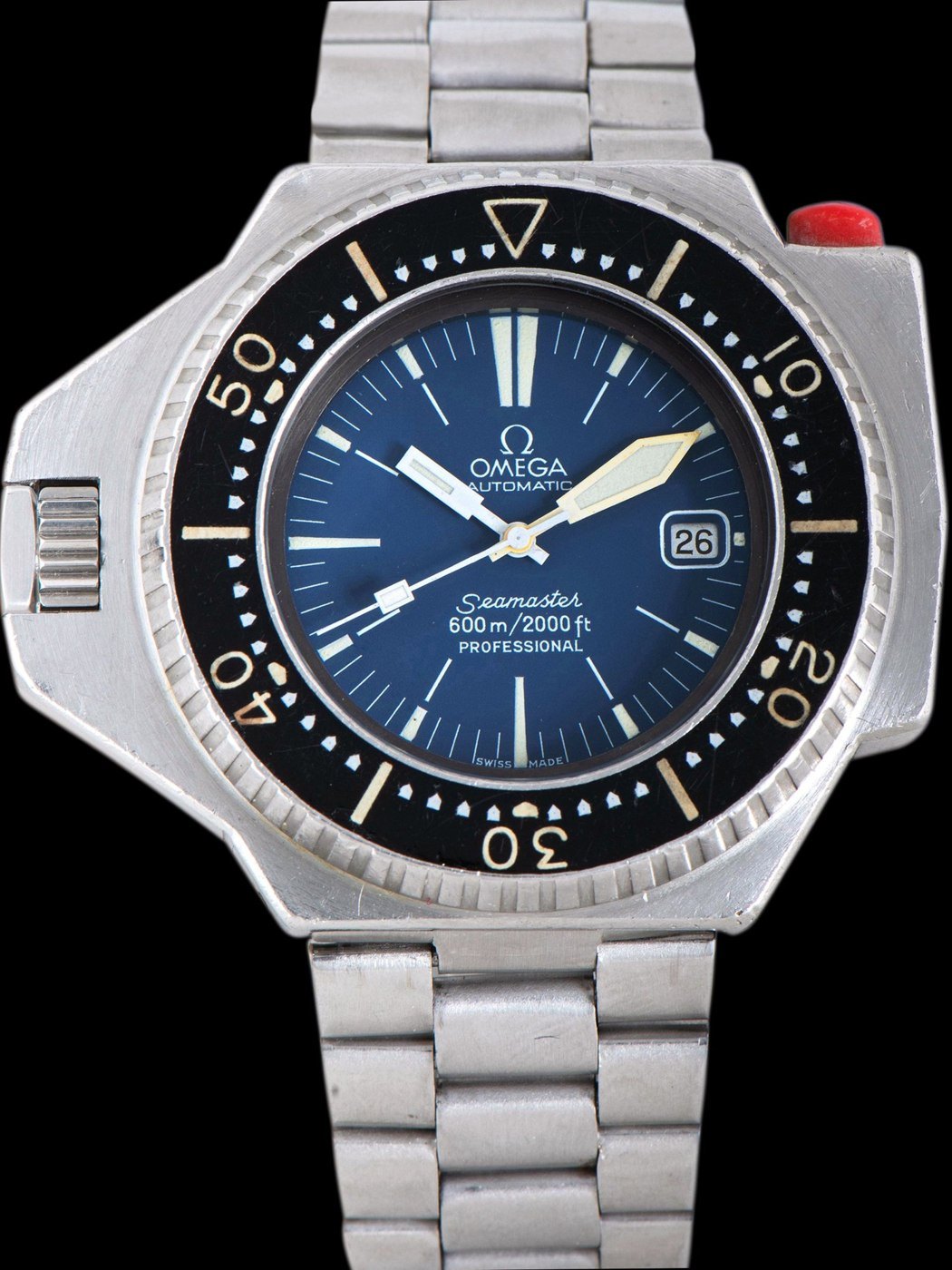
Omega Seamaster Professional 600 'Ploprof'
- Maker / attribution
- Omega (source attribution)
- Date
- 1970s
- Historical period
- Quartz Revolution (1969 – 1990)
- Country of origin
- Switzerland
- Object type
- Diver's watch
- Dimensions
- 55mm
- Holding institution
- Zamanito / Craft & Tailored
- Accession / object no.
- omega-seamaster-professional-600-ploprof-f77a94022a
- Credit line
- Zamanito / Craft & Tailored
- Catalogue title (original)
- ساعت مچی غواصی امگا Omega Seamaster Professional 600 Ploprof رفرنس 166.077 (English)
View the source record ↗ (opens another website in a new tab)Suggest a correction
Record summary
Held and catalogued by Zamanito / Craft & Tailored (object number omega-seamaster-professional-600-ploprof-f77a94022a), this is a diver's watch attributed to Omega, made in Switzerland, dated 1970s. The Atlas places it in the Quartz Revolution period (1969 – 1990) of its Wristwatches collection. Recorded dimensions: 55mm. The record is illustrated with 1 photograph.
Assembled from the source record's structured fields. Dates and attributions are given as the source states them; where a field is missing the Atlas leaves it blank rather than estimating.
Catalogue description
Original object description
Commonly termed the 'Ploprof' from 'Plongeur Professionnel', this stainless steel Omega Seamaster Professional 600 was developed for deep-sea and commercial diving tasks, notably those performed by COMEX. The model was initially displayed in prototype form at the 1969 Basel Fair prior to reaching the retail market in April 1971. Its distinctive 55mm asymmetrical steel case was created to withstand high water pressure during late-1960s offshore oil drilling and experimental deep-water exploration, incorporating a specialized crown-guard locking system. The watch houses an automatic movement with date and is mounted on an Omega reference 1162 steel bracelet fitted with 162 end links. Beneath a mineral crystal, the matte blue 'Mk V' dial carries green-tinted tritium hour markers and an original metallic date disc at 3 o'clock. A bidirectional 'Mk II' bezel handles elapsed time, rotating only when released by pressing a large red push-button set on the upper case flank. Although showing typical handling marks, the case is noted to retain its factory contours and sharp lines, and the movement has undergone a full service. The timepiece is presented without its original box or paperwork.
Historical context
Quartz Revolution (1969 – 1990)
Seiko's Astron begins mass quartz timekeeping; traditional industries contract sharply.
Quartz and digital watches transformed the market after 1969. Swiss employment collapsed, Japanese and Hong Kong production soared, and the Swatch (1983) helped the Swiss industry recover; mechanical watches survived as luxury goods.
Read the period in the timelineMore wristwatches from this periodEarlier: Modern Mechanical Horology
Atlas type guide
Dive and water-resistant watches
Keeping water and dust out of a wristwatch was a long-standing challenge. Rolex's screw-down Oyster case (1926) and Omega's Marine (1932) were landmarks; in the early 1950s Blancpain's Fifty Fathoms and Rolex's Submariner defined the professional dive watch with rotating bezels for timing dives, luminous dials and high water resistance. The ISO 6425 standard (1982) later codified what a 'diver's watch' must do.
Dive watches became icons of post-war design and exploration, and their evolution — helium escape valves, ceramic bezels, saturation-diving depth ratings — records the history of underwater work.
What to look for
- Unidirectional or bidirectional rotating bezel with minute markings.
- Screw-down crown and case back; depth rating printed on the dial.
- Luminous hands and markers (radium before c. 1960, tritium c. 1960–1998, then Super-LumiNova).
- Reference numbers on the case between the lugs or inside the back.
Dating clues
- Screw-down Oyster cases: from 1926.
- Professional dive watches: from 1953.
- Tritium 'T' marks on dials: c. 1960–1998.
General guidance written by the Atlas editors about this kind of object. It is not a statement about this particular piece; for that, rely on the source record above and on physical examination.
Related records

Instruments · 1950–1976
Omega Megaquartz 2400 marine chronometer, 1950–1976
Science Museum Group, London

Instruments · 1960–1979
Stopwatch / timer by Omega, 1960–1979
Science Museum Group, London

Instruments · 1960–1979
Stopwatch / timer by Omega, Switzerland, 1960–1979
Science Museum Group, London

Instruments · 1960–1979
Stopwatch by Omega, Swiss made, single-button type reading 0 - 60 seconds in fifths and 0 - 5 minutes in minutes on subsidiary dial, 1960-79.
Science Museum Group, London

Wristwatches · 1970
Wristwatch by Heno, Switzerland, 1970
Museum Rotterdam
Wristwatches · 1973
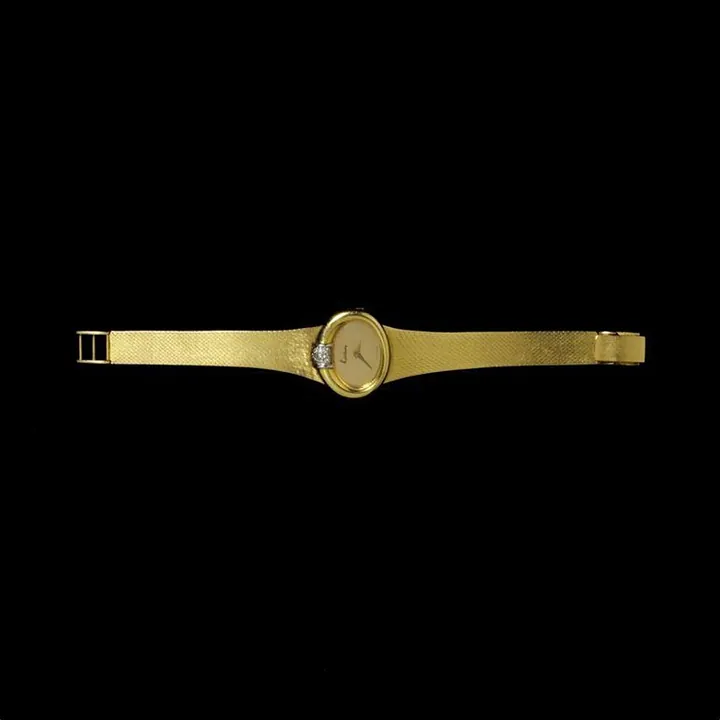
Woman's watch, gold with diamonds set in platinum. Made for Kutchinsky, London by Chopard et Cie. Switzerland, 1973
Victoria and Albert Museum, London
Wristwatches · 1985–1991
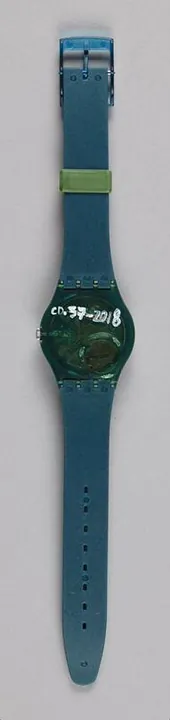
Swatch dummy watch: Blue Leaves GN104 design
Victoria and Albert Museum, London
Wristwatches · 1985–1991
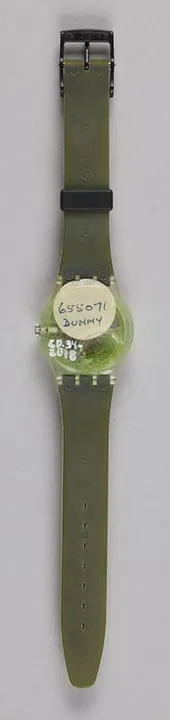
Swatch dummy watch: Technosphere GK101 design
Victoria and Albert Museum, London