
Wristwatches · Wristwatch
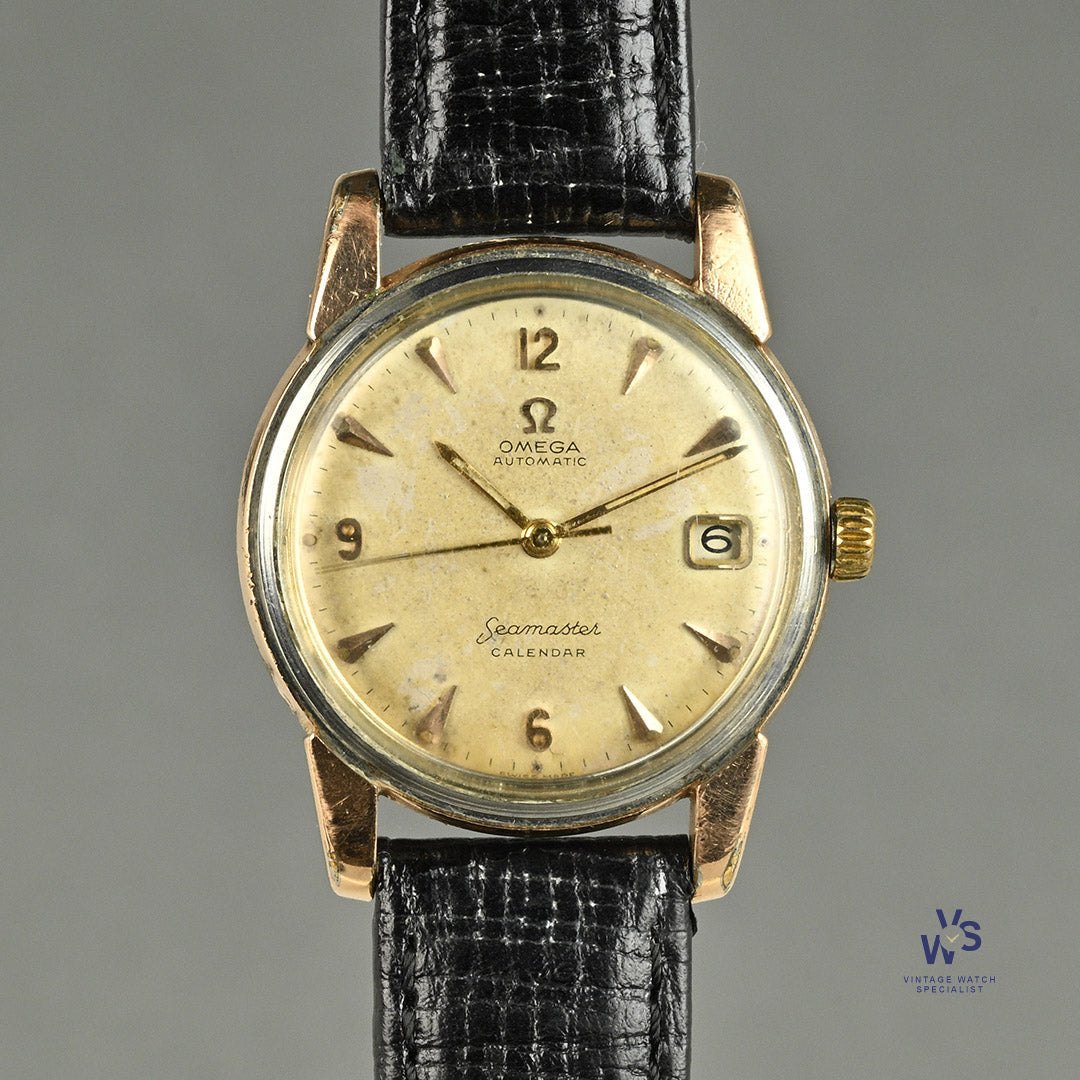
Omega Seamaster Calendar Automatic, ref. 2849-8 SC, circa 1958
- Maker / attribution
- Omega (maker)
- Date
- c. 1958
- Historical period
- Modern Mechanical Horology (1945 – 1969)
- Country of origin
- Switzerland
- Object type
- Wristwatch
- Dimensions
- Case 34 mm
- Stock no.
- vws4383cs
- Credit line
- Dealer listing, Vintage Watch Specialist (vws4383cs)
- Catalogue title (original)
- Omega Seamaster Calendar Automatic - Reference 2849-8 SC - c.1958 (English)
View the source record (dealer listing) ↗ (opens another website in a new tab)Suggest a correction
Record summary
Catalogued by Vintage Watch Specialist (dealer), United Kingdom (stock number vws4383cs), this is a wristwatch by Omega, made in Switzerland, dated c. 1958. The Atlas places it in the Modern Mechanical Horology period (1945 – 1969) of its Wristwatches collection. Recorded dimensions: Case 34 mm. The record is illustrated with 6 photographs.
Assembled from the source record's structured fields. Dates and attributions are given as the source states them; where a field is missing the Atlas leaves it blank rather than estimating.
Catalogue description
Dealer description — Vintage Watch Specialist
The Omega Seamaster was introduced in 1948 and is now one of the longest-running names in the Omega catalogue. The earliest Seamasters, however, looked very different from the diving watches with which the name is so closely associated today. They were elegant everyday watches, combining traditional Swiss styling with cases designed to provide greater protection for the movement during daily wear. During the 1950s, Omega steadily developed the collection, adding automatic movements and useful complications such as the date. The resulting Seamaster Calendar watches sit at an interesting point in the model's evolution: still very much classical mid-century dress watches, but increasingly practical for everyday use. The Calibre 503 belongs to Omega's important generation of full-rotor automatic movements from this period. With 20 jewels, central seconds, a date display and approximately 46 hours of power reserve, it represented the kind of dependable automatic movement around which Omega built much of its reputation during the post-war years. Nearly seven decades later, watches such as this show another side of the Seamaster story – long before the collection became synonymous with professional diving, it was already establishing itself as one of Omega's most enduring names. What’s on Offer Here we have an Omega Seamaster Calendar Automatic, reference 2849-8 SC, dating from approximately 1958 and powered by the 20-jewel Omega Calibre 503. The watch has a 34mm rose-gold-plated case, measuring approximately 42mm from top to bottom. Long, angular lugs give it more presence than the case diameter might initially suggest, while the combination of warm rose-gold tones and a black leather strap is quintessentially 1950s. But it is the dial that gives this particular example its personality. Originally light in colour, it has developed extensive natural patina across the surface, creating a mottled cream appearance with darker areas and spotting throughout. Rather than presenting as a pristine vintage dial, it wears its age very visibly – and for those who enjoy watches that have acquired an individual character over the decades, there is plenty to appreciate here. The dial combines applied rose-gold-tone triangular hour markers with Arabic numerals at 12, 9 and 6, matching hands and a framed date aperture at 3 o'clock. The applied Omega symbol and Omega Automatic signature sit beneath 12, with the wonderfully period Seamaster Calendar script above 6 o'clock. The case also shows clear evidence of its life. There are surface marks and areas of wear to the rose-gold plating, particularly around the case edges and bezel, all of which are visible in the photographs and reflected in our 7.5/10 condition rating. Turn the watch over and the stainless-steel caseback carries the familiar Omega Seamaster hippocampus medallion, another lovely period detail. Inside is the Omega Calibre 503, a 20-jewel automatic mechanical movement with an approximate 46-hour power reserve. The watch is fitted to a black leather strap with an adjustable fit. This watch forms part of a larger collection that we have been asked to sell on behalf of a watch collector's family. If you would like the watch serviced before receiving it, this can be arranged through our watchmaker at additional cost. Simply leave a note when placing your order and we will contact you to discuss the options.
Historical context
Modern Mechanical Horology (1945 – 1969)
Tool watches for divers, pilots and astronauts; electric watches anticipate the electronic age.
The classic era of the mechanical wristwatch: dive watches, chronographs for motor racing and space flight, GMT watches for jet travel, slim dress watches, automatic calendars, and the rise of Japanese manufacturers alongside Swiss, American, German and Soviet industries.
Read the period in the timelineMore wristwatches from this periodEarlier: Golden Age of Mechanical Watchmaking
Atlas type guide
Dive and water-resistant watches
Keeping water and dust out of a wristwatch was a long-standing challenge. Rolex's screw-down Oyster case (1926) and Omega's Marine (1932) were landmarks; in the early 1950s Blancpain's Fifty Fathoms and Rolex's Submariner defined the professional dive watch with rotating bezels for timing dives, luminous dials and high water resistance. The ISO 6425 standard (1982) later codified what a 'diver's watch' must do.
Dive watches became icons of post-war design and exploration, and their evolution — helium escape valves, ceramic bezels, saturation-diving depth ratings — records the history of underwater work.
What to look for
- Unidirectional or bidirectional rotating bezel with minute markings.
- Screw-down crown and case back; depth rating printed on the dial.
- Luminous hands and markers (radium before c. 1960, tritium c. 1960–1998, then Super-LumiNova).
- Reference numbers on the case between the lugs or inside the back.
Dating clues
- Screw-down Oyster cases: from 1926.
- Professional dive watches: from 1953.
- Tritium 'T' marks on dials: c. 1960–1998.
General guidance written by the Atlas editors about this kind of object. It is not a statement about this particular piece; for that, rely on the source record above and on physical examination.
Related records

Instruments · 1950–1976
Omega Megaquartz 2400 marine chronometer, 1950–1976
Science Museum Group, London

Instruments · 1960–1979
Stopwatch / timer by Omega, 1960–1979
Science Museum Group, London

Instruments · 1960–1979
Stopwatch / timer by Omega, Switzerland, 1960–1979
Science Museum Group, London

Instruments · 1960–1979
Stopwatch by Omega, Swiss made, single-button type reading 0 - 60 seconds in fifths and 0 - 5 minutes in minutes on subsidiary dial, 1960-79.
Science Museum Group, London

Wristwatches · 1945
Wristwatch by Eterna, 1945
Museum Rotterdam

Wristwatches · c. 1945
Breitling Premier, ref. 790, c. 1945
Antiquorum auction archive, Geneva

Wristwatches · c. 1945
Universal Genève Uni-Compax, ref. 22492, c. 1945
Antiquorum auction archive, Geneva

Wristwatches · c. 1950s
Baume & Mercier wristwatch, c. 1950s
Antiquorum auction archive, Geneva