
Wristwatches · Wristwatch
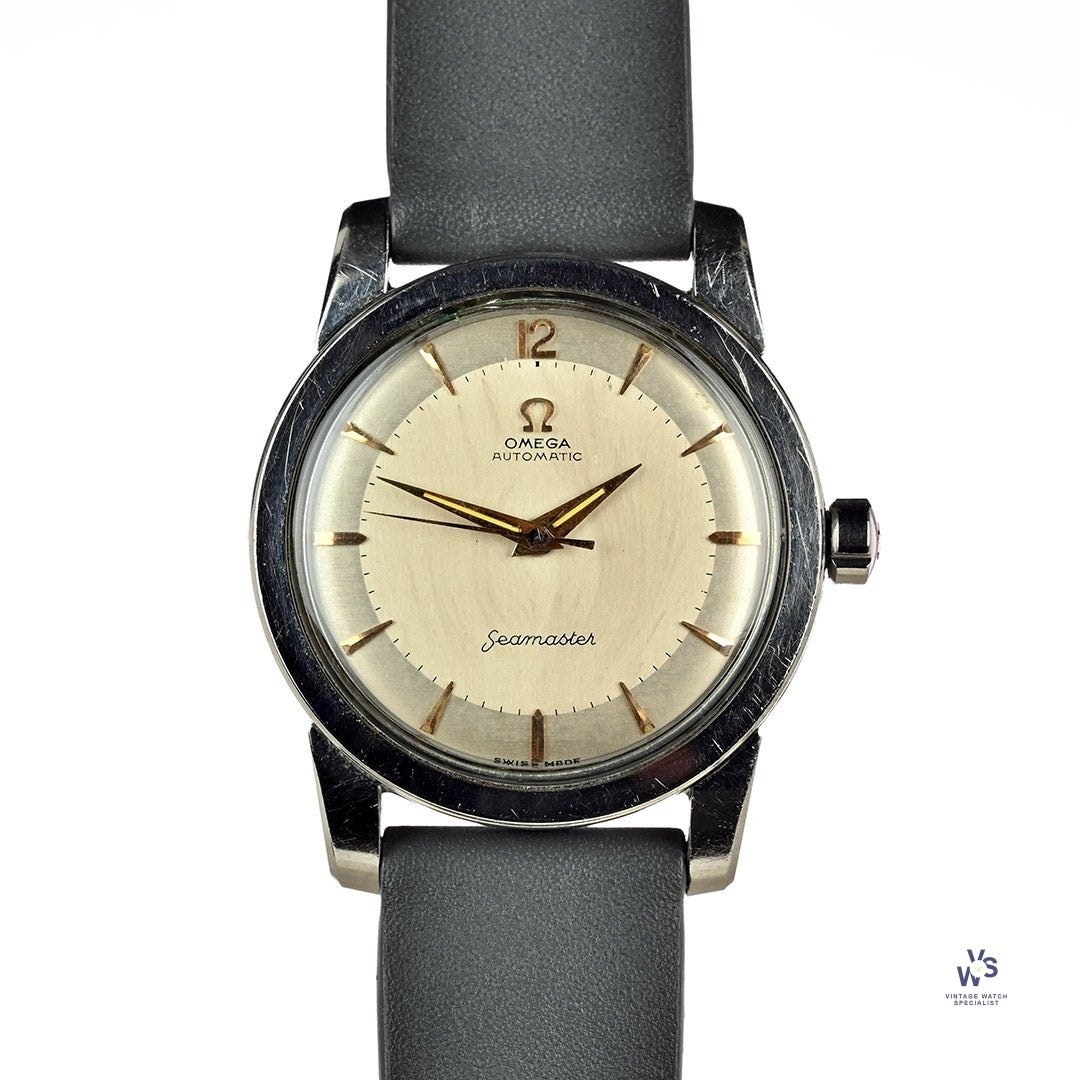
Omega Seamaster 'Bumper', ref. 2577, Silver Dial, circa 1954
- Maker / attribution
- Omega (maker)
- Date
- c. 1954
- Historical period
- Modern Mechanical Horology (1945 – 1969)
- Country of origin
- Switzerland
- Object type
- Wristwatch
- Materials / technique
- silver
- Stock no.
- vws3000
- Credit line
- Dealer listing, Vintage Watch Specialist (vws3000)
- Catalogue title (original)
- Omega Seamaster 'Bumper' - Model Ref: 2577 - Silver Dial - c.1954 (English)
View the source record (dealer listing) ↗ (opens another website in a new tab)Suggest a correction
Record summary
Catalogued by Vintage Watch Specialist (dealer), United Kingdom (stock number vws3000), this is a wristwatch by Omega, made in Switzerland, dated c. 1954. The Atlas places it in the Modern Mechanical Horology period (1945 – 1969) of its Wristwatches collection. Materials and techniques recorded by the source: silver. The record is illustrated with 6 photographs.
Assembled from the source record's structured fields. Dates and attributions are given as the source states them; where a field is missing the Atlas leaves it blank rather than estimating.
Catalogue description
Dealer description — Vintage Watch Specialist
A Beautiful Omega Seamaster 'Bumper' Model 2577, with an Exquisite Silver Dial Boasting Unusual Patina, c.1954 The bumper watch movement is a fascinating innovation in the world of horology. Developed in the mid-20th century, it revolutionized the way automatic watches functioned. Unlike traditional automatic movements that use a rotor to wind the mainspring, bumper movements employ a weight that swings back and forth within the watch case. This swinging motion generates energy and transfers it to the mainspring through a series of gears. As a result, the watch is self-winding without requiring manual winding or external power sources. The name "bumper" comes from the distinctive sound produced by this type of movement when it reaches its limits during oscillation. The hammer weight hits two tiny springs at each end of its swing, which causes it to reverse direction and start swinging back again. This unique mechanism provides an efficient transfer of energy while ensuring that excessive force isn't applied to delicate components. One advantage of bumper movements is their ability to maintain accuracy even when not worn regularly. The swinging weight continues to wind the mainspring as long as there is movement, keeping the watch running smoothly for extended periods without user intervention. However, bumper movements do have their limitations. Due to their design, they tend to be less shock-resistant than other automatic movements. What’s On Offer Just look at that dial - so beautiful! This 1950s Omega Seamaster boasts a silver dial furnished with gilt arrowhead hour markers and stylish Daphine hands with luminous inserts. On close inspection the centre of the dial has taken on some patina which is strangely resemblant to a phoenix from the ashes - can you see it? This is the joy of vintage watches, isn't it? You will never find another watch which has aged in the same way so it is completely unique. The dial is encapsulated underneath Omega-signed acrylic crystal and encased in stainless steel. This watch has been well taken care of and presents with the usual signs of light wear we expect to see on any watch at the ripe old age of over 70 years old! The caseback is engraved with Seammaster, not the Hippocampus as this watch predates that era of the Seamaster! A beautiful watch with a beautiful dial, light and comfortable on the wrist. I've said it before and I'll say it again, you can not go wrong with a vintage Omega!
Historical context
Modern Mechanical Horology (1945 – 1969)
Tool watches for divers, pilots and astronauts; electric watches anticipate the electronic age.
The classic era of the mechanical wristwatch: dive watches, chronographs for motor racing and space flight, GMT watches for jet travel, slim dress watches, automatic calendars, and the rise of Japanese manufacturers alongside Swiss, American, German and Soviet industries.
Read the period in the timelineMore wristwatches from this periodEarlier: Golden Age of Mechanical Watchmaking
Atlas type guide
Dive and water-resistant watches
Keeping water and dust out of a wristwatch was a long-standing challenge. Rolex's screw-down Oyster case (1926) and Omega's Marine (1932) were landmarks; in the early 1950s Blancpain's Fifty Fathoms and Rolex's Submariner defined the professional dive watch with rotating bezels for timing dives, luminous dials and high water resistance. The ISO 6425 standard (1982) later codified what a 'diver's watch' must do.
Dive watches became icons of post-war design and exploration, and their evolution — helium escape valves, ceramic bezels, saturation-diving depth ratings — records the history of underwater work.
What to look for
- Unidirectional or bidirectional rotating bezel with minute markings.
- Screw-down crown and case back; depth rating printed on the dial.
- Luminous hands and markers (radium before c. 1960, tritium c. 1960–1998, then Super-LumiNova).
- Reference numbers on the case between the lugs or inside the back.
Dating clues
- Screw-down Oyster cases: from 1926.
- Professional dive watches: from 1953.
- Tritium 'T' marks on dials: c. 1960–1998.
General guidance written by the Atlas editors about this kind of object. It is not a statement about this particular piece; for that, rely on the source record above and on physical examination.
Related records

Instruments · 1950–1976
Omega Megaquartz 2400 marine chronometer, 1950–1976
Science Museum Group, London

Instruments · 1960–1979
Stopwatch / timer by Omega, 1960–1979
Science Museum Group, London

Instruments · 1960–1979
Stopwatch / timer by Omega, Switzerland, 1960–1979
Science Museum Group, London

Instruments · 1960–1979
Stopwatch by Omega, Swiss made, single-button type reading 0 - 60 seconds in fifths and 0 - 5 minutes in minutes on subsidiary dial, 1960-79.
Science Museum Group, London

Wristwatches · 1945
Wristwatch by Eterna, 1945
Museum Rotterdam

Wristwatches · c. 1945
Breitling Premier, ref. 790, c. 1945
Antiquorum auction archive, Geneva

Wristwatches · c. 1945
Universal Genève Uni-Compax, ref. 22492, c. 1945
Antiquorum auction archive, Geneva

Wristwatches · c. 1950s
Baume & Mercier wristwatch, c. 1950s
Antiquorum auction archive, Geneva