
Wristwatches · Wristwatch
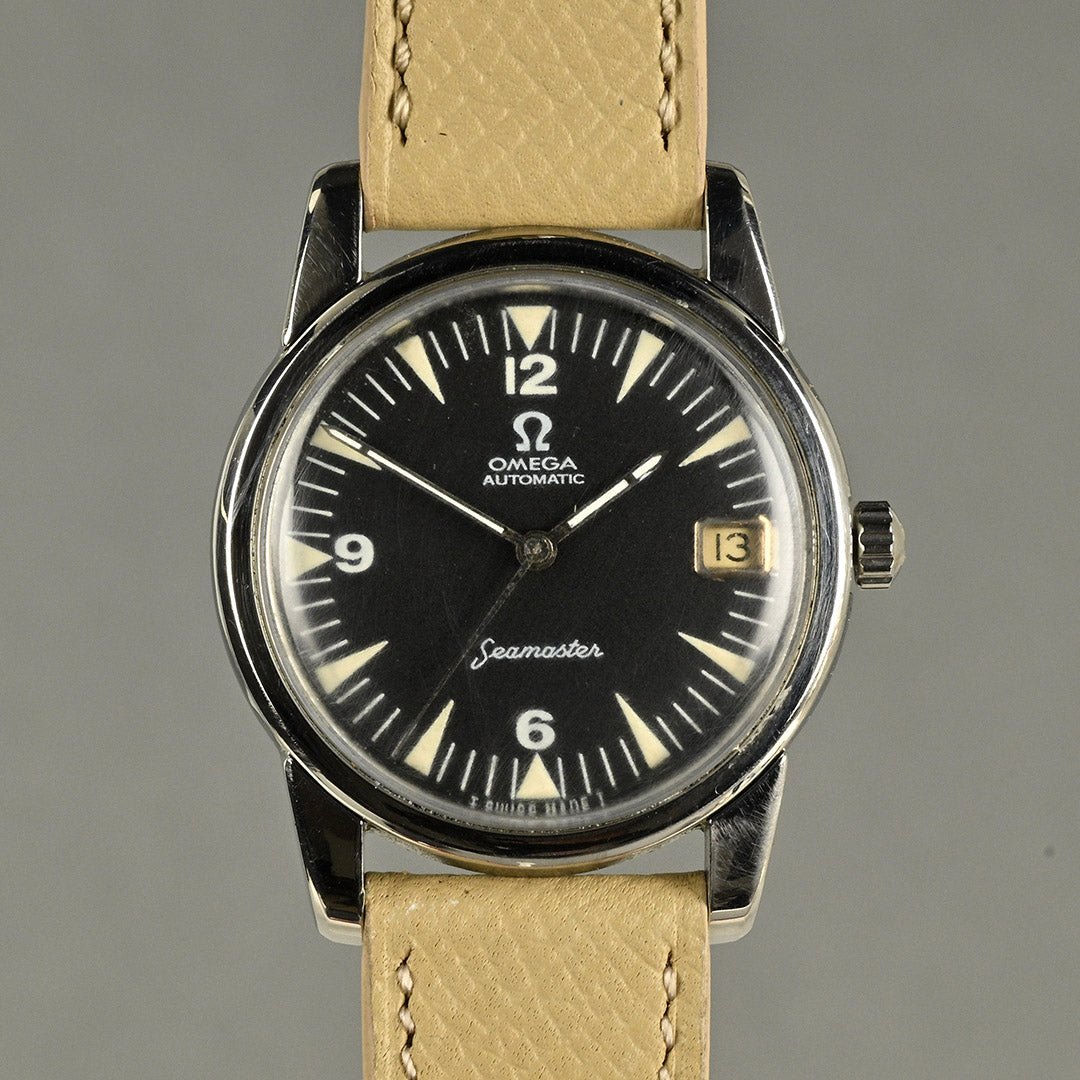
Omega Seamaster Auto Date, ref. 166-009, circa 1963
- Maker / attribution
- Omega (maker)
- Date
- c. 1963
- Historical period
- Modern Mechanical Horology (1945 – 1969)
- Country of origin
- Switzerland
- Object type
- Wristwatch
- Dimensions
- Case 34.5 mm
- Stock no.
- vws4398cs
- Credit line
- Dealer listing, Vintage Watch Specialist (vws4398cs)
- Catalogue title (original)
- Omega Seamaster Auto Date - Reference 166-009 - c.1963 (English)
View the source record (dealer listing) ↗ (opens another website in a new tab)Suggest a correction
Record summary
Catalogued by Vintage Watch Specialist (dealer), United Kingdom (stock number vws4398cs), this is a wristwatch by Omega, made in Switzerland, dated c. 1963. The Atlas places it in the Modern Mechanical Horology period (1945 – 1969) of its Wristwatches collection. Recorded dimensions: Case 34.5 mm. The record is illustrated with 6 photographs.
Assembled from the source record's structured fields. Dates and attributions are given as the source states them; where a field is missing the Atlas leaves it blank rather than estimating.
Catalogue description
Dealer description — Vintage Watch Specialist
Introduced in 1948, the Omega Seamaster has become one of the most recognisable collections in Swiss watchmaking. Originally developed as a robust, water-resistant wristwatch for everyday use, the Seamaster combined Omega's established reputation for precision with practical construction and understated elegance. By the early 1960s, the collection had expanded to include a wide variety of automatic models, many featuring the increasingly popular date complication. This was an important period for Omega's mechanical movements. The company's 500-series automatic calibres had earned an excellent reputation, offering dependable self-winding performance in watches designed to be worn regularly rather than reserved for special occasions. The Calibre 562, introduced in the late 1950s, was part of this successful family. Featuring automatic winding and a date display, it became a familiar sight inside Omega's Seamasters and other models of the period. The Seamaster Reference 166.009 belongs to this era of classic Omega design, combining compact proportions, a practical date display and the reassuring presence of a traditional Swiss automatic movement. More than sixty years later, these early Seamasters remain appealing for their elegant proportions, mechanical craftsmanship and the variety of dial and case designs produced during one of Omega's most interesting decades. What's on Offer We are pleased to offer this distinctive Omega Seamaster Automatic Date Reference 166.009, dating to approximately 1963 , featuring a stainless steel case, striking black dial and Omega's 24-jewel Calibre 562 automatic movement. The first thing that catches the eye is undoubtedly the dial. Its deep black background provides a dramatic contrast to the bold, cream-coloured triangular hour markers, creating a highly distinctive appearance. Large Arabic numerals at 12, 6 and 9 o'clock add further character, while the combination of pointed hour markers and a finely detailed outer minute track gives the watch an almost instrument-like quality. The Omega name and applied-style logo sit beneath 12 o'clock, with Automatic immediately below, while the familiar Seamaster signature appears in elegant script above 6 o'clock. At 3 o'clock, a framed date aperture provides a practical everyday complication without disrupting the overall balance of the dial. The slender hands complement the watch's clean design, with contrasting light-coloured detailing helping them stand out against the black background. A central seconds hand completes the arrangement. The dial is assessed as being in excellent condition and presents particularly well. The stainless steel case measures approximately 34.5mm across, excluding the crown, with a lug-to-lug measurement of 42mm. These are classic early-1960s proportions, offering an elegant fit on the wrist while allowing the striking dial to take centre stage. The case is assessed as being in very good condition, displaying the expected light marks of wear associated with a vintage watch of this age. Its polished surfaces and distinctive lugs give it a pleasingly refined appearance. Protecting the dial is an Omega-signed Plexiglass crystal , complete with the small Omega logo etched into the centre. This is a lovely detail that will be appreciated by collectors of vintage Omega watches. The crystal is assessed as being in excellent condition. Turning the watch over reveals the familiar Seamaster hippocampus emblem on the stainless steel caseback, one of the collection's most recognisable design features. Inside beats the Omega Calibre 562 , a 24-jewel automatic mechanical movement with an approximate power reserve of 50 hours. This movement belongs to Omega's highly regarded 500-series family and offers the convenience of self-winding operation alongside the traditional appeal of mechanical watchmaking. The watch is presented on a cream leather strap, an unusual but very effective choice that picks up the lighter tones of the dial markers and creates a particularly attractive contrast with the stainless steel case. With its bold black dial, elegant proportions and classic Omega automatic movement, this Seamaster has plenty of personality. It would make an interesting addition to a collection of vintage Omega watches, particularly for someone who appreciates the more distinctive dial designs associated with the period. Condition Report: Crystal: Excellent Dial: Excellent Bezel: Very Good Case: Very Good Movement: See Description Overall: Excellent
Historical context
Modern Mechanical Horology (1945 – 1969)
Tool watches for divers, pilots and astronauts; electric watches anticipate the electronic age.
The classic era of the mechanical wristwatch: dive watches, chronographs for motor racing and space flight, GMT watches for jet travel, slim dress watches, automatic calendars, and the rise of Japanese manufacturers alongside Swiss, American, German and Soviet industries.
Read the period in the timelineMore wristwatches from this periodEarlier: Golden Age of Mechanical Watchmaking
Atlas type guide
Dive and water-resistant watches
Keeping water and dust out of a wristwatch was a long-standing challenge. Rolex's screw-down Oyster case (1926) and Omega's Marine (1932) were landmarks; in the early 1950s Blancpain's Fifty Fathoms and Rolex's Submariner defined the professional dive watch with rotating bezels for timing dives, luminous dials and high water resistance. The ISO 6425 standard (1982) later codified what a 'diver's watch' must do.
Dive watches became icons of post-war design and exploration, and their evolution — helium escape valves, ceramic bezels, saturation-diving depth ratings — records the history of underwater work.
What to look for
- Unidirectional or bidirectional rotating bezel with minute markings.
- Screw-down crown and case back; depth rating printed on the dial.
- Luminous hands and markers (radium before c. 1960, tritium c. 1960–1998, then Super-LumiNova).
- Reference numbers on the case between the lugs or inside the back.
Dating clues
- Screw-down Oyster cases: from 1926.
- Professional dive watches: from 1953.
- Tritium 'T' marks on dials: c. 1960–1998.
General guidance written by the Atlas editors about this kind of object. It is not a statement about this particular piece; for that, rely on the source record above and on physical examination.
Related records

Instruments · 1950–1976
Omega Megaquartz 2400 marine chronometer, 1950–1976
Science Museum Group, London

Instruments · 1960–1979
Stopwatch / timer by Omega, 1960–1979
Science Museum Group, London

Instruments · 1960–1979
Stopwatch / timer by Omega, Switzerland, 1960–1979
Science Museum Group, London

Instruments · 1960–1979
Stopwatch by Omega, Swiss made, single-button type reading 0 - 60 seconds in fifths and 0 - 5 minutes in minutes on subsidiary dial, 1960-79.
Science Museum Group, London

Wristwatches · 1945
Wristwatch by Eterna, 1945
Museum Rotterdam

Wristwatches · c. 1945
Breitling Premier, ref. 790, c. 1945
Antiquorum auction archive, Geneva

Wristwatches · c. 1945
Universal Genève Uni-Compax, ref. 22492, c. 1945
Antiquorum auction archive, Geneva

Wristwatches · c. 1950s
Baume & Mercier wristwatch, c. 1950s
Antiquorum auction archive, Geneva