
Wristwatches · Automatic wristwatch
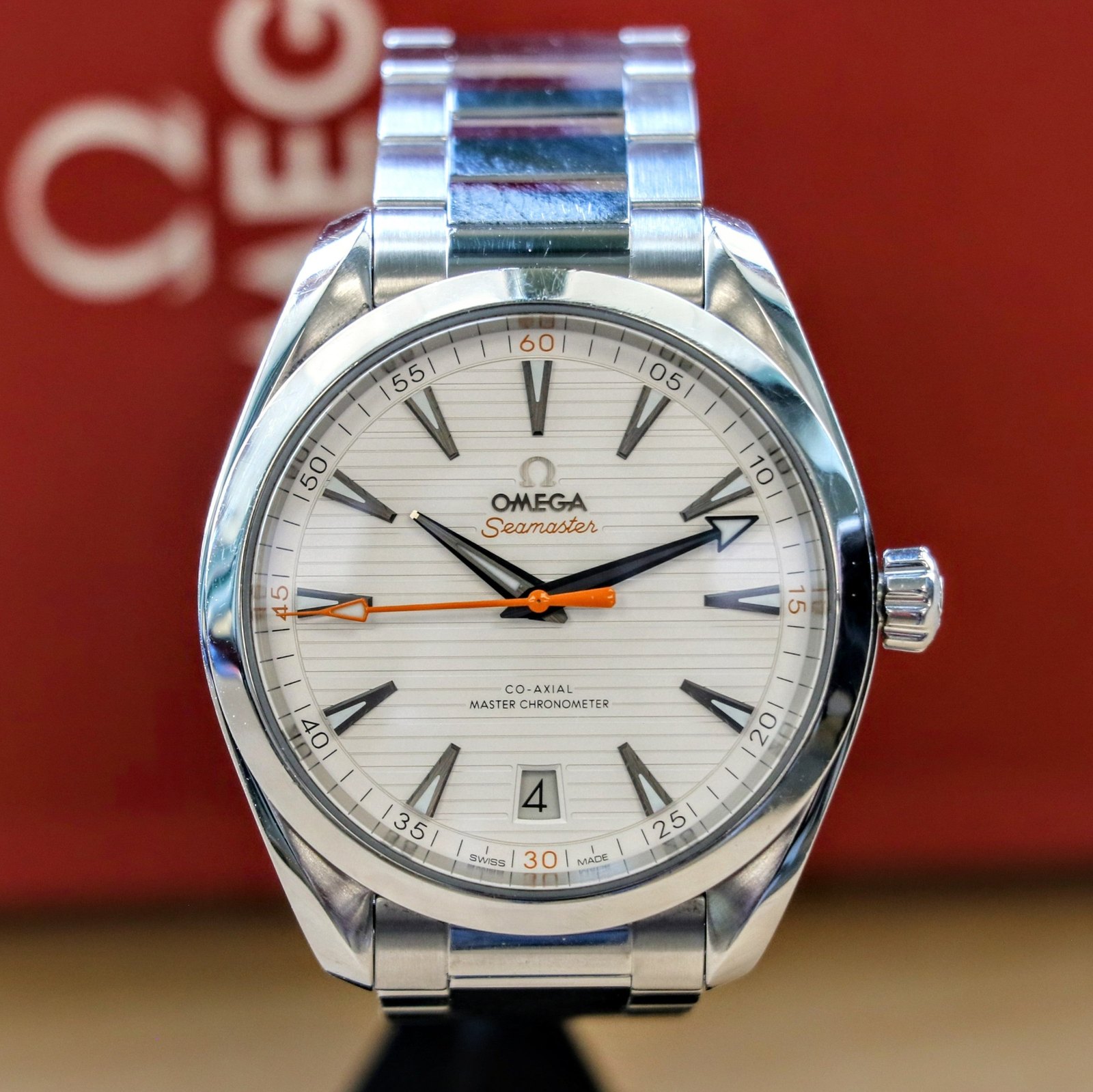
OMEGA Seamaster Aqua Terra 150M Co-Axial Master Chronometer 41mm
- Maker / attribution
- OMEGA (source attribution)
- Date
- 2010s
- Historical period
- Contemporary Horology (2010 – Present)
- Country of origin
- Switzerland
- Object type
- Automatic wristwatch
- Holding institution
- Secondhand Horology
- Accession / object no.
- WA-3914
- Credit line
- Secondhand Horology
- Catalogue title (original)
- OMEGA Seamaster Aqua Terra 150M Watch 41mm Master Chronometer Automati – SECOND HAND HOROLOGY (English)
View the source record ↗ (opens another website in a new tab)Suggest a correction
Record summary
Held and catalogued by Secondhand Horology (object number WA-3914), this is an automatic wristwatch attributed to OMEGA, made in Switzerland, dated 2010s. The Atlas places it in the Contemporary Horology period (2010 – Present) of its Wristwatches collection. The record is illustrated with 1 photograph.
Assembled from the source record's structured fields. Dates and attributions are given as the source states them; where a field is missing the Atlas leaves it blank rather than estimating.
Catalogue description
Original object description
Originating in Switzerland during the 2010s, this pre-owned automatic wristwatch by Omega belongs to the Seamaster Aqua Terra 150M line under reference number 220.10.41.21.02.001. Constructed in stainless steel, the 41 mm case is equipped with a screw-in winding crown, a domed sapphire crystal treated with anti-reflective coating on both surfaces, and a display back defined by a wave-contoured perimeter. A matching stainless steel bracelet secured by a butterfly-style deployant clasp is fitted to the watch. Beneath the crystal, the silver-toned dial exhibits a horizontal relief motif reminiscent of yacht decking, fitted with blackened hands and hour markers containing white Super-LumiNova luminescence. A calendar window is positioned at the 6 o'clock location, while bright orange highlights pick out the central second hand, the quarter-hour Arabic numerals, and the inscription 'Seamaster'. The timepiece houses the 39-jewel Omega calibre 8900, a self-winding, METAS-certified Master Chronometer mechanism resistant to magnetic fields, providing an autonomous 60-hour power reserve alongside an independently adjustable time-zone feature. This example retains its instructional documentation, though its factory box is no longer present.
Inscriptions & marks
89122985
Historical context
Contemporary Horology (2010 – Present)
Silicon components, connected watches, optical-lattice research clocks and a thriving independent scene.
Smartwatches became the world's best-selling watches, while mechanical watchmaking focuses on craft, innovation (silicon components, new escapements) and independent makers.
Read the period in the timelineMore wristwatches from this periodEarlier: Mechanical Renaissance
Atlas type guide
Automatic (self-winding) watches
Self-winding watches use the wearer's motion to wind the mainspring. Abraham-Louis Perrelet and Breguet made 'perpétuelle' pocket watches with oscillating weights in the late eighteenth century, but the principle only became practical in the wristwatch. John Harwood patented a bumper automatic in 1923; Rolex's Perpetual rotor (1931) winding in one direction, and later bidirectional rotors (Eterna, Felsa Bidynator), established the modern form. Micro-rotors (Universal Genève, Buren) and peripheral rotors made automatic watches thinner.
What to look for
- A semicircular rotor turning 360° over the movement, or a 'bumper' weight that rebounds between springs.
- 'Automatic', 'Perpetual' or 'Self-winding' on the dial.
- A sealed screw-back case, since automatic watches are wound less often by the crown.
Dating clues
- Bumper automatics: 1923–c. 1955.
- Full rotors: from 1931 (Rolex); widespread after c. 1950.
- Micro-rotors: from 1954–1958.
General guidance written by the Atlas editors about this kind of object. It is not a statement about this particular piece; for that, rely on the source record above and on physical examination.
Related records
Wristwatches · 1971
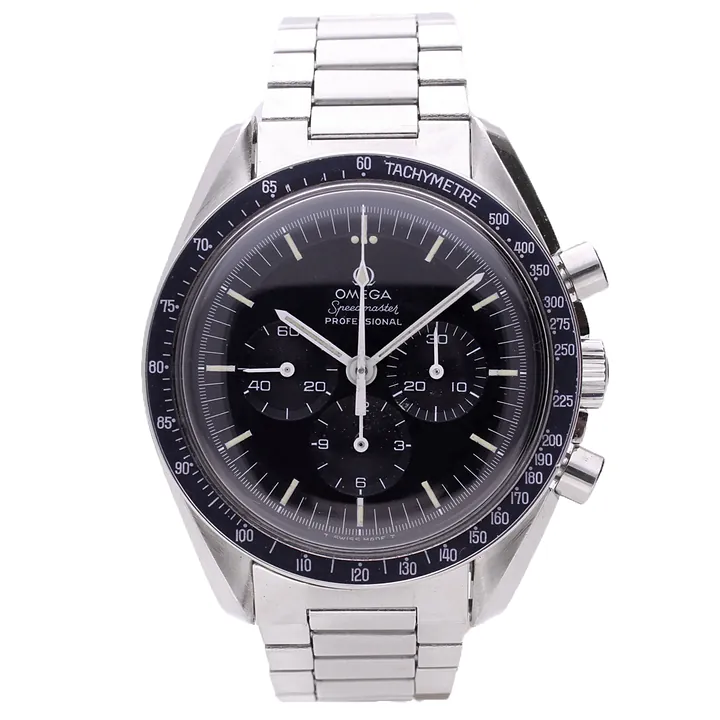
Stainless steel Omega ref. 145.022 Speedmaster Professional chronograph wristwatch, 1971
Somlo Antiques (dealer), London
Wristwatches · 1979
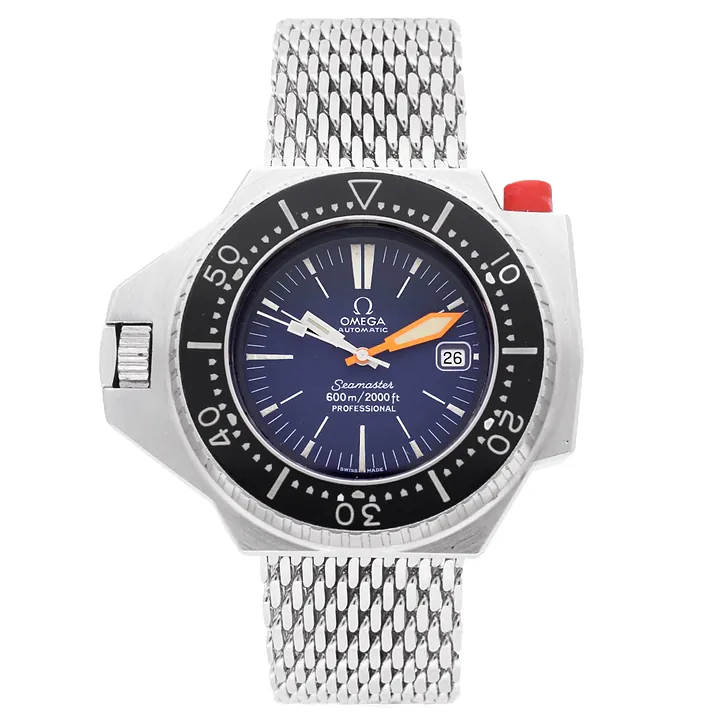
Stainless steel Omega Seamaster PloProf 600m automatic divers wrist watch, 1979
Somlo Antiques (dealer), London
Wristwatches · 1961
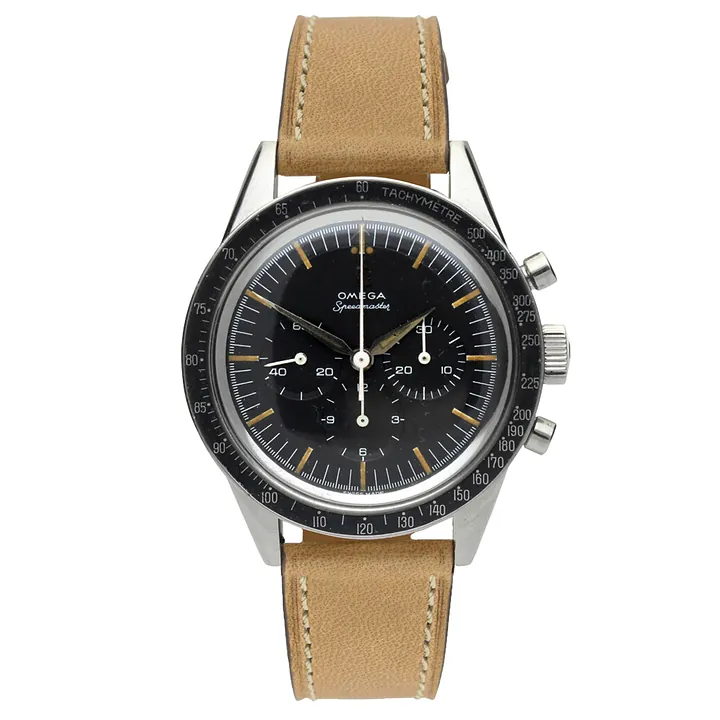
Stainless steel Omega ref. 2998-4 Speedmaster chronograph wristwatch, 1961
Somlo Antiques (dealer), London
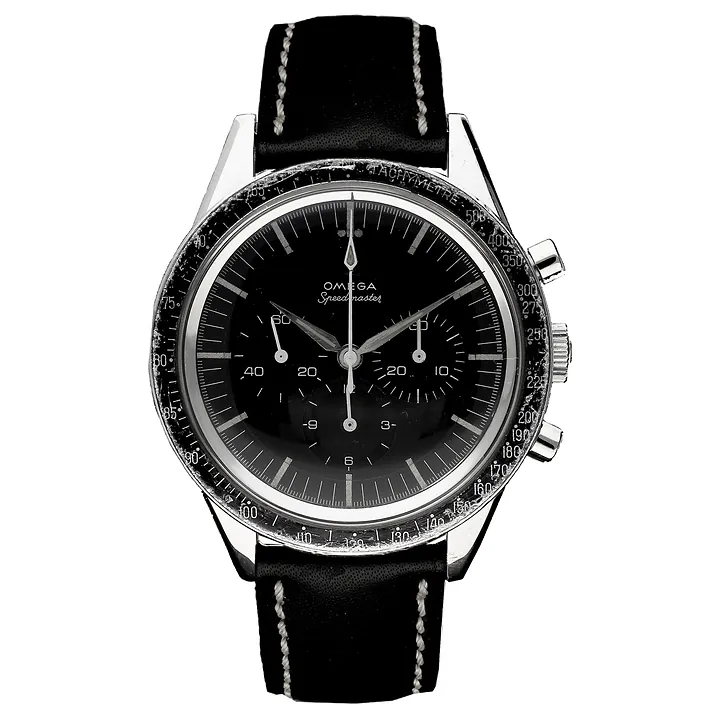
Wristwatches · 1963
Stainless steel Omega ref. 2998-4 Speedmaster chronograph wristwatch, 1963
Somlo Antiques (dealer), London

Wristwatches · c. 2010s
Breguet Type XXI, ref. 3810, c. 2010s (Antiquorum Lot 381-24)
Antiquorum auction archive, Geneva

Wristwatches · c. 2010s
Breguet Type XXI, ref. 3810, c. 2010s (Antiquorum Lot 386-229)
Antiquorum auction archive, Geneva

Wristwatches · Sold in September 2010
Breitling Cosmonaute, ref. A 22322, Sold in September 2010
Antiquorum auction archive, Geneva

Wristwatches · c. 2010
Corum Bubble Chrono, ref. 396.150.20, c. 2010
Antiquorum auction archive, Geneva