
Wristwatches · Wristwatch
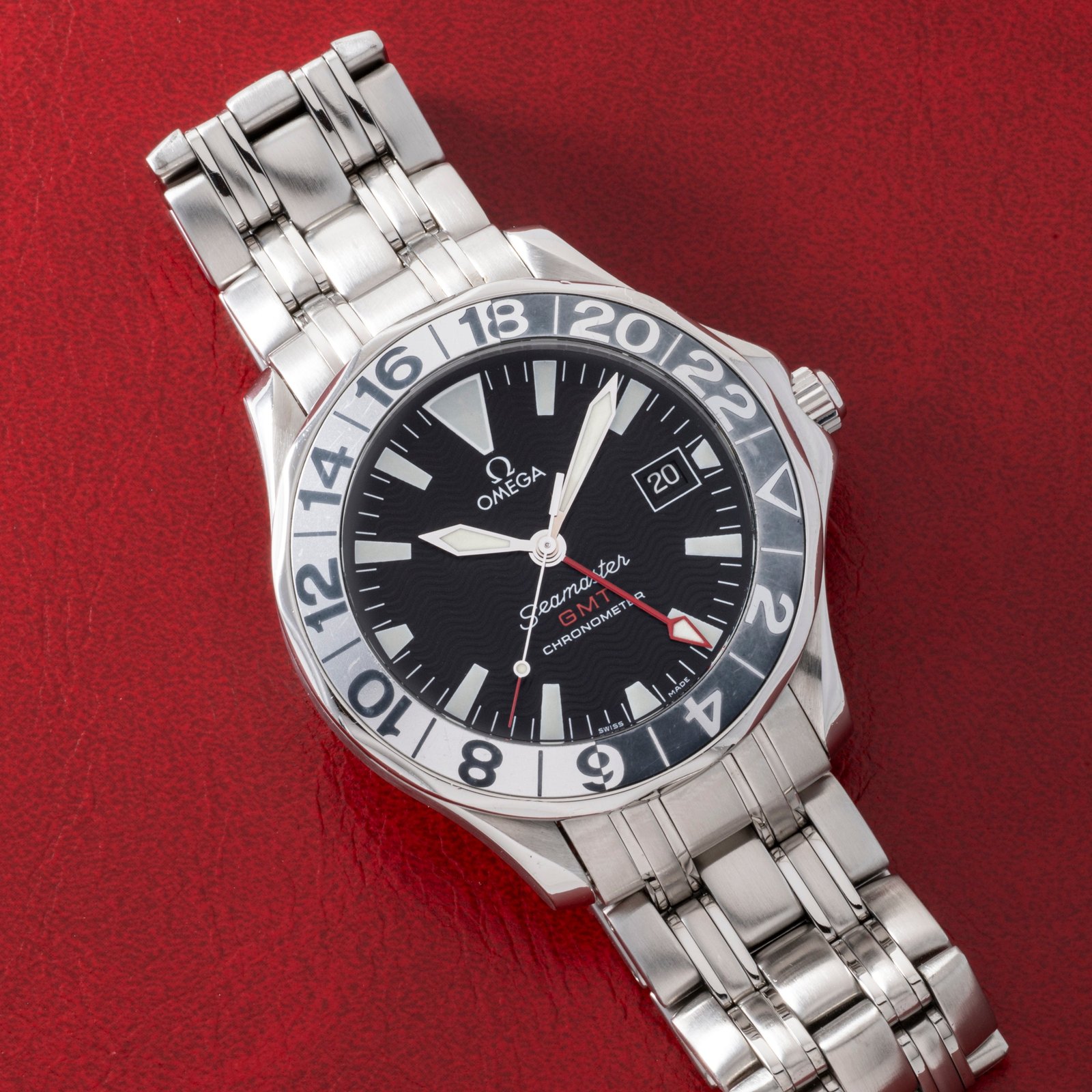
Omega Seamaster 300 Professional GMT, c. 2006
- Maker / attribution
- Omega (maker)
- Date
- c. 2006
- Historical period
- Mechanical Renaissance (1990 – 2010)
- Country of origin
- Switzerland
- Object type
- Wristwatch
- Dimensions
- Case 41.5 mm
- Stock no.
- 40960322
- Credit line
- Dealer listing, Analog/Shift (40960322)
- Catalogue title (original)
- Omega Seamaster 300 Professional GMT (English)
View the source record (dealer listing) ↗ (opens another website in a new tab)Suggest a correction
Record summary
Catalogued by Analog/Shift (dealer), New York (stock number 40960322), this is a wristwatch by Omega, made in Switzerland, dated c. 2006. The Atlas places it in the Mechanical Renaissance period (1990 – 2010) of its Wristwatches collection. Recorded dimensions: Case 41.5 mm. The record is illustrated with 6 photographs.
Assembled from the source record's structured fields. Dates and attributions are given as the source states them; where a field is missing the Atlas leaves it blank rather than estimating.
Catalogue description
Dealer description — Analog/Shift
In 1957, Omega introduced the Seamaster 300 — a timepiece that would help define its tool watch strategy well into the 21st century. Featuring a robust steel case with a 300-meter depth rating, a rotating bezel graduated with an elapsed-minute scale, and a metal bracelet with diver's expansion links, the early Seamaster 300 was not only a functional a diver that would go on to see use in Her Majesty's Navy, but is arguably one of the handsomest sports watch designs of the past century. As it evolved, the Omega Seamaster 300 went on to see myriad small evolutionary changes, with nearly innumerable variants in a variety of materials and colorways produced in the past 60 years. This fact alone has made the Seamaster Professional line (as it came to be known) so desirable to a large portion of the collector community. In other words, people love them simply because they don't all look the same . One of the watershed design motifs debuted in the 1990s with the introduction of blue and black “wave” dials popularized by Pierce Brosnan's 007 in the 1996 Bond film Goldeneye . This design language lived on well after the '90s ended in both modern James Bond-themed limited editions and within the core collection. The watch that we have here, a Reference 2234.50, is a GMT-equipped take on the original design dating to circa 2006. It features the same 41.5mm twisted lug case with a sapphire crystal, a signed crown, a bidirectional rotating bezel with a black and silver bi-color aluminum insert, and a lovely, luminous black 'wave' dial with a matching 'sword' handset and red GMT hand. Housing Omega's Calibre 1128 automatic GMT movement within, this piece comes fitted to the stainless steel multi-link bracelet with a signed, hidden push-button clasp — which, in our opinion, is aging extremely well. This 50th Anniversary piece packs a few usual refinements and functionality, while staying true to the fundamental design language of the first Seamaster 300 from the 1950s. In short, it 's a watch that's modern yet nostalgic, all at the same time. A rare combination, to be sure!
Historical context
Mechanical Renaissance (1990 – 2010)
Mechanical watches return as cultural objects; independent watchmaking flourishes.
Mechanical watches returned as cultural and luxury objects. Complications, tourbillons and new materials proliferated; independent watchmakers such as George Daniels, F.P. Journe and Philippe Dufour revived artisanal watchmaking; collecting vintage watches became a major field.
Read the period in the timelineMore wristwatches from this periodEarlier: Quartz Revolution
Atlas type guide
Dive and water-resistant watches
Keeping water and dust out of a wristwatch was a long-standing challenge. Rolex's screw-down Oyster case (1926) and Omega's Marine (1932) were landmarks; in the early 1950s Blancpain's Fifty Fathoms and Rolex's Submariner defined the professional dive watch with rotating bezels for timing dives, luminous dials and high water resistance. The ISO 6425 standard (1982) later codified what a 'diver's watch' must do.
Dive watches became icons of post-war design and exploration, and their evolution — helium escape valves, ceramic bezels, saturation-diving depth ratings — records the history of underwater work.
What to look for
- Unidirectional or bidirectional rotating bezel with minute markings.
- Screw-down crown and case back; depth rating printed on the dial.
- Luminous hands and markers (radium before c. 1960, tritium c. 1960–1998, then Super-LumiNova).
- Reference numbers on the case between the lugs or inside the back.
Dating clues
- Screw-down Oyster cases: from 1926.
- Professional dive watches: from 1953.
- Tritium 'T' marks on dials: c. 1960–1998.
General guidance written by the Atlas editors about this kind of object. It is not a statement about this particular piece; for that, rely on the source record above and on physical examination.
Related records

Instruments · 1950–1976
Omega Megaquartz 2400 marine chronometer, 1950–1976
Science Museum Group, London

Instruments · 1960–1979
Stopwatch / timer by Omega, 1960–1979
Science Museum Group, London

Instruments · 1960–1979
Stopwatch / timer by Omega, Switzerland, 1960–1979
Science Museum Group, London

Instruments · 1960–1979
Stopwatch by Omega, Swiss made, single-button type reading 0 - 60 seconds in fifths and 0 - 5 minutes in minutes on subsidiary dial, 1960-79.
Science Museum Group, London

Wristwatches · 2008
Wristwatch by Breitling?, 2008
Museum Rotterdam

Wristwatches · c. 1990s
Audemars Piguet Bamboo, c. 1990s
Antiquorum auction archive, Geneva

Wristwatches · c. 1990
Audemars Piguet Huitieme Perpetual Calendar, ref. 25696PT, c. 1990
Antiquorum auction archive, Geneva

Wristwatches · c. 1990
Breitling Chronomat, ref. b13050.1, c. 1990
Antiquorum auction archive, Geneva