
Wristwatches · Wristwatch
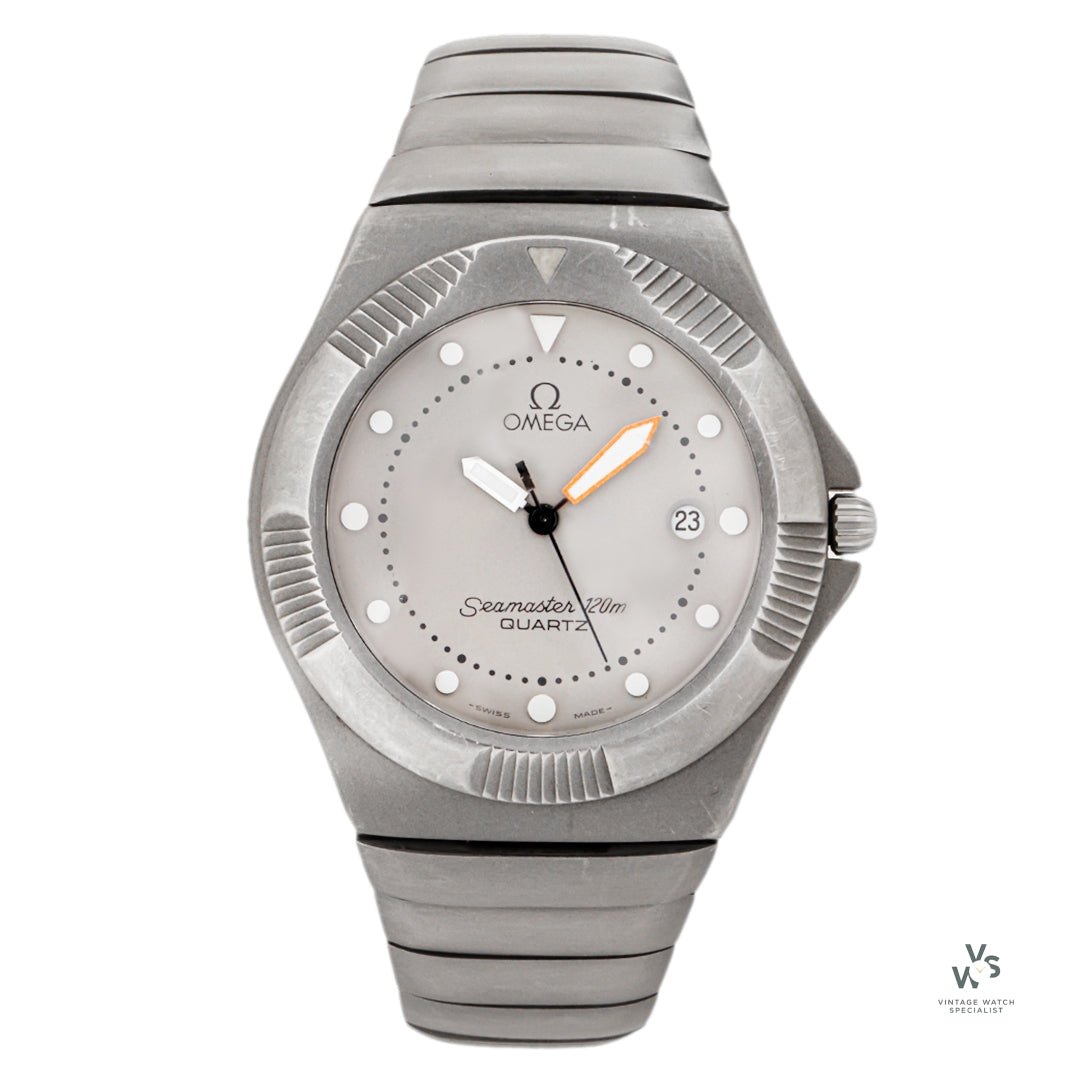
Omega Seamaster 120m Recife, Quartz, ref. 396.0987, circa 1985
- Maker / attribution
- Omega (maker)
- Date
- c. 1985
- Historical period
- Quartz Revolution (1969 – 1990)
- Country of origin
- Switzerland
- Object type
- Wristwatch
- Dimensions
- Case 38 mm
- Stock no.
- vws2589
- Credit line
- Dealer listing, Vintage Watch Specialist (vws2589)
- Catalogue title (original)
- Omega Seamaster 120m Recife - Quartz - Model Ref: 396.0987 - c.1985 (English)
View the source record (dealer listing) ↗ (opens another website in a new tab)Suggest a correction
Record summary
Catalogued by Vintage Watch Specialist (dealer), United Kingdom (stock number vws2589), this is a wristwatch by Omega, made in Switzerland, dated c. 1985. The Atlas places it in the Quartz Revolution period (1969 – 1990) of its Wristwatches collection. Recorded dimensions: Case 38 mm. The record is illustrated with 6 photographs.
Assembled from the source record's structured fields. Dates and attributions are given as the source states them; where a field is missing the Atlas leaves it blank rather than estimating.
Catalogue description
Dealer description — Vintage Watch Specialist
A Nostalgic Nod to the 1980s with this Rare Omega Seamaster Recife in Oxidised Steel with Fully Integrated Bracelet - Model ref: 396.0987 c.1985. We Are Sorry But This Watch Is Now Sold - If However, You Are Looking To Buy Or Sell Something Similar Then Please Email Sales@Vintagewatchspecialist.Com Or Whatsapp/Call +44 7831 454658. Thanks Omega released the Seamaster 120 Recife in 1985 - at which time it was considered sleek, functional and futuristic - some might say it was the last of the real sports diver watches, nothing comparable was produced by Omega after its discontinuation with the Seamaster taking on a more sports-luxe aesthetic. What’s On Offer Who says Quartz ain't cool? The 1980s are seeing a renaissance with quartz watches, at last, becoming more cool than kitsch! The case and fully integrated bracelet of this Recife ( Meaning “Reef” in Portuguese) are crafted from oxidised steel, a look of titanium and light and comfortable on the wrist - we love this bit of 1980s nostalgia! It might be light but it means business, at 38mm it's meaty on the wrist and boasts a simple yet effective dial design borrowing its chunky hands from Omega’s deep-sea beast the “Ploprof" with a zingy punch of orange complimenting the steel colourway. Lumed hour plots and a subtle date wheel complete the dial which is housed underneath mineral crystal completed with a scalloped uni-directional bezel. In a clever design twist, the dial is dished toward the centre and as such the hour plots are staged on platforms of varying depth so ensure accurate positioning. Have a careful look - it almost looks like they are mounted on the crystal......but they are not! Its an optical illusion! The watch is in original vintage condition and as such does have signs of previous wear - but nothing of any concern. This reference was only produced for a hot minute, and then it was gone for good, so the numbers are dwindling which means desirability and collectability are rising - you do the math! WE have not seen another one for sale in around five years! Snap it up now - quartz is coming back you mark my words! Additional information Made from Case: Oxidised Steel Dial: Grey Crystal: Mineral Bracelet: Oxidised Steel Technical specifications Winding: Movement Type: Quartz Calibre: Jewels: 6 Waterproof: When new Power reserve: Purchase details Condition: Excellent Model Reference: 396.0987 Date of issue: c.1985 Dimensions Width (without crown): 38mm Lug width: 23.5mm Lug height: (lug to lug) 41mm Wrist size: 185mm (approx)
Historical context
Quartz Revolution (1969 – 1990)
Seiko's Astron begins mass quartz timekeeping; traditional industries contract sharply.
Quartz and digital watches transformed the market after 1969. Swiss employment collapsed, Japanese and Hong Kong production soared, and the Swatch (1983) helped the Swiss industry recover; mechanical watches survived as luxury goods.
Read the period in the timelineMore wristwatches from this periodEarlier: Modern Mechanical Horology
Atlas type guide
Dive and water-resistant watches
Keeping water and dust out of a wristwatch was a long-standing challenge. Rolex's screw-down Oyster case (1926) and Omega's Marine (1932) were landmarks; in the early 1950s Blancpain's Fifty Fathoms and Rolex's Submariner defined the professional dive watch with rotating bezels for timing dives, luminous dials and high water resistance. The ISO 6425 standard (1982) later codified what a 'diver's watch' must do.
Dive watches became icons of post-war design and exploration, and their evolution — helium escape valves, ceramic bezels, saturation-diving depth ratings — records the history of underwater work.
What to look for
- Unidirectional or bidirectional rotating bezel with minute markings.
- Screw-down crown and case back; depth rating printed on the dial.
- Luminous hands and markers (radium before c. 1960, tritium c. 1960–1998, then Super-LumiNova).
- Reference numbers on the case between the lugs or inside the back.
Dating clues
- Screw-down Oyster cases: from 1926.
- Professional dive watches: from 1953.
- Tritium 'T' marks on dials: c. 1960–1998.
General guidance written by the Atlas editors about this kind of object. It is not a statement about this particular piece; for that, rely on the source record above and on physical examination.
Related records

Instruments · 1950–1976
Omega Megaquartz 2400 marine chronometer, 1950–1976
Science Museum Group, London

Instruments · 1960–1979
Stopwatch / timer by Omega, 1960–1979
Science Museum Group, London

Instruments · 1960–1979
Stopwatch / timer by Omega, Switzerland, 1960–1979
Science Museum Group, London

Instruments · 1960–1979
Stopwatch by Omega, Swiss made, single-button type reading 0 - 60 seconds in fifths and 0 - 5 minutes in minutes on subsidiary dial, 1960-79.
Science Museum Group, London

Wristwatches · 1970
Wristwatch by Heno, Switzerland, 1970
Museum Rotterdam

Wristwatches · 1960–1986
'Tri-Compax' calendar chronograph wristwatch in gold case, by Universal, Geneva, Switzerland, 1960–1986.
Science Museum Group, London

Wristwatches · 1969–1970
Beta 21 Quartz wristwatch movement, made in Switzerland, 1970.
Science Museum Group, London

Wristwatches · c. 1969
Omega Speedmaster Moonwatch, ref. 145022-69st, c. 1969
Antiquorum auction archive, Geneva