
Wristwatches · Wristwatch
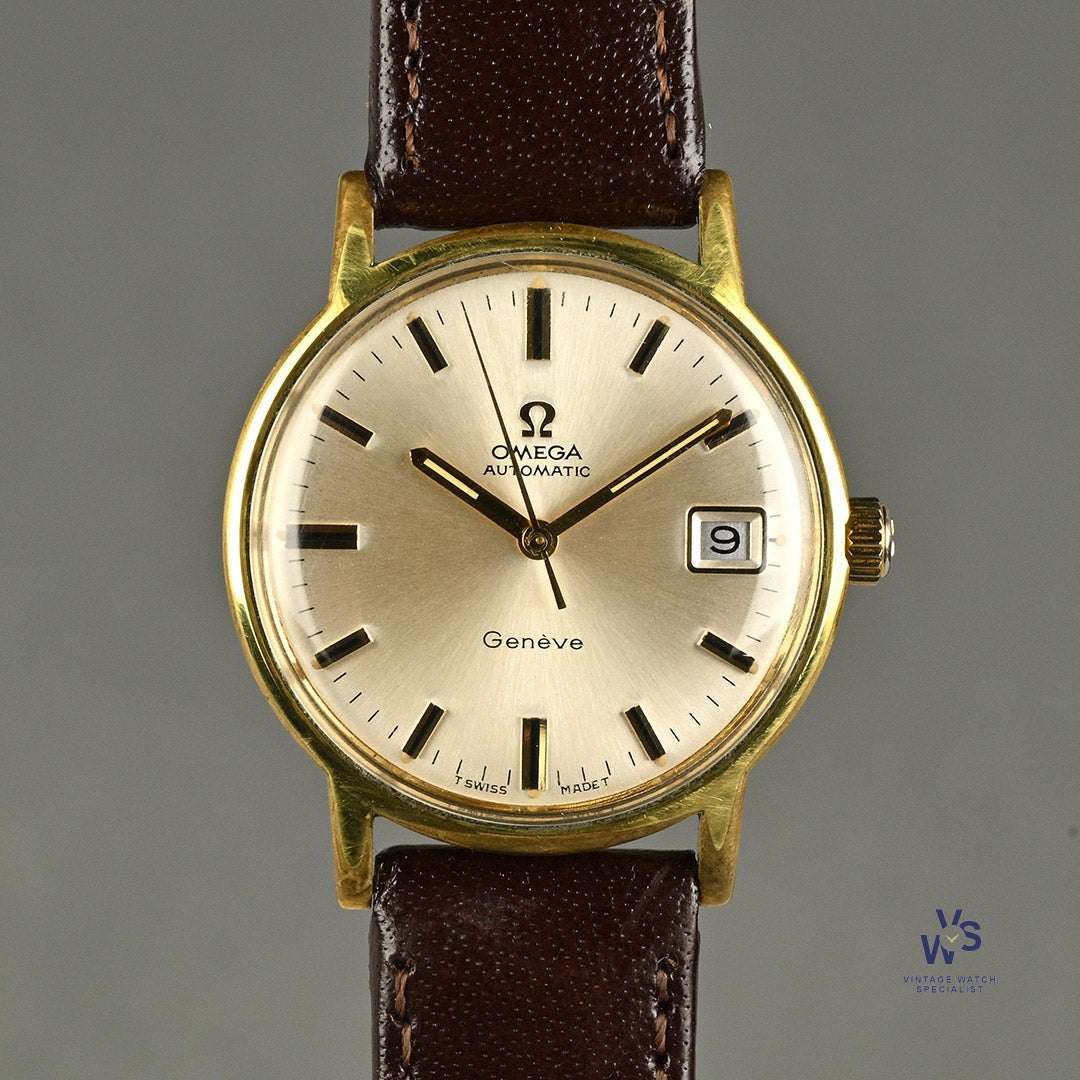
Omega Genève Automatic Date 166.070 Gold Plated Case, circa 1970
- Maker / attribution
- Omega (maker)
- Date
- c. 1970
- Historical period
- Quartz Revolution (1969 – 1990)
- Country of origin
- Switzerland
- Object type
- Wristwatch
- Materials / technique
- gold
- Stock no.
- vws4404cs
- Credit line
- Dealer listing, Vintage Watch Specialist (vws4404cs)
- Catalogue title (original)
- Omega Genève Automatic Date 166.070 Gold Plated Case c.1970 (English)
View the source record (dealer listing) ↗ (opens another website in a new tab)Suggest a correction
Record summary
Catalogued by Vintage Watch Specialist (dealer), United Kingdom (stock number vws4404cs), this is a wristwatch by Omega, made in Switzerland, dated c. 1970. The Atlas places it in the Quartz Revolution period (1969 – 1990) of its Wristwatches collection. Materials and techniques recorded by the source: gold. The record is illustrated with 6 photographs.
Assembled from the source record's structured fields. Dates and attributions are given as the source states them; where a field is missing the Atlas leaves it blank rather than estimating.
Catalogue description
Dealer description — Vintage Watch Specialist
Few names in Swiss watchmaking carry quite the same recognition as Omega . Founded in 1848, the company established an international reputation for precision, reliability and innovation, producing everything from elegant dress watches to the professional timepieces associated with aviation, diving and space exploration. The Omega Genève collection has its roots in the company's celebrated precision watchmaking tradition. The Genève name first appeared on Omega watches during the 1950s, reflecting the company's association with the city and its reputation for fine Swiss watchmaking. By the 1960s, the Genève had evolved into one of Omega's most recognisable collections, offering dependable mechanical movements and attractive, understated designs suited to everyday wear. Automatic models were particularly popular, combining the convenience of self-winding technology with Omega's well-established mechanical expertise. Among the movements used during this period was the excellent Omega Calibre 565 , a 24-jewel automatic movement introduced in the 1960s. Part of Omega's highly regarded 550-series family, it featured a practical date complication with a quick-setting mechanism operated through the winding crown. These movements became known for their robust construction and dependable performance, helping establish the Genève collection as an attractive choice for those seeking a quality Swiss wristwatch. During the same period, watches were frequently presented by British employers to recognise long service, retirement or significant professional achievements. Omega was a particularly appropriate choice for such occasions, combining a respected international name with the lasting appeal of a finely made mechanical timepiece. These presentation watches are especially interesting today, offering collectors not only a piece of horological history but also a personal connection to the lives and careers of their original recipients. What's on Offer Here we have a particularly charming Omega Genève Automatic Date, Reference 166.070, dating from approximately 1970 , with an attractive silver dial, gold-plated case and an interesting piece of British retail history. What makes this example especially appealing is the engraving on the caseback, recording its presentation by Boots the Chemists to E. England in appreciation of long service in 1971 . The inscription reads: IN APPRECIATION 1971 E. ENGLAND FOR LONG SERVICE Accompanied by the Boots emblem, the engraving provides a lovely glimpse into the watch's past. Rather than being simply another vintage Omega, this is a timepiece presented to recognise an individual's years of dedication to one of Britain's best-known high-street businesses. The watch itself is a particularly attractive example of the classic Genève design. Its silver sunburst dial displays a beautiful radial brushed finish, complemented by applied gold-tone baton hour markers with dark central inserts. Matching gold-tone hands provide excellent contrast, while the central seconds hand and neatly framed date aperture at 3 o'clock complete the wonderfully balanced appearance. The applied Omega emblem and signature sit beneath 12 o'clock, with Automatic immediately below, while the Genève name appears above 6 o'clock. The watch retains its original Omega-etched Plexiglass crystal , complete with the discreet Omega emblem at its centre. The gold-plated case features elegant angular lugs, a polished bezel and a signed Omega crown. There are some expected marks of wear to the case, consistent with its age, but it retains a very attractive overall appearance. The watch is fitted with a dark brown leather strap with contrasting stitching, which complements the warmth of the gold-tone case and the understated silver dial beautifully. Inside is the highly regarded Omega Calibre 565 , a 24-jewel automatic mechanical movement from one of Omega's most respected movement families. Its quick-set date function makes it particularly practical for everyday use. Should you prefer to have the watch professionally serviced before delivery, this can be arranged through our watchmaker at an additional cost. Simply add a note when placing the watch in your basket, and we will contact you to discuss the available servicing options. Condition Details: Crystal: Excellent Dial: Excellent Bezel: Very Good Case: Good Movement: Not Serviced Overall: Very Good
Historical context
Quartz Revolution (1969 – 1990)
Seiko's Astron begins mass quartz timekeeping; traditional industries contract sharply.
Quartz and digital watches transformed the market after 1969. Swiss employment collapsed, Japanese and Hong Kong production soared, and the Swatch (1983) helped the Swiss industry recover; mechanical watches survived as luxury goods.
Read the period in the timelineMore wristwatches from this periodEarlier: Modern Mechanical Horology
Atlas type guide
Automatic (self-winding) watches
Self-winding watches use the wearer's motion to wind the mainspring. Abraham-Louis Perrelet and Breguet made 'perpétuelle' pocket watches with oscillating weights in the late eighteenth century, but the principle only became practical in the wristwatch. John Harwood patented a bumper automatic in 1923; Rolex's Perpetual rotor (1931) winding in one direction, and later bidirectional rotors (Eterna, Felsa Bidynator), established the modern form. Micro-rotors (Universal Genève, Buren) and peripheral rotors made automatic watches thinner.
What to look for
- A semicircular rotor turning 360° over the movement, or a 'bumper' weight that rebounds between springs.
- 'Automatic', 'Perpetual' or 'Self-winding' on the dial.
- A sealed screw-back case, since automatic watches are wound less often by the crown.
Dating clues
- Bumper automatics: 1923–c. 1955.
- Full rotors: from 1931 (Rolex); widespread after c. 1950.
- Micro-rotors: from 1954–1958.
General guidance written by the Atlas editors about this kind of object. It is not a statement about this particular piece; for that, rely on the source record above and on physical examination.
Related records

Instruments · 1950–1976
Omega Megaquartz 2400 marine chronometer, 1950–1976
Science Museum Group, London

Instruments · 1960–1979
Stopwatch / timer by Omega, 1960–1979
Science Museum Group, London

Instruments · 1960–1979
Stopwatch / timer by Omega, Switzerland, 1960–1979
Science Museum Group, London

Instruments · 1960–1979
Stopwatch by Omega, Swiss made, single-button type reading 0 - 60 seconds in fifths and 0 - 5 minutes in minutes on subsidiary dial, 1960-79.
Science Museum Group, London

Wristwatches · 1970
Wristwatch by Heno, Switzerland, 1970
Museum Rotterdam

Wristwatches · 1960–1986
'Tri-Compax' calendar chronograph wristwatch in gold case, by Universal, Geneva, Switzerland, 1960–1986.
Science Museum Group, London

Wristwatches · 1969–1970
Beta 21 Quartz wristwatch movement, made in Switzerland, 1970.
Science Museum Group, London

Wristwatches · c. 1969
Omega Speedmaster Moonwatch, ref. 145022-69st, c. 1969
Antiquorum auction archive, Geneva