
Wristwatches · Wristwatch
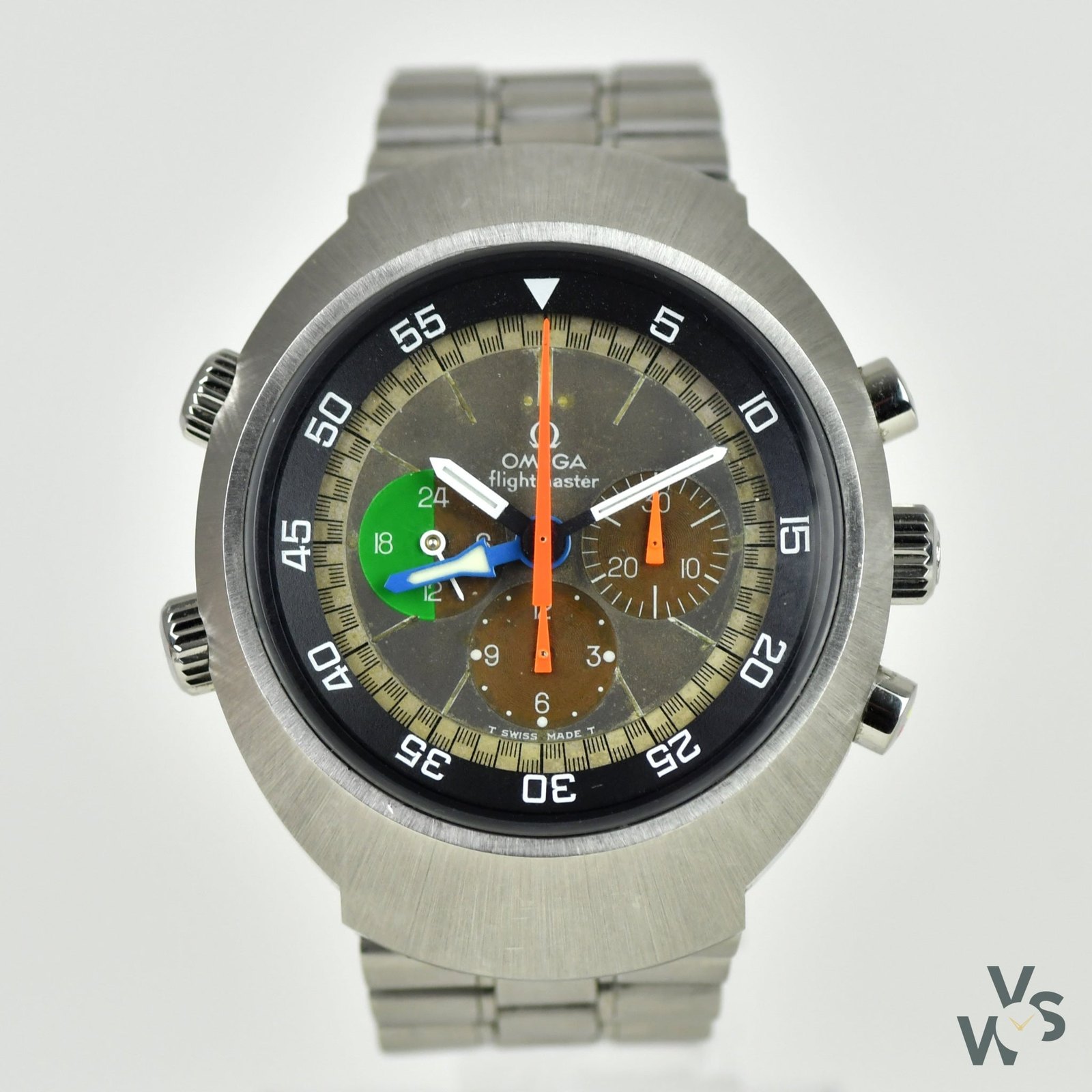
Omega Flightmaster Chronograph GMT, Tropical Patina, ref. 145.013, Cal.910, circa 1970
- Maker / attribution
- Omega (maker)
- Date
- c. 1970
- Historical period
- Quartz Revolution (1969 – 1990)
- Country of origin
- Switzerland
- Object type
- Wristwatch
- Dimensions
- Case 43 mm
- Stock no.
- vws1324cs
- Credit line
- Dealer listing, Vintage Watch Specialist (vws1324cs)
- Catalogue title (original)
- Omega Flightmaster Chronograph GMT - Tropical Patina - C.1970 - Ref: 145.013 - Cal.910 (English)
View the source record (dealer listing) ↗ (opens another website in a new tab)Suggest a correction
Record summary
Catalogued by Vintage Watch Specialist (dealer), United Kingdom (stock number vws1324cs), this is a wristwatch by Omega, made in Switzerland, dated c. 1970. The Atlas places it in the Quartz Revolution period (1969 – 1990) of its Wristwatches collection. Recorded dimensions: Case 43 mm. The record is illustrated with 6 photographs.
Assembled from the source record's structured fields. Dates and attributions are given as the source states them; where a field is missing the Atlas leaves it blank rather than estimating.
Catalogue description
Dealer description — Vintage Watch Specialist
Now sold! If you'd like to register interest in either buying or selling a comparable piece, please contact us . Vintage Omega Flightmaster Chronograph GMT Watch with Orange Hands - Ref. 145.013 - c.1970. See our blog piece on these watches here. This chunky Omega Flightmaster Gents' vintage wristwatch (model reference no. 145.013 dates to c.1970) has a charcoal grey dial with vivid orange and blue chronograph/GMT hands. First produced in 1969, The Flightmaster was Omega's first Chronograph GMT and came at the height of global interest in aviation as Neil Armstrong and Buzz Aldrin successfully completed moonwalks during the Apollo 11 mission. One of Omega’s larger vintage models (with a case width of 43mm) the Flightmaster was used by professional pilots, along with aviation enthusiasts and global travellers. It has been reported that most senior crew members aboard the British Airways Concorde fleet wore this watch (source) . There were three versions (and consequently model reference numbers) of the Flightmaster: the one pictured here (145.013) which was produced with a caliber 910 movement, a domed glass, and a day/night indicator at the 9:00 sub-register. The later iterations of the Flightmaster bore references 145.026 and 145.036 and housed the 911 movement, along with a slightly prouder case than the slightly slimmer fit pictured here. We're currently (July 2020) lucky enough to be in possession of all 3 versions,so if you want the full set be quick! The main dial is a standard chronograph with three sub dials displaying a day/night indicator and two registers for recording minutes and hours. The elegantly curved stainless steel case has colour coded crowns to the left side for adjusting the secondary hour hand, along with rotating the inner bezel, which can also be used to measure time elapsed by lining the triangular marker up with either the minute or either one of the hour hands. The charcoal grey of the dial is still razor clear, in part thanks to the great condition of the glass, and has been complemented beautifully by rich, deep colouring to the dial, or to use the technical term; a 'Tropical Chocolate Patina' . Featuring no fewer than 5 crowns/pushers and 7 hands all brightly coloured, the dial on this watch is timeless on the eyes. Despite its substantial size and robust appearance, the Flightmaster Chronograph is extremely comfortable to wear, due to the ergonomics of the case, a style that Omega refers to as the ‘pilot line.’ Cut from a single block of Swedish stainless steel, the upper case was pressed and tempered sixteen times before assuming its unique elliptical shape, designed to fit the contours of the wrist like a second skin. This watch features a slightly more compressed case fit than the later two variations, meaning it sits slightly closer to the wrist. The Flightmaster also has a 12-hour GMT complication, with the hand moving independently and set through the auxiliary crown, located at 10 o’clock on the case. The case back features a crisply engraved DC-8 super 61 Jet aeroplane along with the word ‘Flightmaster’ and the instantly recognisable Omega symbol. The sunburst brushing effect on the case does reflect the occasional small marking when inspected in the light, though these are of minimal impact to the watch's otherwise excellent condition and aesthetic. We don't believe the watch case as ever been re-finished since leaving the Omega factory. What’s on offer: This watch is sold in a vintage red official Omega box, together with an official receipt of service from Omega, France, and will also be supplied with a Vintage Watch Specialist leather pouch, as per our photos. The watch is an honest example of the model, with the original Omega unpolished case (sharp edges and crisp sunburst finish). Additional information Made from Case: Stainless steel. Crown : Signed Omega Dial: Charcoal grey and chocolate. Crystal: Mineral glass. Bracelet : Original Omega 1159 steel bracelet Technical specifications Winding: Manually wound. Movement type : Mechanical. Calibre : 910. Jewels: 17 . Waterproof : 6 atmospheres. Power reserve: 44 hours Purchase details Condition: Excellent overall condition. Model Reference Number: 145.013 - Cal.910. Date of issue : 1970. Guarantee Supplied with a 12-month Vintage Watch Specialist guarantee. This watch also comes with an official receipt of complete inspection and service of the watch by Omega France, dated to 2014. Dimensions Width: 43mm. Lug width : 22 mm. Lug height (lug to lug) : 52mm Wrist size : Adjustable.
Historical context
Quartz Revolution (1969 – 1990)
Seiko's Astron begins mass quartz timekeeping; traditional industries contract sharply.
Quartz and digital watches transformed the market after 1969. Swiss employment collapsed, Japanese and Hong Kong production soared, and the Swatch (1983) helped the Swiss industry recover; mechanical watches survived as luxury goods.
Read the period in the timelineMore wristwatches from this periodEarlier: Modern Mechanical Horology
Atlas type guide
Chronographs and split-seconds watches
A chronograph is a watch with an additional seconds hand that can be started, stopped and returned to zero independently of the timekeeping. Louis Moinet built an early example in 1816 and Nicolas Rieussec a recording 'chronographe' in 1821; Adolphe Nicole's heart-shaped reset cam (patented 1862) made the modern return-to-zero possible. Split-seconds (rattrapante) chronographs add a second hand that can be stopped for intermediate times; flyback chronographs restart instantly.
Chronographs were essential tools for doctors (pulsometer scales), artillery (telemeter), engineers and sport. In wristwatches, Valjoux, Venus, Lemania and later the automatic chronographs of 1969 (Zenith El Primero, the Chronomatic Calibre 11 group and Seiko 6139) are milestones.
What to look for
- Push-pieces on the case band or a single button in the crown (monopusher).
- Subsidiary registers for minutes and hours; tachymeter, telemeter or pulsometer scales.
- Column wheel versus cam control visible in the movement.
- Calibre markings of specialist makers (Valjoux, Lemania, Venus, Landeron).
Dating clues
- Pocket chronographs with heart cam reset: after 1862.
- Wrist chronographs: from c. 1910; two-button designs from the 1930s.
- Automatic chronographs: from 1969.
General guidance written by the Atlas editors about this kind of object. It is not a statement about this particular piece; for that, rely on the source record above and on physical examination.
Read next:Flyback chronographChronograph
Related records

Instruments · 1950–1976
Omega Megaquartz 2400 marine chronometer, 1950–1976
Science Museum Group, London

Instruments · 1960–1979
Stopwatch / timer by Omega, 1960–1979
Science Museum Group, London

Instruments · 1960–1979
Stopwatch / timer by Omega, Switzerland, 1960–1979
Science Museum Group, London

Instruments · 1960–1979
Stopwatch by Omega, Swiss made, single-button type reading 0 - 60 seconds in fifths and 0 - 5 minutes in minutes on subsidiary dial, 1960-79.
Science Museum Group, London

Wristwatches · 1970
Wristwatch by Heno, Switzerland, 1970
Museum Rotterdam

Wristwatches · 1960–1986
'Tri-Compax' calendar chronograph wristwatch in gold case, by Universal, Geneva, Switzerland, 1960–1986.
Science Museum Group, London

Wristwatches · 1969–1970
Beta 21 Quartz wristwatch movement, made in Switzerland, 1970.
Science Museum Group, London

Wristwatches · c. 1969
Omega Speedmaster Moonwatch, ref. 145022-69st, c. 1969
Antiquorum auction archive, Geneva