
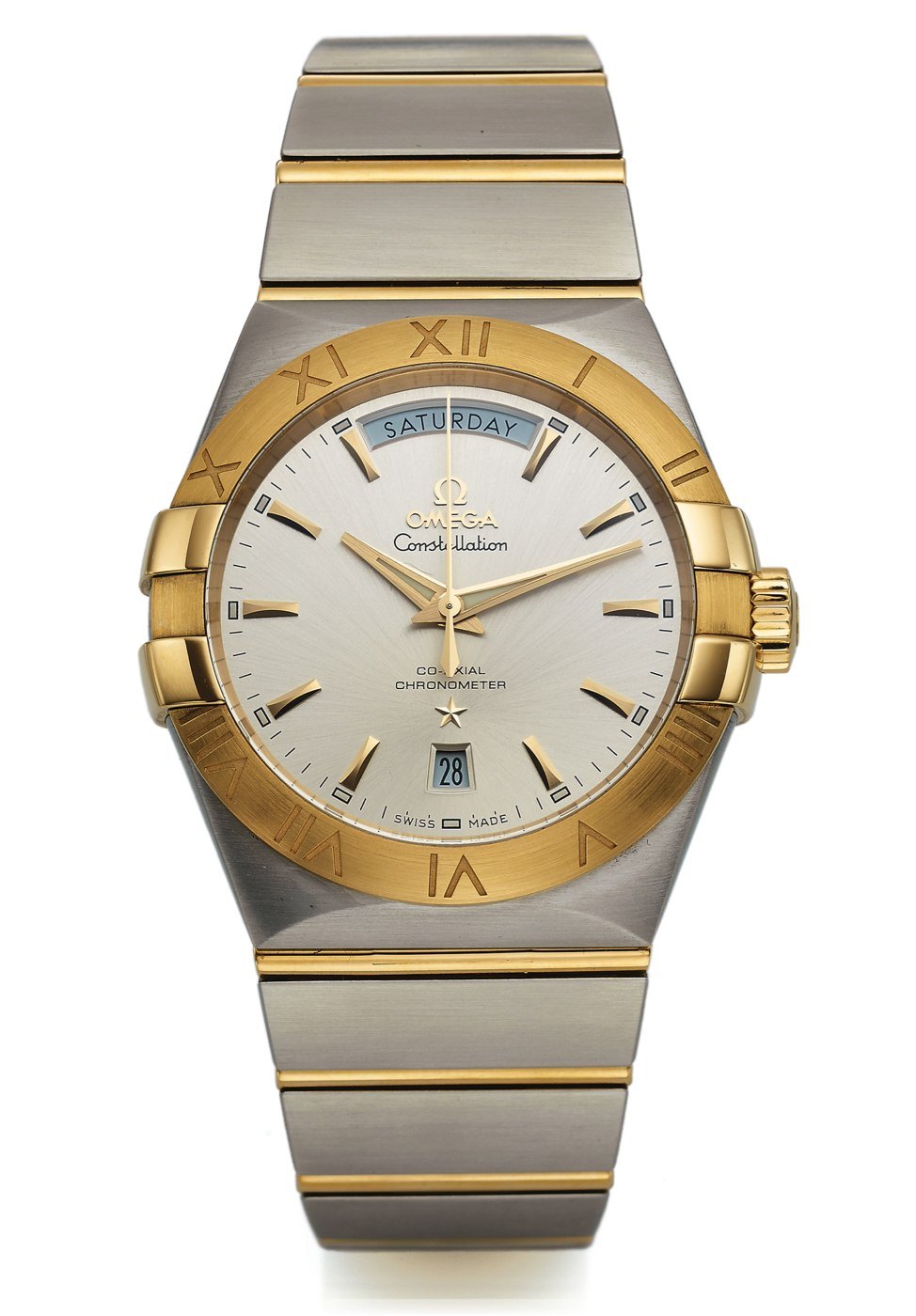
Wristwatches · Automatic chronometer wristwatch with day and date
Omega Constellation Co-Axial Chronometer Ref. SI14
- Maker / attribution
- Omega (source attribution)
- Date
- c. 2010
- Historical period
- Contemporary Horology (2010 – Present)
- Country of origin
- Switzerland
- Object type
- Automatic chronometer wristwatch with day and date
- Holding institution
- Antiquorum
- Accession / object no.
- 210
- Credit line
- Antiquorum
- Catalogue title (original)
- OMEGA REF. SI14 CO-AXIAL \nCHRONOMETER GOLD AND STEEL \nOmega, Co-Axial Escapement, Chronometer, Automatic,\" case No. \n85944312. Made circa 2010. \nVery fine, center seconds, self-winding, water res (English)
View the source record ↗ (opens another website in a new tab)Suggest a correction
Record summary
Held and catalogued by Antiquorum (object number 210), this is an automatic chronometer wristwatch with day and date attributed to Omega, made in Switzerland, dated c. 2010. The Atlas places it in the Contemporary Horology period (2010 – Present) of its Wristwatches collection. The record is illustrated with 1 photograph.
Assembled from the source record's structured fields. Dates and attributions are given as the source states them; where a field is missing the Atlas leaves it blank rather than estimating.
Catalogue description
Original object description
Dating to circa 2010, this chronometer-certified Omega Constellation reference SI14 features a two-body case of stainless steel and 18K yellow gold displaying brushed and polished finishes. Measuring 40 mm in diameter, 14 mm in height, and roughly 195 mm in length, it incorporates sapphire crystals, a screw-down display case back, and 100-metre water resistance. The radial Roman-numeral bezel is bordered by the model's signature side claws. On the satin-brushed silver dial, applied 18K yellow gold baton markers and luminous squares are paired with luminous yellow gold dauphine hands, indicating hours, minutes, central seconds, day of the week via an upper arched window, and date at 6 o'clock. The internal rhodium-plated automatic Omega calibre 8602 features fausses côtes embellishment, a co-axial escapement, a free-sprung flat balance spring, shock protection, and a monometallic balance equipped with timing screws. Bearing case serial 85944312, the watch is signed on the dial, case, and movement, and is mounted to an integrated two-tone link bracelet with a double deployant clasp. Auction assessment awarded as-new condition marks across all components: 1 for the case, 1-01 for the dial, and 1* for the movement.
Inscriptions & marks
85944312
Historical context
Contemporary Horology (2010 – Present)
Silicon components, connected watches, optical-lattice research clocks and a thriving independent scene.
Smartwatches became the world's best-selling watches, while mechanical watchmaking focuses on craft, innovation (silicon components, new escapements) and independent makers.
Read the period in the timelineMore wristwatches from this periodEarlier: Mechanical Renaissance
Atlas type guide
Automatic (self-winding) watches
Self-winding watches use the wearer's motion to wind the mainspring. Abraham-Louis Perrelet and Breguet made 'perpétuelle' pocket watches with oscillating weights in the late eighteenth century, but the principle only became practical in the wristwatch. John Harwood patented a bumper automatic in 1923; Rolex's Perpetual rotor (1931) winding in one direction, and later bidirectional rotors (Eterna, Felsa Bidynator), established the modern form. Micro-rotors (Universal Genève, Buren) and peripheral rotors made automatic watches thinner.
What to look for
- A semicircular rotor turning 360° over the movement, or a 'bumper' weight that rebounds between springs.
- 'Automatic', 'Perpetual' or 'Self-winding' on the dial.
- A sealed screw-back case, since automatic watches are wound less often by the crown.
Dating clues
- Bumper automatics: 1923–c. 1955.
- Full rotors: from 1931 (Rolex); widespread after c. 1950.
- Micro-rotors: from 1954–1958.
General guidance written by the Atlas editors about this kind of object. It is not a statement about this particular piece; for that, rely on the source record above and on physical examination.
Related records

Instruments · 1950–1976
Omega Megaquartz 2400 marine chronometer, 1950–1976
Science Museum Group, London

Instruments · 1960–1979
Stopwatch / timer by Omega, 1960–1979
Science Museum Group, London

Instruments · 1960–1979
Stopwatch / timer by Omega, Switzerland, 1960–1979
Science Museum Group, London

Instruments · 1960–1979
Stopwatch by Omega, Swiss made, single-button type reading 0 - 60 seconds in fifths and 0 - 5 minutes in minutes on subsidiary dial, 1960-79.
Science Museum Group, London

Wristwatches · c. 2010s
Breguet Type XXI, ref. 3810, c. 2010s (Antiquorum Lot 381-24)
Antiquorum auction archive, Geneva

Wristwatches · c. 2010s
Breguet Type XXI, ref. 3810, c. 2010s (Antiquorum Lot 386-229)
Antiquorum auction archive, Geneva

Wristwatches · Sold in September 2010
Breitling Cosmonaute, ref. A 22322, Sold in September 2010
Antiquorum auction archive, Geneva

Wristwatches · c. 2010
Corum Bubble Chrono, ref. 396.150.20, c. 2010
Antiquorum auction archive, Geneva